Five areas describe who wears the garment, and one stack of technology runs through all of them
1 / 8
The field splits into Everyday Comfort, Protective Occupational, Cooling Mechanism, Sports Outdoor and Medical Therapy. Those names mark the wearer and the occasion: ordinary clothing, sealed workwear, the hardware itself, sport, and clinical treatment. The engineering repeats across them. A fan vest belongs to Everyday Comfort and to Protective Occupational. A phase-change pack belongs to Cooling Mechanism and to Medical Therapy. A vented trouser and a vented sleeve are the same construction applied at different body sites.
Retail is selling passive cooling while the patents sit on powered systems
2 / 8
Four products define what a buyer can actually purchase in 2026, and none of them needs a compressor or a thermoelectric stack. A CO₂ cartridge jacket launched in September 2026 for urban heat. Water-based gel beads printed on the inside of clothing were shown to Singapore construction agencies in May and claimed a 9 °C surface reduction. Soaked evaporative workwear has been in daily use by Qatari crews since at least 2023. Fan garments crossed from building sites into office shirts and onto a Paris runway in June.
Strategy
Filing stopped falling in 2026, and every area is now publishing at or above last year's rate
3 / 8
Patents in this field ran 1,037 in 2021, 1,030 in 2022, 819 in 2023, 648 in 2024, 506 in 2025 and 462 through 21 September 2026. That works out at about 53 a month this year against 42 in 2025, so a four-year decline has levelled off at roughly half its 2021 volume.
Research
The claimed invention has moved to the joint between the cold and the skin
4 / 8
A fan, a pump, a thermoelectric module and a compressor arrive as bought parts with datasheets. Little in the record tries to invent them. What gets claimed is the interface: where the cold face presses, how the air gap stays open, how the circuit is sealed, how the module comes off before the wash.
Market
The buyer is an employer, and the price is set per shift
5 / 8
Every deployment named in the coverage is an organisation protecting a crew. 98 Fahren's cooling jackets are worn by police and gig workers through Indian summers above 45 °C. Eztia's gel fabric is being tested by Yamato delivery fleets in Hokkaido, Kajima construction sites in Tokyo, and a professional baseball club. Techniche's soaked uniforms are bought for Qatari construction.
Strategy
The 2021 peak was employers building their own kit, and the demand behind it has fallen away
6 / 8
Protective Occupational is where the decline is concentrated, and its filer list says why. State Grid holds 41 documents, Guangdong Power Grid 13, the PLA General Hospital 17 with a further 10 under a variant name, the affiliated hospitals of two medical universities 7 each. The organisations doing the filing are the organisations whose crews wear the suits. A grid operator that needs a cooler garment for live-line work patents its own design, and a provincial power bureau now files compressor refrigeration built for its own workers.
Research
A detachable module is the most repeated answer in the field
7 / 8
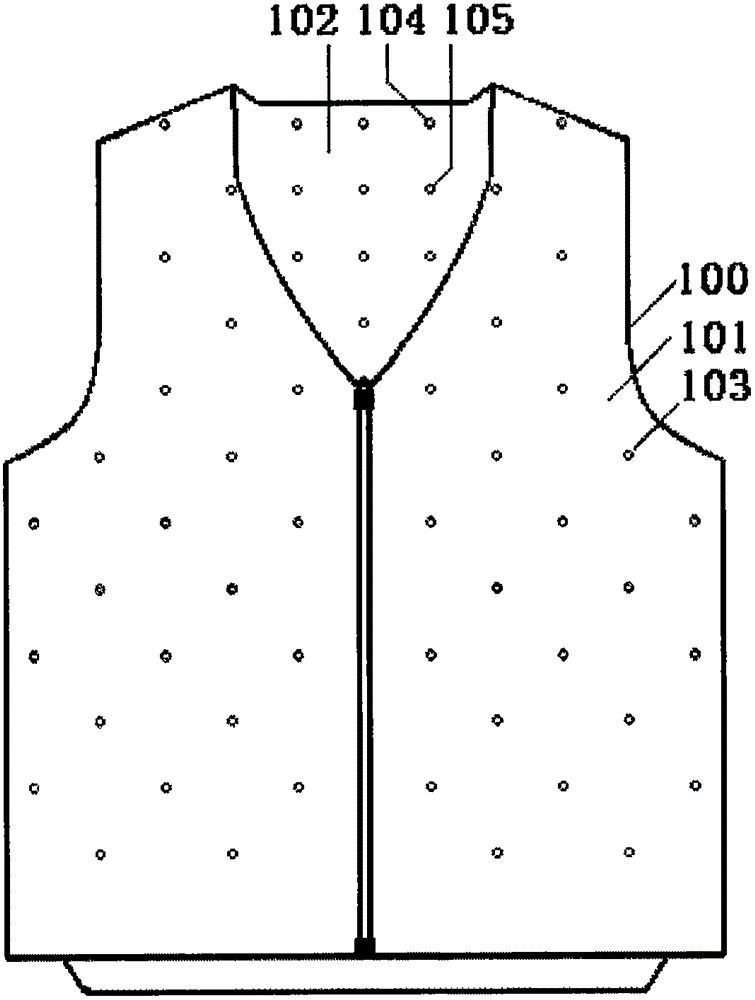
Independent filers converge on the same solution: make the cooling assembly separable so the garment launders and the hardware survives. A fan and battery on a zippered sub-panel, a fan plate fixed to a mounting opening, a resin receiver that a Peltier unit clips into in place of screw rings that vibrate loose, a replaceable cooling pouch at armpit height, and a set of detachable cooling pads inside a suit.
Market
The marketed number is an order of magnitude larger than the measured one
8 / 8
Every performance figure attached to a product is a company claim. The independent measurements cluster far below them.
October 2026 · Ranked by how far each patent goes beyond earlier work.
Patent
Protective suit cuts exercise fatigue 61% versus a butyl-rubber suit by moving sweat through a supported air gap
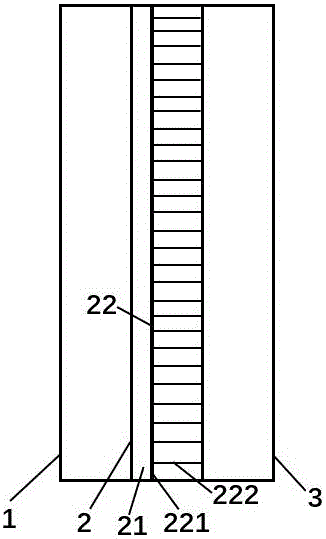
What the patent does. People in sealed protective suits struggle to shed heat and sweat without weakening the chemical barrier. The patent uses skin-side grooves and a selective coating to move sweat into a mechanically held air space, without openings in the barrier. In treadmill testing, fatigue time reached 29 minutes versus 18 minutes for a commercial butyl-rubber suit.
Patent
Airflow-dispersing clothing spreads cooling air evenly across large, uneven surfaces
What the patent does. People struggle to spread concentrated blower air evenly over large or irregular surfaces. The patent uses separate air-inlet and air-outlet channels in two walls, dispersing air through the gap before sending it out. No measured cooling, airflow, drying, or treatment result is reported in a quantified test.