Benzyl Salicylate Environmental Fate & Ecotoxicity
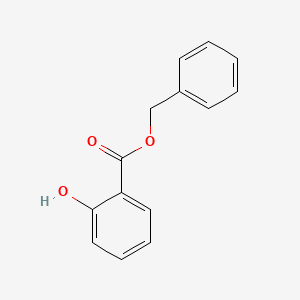
Identifiers
Functions
What is the environmental fate of Benzyl salicylate?
Transport, degradation, persistence and exposure pathways
Environmental Fate / Exposure Summary
Benzyl salicylate's production and use in the soap and cosmetic industry as fragrance, in protective sunscreen lotions, deodorant sprays and as a synthetic flavoring substance and adjuvant in foods for human consumption may result in its release to the environment through various waste streams. Benzyl salicylate occurs naturally in balsams of Peru amd Tolu, in the flower oils of hyacinths and wallflowers, in ylang-ylang oil and in other essential oils and as a volatile constituent of various plant flowers. If released to air, a vapor pressure of 7.8X0-5 mm Hg at 25 °C indicates benzyl salicylate will exist in both the vapor and particulate phases in the atmosphere. Vapor-phase benzyl salicylate will be degraded in the atmosphere by reaction with photochemically-produced hydroxyl radicals; the half-life for this reaction in air is estimated to be 22 hours. Particulate-phase benzyl salicylate will be removed from the atmosphere by wet and dry deposition. Benzyl salicylate contains chromophores that absorb at wavelengths >290 nm and, therefore, may be susceptible to direct photolysis by sunlight. If released to soil, benzyl salicylate is expected to have slight mobility based upon an estimated Koc of 3300. Volatilization from moist soil surfaces may be an important fate process based upon an estimated Henry's Law constant of 2.7X10⁻⁶ atm-cu m/mole. Benzyl salicylate is not expected to volatilize from dry soil surfaces based upon its vapor pressure. Utilizing the Manometric Respirometry test, 93% of the Theoretical BOD was reached in 4 weeks indicating that biodegradation is an important environmental fate process in soil and water. If released into water, benzyl salicylate is expected to adsorb to suspended solids and sediment based upon the estimated Koc. Volatilization from water surfaces may be an important fate process based upon this compound's estimated Henry's Law constant. Estimated volatilization half-lives for a model river and model lake are 14 and 160 days, respectively. However, volatilization from water surfaces is expected to be attenuated by adsorption to suspended solids and sediment in the water column. An estimated BCF of 320 suggests the potential for bioconcentration in aquatic organisms is high. Benzyl salicylate may undergo slow hydrolysis in alkaline soils and waters. Occupational exposure to benzyl salicylate may occur through inhalation and dermal contact with this compound at workplaces where benzyl salicylate is produced or used. Use data and monitoring data indicate that the general population may be exposed to benzyl salicylate via inhalation of air containing product vapors, ingestion of food containing benzyl salicylate, dermal contact with essential oils, waters, and consumer products containing benzyl salicylate(SRC)
Environmental Fate
TERRESTRIAL FATE: Based on a classification scheme(1), an estimated Koc value of 3300(SRC), determined from a structure estimation method(2), indicates that benzyl salicylate is expected to have slight mobility in soil(SRC). Volatilization of benzyl salicylate from moist soil surfaces may be an important fate process(SRC) given an estimated Henry's Law constant of 2.7X10⁻⁶ atm-cu m/mole(SRC) derived from its vapor pressure, 7.8X10⁻⁵ mm Hg(3), and water solubility, 8.8 mg/L(3). However, adsorption to soil is expected to attenuate volatilization(SRC). Benzyl salicylate is not expected to volatilize from dry soil surfaces(SRC) based upon its vapor pressure(3). Utilizing the Manometric Respirometry test, 93% of the Theoretical BOD was reached in 4 weeks indicating that biodegradation is an important environmental fate process in soil(3)
AQUATIC FATE: Based on a classification scheme(1), an estimated Koc value of 3300(SRC), determined from a structure estimation method(2), indicates that benzyl salicylate is expected to adsorb to suspended solids and sediment(SRC). Volatilization from water surfaces may occur(3) based upon an estimated Henry's Law constant of 2.7X10⁻⁶ atm-cu m/mole(SRC) derived from its vapor pressure, 7.8X10⁻⁵ mm Hg(3), and water solubility, 8.8 mg/L(3). Using this Henry's Law constant and an estimation method(4), volatilization half-lives for a model river and model lake are 14 and 160 days, respectively(SRC). However, volatilization from water surfaces is expected to be attenuated by adsorption to suspended solids and sediment in the water column. According to a classification scheme(5), an estimated BCF of 320(SRC), from an estimated log Kow of 4.31(2) and a regression-derived equation(2), suggests the potential for bioconcentration in aquatic organisms is high(SRC). Utilizing the Manometric Respirometry test, 93% of the Theoretical BOD was reached in 4 weeks indicating that biodegradation is an important environmental fate process in water(3)
ATMOSPHERIC FATE: According to a model of gas/particle partitioning of semivolatile organic compounds in the atmosphere(1), benzyl salicylate which has a vapor pressure of 7.8X10⁻⁵ mm Hg at 20 °C(2), will exist in both the vapor and particulate phases in the ambient atmosphere. Vapor-phase benzyl salicylate is degraded in the atmosphere by reaction with photochemically-produced hydroxyl radicals(SRC); the half-life for this reaction in air is estimated to be 22 hours(SRC), calculated from its rate constant of 1.7X10⁻¹¹ cu cm/molecule-sec at 25 °C(SRC) that was derived using a structure estimation method(3). Particulate-phase benzyl salicylate may be removed from the air by wet and dry deposition(SRC). Benzyl salicylate contains chromophores that absorb at wavelengths >290 nm(4) and, therefore, may be susceptible to direct photolysis by sunlight(SRC)
Environmental Biodegradation
AEROBIC: Benzyl salicylate, present at 100 mg/L, reached 93% of its theoretical BOD in 28 days using an activated sludge inoculum at 30 mg/L in the Manometric Respirometry test(1)
Environmental Abiotic Degradation
The rate constant for the vapor-phase reaction of benzyl salicylate with photochemically-produced hydroxyl radicals has been estimated as 1.7X10⁻¹¹ cu cm/molecule-sec at 25 °C(SRC) using a structure estimation method(1). This corresponds to an atmospheric half-life of about 22 hours at an atmospheric concentration of 5X10+5 hydroxyl radicals per cu cm(1). A base-catalyzed second-order hydrolysis rate constant of 1.3X10⁻¹ L/mole-sec(SRC) was estimated using a structure estimation method(2); this corresponds to half-lives of 2 years and 60 days at pH values of 7 and 8, respectively(2). Benzyl salicylate may undergo slow hydrolysis in alkaline soils and waters(3). Benzyl salicylate contains chromophores that absorb at wavelengths >290 nm(4) and, therefore, may be susceptible to direct photolysis by sunlight(SRC)
Environmental Bioconcentration
An estimated BCF of 320 was calculated in fish for benzyl salicylate(SRC), using an estimated log Kow of 4.31(1) and a regression-derived equation(1). According to a classification scheme(2), this BCF suggests the potential for bioconcentration in aquatic organisms is high(SRC)
Soil Adsorption / Mobility
Using a structure estimation method based on molecular connectivity indices(1), the Koc of benzyl salicylate can be estimated to be 3300(SRC). According to a classification scheme(2), this estimated Koc value suggests that benzyl salicylate is expected to have slight mobility in soil
Volatilization from Water / Soil
The Henry's Law constant for benzyl salicylate is estimated as 2.7X10⁻⁶ atm-cu m/mole(SRC) derived from its vapor pressure, 7.8X10⁻⁵ mm Hg(1), and water solubility, 8.8 mg/L(1). This Henry's Law constant indicates that benzyl salicylate is expected to volatilize from water surfaces(2). Based on this Henry's Law constant, the volatilization half-life from a model river (1 m deep, flowing 1 m/sec, wind velocity of 3 m/sec)(2) is estimated as 14 days(SRC). The volatilization half-life from a model lake (1 m deep, flowing 0.05 m/sec, wind velocity of 0.5 m/sec)(2) is estimated as 160 days(SRC). However, volatilization from water surfaces is expected to be attenuated by adsorption to suspended solids and sediment in the water column. Benzyl salicylate's estimated Henry's Law constant indicates that volatilization from moist soil surfaces may occur(SRC). Benzyl salicylate is not expected to volatilize from dry soil surfaces(SRC) based upon its vapor pressure(1)
Natural Pollution Origins
Benzyl salicylate occurs naturally in balsams of Peru amd Tolu, in the flower oils of hyacinths and wallflowers, in ylang-ylang oil and in other essential oils and as a volatile constituent of various plant flowers(1,2)
Artificial Pollution Origins
Benzyl salicylate's production and use in the soap and cosmetic industry as fragrance, in protective sunscreen lotions, deodorant sprays(1), and as a synthetic flavoring substance and adjuvant in foods for human consumption(2), may result in its release to the environment through various waste streams(SRC). Benzyl salicylate has been detected in the effluent of water treatment plants(3-6)
Probable Routes of Human Exposure
According to the 2012 TSCA Inventory Update Reporting data, 8 reporting facilities estimate the number of persons reasonably likely to be exposed during the manufacturing, processing, or use of benzyl salicylate in the United States may be as low as less than 10 workers and as high as 100 workers per plant; the data may be greatly underestimated due to confidential business information (CBI) or unknown values(1)
Occupational exposure to benzyl salicylate may occur through inhalation and dermal contact with this compound at workplaces where benzyl salicylate is produced or used. Use data and monitoring data indicate that the general population may be exposed to benzyl salicylate via inhalation of air containing product vapors, ingestion of food containing benzyl salicylate, dermal contact with essential oils, waters, and consumer products containing benzyl salicylate. (SRC)
Body Burden
The estimated total human skin exposure of benzyl salicylate from the use of multiple cosmetic products is 0.4 mg/kg/day(1)
Where has Benzyl salicylate been measured in the environment?
Measured occurrences across water, soil, sediment, air and effluent
Environmental Water Concentrations
SURFACE WATER: Benzyl salicylate was identified, as one of the most abundant and widespread compounds at concentrations ranging from below the detection limit to 2,400 ng/L, in waters collected during Apr, Oct, and Dec 2015 from Venice Island, Venice Lagoon, and Burano Island, respectively, Italy(1). In surface water samples collected from Saitama Prefecuture, Japan, in September and August 2008, benzyl salicylate was identified in 2/2 stream samples at concentrations of 107 and 197 ng/L. Stream One acts as a drain for untreated domestic wastewaters from approximately 1000 residents who live along the stream. Stream Two is contaminated with domestic wastewaters and sewage treatment plant effluent(2). Benzyl salicylate was not detected in samples collected from heavily polluted rivers (0/6), moderately polluted rivers (0/2), a remote mountain stream, lake, and farm ponds with little wastewater input (0/5)(2)
SEAWATER: Benzyl salicylate was identified at concentrations of 2.2 to 4.5 ng/L in coastal surface seawater samples collected mid Dec 2014 in Terra Nova Bay, Antarctica; it was not detected in samples collected in Nov 2014 and Jan 2015, at the same site(1)
Effluent Concentrations
Benzyl salicylate was identified, not quantified, in wastewaters and sludge collected from Iona Island treatment plant in Vancouver BC in 1983(1). Benzyl salicylate was identified as an emerging pollutant found in wastewaters in Spain(2). Benzyl salicylate was identified in influent, primary effluent and final effluent, collected at sites near Cincinnati OH in 1997, at concentrations of 8,960, 3,310, and 117 ng/L, respectively(3). Benzyl salicylate was identified in US and European influent samples, collected between 1997-1999, at average concentrations of 10.2 and 11.3 ug/L, respectively(4). Benzyl salicylate was identified in 2/4 samples of STP effluent collected at concentrations of 107 and 169 ng/L, collected from Saitama Prefecuture, Japan, in September and August 2008(5). Benzyl salicylate was identified, not quantifed, in samples from the Mario Zucchelli WWTP Terra Nova Bay, Antarctica(6)
Atmospheric Concentrations
INDOOR: Benzyl salicylate was detected at concentrations ranging from not below the detection limit to 0.17 ng/m cu in air samples collected in residential rooms that had been treated with aerosols, electrical diffusion units, as well as different common cleaning products of general domestic use in Spain; it was not detected in air samples taken inside a car(1)
Plant Concentrations
Benzyl salicylate was identified, not quantified, in the essential oil of clove buds, Eugenia caryophyllus(1). Fresh flowers from honeysuckle plants (Lonicera japonica) contained trace concentrations of benzyl salicylate; honeysuckle flowers which had been open for 12 and 24 hours prior to collection contained methyl phenylacetate at 65 ug/kg and trace concentrations, respectively(2). Benzyl salicylate was identified as 0.4% of the content of essential oil from an evergreen bush, Rhododendron caucasicum(3). Benzyl salicylate was identified as a constituent of the essential oil from leaf stem and roots samples of Alpinia menghaiensis and Alpinia maclurei from Vietnam(4). Benzyl salicylate was identified as a constituent of the essential oil of meadowsweet flowers (Filipendula sp)(5). Benzyl salicylate occurs naturally in balsams of Peru amd Tolu(5)
Benzyl salicylate in plants(1)
Plant Concentrations
| Genus species | Family | Common names | Part | Concn (ppm) |
|---|---|---|---|---|
| Dianthus caryophyllus | Caryophyllaceae | Carnation, Clove Pink | Flower | 2.0 - 145.0 |
| Hyacinthus orientalis | Liliaceae | Hyacinth | Flower | 0.32- 4.6 |
| Lonicera japonica | Caprifoliaceae | Japanese Honeysuckle | Flower | 0.001 - 0.065 |
| Cananga odorata | Annonaceae | Ylang-Ylang | Flower | not reported |