Regulations of Reishi Extract
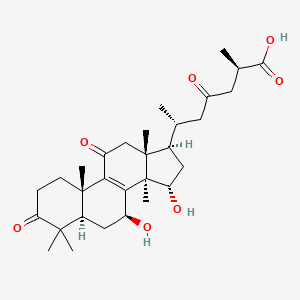
Identifiers
Functions
Where is Reishi Extract used, and what role does it play in each application?
Reishi extract, specifically ganoderic acid A, is a triterpenoid reported in Ganoderma lucidum and related fungi, indicating its role as a bioactive compound in traditional and modern applications. In cosmetics, Ganoderma lucidum extract is listed as an active ingredient with a skin-protecting function, suggesting its use in skincare products to support skin health. Its presence across fungal species points to potential versatility, but the evidence does not detail specific product categories beyond cosmetics. Researchers should treat its application roles as primarily skin-protective, with broader uses implied by its triterpenoid nature but not explicitly documented.
Which product or formulation problem does Reishi Extract address?
Reishi extract addresses the formulation problem of providing skin protection in cosmetic products. Its function is explicitly categorized as skin-protecting, which implies it helps shield the skin from environmental stressors or maintain skin barrier integrity. This is a distinct benefit for formulators seeking ingredients with protective claims. However, the evidence does not specify the exact mechanism or the particular skin conditions it mitigates. Therefore, while it solves the need for a protective functional ingredient, the scope of protection remains undefined, and formulators should verify efficacy for their target application.
What supports the main commercial or clinical uses of Reishi Extract?
The main commercial use of Reishi extract as a skin-protecting ingredient is supported by its active listing in the European Commission's cosmetic ingredient database, which confirms its recognized function in cosmetics. Additionally, ganoderic acid A, a component of Reishi, has been reported in Ganoderma species, providing a chemical basis for its bioactivity. However, there is no clinical or preclinical literature in the available evidence to substantiate specific health benefits. Thus, the commercial use is established, but the clinical evidence base is absent, requiring researchers to rely on traditional knowledge or conduct their own studies.
Which formulation trade-offs should researchers consider for Reishi Extract?
Formulation trade-offs for Reishi extract are not well-defined in the available evidence. The cosmetic ingredient listing shows no restrictions, maximum concentration limits, or usage conditions, suggesting regulatory flexibility. However, the absence of safety hazard data and toxicity tests means formulators cannot assess potential irritancy or stability issues. The extract's triterpenoid nature may influence solubility or compatibility, but no data supports this. Therefore, while regulatory constraints are minimal, the lack of safety and stability information is a significant trade-off, requiring formulators to conduct their own assessments before use.
What are the physicochemical properties of Reishi extract?
| Property | Value | Category |
|---|---|---|
| XLogP3 | 2.2 | Computed Molecular Properties |
| Exact Mass | 516.30870374 | Computed Molecular Properties |
| Monoisotopic Mass | 516.30870374 | Computed Molecular Properties |
| Topological Polar Surface Area | 129.0 | Computed Molecular Properties |
| Complexity | 1070.0 | Computed Molecular Properties |
| Hydrogen Bond Donor Count | 3 | Computed Molecular Properties |
| Hydrogen Bond Acceptor Count | 7 | Computed Molecular Properties |
| Rotatable Bond Count | 6 | Computed Molecular Properties |
| Heavy Atom Count | 37 | Computed Molecular Properties |
| Formal Charge | 0 | Computed Molecular Properties |
Which formulation benchmark best contextualizes Reishi Extract, and what differs?
A relevant formulation benchmark for Reishi extract is other skin-protecting botanical extracts used in cosmetics, such as those with antioxidant or anti-inflammatory properties. However, the evidence does not provide comparative data on efficacy, concentration, or formulation compatibility. Reishi extract's triterpenoid composition may offer a unique mechanism, but without benchmark data, formulators cannot position it against alternatives. The key difference is that Reishi extract has a recognized cosmetic function but lacks the clinical substantiation that many competing ingredients have. Thus, while it fits the skin-protecting category, its differentiation remains unproven.