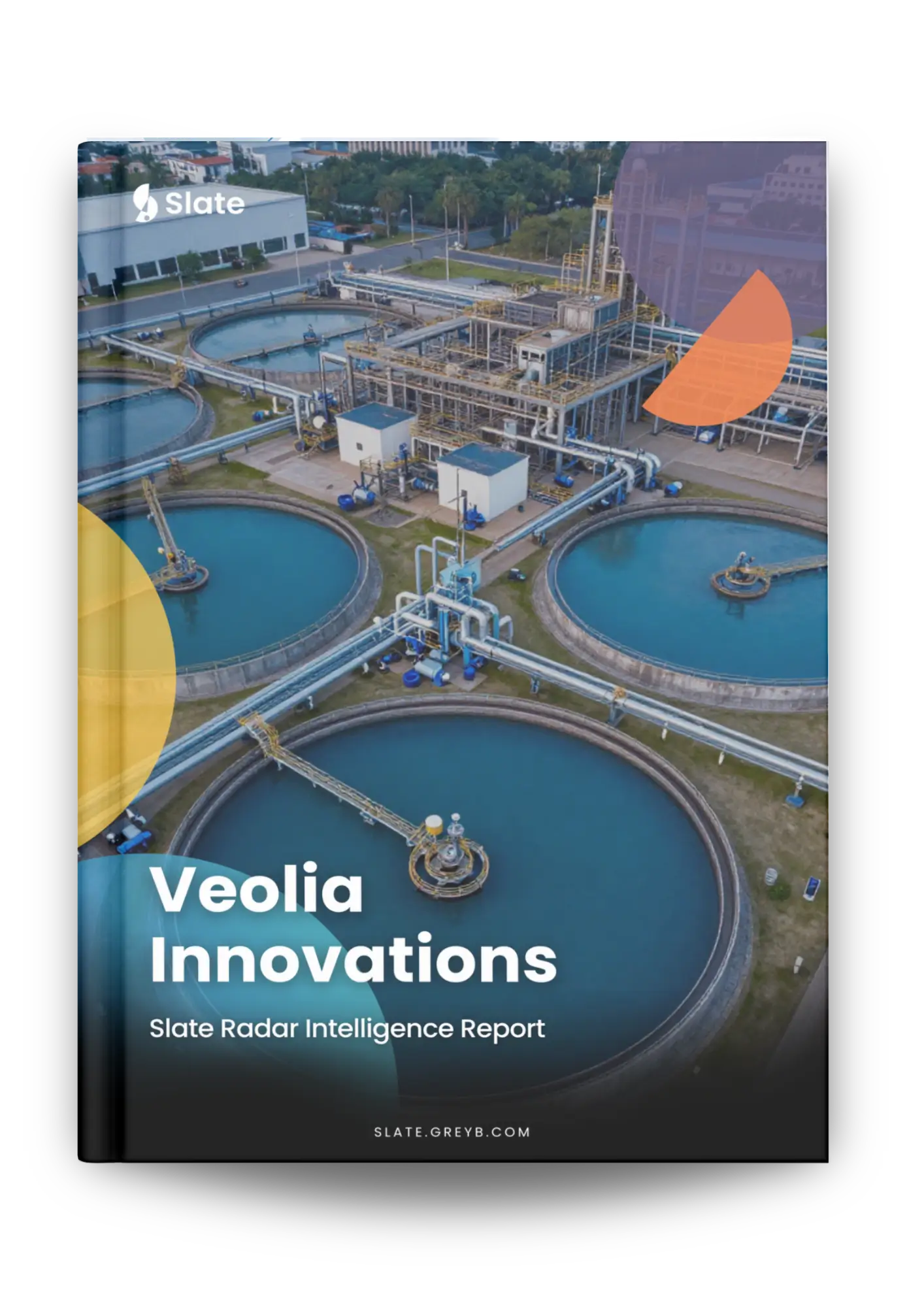
Veolia’s 2024–2026 patent activity does not read like a conventional water and waste portfolio. Across 219 innovations, the stronger signal is a shift toward high-recovery mineral extraction, predictive infrastructure management, and automated hazardous waste handling.
The contradiction is important: while Veolia is still associated with municipal water treatment and disposal contracts, its filings show a much larger move into lithium recovery, potassium sulfate production, semi-batch reverse osmosis, neural network-based maintenance, and zero-entry remediation.
We analyzed Veolia’s innovations to show where the company is creating new margin pools, which suppliers may become less relevant, and which industrial customers may face deeper technical lock-in.
Three Signals from Veolia’s Filings Stand Out
Wastewater treatment is becoming a mineral extraction platform
Veolia’s filings cover lithium isolation from brines and battery waste, zero-liquid-discharge lithium conversion, potassium sulfate recovery from wood pulping ash, and high-recovery membrane systems. The commercial implication is clear: Veolia is not only treating industrial waste streams; it is positioning those streams as feedstock for chemical production.
Semi-batch reverse osmosis is the architecture to watch
Veolia’s semi-batch RO and silica-removal filings point to 90%+ water recovery in silica-saturated environments using regenerable iron hydroxide and akageneite-based adsorbents. This matters because water-stressed mining, pulp, semiconductor, and industrial sites need recovery rates that standard continuous-flow systems struggle to sustain without fouling.
Predictive maintenance is being detached from Veolia-owned hardware
The report shows neural network-based equipment health indicators, pipeline defect characterization, robot imaging, power-consumption monitoring, and smart water plant dispatching. That makes the digital layer commercially important: Veolia can manage third-party or legacy infrastructure without replacing the entire plant.
Hazardous waste is moving toward zero-entry operations
Veolia’s patents on trailer-mounted robotic arms, remote catalyst removal, radiation-shielded camera systems, continuous vitrification, PFAS incineration, and hydrogen-safe dewatering show a different remediation model. The intent is already visible: reduce human exposure while making high-toxicity waste handling more scalable.
What’s Inside The Report?
Where is Veolia building its resource recovery moat?
A breakdown of how lithium, potassium sulfate, silica, selenium, and high-purity water recovery are being built into Veolia’s treatment architecture.
Which waste streams are becoming commercial feedstocks?
Analysis of battery black mass, natural brines, wood pulping ash, metallic sulfate effluents, evaporator blowdown, and industrial wastewater streams that Veolia is converting into higher-value outputs.
How is semi-batch RO changing industrial water economics?
A look at variable-volume reverse osmosis, silica adsorption, regenerable iron hydroxide, flux control, and zero-liquid-discharge systems that raise recovery rates while lowering chemical dependence.
Where is Veolia reducing labor exposure through automation?
A cluster-level view of robotic tank cleaning, fixed-bed catalyst removal, radiation-protected imaging, automated vitrification, PFAS destruction, and sludge incineration control.
How does Veolia’s AI layer change the service model?
A practical readout on neural networks, robotic inspection, membrane replacement prediction, power monitoring, and smart dispatching as tools for lifecycle infrastructure management.
The 13 Major Patent Clusters We Analyzed
The report maps Veolia’s 219 innovations into 13 clusters, showing where the company is strengthening legacy wastewater treatment and where it is building categorically different capabilities in resource recovery and hazardous remediation.
- Biological Wastewater Treatment via Activated Sludge, Biofilm Carriers & Deammonification (32 patents)
- Wastewater Treatment Hardware via Aeration Tanks, Sedimentation Pools & Filtration Barrels (30 patents)
- Rotary Disc Filter Media Cleaning via High-Pressure Guided Lances & Drums (25 patents)
- Hazardous Waste Processing via Vitrification, Robotic Cleaning & Mechanical Lifting (23 patents)
- Fluid Treatment via Ion Exchange, Activated Carbon & Membrane Filtration (20 patents)
- Membrane Water Filtration via Reverse Osmosis, Nanofiltration & Electrodialysis Systems (18 patents)
- Predictive Maintenance Modeling via Neural Networks, Data Acquisition & Robot Imaging (16 patents)
- Potassium Sulfate Recovery via Wood Pulping Ash Dissolution & Concentration (15 patents)
- Silica Removal via Semi-Batch Reverse Osmosis & Iron Hydroxide Adsorption (11 patents)
- Lithium Recovery via Carbonate Precipitation, Brine Electrodialysis & Scale Removal (10 patents)
- Hazardous Waste Treatment via Incineration, Sludge Dewatering & Solidification Processes (8 patents)
- Biological Reduction of Selenate to Selenite via Microbial Binding Sites (7 patents)
- Liquid Matrix Filtration via Multi-Stage Chambers, Ion Exchange & Flotation (4 patents)
Key Strategic Questions Answered
- Which Veolia patent clusters show a shift from waste disposal revenue to recovered mineral and chemical revenue?
- Where is Veolia using semi-batch RO, silica adsorption, and zero-liquid-discharge systems to unlock water-stressed industrial sites?
- Which lithium recovery steps is Veolia protecting: brine purification, black mass processing, carbonate scale removal, or hydroxide conversion?
- How could potassium sulfate recovery change the economics of wood pulping ash treatment and recovery boiler operations?
- Where does Veolia’s predictive maintenance layer create value without requiring full replacement of municipal or industrial infrastructure?
- Which hazardous waste applications are moving from manual intervention to robotics, radiation-shielded imaging, and automated thermal treatment?
- Which suppliers of membranes, adsorbents, filter media, robotics, and chemical consumables should track Veolia’s architecture shifts first?
Download the Full Report
Download the full Veolia Innovation Landscape Report to access the complete 2024–2026 analysis of 219 innovations across 13 major clusters and 4 emerging signals. Inside, you get the cluster map, representative innovations, strategic implications, second- and third-order consequences, and supplier-level risk signals across lithium recovery, potassium sulfate recovery, membrane filtration, biological treatment, predictive maintenance, and hazardous waste remediation.