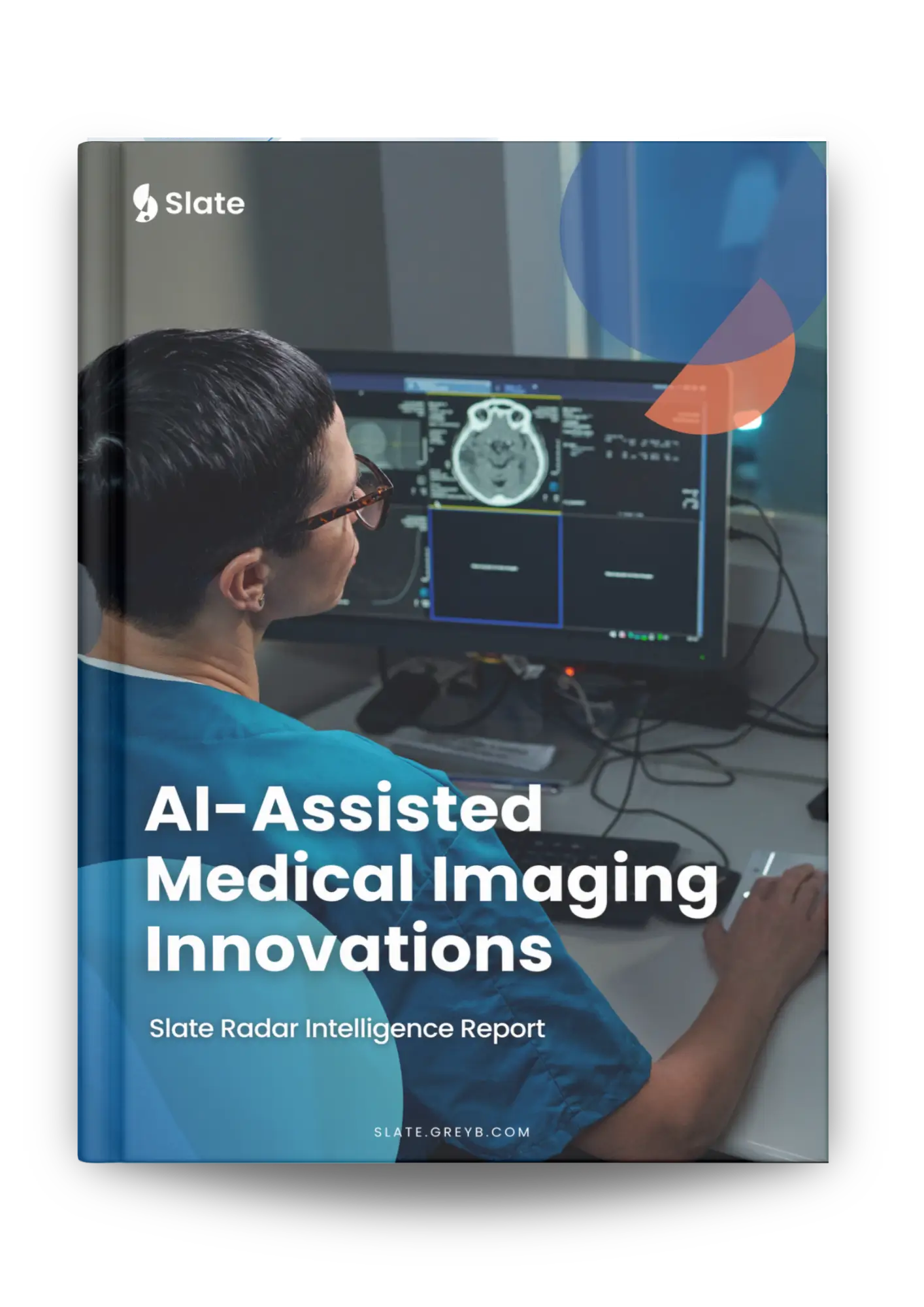
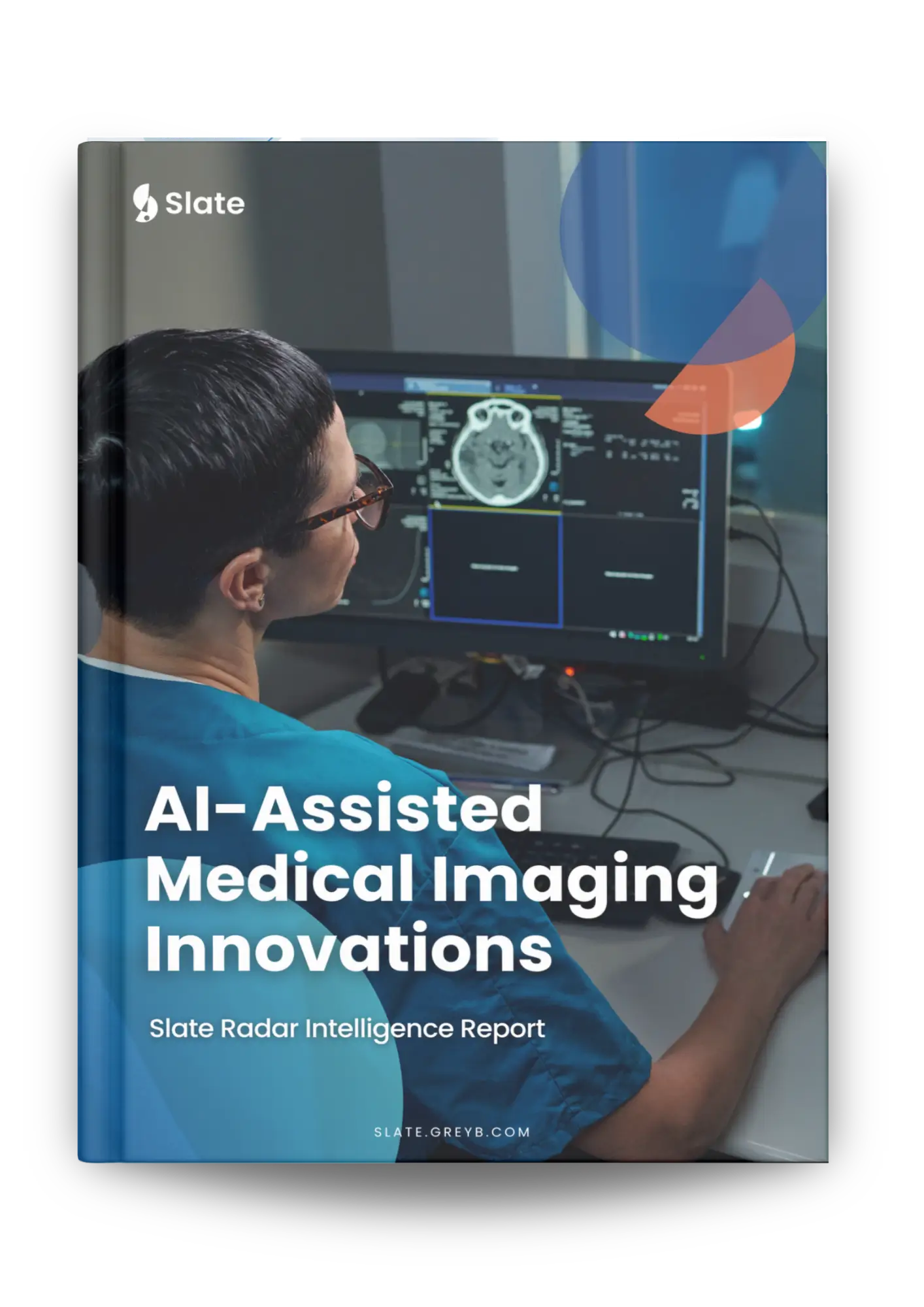
Philips, Siemens Healthineers, and GE HealthCare dominate an 896-innovation cluster for real-time ultrasound and fluoroscopy guidance, yet all three are absent from retinal analysis, while Siemens and GE have zero publications in dermatology and wound grading.
The market is splitting. Hardware incumbents are defending the operating theater while specialized AI firms, therapeutic companies, and universities capture the diagnostic intelligence layer.
We analyzed 14 research clusters spanning 5,768 listed innovations to show where value, IP risk, and acquisition pressure are moving.
3 Key Changes Shaping AI-Assisted Medical Imaging
Medical imaging companies are facing three connected pressures as AI moves from image interpretation into live procedures, multimodal prediction, and automated treatment planning.
- Procedural AI is becoming hardware-dependent: Companies without raw scanner access, motion correction, and sub-second inference may be excluded from high-margin surgical and interventional workflows.
- Diagnostic intelligence is moving beyond the scanner: Firms that combine images with pathology, genomics, EEG, wearables, and clinical data can control the diagnostic outcome while acquisition hardware becomes more interchangeable.
- Planning software is becoming the clinical gatekeeper: Digital twins, anatomical segmentation, and dose prediction are shifting procurement value, recurring revenue, and liability toward the accuracy of the software model.
What’s Inside the Report?
- Why is the operating theater becoming the strongest OEM moat? See how Philips, Siemens Healthineers, GE HealthCare, Olympus, and Intuitive Surgical are linking AI to proprietary hardware, raw signal processing, and real-time procedural guidance.
- When does diagnostic AI turn the scanner into a data feeder? Learn how multimodal fusion and predictive models are separating clinical insight from image acquisition and changing hospital platform requirements.
- Why will digital twin fidelity decide who controls treatment planning? Understand how segmentation, motion correction, 3D modeling, and dose prediction are reshaping radiotherapy, dentistry, and specialized surgery.
- Where are specialized players displacing traditional imaging companies? Track how Genentech, Alcon, Paige AI, Align Technology, Softbank, P&G, and academic institutions are building positions in overlooked diagnostic niches.
- Which research areas could create freedom-to-operate pressure? Identify clusters where academic and niche players are securing advanced fusion, registration, and prediction IP that may force licensing, acquisition, or cross-licensing.
- How could reimbursement and liability move toward the algorithm? Explore why automated guidance, explainable AI, and model-based planning may change who carries clinical risk and how providers are paid.
The 14 Research Clusters We Analyzed
The report maps 5,768 listed innovations across procedural imaging, multimodal diagnosis, planning software, and specialized clinical applications.
- Neural network image segmentation, classification, and lesion detection (1,767 innovations)
- Ultrasound and fluoroscopy image processing through neural network model inference (896 innovations)
- Multimodal machine learning fusion for disease detection and risk prediction (685 innovations)
- Multimodal signal fusion using EEG, computer vision, and brain imaging (618 innovations)
- Ultrasound image processing through frame classification, sequence splitting, and feature fusion (281 innovations)
- Multimodal medical image registration using deformation fields and spatial-frequency fusion (260 innovations)
- Neural network analysis of ECG data for cardiac rhythm classification (233 innovations)
- Retinal image analysis using OCT, fundus photography, and multimodal fusion (220 innovations)
- Intraoral 3D scanning and image analysis using point-cloud segmentation (205 innovations)
- Endoscopic image analysis through lesion detection, segmentation, and feature fusion (201 innovations)
- Deep learning image segmentation and analysis for wound grading and measurement (145 innovations)
- Automated radiotherapy planning through anatomical segmentation and dose distribution prediction (120 innovations)
- Deep learning image analysis using convolutional neural networks for dermatology (97 innovations)
- Machine learning analysis using tongue, facial, and acupoint image processing (40 innovations)
Key Trends You Can’t Ignore
Real-time guidance is moving AI into the procedure: Medical imaging AI is shifting from post-scan analysis to live clinical support. This change could determine which companies control the highest-value workflows.
Multimodal intelligence is weakening the link between diagnosis and hardware: Specialized players are combining imaging with genomic, clinical, and physiological data. This may reduce the strategic value of owning the scanner alone.
Digital twins are becoming central to treatment planning: AI-generated patient models are starting to shape radiotherapy and surgical decisions. Control over these models could influence software revenue, clinical standards, and hospital adoption.
Academic and niche players are building strategic IP positions: Universities and specialized firms are advancing multimodal imaging technologies faster than many established companies. This could increase future licensing, acquisition, and freedom-to-operate pressure.
Specialized diagnostic niches are creating new entry points: Companies outside traditional medical imaging are gaining ground in areas such as retinal analysis, dentistry, and dermatology. Their ability to connect diagnosis with treatment may reshape where value is captured.
Download the Full AI-Assisted Medical Imaging and Diagnostics Innovation Report
Get complete access to the 14-cluster innovation map, company and publication comparisons, representative patent-backed technologies, and the market, regulatory, freedom-to-operate, and second-order signals shaping the next phase of medical imaging AI.