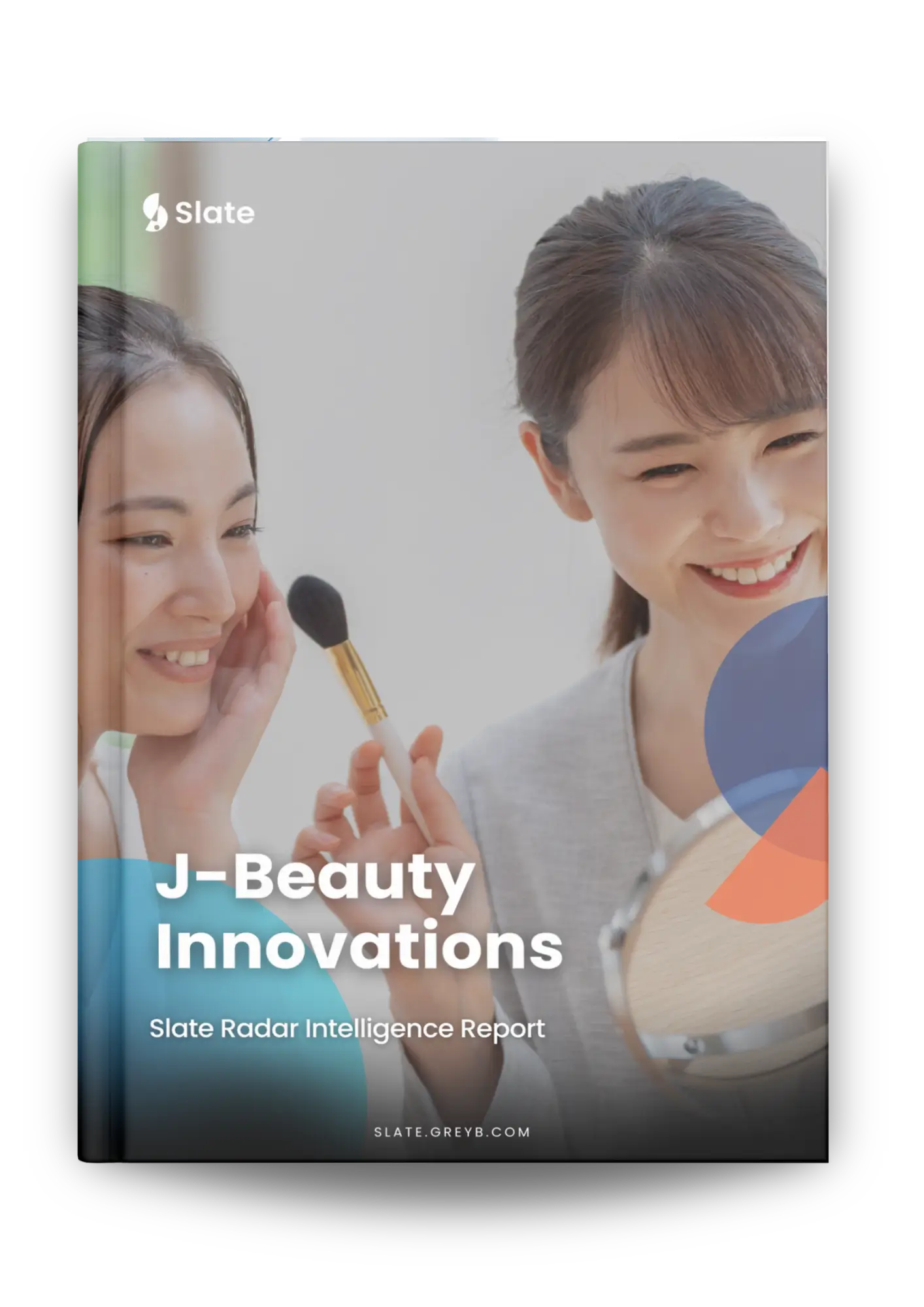
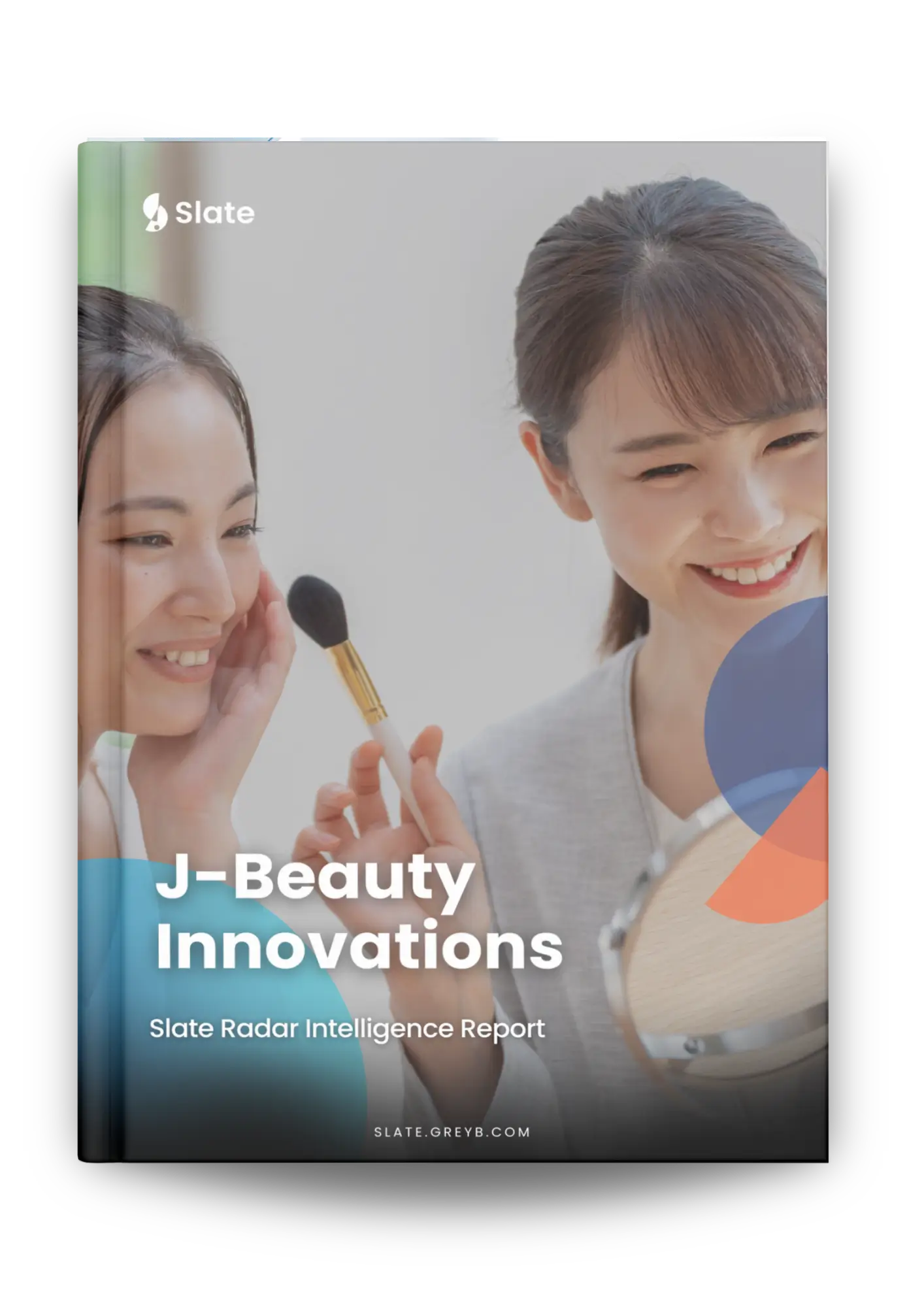
South Korean and Chinese entities account for 100% of the recent plant-derived antibacterial and preservative innovations in the analyzed cluster, while major Japanese incumbents remain largely absent. At the same time, publication activity in lipid-based moisture regulation doubled from 3 innovations in 2023–2024 to 6 in 2025–2026.
We analyzed 85 innovations across 13 research clusters to identify where J-Beauty’s technical advantage is strengthening, where regional competitors are closing the gap, and which emerging areas could reshape R&D priorities.
Key Signals Shaping J-Beauty Innovation Strategy
Botanical ingredients are not disappearing from J-Beauty. What is changing is where companies are trying to build defensibility around them: biological mechanisms, delivery systems, fermentation assets, and functional technologies that are harder to reproduce.
- The botanical may be easier to copy than the mechanism behind it: R&D is moving from broad antioxidant and moisturizing claims toward specific cellular pathways that require deeper validation.
- The delivery system is becoming part of the competitive moat: Nanoemulsions, lipid frameworks, vesicles, and other architectures are increasingly determining whether familiar actives can support premium efficacy claims.
- Regional competitors are moving into areas incumbents have left comparatively open: Preservation, advanced skin repair, and selected delivery technologies are showing meaningful activity outside Japan, creating new IP and partnership considerations.
What’s Inside the Report?
Where is J-Beauty still technically ahead?
See which innovation clusters show concentrated Japanese R&D positions and where those positions depend on mechanism-level IP rather than traditional ingredient heritage.
Is the delivery system becoming more valuable than the active?
Understand where nanoemulsions, lipid structures, vesicles, and penetration technologies are changing the basis of botanical differentiation.
Can fermentation remain a J-Beauty moat?
Track how innovation is moving from fermentation as a process toward proprietary strains, strain-substrate combinations, and measurable metabolic outputs.
Where are regional competitors building positions before incumbents respond?
Identify technical areas where Chinese and South Korean innovators are establishing meaningful activity with comparatively limited participation from major Japanese companies.
Is scalp care moving beyond topical formulation?
Explore how biological actives are beginning to combine with delivery hardware, potentially creating a new intersection between cosmetic R&D and device technologies.
Which sustainability requirements are becoming material-science problems?
See how microplastic replacement, mineral particles, glass powders, and formulation performance are converging into new technical IP opportunities.
The Research Clusters We Analyzed
The report maps the major technical directions reshaping J-Beauty, from biological pathway targeting and precision fermentation to advanced delivery and clean-label formulation.
- Botanical actives targeting antioxidant activity, hyaluronic acid, skin proteins, regenerative pathways, and cellular differentiation. (14 innovations)
- Botanical extracts and lipid enhancers for sebum control, moisture retention, ceramide activity, and skin-barrier regulation. (9 innovations)
- Defined microbial and yeast fermentation systems using specific strains, substrates, postbiotics, and metabolic pathways. (7 innovations)
- Nanoemulsion, wax, protein, and lipid-framework formulations improving stability, absorption, and active delivery. (4 innovations)
- Botanical extracts, polysaccharides, cell-culture ingredients, and natural compounds for topical skin repair and regeneration. (12 innovations)
- Plant-derived antibacterial and preservative systems using multi-extract botanical combinations. (8 innovations)
- Botanical formulations targeting skin whitening, antioxidant activity, irritation reduction, and inflammation. (4 innovations)
- Collagen peptide and botanical systems using phospholipid stabilization and penetration-enhancing technologies. (3 innovations)
- Ferment filtrates, peptides, exosomes, and vesicle systems for dermal barrier support and deeper active delivery. (3 innovations)
- Botanical and biological approaches to hair growth and scalp care, including fibrosis targeting and device-assisted delivery. (7 innovations)
The report also examines three adjacent areas increasingly relevant to J-Beauty strategy: anti-inflammatory plant distillates and cytokine-targeting formulations, sustainable glass and mineral-particle technologies replacing synthetic materials, and the evolving role of cultural and digital communication in protecting J-Beauty’s premium positioning across international markets.
Key Trends You Can’t Ignore
Biological specificity is becoming the new premium filter: J-Beauty innovation is moving beyond broad botanical efficacy toward much narrower biological endpoints. One incumbent already shows unusually concentrated activity in this area, but the wider competitive picture is more fragmented than it first appears.
Delivery technology is starting to redraw the competitive boundary: Publication activity in one lipid-focused cluster has already doubled, while nano-scale and vesicle-based approaches are appearing across multiple parts of the landscape. The report identifies where this acceleration is occurring and which players may be under-positioned as delivery becomes more important.
J-Beauty’s fermentation advantage is becoming harder to defend: Competitors are moving beyond basic fermented extracts toward specific strains, multi-strain systems, and more sophisticated biological processes. That changes what actually constitutes defensible fermentation IP, and the companies best positioned for that shift are not necessarily the most obvious ones.
Clean-label preservation is exposing an unexpected white space: Every recent innovation in the analyzed botanical preservative cluster comes from South Korean or Chinese entities. What matters is not only who is filing, but what continued absence from this area could mean for future formulation freedom, sourcing, and clean-beauty claims.
Scalp care is beginning to intersect with delivery hardware: Botanical hair-growth research is no longer limited to new extract combinations. Device-assisted approaches are appearing alongside biological mechanisms, suggesting that future competitive positions may depend on capabilities outside traditional cosmetic formulation.
Download the Full J-Beauty Innovation Landscape Report
Get detailed access to the complete 13-cluster analysis, company-level innovation positions, representative technologies and patents, competitive anomalies, and second- and third-order implications for R&D, IP, sourcing, and partnership strategy.