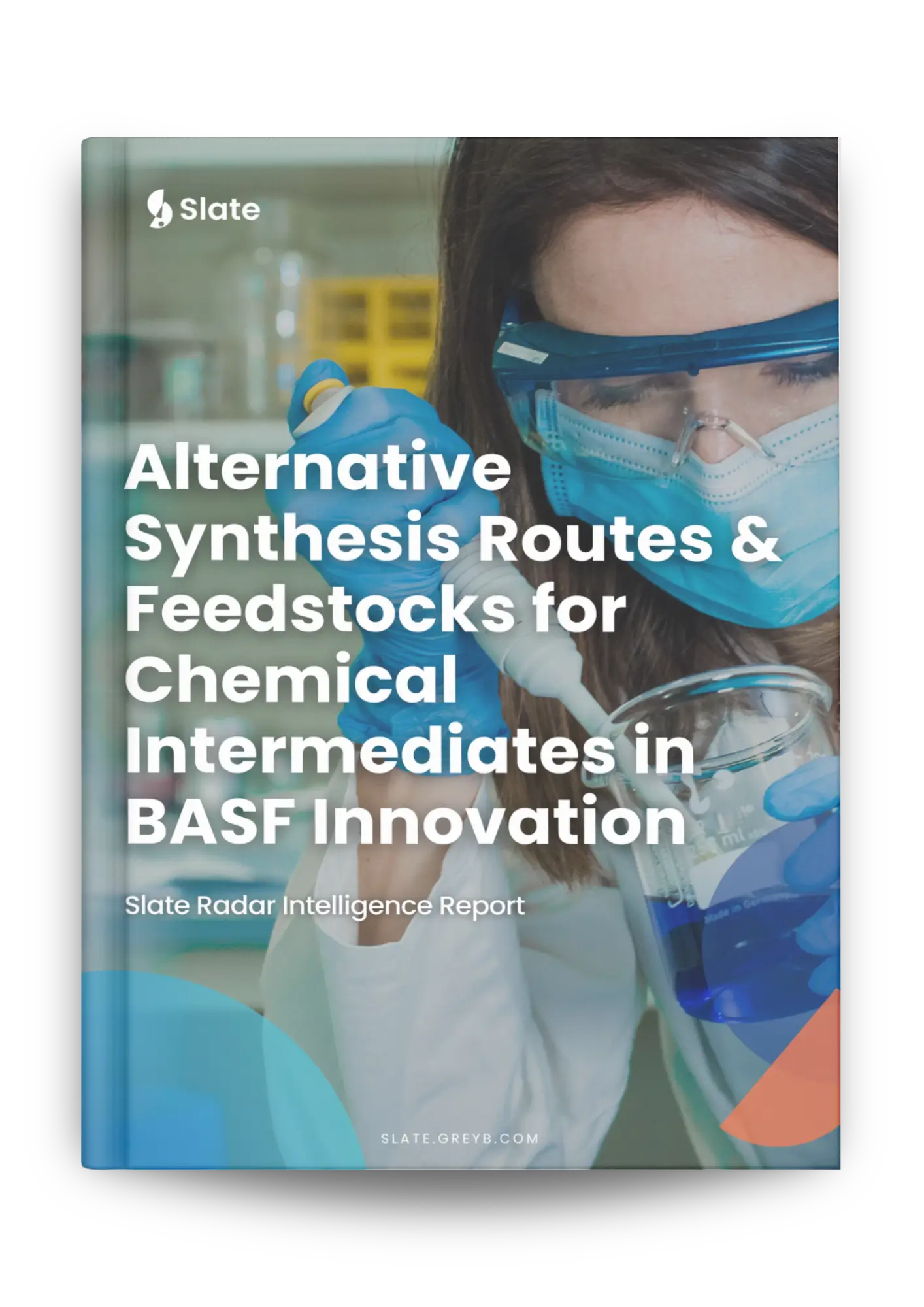
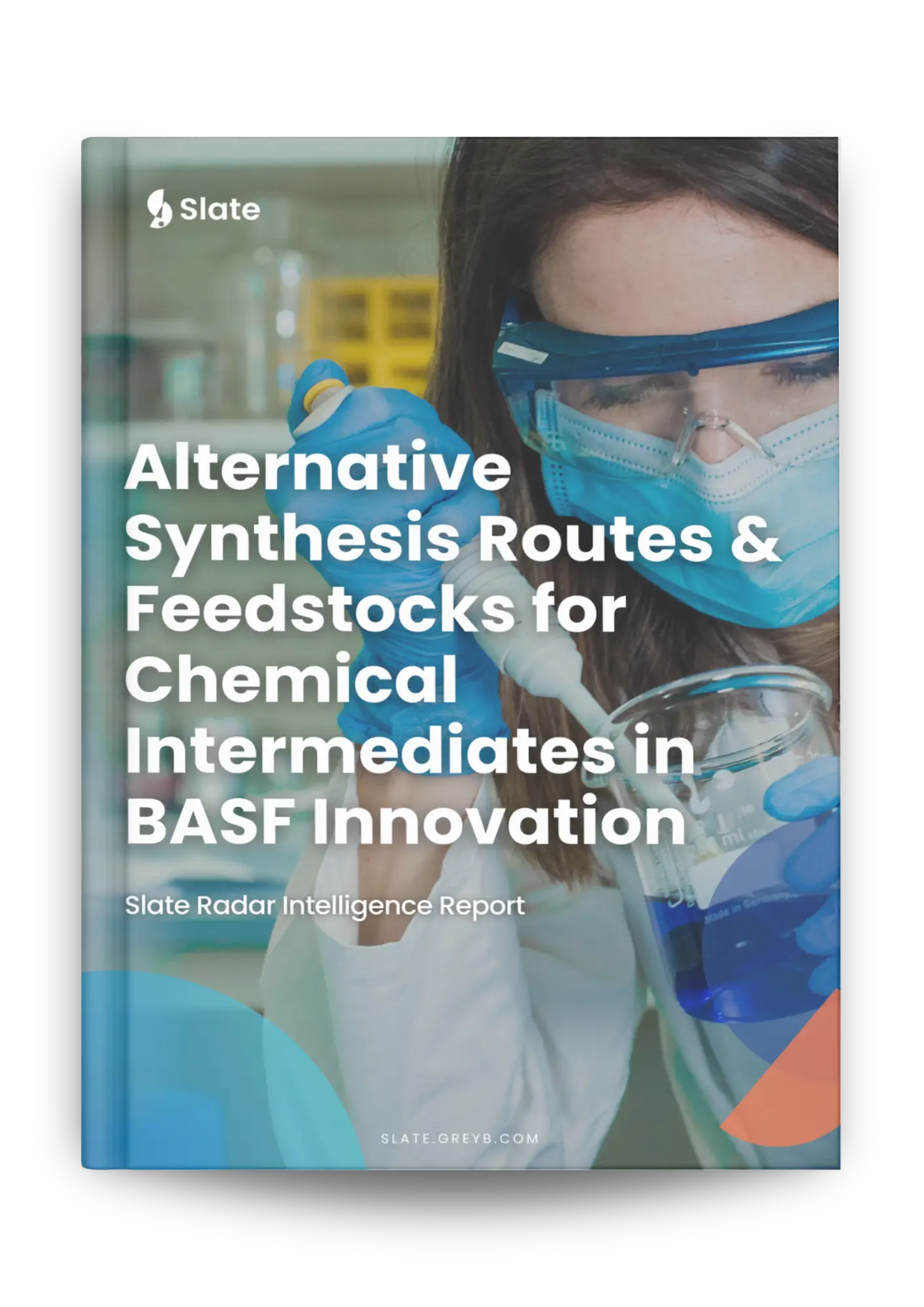
Alternative-feedstock chemistry is moving beyond one-for-one substitution. BASF’s innovation activity increasingly connects waste-derived carbon, renewable alcohols, CO2, electrolysis-derived hydrogen, and recycled intermediates directly into established chemical production routes.
We analyzed 272 innovations across 16 technology clusters to identify which synthesis routes BASF is accelerating, where alternative feedstocks are entering existing production systems, and which technologies could reshape the economics of chemical intermediates.
Key Signals Reshaping Chemical Intermediates Innovations
Decarbonization is changing more than the source of carbon. It is beginning to affect process design, verification, catalyst requirements, and the role of existing chemical infrastructure.
- Waste carbon is moving deeper into conventional chemical production. Plastic pyrolysis streams are increasingly being connected to established nitration, hydroformylation, and other downstream processes.
- Renewable origin is becoming technically measurable. BASF’s work around electrolysis-derived hydrogen and isotopic signatures points toward new ways of verifying how an intermediate was produced.
- Feedstock substitution is giving way to process integration. R&D increasingly focuses on converting renewable inputs directly into higher-value downstream intermediates rather than stopping at basic alcohols or olefins.
What’s Inside the Report?
How is BASF integrating plastic waste into existing chemical value chains?
See where pyrolysis-derived streams are being routed into established intermediate production rather than developed as standalone recycling pathways.
Can the renewable origin of a chemical become physically verifiable?
It examines BASF’s emerging work around electrolysis-derived hydrogen and molecular signatures that could change how green intermediates are authenticated.
Which routes are moving renewable alcohols further downstream?
Explore how catalytic coupling, dehydration, and downstream integration are being used to turn alternative feedstocks into higher-value intermediates.
Where is BASF building the strongest IP positions?
Compare technology clusters where BASF holds highly concentrated publication positions with areas where the landscape remains more open.
How is circularity changing specialty intermediate design?
See how amines, polyurethane intermediates, and other building blocks are being redesigned around recycling and end-of-life requirements.
Which parts of existing chemical infrastructure could become more valuable?
It identifies where feedstock flexibility, catalyst adaptation, electrification, and process integration may allow legacy assets to participate in lower-carbon production.
The Technology Clusters We Analyzed
The landscape covers 272 innovations spanning renewable feedstocks, catalytic conversion, process electrification, specialty intermediates, and chemical recycling.
- Guerbet alcohol conversion using homogeneous transition-metal catalysts. (35 innovations)
- Renewable ethanol dehydration for ethylene- and propylene-derived intermediates. (29 innovations)
- Catalytic amination of glycols and alcohols for ethyleneamines and alkanolamines. (23 innovations)
- Plastic-waste pyrolysis integrated with hydroformylation and nitration. (23 innovations)
- Copper, zeolite, silica, and metal-oxide catalysts for oxygenate synthesis. (18 innovations)
- Methanol synthesis using CO2, hydrogen, and carbonaceous-feedstock pyrolysis. (17 innovations)
- Chemical intermediate synthesis using water electrolysis and non-fossil energy. (15 innovations)
- Acetylene and synthesis-gas production through partial oxidation. (8 innovations)
- Citral, prenal, and isoprenol synthesis through condensation and dehydrogenation. (31 innovations)
- C2-C4 olefin production through methanol and dimethyl ether conversion. (15 innovations)
- Amine synthesis through alkylation, oxidation, and acetylene-based routes. (7 innovations)
- Acrylic acid production through heterogeneous gas-phase partial oxidation. (7 innovations)
- Amino acid ester and surfactant synthesis through lactam and aldehyde reactions. (3 innovations)
- Continuous n-butyl (meth)acrylate production using acidic catalysis and polymerization inhibition. (19 innovations)
- Polyurethane, polyurea, and polyisocyanurate chemical recycling through alcoholysis and solvent-efficient recovery. (15 innovations)
- Isobutene recovery from C4 hydrocarbons through etherification, distillation, and cleavage. (7 innovations)
Key Trends You Can’t Ignore
Plastic waste is being pulled into mainstream intermediate chemistry.
BASF’s activity suggests pyrolysis-derived material is being treated less as a separate recycling output and more as another feedstock for established chemical production. This shift is opening new downstream synthesis routes, although technical bottlenecks remain.
The next green-chemical standard may require more than mass balance.
A distinct R&D stream is emerging around physically verifying renewable inputs through molecular signatures. BASF is exploring how these verification methods could authenticate the renewable origin of chemical intermediates.
Renewable ethanol is moving beyond commodity molecules.
BASF is increasingly protecting routes that carry renewable alcohols further into specialty intermediates. This shift is creating new opportunities for catalytic innovation and stronger IP positions in downstream chemical production.
Feedstock flexibility is becoming a process-design problem.
CO2, waste-derived oils, methanol, ethanol, and other alternative inputs do not behave like conventional fossil feedstocks. Handling this variability requires advances in catalyst design, reactor configurations, and purification processes.
Circularity is moving into the molecule itself.
Some of BASF’s specialty-amine work is no longer focused only on making intermediates more efficiently. The chemistry is being redesigned around what happens at the end of the customer’s product life, creating a different basis for differentiation.
Download the Alternative Synthesis Routes & Feedstocks for Chemical Intermediates in BASF Innovation Report
Get complete access to the complete 16-cluster analysis, 272 mapped innovations, BASF IP concentration signals, alternative-feedstock pathways, process-integration strategies, representative innovations, and strategic implications.