Bromine still performs in many industrial applications. The bigger question is which applications still justify the supply, qualification, customer, and regulatory risks that come with it.
A brominated material can meet every engineering specification and still become the wrong business choice. Sometimes, the trigger isn’t a new regulation. It’s a customer requirement.
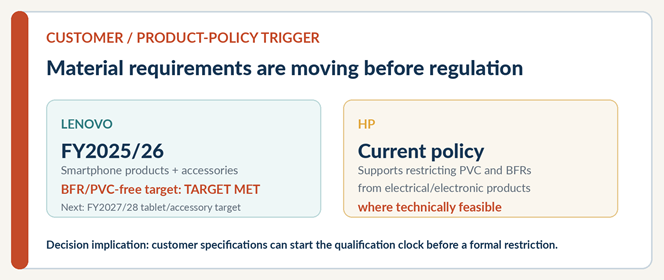
Lenovo’s environmental targets include a FY2025/26 goal for smartphone products and accessories to be free of PVC and brominated flame retardants, controlled at 1,000 ppm. HP’s current materials policy also supports restricting PVC and brominated flame retardants in electrical and electronic products where technically feasible.
Neither policy means bromine has stopped working. They show something more important: a material can remain technically suitable while becoming commercially harder to justify.
For companies using brominated materials, the question is no longer simply whether the chemistry works. It’s whether the application still makes sense when customer requirements, supply security, regulation, lifecycle impacts, qualification time, and alternative performance are considered together.
| Does bromine remain the best-qualified material for this function after considering supply security, regulation, lifecycle behavior, cost, customer requirements, and alternative performance together? |
Why Bromine Risks Differ Across Industries
When companies assess bromine exposure, it’s tempting to treat bromine as a single category. In practice, that approach can obscure the real risks.
The decision depends on:
| Molecule × grade × supplier × process conditions × customer specification × end-of-life pathway |
Consider the differences between calcium bromide used in completion fluids, an additive brominated flame retardant, and hydrogen bromide used in a qualified semiconductor etching process. All contain bromine, but their functions, performance requirements, and risk profiles are very different.
The same applies to individual flame-retardant chemistries. A reactive brominated material isn’t interchangeable with a legacy polybrominated diphenyl ether (PBDE) simply because both contain bromine.
Supply statistics need the same context.
Albemarle’s 2025 Form 10-K reports approximately 162.43 million tonnes of measured bromide-ion resources attributable to its interest in the Jordan Bromine Company. However, its reserve estimate is constrained mainly by plant processing capability and the term of the Jordanian concession, which runs until 2058.
In other words, having substantial bromide resources doesn’t automatically guarantee that every industrial customer can obtain the right material when needed.
Industrial customers don’t buy bromine atoms in the Dead Sea. They buy a qualified derivative with a defined purity and formulation, from an approved source, delivered reliably into an operating production system.
A company can therefore have access to abundant bromine resources and still face significant exposure if only one grade, one supplier, or one production facility has been qualified. That’s why the strategic decision needs to happen at the application level.
Four Strategies for Managing Bromine Dependence
Not every brominated application needs to follow the same path. Depending on the function, supply position, and availability of alternatives, companies have four options.
| The decision companies face | When it becomes credible |
| Defend bromine where its advantage remains difficult to reproduce | Alternatives cannot meet the required density, selectivity, fire performance, durability, or process yield. |
| Reduce bromine where the same function can be delivered at lower loading | Better synergists, reactive systems, recovery, or formulation changes can reduce dependence without sacrificing performance. |
| Replace bromine where another system performs better overall | The alternative improves the complete product or process and has credible supply, regulatory, and qualification evidence. |
| Redesign the system where no direct substitute is good enough | A different polymer, treatment train, fluid architecture, reaction pathway, or manufacturing process can remove the original bromine function. |
This framework avoids forcing every application into a keep-or-eliminate decision.
Three Questions Determine Whether Bromine Should Stay or Go
Before comparing substitute chemicals, companies need to understand what the existing material does, what could go wrong if it changes, and how much time a transition would require.
1. What performance requirement cannot fail?
Start with the incumbent material and the function it performs. What does the production system need from it, and what would happen if that performance changed?
For a completion fluid, the critical requirements may be density and crystallization behavior.
For a flame-retardant formulation, they may include fire rating, smoke generation, viscosity, mechanical performance, and electrical properties.
In semiconductor manufacturing, selectivity and profile control matter only if the resulting process continues to protect wafer yield.
These requirements define the performance boundary. If an alternative cannot meet that boundary under real operating conditions, bromine may still be the right choice.
2. Does the alternative reduce risk, or simply remove bromine?
Bromine-free and lower-risk are not the same thing. Consider the US Environmental Protection Agency’s (EPA) 2026 draft risk evaluation for tetrabromobisphenol A (TBBPA). The draft identifies unreasonable worker risk from inhalation under three conditions of use and unreasonable environmental risk from releases to surface water under two processing or disposal conditions.
These findings relate to specific uses and exposure routes. They shouldn’t be interpreted as evidence that all brominated materials present the same risks.
The alternatives need equally careful assessment.
Canada’s assessment of decabromodiphenyl ethane (DBDPE), an alternative to decaBDE used in several polymer and electronics applications, concluded that DBDPE meets the environmental criterion under the Canadian Environmental Protection Act (CEPA). The concerns include its persistence and the potential formation of harmful transformation products.
This is an important consideration when evaluating substitutes. A new material might remove one concern while introducing another. Companies should therefore assess alternatives across the full product lifecycle, including:
- Material loading and migration.
- Degradation and transformation products.
- Worker exposure during processing.
- Waste handling and disposal.
- Recycling compatibility.
- Product durability and service life.
Without these checks, a company risks qualifying a material that solves today’s problem but creates another one later.
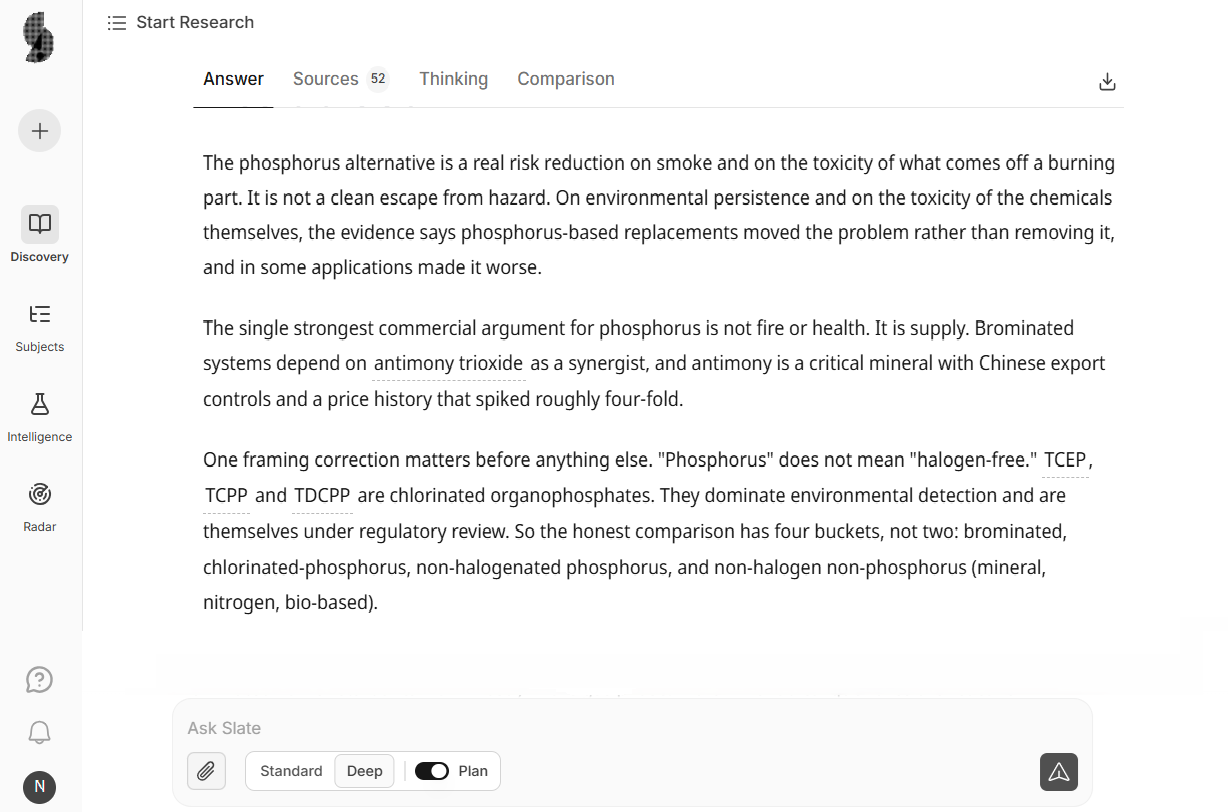
| The difficulty is that this evidence rarely sits in one place. Performance data may appear in research papers, emerging formulations in patents, and risk considerations in regulatory assessments. This is where tools like Slate can shorten the first stage of evaluation. R&D teams can investigate an alternative across patents and scientific literature together, compare supporting and conflicting evidence, and trace each finding back to its original source before deciding which candidates deserve deeper testing. |
3. How long will qualification take?
The third question is often overlooked until a company has to make a change under pressure.
According to the US Geological Survey (USGS), Israel accounted for 43% of reported global bromine production in 2024, excluding confidential US production. Jordan accounted for another 26%.
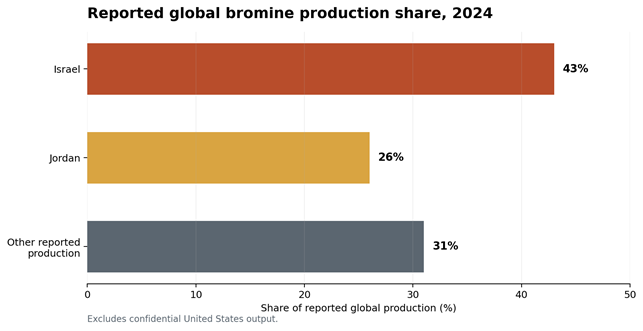
This concentration matters because disruptions at major production sites can quickly affect buyers.
Flooding at the Jordan Bromine Company in late 2025 illustrated that exposure. In its first-quarter 2026 update, Albemarle reported that the operation had fully recovered. The company also cited higher-than-expected bromine pricing in Chinese and Indian spot markets.
Even when production recovers, customers may still face sourcing challenges. Having a second supplier on paper doesn’t necessarily mean having a second qualified source.
An alternative grade may require testing, production trials, customer approval, fire certification, regulatory documentation, or months of process validation before it can be used commercially.
The real supply risk is therefore partly measured in qualification time.
This creates what can be called qualification debt: the liability that builds up when a company hasn’t qualified a second source, alternative chemistry, or replacement process before a customer specification changes, a material enters regulatory review, or supply is disrupted.
The problem becomes visible when the company needs to act. By then, the alternative may still be in testing, certification, or customer approval.
The examples that follow span different industrial applications, but they point to four distinct decisions: defend bromine where its performance remains difficult to reproduce, reduce dependence where formulation changes can help, replace it where another chemistry performs better overall, and redesign the system when direct substitution misses the real problem.
| Reducing qualification debt starts before laboratory qualification. Companies first need visibility into which alternative chemistries are gaining technical evidence, which companies are developing them, and whether new patents or studies are changing their viability. With Slate, teams can continuously track these signals across patents and scientific literature and set alerts around specific chemistries, applications, competitors, or technologies. That gives R&D more time to investigate promising options before switching becomes urgent. |
When Should Companies Defend Bromine? Applications Where Performance Still Matters
Bromine deserves to stay where it delivers a function that alternatives cannot reliably reproduce under the required operating conditions.
Two examples show why a blanket substitution strategy can be counterproductive.
1. High-density completion fluids: When density limits substitution
Calcium bromide remains useful in oil and gas completion fluids because it can provide a dense, clear fluid without suspended solids.
Potassium formate offers advantages under selected operating conditions. A 2025 study reported optimized formate and carbonate systems remaining stable below approximately −17°C, compared with a reported crystallization temperature below approximately −6.67°C for the calcium bromide reference. Under the study’s Iranian cost assumptions, the potassium-based systems were also cheaper.
Those findings make formates worth considering, but density remains a key limitation.
According to TETRA’s clear brine fluid specifications, potassium formate can reach densities of up to 13.1 lb/gal. Its halide fluid specifications list single-salt calcium bromide at up to 15.1 lb/gal, while cesium formate can reach 19.2 lb/gal.
Potassium formate therefore cannot cover every well condition currently served by heavier bromide fluids.
The practical takeaway is straightforward: where hydrostatic requirements push the alternative outside a credible operating window, bromide remains worth defending. Where density requirements fall within the formate window, alternatives may offer a better overall balance of cost and performance.
2. Semiconductor etching: Why experimental results aren’t enough
In semiconductor manufacturing, process control and wafer yield define the performance boundary.
Comparative research on Cl₂/O₂ and HBr/O₂ plasma systems found similar silicon-etching yields under selected conditions, while also identifying meaningful differences in plasma chemistry and process behavior.
This suggests that chlorine-based chemistry can reproduce some silicon-etching behavior under particular reactor conditions. It does not establish chlorine as a qualified commercial replacement for hydrogen bromide.
Experimental etching yield is not the same as commercial wafer yield. Residues, profile control, critical dimensions, selectivity, chamber conditions, and defect rates all influence whether a process can run reliably at scale.
For a high-value semiconductor process, maintaining the qualified process window may matter more than saving money on process gas. Bromine chemistry remains worth defending where it protects the required process window and no qualified alternative can reproduce it reliably.
How to Reduce Bromine Use Without Replacing the Entire Chemistry
Companies often frame the decision as a choice between keeping bromine and eliminating it. There’s another option: reduce dependence without rebuilding the entire product or process.
In some applications, changing the formulation can lower material use or improve overall performance while preserving much of the existing qualification work.
Change the synergist before changing the flame-retardant chemistry
Antimony trioxide is commonly used as a synergist in brominated flame-retardant systems.
A 2024 study explored replacing antimony trioxide in brominated acrylonitrile butadiene styrene (ABS) with calcium hypophosphite and talc.
The formulation remained brominated, but the redesigned system reduced peak heat-release rate by approximately 60% and total smoke production by approximately 21% compared with the bromine/antimony reference.
This illustrates why the most useful improvement doesn’t always involve removing the incumbent chemistry.
Depending on the application, companies may be able to reduce bromine dependence through:
- Changes to synergists or other formulation components.
- Lower bromine loading.
- A shift from additive to reactive flame-retardant chemistry.
- Improved recovery and reuse.
- Tighter process control.
A full bromine-free redesign may still be necessary in some cases. But where formulation changes can achieve the required performance, reducing dependence may be more practical and less disruptive.
It can also help preserve existing qualification work and, in some applications, avoid reopening the entire certification program.
When Should Companies Replace Bromine? Evaluating Alternative Chemistries
Replacement becomes credible when another material does more than remove bromine. It needs to improve the complete product or process against the requirements that matter. That means looking beyond a single laboratory result or headline performance metric.
1. Flame retardants: Can phosphorus-based alternatives compete?
Flame-retardant development offers examples of how selective replacement may work.
A 2024 study published by the American Chemical Society developed a low-phosphorus epoxy modifier that achieved a UL-94 V-0 rating at a phosphorus content of 0.42%.
Compared with untreated epoxy, the formulation reduced peak heat release by 31.4%, total smoke production by 19.1%, and maximum carbon monoxide emissions by 39.4%. The researchers also reported improved toughness.
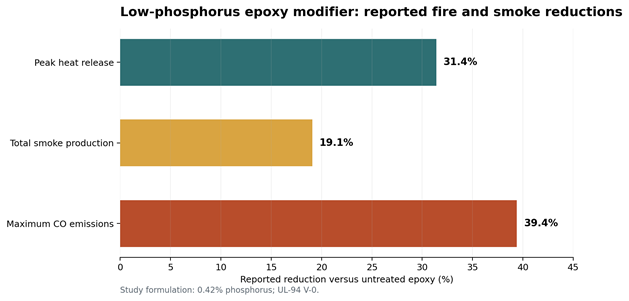
Reported reductions in peak heat release, total smoke production, and maximum carbon monoxide emissions compared with untreated epoxy. Source: 2024 ACS study. Study formulation: 0.42% phosphorus; UL-94 V-0.
These results are promising, but the benchmark matters.
The study’s primary comparison was against untreated epoxy, not every optimized commercial brominated flame-retardant formulation.
The commercial question is whether the same advantages hold up during production processing, aging, certification, scale-up, and customer qualification. The alternative also needs to be compared directly with the incumbent formulation, not just with an untreated material.
A material becomes a credible replacement candidate when it improves the complete system and can be qualified at an acceptable cost and lead time.
2. Completion fluids: Replace bromide when the well conditions allow it
Completion fluids offer another example of why replacement decisions need clear boundaries.
Where the required density falls within the formate operating window, alternatives may offer advantages in crystallization temperature, corrosion behavior, formation compatibility, or local economics.
Outside that window, bromide may remain the better choice.
The same chemistry can therefore belong in the Replace category for one well and the Defend category for another. The difference isn’t necessarily the material itself; it’s the operating conditions and the function the fluid must perform.
That’s why application-level analysis is more useful than declaring one chemistry universally superior.
When Is Redesign Better Than Direct Bromine Substitution?
Sometimes, the problem isn’t the presence of bromine itself. It’s how the broader system uses it.
In these cases, replacing one chemical with another may reproduce the same underlying limitation. Redesigning the process or material architecture can offer a more effective solution.
1. Water treatment: Why replacing bromine may not solve the problem
Bromine chemistry can remain effective under water conditions where chlorine performance falls, including higher-pH or ammonia-containing systems, as discussed in published research on bromine disinfection.
A direct chemical swap doesn’t automatically resolve the wider water-treatment challenge.
Each option has trade-offs:
- UV treatment reduces chemical use but leaves no persistent disinfectant residual.
- Chlorine behaves differently depending on water chemistry.
- Ozone is a strong oxidant, but in bromide-containing water it can produce bromate.
The last point is particularly important. The US EPA’s National Primary Drinking Water Regulations set a maximum contaminant level of 0.010 mg/L for bromate in drinking water.
A plant could therefore remove a bromine-based disinfectant and still generate a regulated bromine-containing by-product through another treatment process.
The more useful question is whether the treatment train is appropriate for the source water and the plant’s operating requirements.
The key variables include source-water chemistry, microbial targets, residual-disinfection requirements, bromide concentration, and operator capability.
Where these variables drive the constraint, redesigning the treatment train may create more value than replacing one disinfectant with another.
2. Zinc-bromine batteries: Improve how bromine behaves
Zinc-bromine batteries illustrate the same principle from a different angle. Here, the limitation may not be bromine itself. It may be the form bromine takes within the battery system.
A 2025 Nature Energy study used sodium sulfamate to reduce free bromine and form a milder brominated species.
The redesigned system reported an energy density of 152 Wh/L, compared with 90 Wh/L for the conventional reference. It also demonstrated more than 600 cycles compared with approximately 30 for the reference, alongside stable operation of a 5 kW stack for more than 700 cycles.
These findings don’t establish commercial readiness. Further validation is needed to understand scale-up, manufacturing, cost, and long-term operational performance.
But the study points to an important distinction: the bottleneck may be free bromine concentration, crossover, or reaction control rather than bromine chemistry itself.
If one of these factors limits performance, abandoning bromine may solve the wrong problem. Redesigning the system around the actual bottleneck could offer a more promising route.
Bromine Substitution Can Start Before Formal Regulation
Regulatory developments remain important, but they shouldn’t be the only reason to begin evaluating alternatives. The commercial case for substitution can change well before a formal restriction takes effect.
The European Chemicals Agency (ECHA) is preparing an Annex XV restriction dossier covering certain non-polymeric aromatic brominated flame retardants used in electrical and electronic equipment, construction products, and textiles.
The ECHA Registry of Restriction Intentions lists 11 December 2026 as the expected submission date.
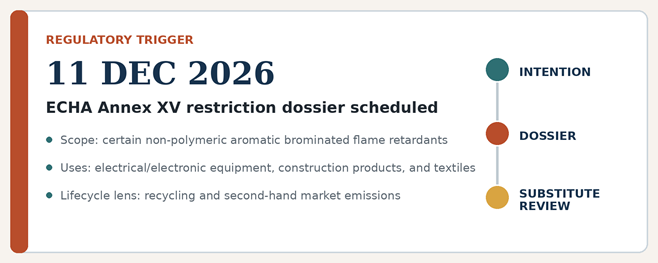
For companies using potentially affected materials, the important question isn’t just when a restriction might take effect. It’s when qualification must begin to preserve the option to switch.
If an alternative requires months of laboratory testing, production trials, certification, and customer approval, waiting for a final regulatory deadline may leave too little time to make a controlled transition.
Customer requirements can create the same pressure even earlier. A new supplier questionnaire, product specification, sourcing requirement, or material-disclosure request may trigger a review long before a formal restriction is implemented.
This is why bromine substitution isn’t just a regulatory issue. It’s a cross-functional decision.
- R&D teams need to establish whether an alternative can reproduce the required performance.
- Procurement teams need confidence in qualified supply depth and continuity.
- Sustainability teams need to determine whether the alternative actually reduces lifecycle risk.
- Product teams need to understand customer requirements and acceptance criteria.
- Leadership teams need visibility into which qualification programs deserve investment before they become urgent.
When these functions work together early, companies have more time to test alternatives, compare results, reject weak candidates, and negotiate with suppliers.
How to Assess Bromine Exposure Across Your Product Portfolio
A useful bromine review shouldn’t begin with a list of substitute chemicals. It should begin with the applications in which bromine is currently used. For each application, companies can work through seven questions.
1. What function does bromine perform?
Identify the specific role it plays and the performance requirements that cannot fail if the material is removed or changed.
2. How secure is the qualified supply?
Establish how many suppliers, material grades, and production locations are genuinely approved. Distinguish between a supplier that could provide the material and one that has completed the required qualification.
3. Which customers could trigger a change?
Identify customers with low-halogen, material-disclosure, recycling, or restricted-substance requirements. Assess whether those requirements are likely to affect the current formulation or process.
4. Where does the regulatory exposure sit?
Determine whether the concern relates to the molecule itself, a specific use condition, worker exposure, a waste stream, or the end-of-life pathway.
5. How long would qualification take?
Estimate the time required to approve another supplier, chemistry, grade, or process. Include testing, production trials, certification, documentation, and customer approval.
6. Does the substitute reduce the overall risk?
Evaluate the alternative’s performance, durability, exposure profile, degradation behavior, waste implications, recycling compatibility, and supply availability. Removing bromine alone isn’t enough.
7. What will switching actually cost?
Consider the impact on processing conditions, product performance, certification, customer approval, production continuity, and development resources. The answers determine whether an application belongs in Defend, Reduce, Replace, or Redesign.
More importantly, they help companies distinguish between an application that genuinely needs an immediate change and one where a planned qualification program would preserve future options.
A technically promising alternative that still needs substantial qualification isn’t an emergency replacement. It’s a development program that should begin while the company still has room to test, reject, improve, and negotiate.
The Future of Bromine Depends on Better Application-Level Decisions
Bromine isn’t disappearing from industrial chemistry, and in many applications, it shouldn’t. Its continued use will depend on where it delivers performance that alternatives cannot reliably reproduce, where its use can be reduced without compromising the product, and where another chemistry or a redesigned system offers a better overall outcome.
The immediate risk is that companies wait until a supply disruption, customer requirement, or regulatory change turns a manageable qualification program into an urgent one.
A more practical approach is to map brominated applications now, understand where qualified supply is concentrated, assess the alternatives against real operating conditions, and begin validation before a decision becomes unavoidable.
The same application-level logic applies to other material transitions where technical performance, supply security, regulation, and qualification time intersect.
Bromine should still be defended where it wins. But where the case is weakening, the substitution clock may already have started.
| Where does your bromine exposure actually sit? The challenge isn’t finding a list of bromine alternatives. It’s determining which alternatives are credible for each application before supply, regulatory, or customer pressure makes the decision urgent. Slate Prism helps R&D teams investigate that question systematically. Compare alternative technologies across patents and papers, weigh supporting and conflicting evidence, bring your own specifications and supplier documents into the analysis, and track new developments as the landscape changes. The result is a clearer basis for deciding what to Defend, Reduce, Replace, or Redesign, while there is still time to qualify the right option. |