Meet GreyB at IFT First 2026
GreyB partners with leading food brands so their R&D teams commit with conviction: which ingredients to pursue, which technologies are dead ends, where the next breakthrough is coming from, and which trends are noise.
Food's next breakthrough isn't in food. Slate finds it.
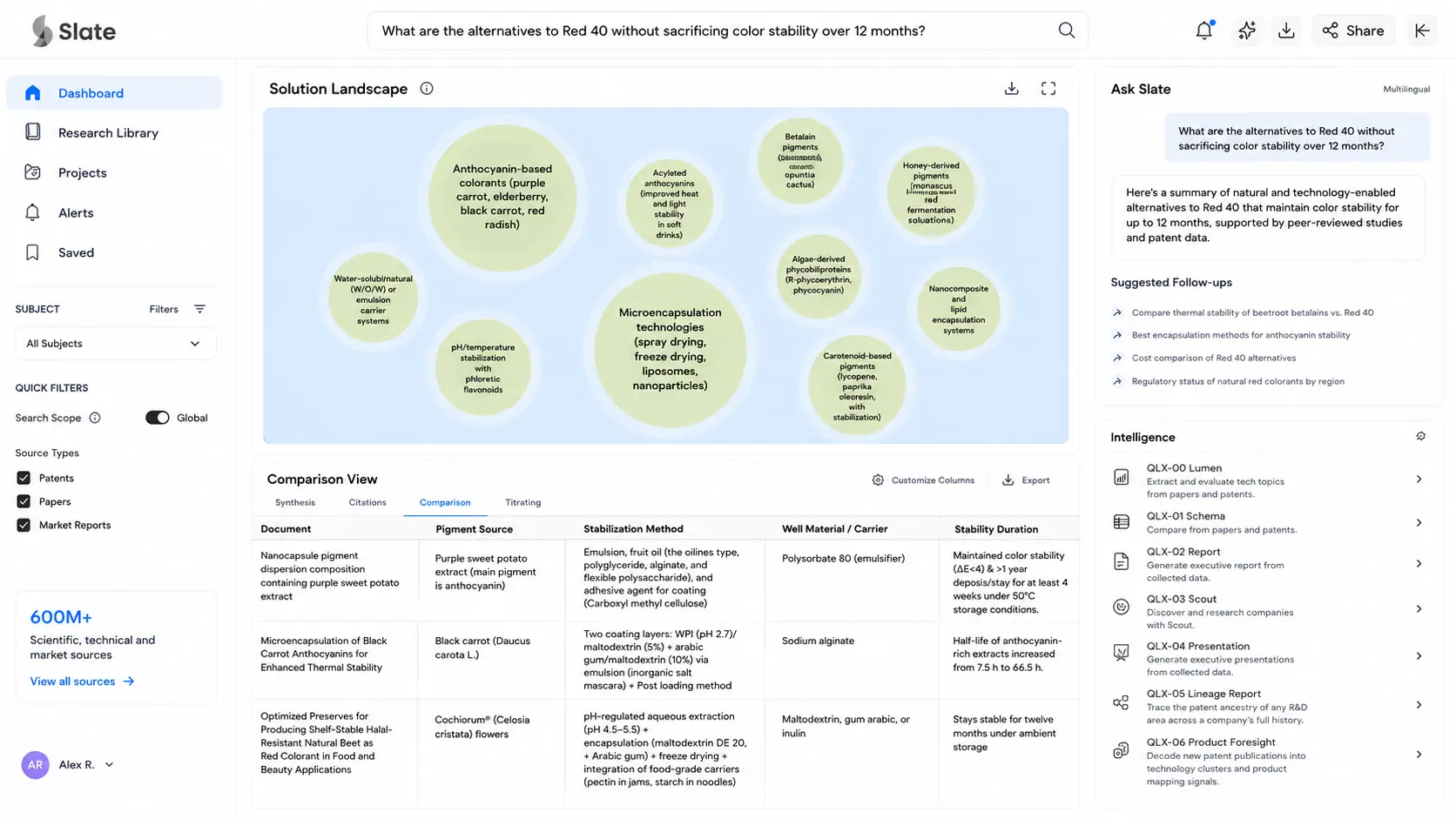
Complex R&D problems require looking past your industry and past keywords. Slate works like an R&D expert who looks beyond the state of the art and connects solutions from adjacent industries.
Trusted by researchers at









Everyone Sees These Trends. Almost No One Has the Evidence.
Fiber, protein, upcycling dominated IFT Chicago. But market interest does not guarantee commercial success. This report evaluates five F&B trends across 600 million+ sources, scientific evidence, regulation, IP, scale-up, and commercial feasibility. It helps R&D teams see what is ready to advance, what still needs validation, and where the biggest barriers remain.

GLP-1 Companion Nutrition
Only 18.6% stay on GLP-1s at one year. The cessation cohort is the market.
Postbiotics
Heat-killed Akkermansia cleared the FDA NDI gate. The path is open today.
Precision Fermentation
The technology is proven. Risk concentrates in a $62–109M GRAS kill gate.
Food-as-Medicine
KP NOURISH missed its primary endpoint. The 2027–2028 UPF deadline is set.
Upcycled Bioactives
One feedstock meets spec-grade threshold. No human trial proves efficacy yet.
GLP-1 Companion Nutrition
Where the Market Is and What the Evidence Actually Supports
Only 18.6% stay on GLP-1s at one year. The cessation cohort is the market, and the premium protein claim nobody has validated.
- Cessation cohort sized across three distinct buyer segments
- What the FTC's two-trial precedent means for claim strategy
- Whitespace in resistant starch and satiety positioning
- What a defensible weight-maintenance claim costs to prove
Postbiotics
Regulatory Pathways, Shelf-Life Data, and Where the IP Landscape Is Open
A deeper study on regulatory paths, consumer expectations, and ingredient stability for heat-killed probiotics.
- Inactivation methods ranked by low-cost scalable options
- NDI versus GRAS risk profiles for novel inactivated strains
- Commercial shelf-life and CPG format readiness for ambient distribution
- Where systematic review certainty ratings create risk for claim positioning
Precision Fermentation
GRAS Strategy, Allergenicity Assessment, and the $62–109M Capital Map
The core technology is proven at pharmaceutical scale. Risk concentrates in regulatory timing and cost engineering.
- GRAS filing strategy compared: self-affirmed, FDA-notified, hybrid
- Three-gate capital model from strain lock to commercial scale
- Phage contamination risk economics and mitigation cost
- Residual GMM DNA compliance across the US, EU, and China
- Allergenicity assessment tools that outperform the Codex 35%/80-aa threshold
Food-as-Medicine
What the Evidence, the Payer Architecture, and the 2027–2028 Regulatory Window Mean for CPG
KP NOURISH missed its primary endpoint. The 2027–2028 UPF definition convergence sets the reformulation deadline.
- Marker ingredients under combined regulatory and epidemiological pressure
- Payer and reimbursement channel map for CPG access
- Claim-risk matrix: structure/function versus disease boundary
- What the NIH NPH results expected in 2027 will decide for precision nutrition investment
Upcycled Bioactives
Feedstock Selection, Extraction Economics, and the IP Window Before Standards Catch Up
Rapeseed meal holds sinapic acid at 3.6% variance. No human trial proves efficacy yet, which is where the whitespace sits.
- Feedstock candidates compared by consistency, volume, and supply
- Green extraction methods with techno-economics side by side
- Bioaccessibility translation gaps that break in vitro models
- Standardization and the IP timing window before it closes
Bring us your hardest R&D question.
A formulation constraint. A competitor move. An emerging technology. A regulatory risk. Slate will investigate the evidence, connect the signals, and reveal what generic AI research is likely to miss.
Which trend will make it to the market first?
Scout which trends are closer to commercialization, which need more validation, and where adjacent industries are already showing early signals before they appear in food.

Decision-grade R&D intelligence for F&B teams
De-risk R&D decisions and accelerate research throughput with confident product, ingredient, and technology choices backed by traceable evidence.
Adopt adjacent industry innovations before they hit mainstream F&B
Surface research whitespaces being overlooked by the industry
Spot emerging ingredients, trends, and consumer shifts 12–18 months early
Track Novel Food, GRAS, and labeling filings with predictive regulatory intel
Identify companies, suppliers, and startups that match your requirements
Know where competitors are researching and investing before they arrive at shelf
See Slate in action on your ongoing R&D challenge
Book a personalized demo and see how Slate turns scattered R&D signals into decisions you can confidently act on.
Say Hi to GreyB’s expert:
Meet us at booth 4949. We’ll be on the floor all four days. Stop by for a quick conversation.


Who are we?

Facing A Roadblock In R&D?
Our Experts Are Here To Help.

