Bronopol Environmental Fate & Ecotoxicity
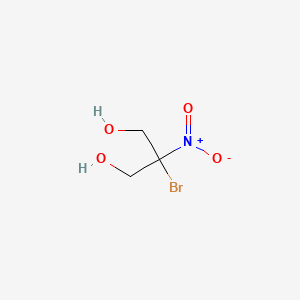
Identifiers
Hazards


What is the environmental fate of Bronopol?
Transport, degradation, persistence and exposure pathways
Environmental Fate / Exposure Summary
Bronopol's production and use as a preservative for cosmetics and pharmaceuticals may result in its release to the environment through various waste streams; its use as an agricultural bacteriostat will result in its direct release to the environment. If released to air, a vapor pressure of 1.26X10⁻⁵ mm Hg at 20 °C indicates bronopol will exist in both the vapor and particulate phases in the atmosphere. Vapor-phase bronopol will be degraded in the atmosphere by reaction with photochemically-produced hydroxyl radicals; the half-life for this reaction in air is estimated to be 11 days. Particulate-phase bronopol will be removed from the atmosphere by wet and dry deposition. Bronopol rapidly photodegrades at pH 4 exhibiting a photolysis half-life of 24 hours in water; under natural sunlight, a photolysis half-life of 2 days is expected. Therefore, bronopol may be susceptible to direct photolysis. If released to soil, bronopol is expected to have very high mobility based upon an estimated Koc of 1. Volatilization from moist soil surfaces is not expected to be an important fate process based upon an estimated Henry's Law constant of 1.3X10⁻¹¹ atm-cu m/mole. Bronopol is not expected to volatilize from dry soil surfaces based upon its vapor pressure. Utilizing the Japanese MITI test, 0% of the theoretical BOD was reached in 4 weeks indicating that biodegradation is not an important environmental fate process. If released into water, bronopol is not expected to adsorb to suspended solids and sediment based upon the estimated Koc. Volatilization from water surfaces is not expected to be an important fate process based upon this compound's estimated Henry's Law constant. An estimated BCF of 3 suggests the potential for bioconcentration in aquatic organisms is low. At 20 °C, the hydrolysis half-life was extrapolated to be about 18 years at pH 4, about 1.5 years at pH 6, and approximately 2 months at pH 8. Occupational exposure to bronopol may occur through inhalation of dust and dermal contact with this compound at workplaces where bronopol is produced or used. Use data indicate that the general population may be exposed to bronopol via dermal contact with this compound or other consumer products containing bronopol. (SRC)
Environmental Fate
TERRESTRIAL FATE: Based on a classification scheme(1), an estimated Koc value of 1(SRC), determined from a structure estimation method(2), indicates that bronopol is expected to have very high mobility in soil(SRC). Volatilization of bronopol from moist soil surfaces is not expected to be an important fate process(SRC) given an estimated Henry's Law constant of 1.3X10⁻¹¹ atm-cu m/mole(SRC), based upon its vapor pressure, 1.26X10⁻⁵ mm Hg(3), and water solubility, 2.5X10+5 mg/L(4). Bronopol is not expected to volatilize from dry soil surfaces(SRC) based upon its vapor pressure(3). A 0% of theoretical BOD using activated sludge in the Japanese MITI test(5) suggests that biodegradation is not an important environmental fate process in soil(SRC)
AQUATIC FATE: Based on a classification scheme(1), an estimated Koc value of 1(SRC), determined from a structure estimation method(2), indicates that bronopol is not expected to adsorb to suspended solids and sediment(SRC). Volatilization from water surfaces is not expected(3) based upon an estimated Henry's Law constant of 1.3X10⁻¹¹ atm-cu m/mole(SRC), derived from its vapor pressure, 1.26X10⁻⁵ mm Hg(4), and water solubility, 2.5X10+5 mg/L(5). Bronopol is stable to hydrolysis under normal environmental conditions. At 20 °C, the hydrolysis half-life was extrapolated to be about 18 years at pH 4, about 1.5 years at pH 6, and approximately 2 months at pH 8(6). Bronopol rapidly photodegrades at pH 4 exhibiting a photolysis half-life of 24 hours in water(6). According to a classification scheme(7), an estimated BCF of 1(SRC), from an estimated log Kow of -0.64(2) and a regression-derived equation(2), suggests the potential for bioconcentration in aquatic organisms is low(SRC). Bronopol was not biodegraded using a mixed culture sewage sludge test(8); therefore, biodegradation is not expected to be an important fate process in the aquatic environment(SRC)
ATMOSPHERIC FATE: According to a model of gas/particle partitioning of semivolatile organic compounds in the atmosphere(1), bronopol, which has a vapor pressure of 1.26X10⁻⁵ mm Hg at 20 °C(2), is expected to exist in both the vapor and particulate phases in the ambient atmosphere. Vapor-phase bronopol is degraded in the atmosphere by reaction with photochemically-produced hydroxyl radicals(SRC); the half-life for this reaction in air is estimated to be 11 days(SRC), calculated from its rate constant of 1.3X10⁻¹² cu cm/molecule-sec at 25 °C(SRC) that was derived using a structure estimation method(2). Particulate-phase bronopol may be removed from the air by wet and dry deposition(SRC). Bronopol rapidly photodegrades at pH 4 exhibiting a photolysis half-life of 24 hours in water; under natural sunlight, a photolysis half-life of 2 days is expected(3). Therefore, bronopol may be susceptible to direct photolysis(SRC)
Environmental Biodegradation
AEROBIC: Bronopol was not biodegraded using a mixed culture sewage sludge test(1). Bronopol, present at 100 mg/L, reached 0% of its theoretical BOD in 4 weeks using an activated sludge inoculum at 30 mg/L in the Japanese MITI test(2)
Environmental Abiotic Degradation
The rate constant for the vapor-phase reaction of bronopol with photochemically-produced hydroxyl radicals has been estimated as 1.3X10⁻¹² cu cm/molecule-sec at 25 °C(SRC) using a structure estimation method(1). This corresponds to an atmospheric half-life of about 11 days at an atmospheric concentration of 5X10+5 hydroxyl radicals per cu cm(1). Bronopol is stable to hydrolysis under normal environmental conditions. At 20 °C, the hydrolysis half-life was extrapolated to be about 18 years at pH 4, about 1.5 years at pH 6, and approximately 2 months at pH 8. At elevated temperatures (>30 °C) or high pH, rapid hydrolysis may occur producing formaldehyde and to a lesser extent tris(2-hydroxymethyl-2-nitropropane-1,3-diol), 2-bromo-2-nitroethanol, and other polymeric and aliphatic nitro compounds(2). Bronopol rapidly photodegrades at pH 4 exhibiting a photolysis half-life of 24 hours in water. Degradation products identified included tris(2-hydroxymethyl-2-nitropropane-1,3-diol). Under natural sunlight (assuming 12 hours of light and dark), a half-life of 2 days is expected(2)
Environmental Bioconcentration
An estimated BCF of 3 was calculated in fish for bronopol(SRC), using an estimated log Kow of -0.64(1) and a regression-derived equation(1). According to a classification scheme(2), this BCF suggests the potential for bioconcentration in aquatic organisms is low(SRC)
Soil Adsorption / Mobility
Using a structure estimation method based on molecular connectivity indices(1), the Koc of bronopol can be estimated to be 1(SRC). According to a classification scheme(2), this estimated Koc value suggests that bronopol is expected to have very high mobility in soil
Volatilization from Water / Soil
The Henry's Law constant for bronopol is estimated as 1.3X10⁻¹¹ atm-cu m/mole(SRC) derived from its vapor pressure, 1.3X10⁻⁵ mm Hg(1), and water solubility, 2.5X10+5 mg/L(2). This Henry's Law constant indicates that bronopol is expected to be essentially nonvolatile from moist soil and water surfaces(3). Bronopol is not expected to volatilize from dry soil surfaces(SRC) based upon its vapor pressure(1)
Artificial Pollution Origins
Bronopol's production and use as a preservative for cosmetics and pharmaceuticals(1) may result in its release to the environment through various waste streams(SRC); its use as an agricultural bacteriostat(1) will result in its direct release to the environment(SRC)
Probable Routes of Human Exposure
According to the 2006 TSCA Inventory Update Reporting data, the number of persons reasonably likely to be exposed in the industrial manufacturing, processing, and use of bronopol is 100 to 999; the data may be greatly underestimated(1)
NIOSH (NOES Survey 1981-1983) has statistically estimated that 5,176 workers (4,904 of these were female) were potentially exposed to bronopol in the US(1). Occupational exposure to bronopol may occur through inhalation of dust and dermal contact with this compound at workplaces where bronopol is produced or used. Use data indicate that the general population may be exposed to bronopol via dermal contact with this compound or other consumer products containing bronopol(SRC)
What ecotoxicity evidence is reported for Bronopol?
Reported endpoints by species, duration and observed effect
Ecotoxicity Values
LD50; Species: Anas platyrhynchos (Mallard duck) oral 509.5 mg/kg /99.4% a.i./ /from table/
LC50; Species: Anas platyrhynchos (Mallard duck) oral >10,000 ppm /in the diet/ for 8 days /100% a.i./ /from table/
LC50; Species: Colinus virginianus (Northern bobwhite) oral 4487.6 ppm /in the diet/ /8 days /100% a.i./ /from table/
LC50; Species: Oncorhynchus mykiss (Rainbow trout); Conditions: flow through; Concentration: 41.6 ppm for 96 hr (95% confidence interval: 36-45 ppm) /100% a.i./ /from table/
For more Ecotoxicity Values (Complete) data for BRONOPOL (9 total), please visit the HSDB record page