Butyl Acetate Environmental Fate & Ecotoxicity
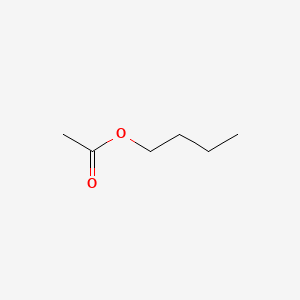
Identifiers
Functions
Hazards


What is the environmental fate of Butyl acetate?
Transport, degradation, persistence and exposure pathways
Environmental Fate / Exposure Summary
n-Butyl acetate's production and use in the manufacturing of lacquers, artificial leather, photographic films, plastics, safety glass and as a solvent may result in its release to the environment through various waste streams. n-Butyl acetate occurs naturally in many fruits and plants and may be released into the environment as a plant volatile. If released to air, a vapor pressure of 11.5 mm Hg at 25 °C indicates n-butyl acetate will exist solely as a vapor in the atmosphere. Vapor-phase n-butyl acetate will be degraded in the atmosphere by reaction with photochemically-produced hydroxyl radicals; the half-life for this reaction in air is estimated to be 3.2 days. n-Butyl acetate does not contain chromophores that absorb at wavelengths >290 nm and, therefore, is not expected to be susceptible to direct photolysis by sunlight. If released to soil, n-butyl acetate is expected to have very high mobility based upon an estimated Koc of 19. Volatilization from moist soil surfaces is expected to be an important fate process based upon a Henry's Law constant of 2.81X10⁻⁴ atm-cu m/mole. n-Butyl acetate may volatilize from dry soil surfaces based upon its vapor pressure. Using a standard BOD dilution technique and a sewage inoculum, theoretical BODs of 56% to 86% were observed during 5 and 20 day incubation periods, which suggests that n-butyl acetate may biodegrade in soil. If released into water, n-butyl acetate is not expected to adsorb to suspended solids and sediment based upon the estimated Koc. 5-Day theoretical BOD values of 20.9%, 56.8% and 51.8% were measured for n-butyl acetate in river water, distilled water and seawater, respectively, indicating biodegradation in water may be an important fate process. Volatilization from water surfaces is expected to be an important fate process based upon this compound's Henry's Law constant. Estimated volatilization half-lives for a model river and model lake are 6.5 hours and 5.3 days, respectively. An estimated BCF of 7 suggests the potential for bioconcentration in aquatic organisms is low. Hydrolysis may be an important environmental fate for this compound based upon experimentally determined hydrolysis half-lives of 2 yrs and 78 days at pH 7 and 8, respectively. Occupational exposure to n-butyl acetate may occur through inhalation and dermal contact with this compound at workplaces where n-butyl acetate is produced or used. Monitoring data indicate that the general population may be exposed to n-butyl acetate via inhalation of ambient air, ingestion of food and drinking water, smoking cigarettes and use of consumer products containing this compound. (SRC)
Environmental Fate
TERRESTRIAL FATE: Based on a classification scheme(1), an estimated Koc value of 19(SRC), determined from a structure estimation method(2), indicates that n-butyl acetate is expected to have very high mobility in soil(SRC). Volatilization of n-butyl acetate from moist soil surfaces is expected to be an important fate process(SRC) given a Henry's Law constant of 2.81X10⁻⁴ atm-cu m/mole(3). n-Butyl acetate is expected to volatilize from dry soil surfaces(SRC) based upon a vapor pressure of 11.5 mm Hg at 25 °C(4). Using a standard BOD dilution technique and a sewage inoculum, theoretical BODs of 56% to 86% were observed during 5 and 20 day incubation periods(5), suggesting that n-butyl acetate may biodegrade in soil(SRC)
AQUATIC FATE: Based on a classification scheme(1), an estimated Koc value of 19(SRC), determined from a structure estimation method(2), indicates that n-butyl acetate is not expected to adsorb to suspended solids and sediment(SRC). Volatilization from water surfaces is expected(3) based upon a Henry's Law constant of 2.81X10⁻⁴ atm-cu m/mole(4). Using this Henry's Law constant and an estimation method(3), volatilization half-lives for a model river and model lake are 6.5 hours and 5.3 days, respectively(SRC). According to a classification scheme(5), an estimated BCF of 7(SRC), from its log Kow of 1.78(6) and a regression-derived equation(2), suggests the potential for bioconcentration in aquatic organisms is low(SRC). Hydrolysis may be an important environmental fate for this compound based upon experimentally determined hydrolysis half-lives of 2 yrs and 78 days at pH 7 and 8, respectively(2). Using river water as seed, 5-day and 20-day theoretical BODs of 20.9% and 55.4%, respectively, were measured(7), suggesting that biodegradation may be an important environmental fate process in water(SRC)
ATMOSPHERIC FATE: According to a model of gas/particle partitioning of semivolatile organic compounds in the atmosphere(1), n-butyl acetate, which has a vapor pressure of 11.5 mm Hg at 25 °C(2), is expected to exist solely as a vapor in the ambient atmosphere. Vapor-phase n-butyl acetate is degraded in the atmosphere by reaction with photochemically-produced hydroxyl radicals(SRC); the half-life for this reaction in air is estimated to be 3.2 days(SRC), calculated from its rate constant of 4.9X10⁻¹² cu cm/molecule-sec at 25 °C(3). n-Butyl acetate does not contain chromophores that absorb at wavelengths >290 nm(4) and, therefore, is not expected to be susceptible to direct photolysis by sunlight(SRC)
Environmental Biodegradation
AEROBIC: Using a settled sewage seed, 5-day and 20-day theoretical BODs of 23.5% and 57.4% were measured for n-butyl acetate via standard dilution water tests(1). Using river water as seed, 5-day and 20-day theoretical BODs of 20.9% and 55.4% were measured(1). Using a filtered sewage seed, 5-day and 20-day theoretical BODs of 58% and 83% were measured in freshwater dilution tests; 5-day and 20-day theoretical BODs of 40% and 61% were measured in salt water(2). A 5-day theoretical BOD of 56.8% and 51.8% were measured for n-butyl acetate in distilled water and seawater, respectively, using the standard dilution method(3). Using a raw sewage seed, 5, 10, 15, and 20-day theoretical BODs of 56%, 68%, 70% and 83% were observed for n-butyl acetate(4). Using OECD method 301D and Closed Bottle test measuring oxygen consumption, n-butyl acetate achieved 98% and 83% theoretical BOD in 28 days, respectively(5). A Theoretical BOD of 52% (0.15 to 0.5 Lb/Lb) in 5 days has also been reprted(6)
Environmental Abiotic Degradation
The rate constant for the vapor-phase reaction of n-butyl acetate with photochemically-produced hydroxyl radicals has been reported as 4.9X10⁻¹² cu cm/molecule-sec at 25 °C(1). This corresponds to an atmospheric half-life of about 3.2 days at an atmospheric concentration of 5X10+5 hydroxyl radicals per cu cm(1). A base-catalyzed second-order hydrolysis rate constant of 0.10 L/mole-sec(SRC) was estimated using a structure estimation method(2); this corresponds to half-lives of 2 yrs and 78 days at pH values of 7 and 8, respectively(2). n-Butyl acetate does not contain chromophores that absorb at wavelengths >290 nm(3) and, therefore, is not expected to be susceptible to direct photolysis by sunlight(SRC)
Environmental Bioconcentration
An estimated BCF of 7 was calculated in fish for n-butyl acetate(SRC), using a log Kow of 1.78(1) and a regression-derived equation(2). According to a classification scheme(3), this BCF suggests the potential for bioconcentration in aquatic organisms is low(SRC)
Soil Adsorption / Mobility
Using a structure estimation method based on molecular connectivity indices(1), the Koc of n-butyl acetate can be estimated to be 19(SRC). According to a classification scheme(2), this estimated Koc value suggests that n-butyl acetate is expected to have very high mobility in soil
Volatilization from Water / Soil
The Henry's Law constant for n-butyl acetate is 2.81X10⁻⁴ atm-cu m/mole(1). This Henry's Law constant indicates that n-butyl acetate is expected to volatilize from water surfaces(2). Based on this Henry's Law constant, the volatilization half-life from a model river (1 m deep, flowing 1 m/sec, wind velocity of 3 m/sec)(2) is estimated as 6.5 hours(SRC). The volatilization half-life from a model lake (1 m deep, flowing 0.05 m/sec, wind velocity of 0.5 m/sec)(2) is estimated as 5.3 days(SRC). n-Butyl acetate's Henry's Law constant indicates that volatilization from moist soil surfaces may occur(SRC). n-Butyl acetate is expected to volatilize from dry soil surfaces(SRC) based upon a vapor pressure of 11.5 mm Hg(3)
Natural Pollution Origins
n-Butyl acetate occurs naturally in many fruits and plants(1,2) and may be released into the environment as a plant volatile(1). n-Butyl acetate occurs especially in some varieties of apples and in bananas(3)
Artificial Pollution Origins
n-Butyl acetate's production and use in the manufacturing of lacquer, artificial leather, photographic films, plastics and safety glass and as an organic solvent(1) may result in its release to the environment through various waste streams(SRC)
Probable Routes of Human Exposure
According to the 2016 TSCA Inventory Update Reporting data, 53 reporting facilities estimate the number of persons reasonably likely to be exposed during the manufacturing, processing, or use of methyl isobutyl ketone in the United States may be as low as 100 workers and as high as 10,000 workers per plant; the data may be greatly underestimated due to confidential business information (CBI) or unknown values(1)
NIOSH (NOES Survey 1981-1983) has statistically estimated that 822,099 workers (143,606 of these were female) were potentially exposed to n-butyl acetate in the US(1). Occupational exposure to n-butyl acetate may occur through inhalation and dermal contact with this compound at workplaces where n-butyl acetate is produced or used. Monitoring data indicate that the general population may be exposed to n-butyl acetate via inhalation of ambient air, ingestion of food and drinking water, smoking cigarettes and use of consumer products containing this compound(SRC)
The average TWA (time-weighted average) of n-butyl acetate detected in worker breathing zones of 3 companies using spray painting and gluing was 0.8 ppm; the highest single concentration was 6.8 ppm(1). The TWA of n-butyl acetate in workrooms of screen printing shops was in the range of 0.02-0.79 mg/cu m and the TWA of n-butyl acetate in houses above these shops were in the range of 0.08-0.14 mg/cu m(2). n-Butyl acetate was detected in the breathing zones of a microelectronics fabrication plant at concentrations of <0.3 ppb(3). n-Butyl acetate was detected in the breathing zone of a paint manufacturing plant at an average concentration of 5.07 ppm(4). n-Butyl acetate was reported in personal air samples of painters in six auto-painting garages at 0.3 to 1.0 ppm(5). n-Butyl acetate was identified in the breathing zones of silk screen printing shops at an average concentration of 2.8 mg/cu m(6). n-Butyl acetate was detected in the breathing zone of 57 of 70 artificial nail technicians at concentrations of 0.001 to 0.42 ppm(7). n-Butyl acetate was reported at <1 to 22 ppm during parquet work (installation with dispersion adhesives, puttying, sanding after puttying, undercoat varnishing and urea-formaldehyde varnishing)(8). Personal air samples taken while spraying primer on airplanes in three different hangers averaged 1.29, 1.79 and 2.08 ppm; while spraying surface paint averages were 4.03, 3.55 and 4.63 ppm for n-butyl acetate(9). In 46 painting workshops located in Sidney, Australia, n-butyl acetate was detected in 7 of 70 personal air samples at 2 to 23 mg/cu m(10)
Body Burden
n-Butyl acetate was detected in the expired breath of 3 of 8 human subjects at an expiration rate of 8.7-41.0 ug/hr(1). n-Butyl acetate was detected in 31 % of 387 expired air samples collected from 54 human volunteers at a mean concentration of 0.2 ng/L(2)
What ecotoxicity evidence is reported for Butyl acetate?
Reported endpoints by species, duration and observed effect
Ecotoxicity Values
LC50; Species: Chlorococcales (Green Algae Order); Conditions: freshwater, static; Concentration: 1200000 ug/L for 24 hr /formulation/
LC50; Species: Daphnia magna (Water Flea) age < or =24 hr; Conditions: freshwater, static, 20-22 °C; Concentration: 205000 ug/L for 24 hr /formulation/
LC50; Species: Lepomis macrochirus (Bluegill); Conditions: static bioassay in fresh water, mild aeration applied after 24 hr, 23 °C; Concentration: 100 ppm for 96 hr
LC50; Species: Menidia beryllina (Inland silverside); Conditions: static bioassay in synthetic seawater, mild aeration applied after 24 hr, 23 °C; Concentration: 185 ppm for 96 hr
For more Ecotoxicity Values (Complete) data for n-Butyl acetate (12 total), please visit the HSDB record page
Where has Butyl acetate been measured in the environment?
Measured occurrences across water, soil, sediment, air and effluent
Environmental Water Concentrations
GROUNDWATER: n-Butyl acetate was detected in groundwater in the Netherlands at a maximum concentration of 1 ppb(1)
DRINKING WATER: n-Butyl acetate was detected in less than 5% of finished waters using groundwater supplies based on US federal studies(1). n-Butyl acetate was qualitatively detected in finished drinking water from England(2) and Dordrecht, Germany(3)
SURFACE WATER: n-Butyl acetate was qualitatively detected in Ijssel Lake water, The Netherlands(1)
Effluent Concentrations
n-Butyl acetate was identified in 1 of 63 US industrial wastewater effluents at a concentration below 10 ppb(1). n-Butyl acetate was detected at a mean concentration of 5.72 ug/cu m in the effluent of a waste incinerator in Germany(2). n-Butyl acetate was identified in the effluents of waste treatment facilities in CA and Washington DC(3). UK emissions of n-butyl acetate were reported as 0.44% by mass distribution in 1990(4). Estimated yearly road traffic emissions of n-butyl acetate in Switzerland is reported as 0.007 kilotons(5). n-Butyl acetate was detected in 33 of 44 furniture emission samples(6)
Atmospheric Concentrations
URBAN/SUBURBAN: n-Butyl acetate was detected at a concentration of 3,000 ng/cu m in the air near an industrial site in Newark, NJ(1)
INDOOR AIR: n-Butyl acetate was detected at median concentrations of 2-5 ug/cu m in private homes in England(1) and at 34 and 14 ug/cu m in homes in northern Italy(2). n-Butyl acetate was identified in 69% of samples taken from 26 houses in Finland(3). The mean concentration of n-butyl acetate reported in West German houses was 6.1 ug/cu m(4). n-Butyl acetate was detected at a concentration of 549 ug/cu m in a freshly renovated building in Switzerland(5). n-Butyl acetate was found at concentrations of <0.1-2.8 ppb in new manufactured and at 0.6-14.1 ppb in site-built houses(6). Indoor air concentrations of n-butyl acetate were reported at 0.5 to 1905.8 ug/cu m during 18 days of finishing work on a newly built apartment, these values dropped to <0.1 to 9.7 ug/cu m two months later and to <0.1 to 22.4 ug/cu m nine months later(7)
RURAL/REMOTE: n-Butyl acetate was identified, not quantified, in a forest in Germany(1)
SOURCE DOMINATED: n-Butyl acetate was reported in paint mixing area of six auto-painting garages at 0.2 to 2.0 ppm(1)
Food Survey Values
n-Butyl acetate has been detected as a volatile flavor component of baked potatoes(1) and roasted filbert nuts(2). It has been identified as a naturally occurring flavor and fragrance component of apples(3). n-Butyl acetate has been identified in cheese volatiles(4), apricots and plumbs(5), dalieb fruit(6), apples(7,8), volatiles of chickpea seeds(9) and nectarines(10). n-Butyl acetate was not detected in scrambled eggs made from supermarket purchased, fresh unstored or fresh stored eggs(11)
Plant Concentrations
Butyl acetate has been identified as a naturally occurring component of apples(1). Butyl acetate was reported in the skin and pulp of Queen Anne's pocket melon (Cucumis melo L) at 123.9 and 110.5 ug/kg, respectively(2). n-Butyl acetate was detected in the head space of golden delicious apples 1, 5, 8, 12, 14, 16, 19 and 22 days after harvesting at concentrations of 0.53, 1.73, 15.35, 64.97, 81.45, 78.25, 79.41 and 71.12 ug/6 L head space, respectively(3). n-Butyl acetate was detected as a volatile component of Miyabi variety of Japanese muskmelon(4)
n-Butyl acetate occurrence in plants(1)
Other Environmental Concentrations
n-Butyl acetate was detected in the head space of a liquid wax house product(1). n-Butyl acetate was detected in 18% of 58 organic thinner products with an arithmetic mean of 16.8 and was not detected in degreasers or other miscellaneous organic solvent products collected nationwide in Japan(2). n-Butyl acetate was identified, not quantified, in the emissions of textile floor coverings(3) and printing inks(4). n-Butyl acetate was detected in printers ink for serigraphy on paper, paper boards, electric and electronic article(5). n-Butyl acetate was emitted from three day old floor coverings at rates of 5 and 1 ug/sq m-hr for oiled parquet and waxed parquet, respectively(6). These rates remained the same after 28 days(6). n-Butyl acetate was detected in 33 of 44 furniture emission samples(7). n-Butyl acetate was detected but not quantified in the emissions of kitchen waste exudate(8), waste exudate and head space in laboratory waste(9). n-Butyl acetate was detected in solfataric fields near Mendeleev, Golovnin and Tyatya volcanos(10). n-Butyl acetate is a component of tobacco and tobacco smoke(11)
Plant Concentrations
| Genus species | Family | Common name(s) | Part | Concn (ppm) |
|---|---|---|---|---|
| Aesculus hippocastanum | Hippocastanaceae | Horse chestnut | Flower essent. oil | 21,000 |
| Psidium guajava | Myrtaceae | Guava | Fruit | 1,000 |
| Plectranthus soleoides | Lamiaceae | not reported | Shoot | 6-42 |
| Thymus longicaulis | Mamiaceae | Kekik; Tas kekik | Shoot | 0.8 |
| Carica papaya | Cariaceae | Papaya | Fruit | not reported |
| Malus domestica | Rosaceae | Apple | Plant; fruit | not reported |
| Canaga odorata | Annonaceae | Chananga; Ylang-ylang | Fruit | not reported |
| Ribes nigrum | Grossulariaceae | Black current | Fruit | not reported |
| Sambucus nigra | Adoxaceae | European elder; European elderberry; Elder; Black elder; European Alder | Flower essent. oil | not reported |
| Cucumis melo | Cucurbitaceae | Cantaloupe; Nutmeg melon; Muskmelon; Persian melon; Netted melon; melon | Petiole | not reported |
| Cymbopogon pakeri | Poaceae | Skhabar | Plant | not reported |
| Lavandula x intermedia | Lamiaceae | Lavandin; Dutch lavender | Plant | not reported |