Dmdm Hydantoin Environmental Fate & Ecotoxicity
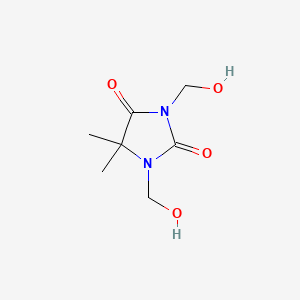
Identifiers
Functions
Hazards


What is the environmental fate of Dmdm hydantoin?
Transport, degradation, persistence and exposure pathways
Environmental Fate / Exposure Summary
1,3-Dimethylol-5,5-dimethylhydantoin's production and use as an antimicrobial preservative may result in its release to the environment through various waste streams. Its use in numerous household products, such as antibacterial hand soaps, shampoos, moisturizing creams, body washes, conditioners, and hair care products and its use as an inert ingredient in pesticide formulations may result in its direct release to the environment. If released to air, a vapor pressure of 9.0X10⁻⁸ mm Hg at 25 °C indicates 1,3-dimethylol-5,5-dimethylhydantoin will exist in both the vapor and particulate phases in the atmosphere. Vapor-phase 1,3-dimethylol-5,5-dimethylhydantoin will be degraded in the atmosphere by reaction with photochemically-produced hydroxyl radicals; the half-life for this reaction in air is estimated to be 13 hours. Particulate-phase 1,3-dimethylol-5,5-dimethylhydantoin will be removed from the atmosphere by wet or dry deposition. 1,3-Dimethylol-5,5-dimethylhydantoin does not contain chromophores that absorb at wavelengths >290 nm and, therefore, is not expected to be susceptible to direct photolysis by sunlight. If released to soil, 1,3-dimethylol-5,5-dimethylhydantoin is expected to have very high mobility based upon a measured Koc of <17.8. Volatilization from moist soil surfaces is not expected to be an important fate process based upon an estimated Henry's Law constant of 2.9X10⁻¹⁴ atm-cu m/mole. 1,3-Dimethylol-5,5-dimethylhydantoin is not expected to volatilize from dry soil surfaces based upon its vapor pressure. 1,3-Dimethylol-5,5-dimethylhydantoin was found to be readily biodegradable using OECD Guideline 301A with 75% degradation in 10 days and 95% degradation in 28 days. 1,3-Dimethylol-5,5-dimethylhydantoin is susceptible to aqueous hydrolysis with half-lives of <1 day at pH 7 and pH 9; no hydrolysis occurs at pH 4. This suggests that abiotic hydrolysis may be an important fate process in neutral or alkaline soils. If released into water, 1,3-dimethylol-5,5-dimethylhydantoin is not expected to adsorb to suspended solids and sediment based upon the Koc. Volatilization from water surfaces is not expected to be an important fate process based upon this compound's estimated Henry's Law constant. An estimated BCF of 3 suggests the potential for bioconcentration in aquatic organisms is low. Aqueous hydrolysis is expected to be an important fate process in neutral and alkaline waters. Occupational exposure to 1,3-dimethylol-5,5-dimethylhydantoin may occur through inhalation and dermal contact with this compound at workplaces where 1,3-dimethylol-5,5-dimethylhydantoin is produced or used. Use data indicate that the general population may be exposed to 1,3-dimethylol-5,5-dimethylhydantoin via dermal contact with consumer products, such as shampoos, hand sanitizers and other household products, containing 1,3-dimethylol-5,5-dimethylhydantoin. The general population may be exposed to 1,3-dimethylol-5,5-dimethylhydantoin via ingestion of foods as a result of indirect food uses that include paper and adhesives used to package food products. (SRC)
Environmental Fate
TERRESTRIAL FATE: Based on a classification scheme(1), a measured Koc value of <17.8(2) indicates that 1,3-dimethylol-5,5-dimethylhydantoin is expected to have very high mobility in soil(SRC). Volatilization of 1,3-dimethylol-5,5-dimethylhydantoin from moist soil surfaces is not expected to be an important fate process(SRC) given an estimated Henry's Law constant of 2.9X10⁻¹⁴ atm-cu m/mole(SRC), derived from its vapor pressure, 9.0X10⁻⁸ mm Hg(2), and water solubility, 7.73X10+5 mg/L(3). 1,3-Dimethylol-5,5-dimethylhydantoin is not expected to volatilize from dry soil surfaces based upon its vapor pressure(SRC). 1,3-Dimethylol-5,5-dimethylhydantoin was found to be readily biodegradable using OECD Guideline 301 A (Ready Biodegradability: DOC Die Away Test) with 75% degradation in 10 days and 95% degradation in 28 days(2). 1,3-Dimethylol-5,5-dimethylhydantoin is susceptible to aqueous hydrolysis with half-lives of <1 day at pH 7 and pH 9(2); no hydrolysis occurs at pH 4(2). This suggests that abiotic hydrolysis may be an important fate process in neutral or alkaline soils(SRC)
AQUATIC FATE: Based on a classification scheme(1), a measured Koc value of 1 year, <1 day and < 1 day at 25 °C(3) suggesting that hydrolysis is an important fate process in neutral and alkaline waters(SRC). 5,5-Dimethylhydantoin and formaldehyde were identified as the hydrolysis products(3)
ATMOSPHERIC FATE: According to a model of gas/particle partitioning of semivolatile organic compounds in the atmosphere(1), 1,3-dimethylol-5,5-dimethylhydantoin, which has a vapor pressure of 9X10⁻⁸ mm Hg at 25 °C(2), will exist in both the vapor and particulate phases in the ambient atmosphere. Vapor-phase 1,3-dimethylol-5,5-dimethylhydantoin is degraded in the atmosphere by reaction with photochemically-produced hydroxyl radicals(SRC); the half-life for this reaction in air is estimated to be 13 hours(SRC), calculated from its rate constant of 3.0X10⁻¹¹ cu cm/molecule-sec at 25 °C(SRC) that was derived using a structure estimation method(3). Particulate-phase 1,3-dimethylol-5,5-dimethylhydantoin may be removed from the air by wet or dry deposition(SRC). Based on direct photolysis tests with 5,5-dimethylhydantoin(2), 1,3-dimethylol-5,5-dimethylhydantoin does not contain chromophores that absorb at wavelengths >290 nm and, therefore, is not expected to be susceptible to direct photolysis by sunlight(SRC)
Environmental Biodegradation
AEROBIC: Using OECD Guideline 301 A (new version) (Ready Biodegradability: DOC Die Away Test), 1,3-dimethylol-5,5-dimethylhydantoin was found to be readily biodegradable in activated sludge with 75% degradation in 10 days and 95% degradation in 28 days(1). The degradation product of 1,3-dimethylol-5,5-dimethylhydantoin, 5,5-dimethylhydantoin, was found to be readily biodegradable via OECD Guideline 301 B (Ready Biodegradability: CO2 Evolution Test) with 87% CO2 evolution within 28 days of incubation and >60% degradation in 10 days(1). 5,5-Dimethylhydantoin was steadily biodegraded using OECD Guideline 308 (Aerobic and Anaerobic Transformation in Aquatic Sediment Systems) with half-lives of 13-24 days(1)
Environmental Abiotic Degradation
The rate constant for the vapor-phase reaction of 1,3-dimethylol-5,5-dimethylhydantoin with photochemically-produced hydroxyl radicals has been estimated as 3.0X10⁻¹¹ cu cm/molecule-sec at 25 °C(SRC) using a structure estimation method(1). This corresponds to an atmospheric half-life of about 13 hours at an atmospheric concentration of 5X10+5 hydroxyl radicals per cu cm(1). Aqueous hydrolysis tests conducted pH 4, pH 7 and pH 9, determined respective hydrolysis half-lives of >1 year, 290 nm for 30 days and pH 6.88-7.12(2); the direct photolysis half-life was approximated to be 878 days(2). This suggests that the structurally similar 1,3-dimethylol-5,5-dimethylhydantoin (in terms of chromophores that absorb at wavelengths >290 nm) is not expected to be susceptible to direct photolysis by sunlight(SRC)
Environmental Bioconcentration
An estimated BCF of 3 was calculated in fish for 1,3-dimethylol-5,5-dimethylhydantoin(SRC), using a log Kow of -2.9(1) and a regression-derived equation(2). According to a classification scheme(2), this BCF suggests the potential for bioconcentration in aquatic organisms is low(SRC). Dimethylhydantoin (DMT), a degradation product of 1,3-dimethylol-5,5-dimethylhydantoin, has a BCF of 0.08(1)
Soil Adsorption / Mobility
Using OECD Guideline 121 (Estimation of the Adsorption Coefficient (Koc) on Soil and on Sewage Sludge using High Performance Liquid Chromatography (HPLC)), the Koc of 1,3-dimethylol-5,5-dimethylhydantoin was determined to be <17.8(1). According to a classification scheme(2), this estimated Koc value suggests that 1,3-dimethylol-5,5-dimethylhydantoin is expected to have very high mobility in soil
Volatilization from Water / Soil
The Henry's Law constant for 1,3-dimethylol-5,5-dimethylhydantoin is estimated as 2.9X10⁻¹⁴ atm-cu m/mole(SRC) derived from its vapor pressure, 9.0X10⁻⁸ mm Hg(1), and water solubility, 7.73X10+5 mg/L(2). This Henry's Law constant indicates that 1,3-dimethylol-5,5-dimethylhydantoin is expected to be essentially nonvolatile from water surfaces(3). 1,3-Dimethylol-5,5-dimethylhydantoin's estimated Henry's Law constant indicates that volatilization from moist soil surfaces is not expected to occur(SRC). 1,3-Dimethylol-5,5-dimethylhydantoin is not expected to volatilize from dry soil surfaces(SRC) based upon its vapor pressure
Artificial Pollution Origins
1,3-Dimethylol-5,5-dimethylhydantoin's production and use as an antimicrobial in adhesives, air fresheners, caulking compounds, clay slurries, cleansers, coatings, dispersed colors, resin emulsions, fabric softeners, hydraulic fluids, inks, latex, liquid detergents, metal working cutting fluids, paints (emulsion, latex, water-based), paper/paperboard coatings, polishes, polymers (synthetic), powdered detergents, sealants, carpet shampoos, soap, stains (preservative incorporation), starch solutions, textiles, and wax(1) may result in its release to the environment through various waste streams(SRC). Its use in numerous household products, such as antibacterial hand soaps, shampoos, moisturizing creams, body washes, conditioners, hair care products(2) and its use as an inert ingredient in pesticide formulations(3) will result in its direct release to the environment(SRC)
Probable Routes of Human Exposure
According to the 2012 TSCA Inventory Update Reporting data, the number of persons reasonably likely to be exposed in the industrial manufacturing, processing, and use of 1,3-dimethylol-5,5-dimethylhydantoin is 50-99; the data may be greatly underestimated(1)
NIOSH (NOES Survey 1981-1983) has statistically estimated that 88,285 workers (67,234 of these are female) are potentially exposed to 1,3-dimethylol-5,5-dimethylhydantoin in the US(1). The NOES Survey does not include farm workers. Occupational exposure to 1,3-dimethylol-5,5-dimethylhydantoin may occur through inhalation and dermal contact with this compound at workplaces where 1,3-dimethylol-5,5-dimethylhydantoin is produced or used. Use data indicate that the general population may be exposed to 1,3-dimethylol-5,5-dimethylhydantoin via dermal contact with consumer products, such as shampoos, hand sanitizers and other household products(2), containing 1,3-dimethylol-5,5-dimethylhydantoin(SRC). The general population may be exposed to 1,3-dimethylol-5,5-dimethylhydantoin via ingestion of foods as a result of indirect food uses that include paper and adhesives used to package food products(3)
Cosmetic products containing DMDM Hydantoin are applied to the skin and hair and may come in contact with the eyes, nasal mucosa, and other parts of the body ... Product formulations containing DMDM Hydantoin may be applied as often as several times daily. Many of the products may be expected to remain in contact with the skin for as briefly as 15 to 30 minutes and may be used repeatedly over a period of several years(1)
Data provided by FDA in 2002 indicated that DMDM Hydantoin was being used in 963 cosmetic products. Current use concentration data indicate slightly lower maximum use concentration of 0.8%, compared to the 1% maximum use concentration that was reported in 1981 ... patch test results for DMDM Hydantoin in large populations of patients with suspected allergic contact dermatits indicated that the frequency of allergic reactions to DMDM Hydantoin has not increased over time(1)
What ecotoxicity evidence is reported for Dmdm hydantoin?
Reported endpoints by species, duration and observed effect
Ecotoxicity Values
LC50; Species: Anas platyrhynchos (Mallard duck) age 10-15 days; diet >5000 ppm for 8 days
LD50; Species: Anas platyrhynchos (Mallard duck) oral >1470 mg/kg
LC50; Species: Colinus virginianus (Northern bobwhite) diet >5000 ppm for 8 days
EC50; Species: Daphnia magna (Water flea) age <24 hr; Conditions: freshwater; static; Concentration: 37 ppm for 96 hr (95% confidence interval: 27-51 ppm); Effect: intoxication, immobilization /55% purity/
For more Ecotoxicity Values (Complete) data for 1,3-DIMETHYLOL-5,5-DIMETHYLHYDANTOIN (6 total), please visit the HSDB record page