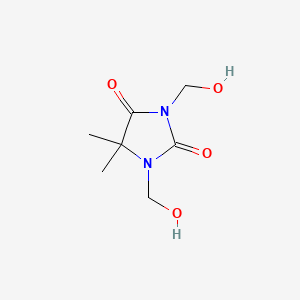


DMDM hydantoin: rules by market, safety and alternatives
DMDM hydantoin is a preservative that stops microbes growing in water-based products such as shampoo and conditioner. DMDM hydantoin is a formaldehyde releaser, which means it works by releasing small amounts of formaldehyde, and its INCI name is DMDM Hydantoin.
Does this affect your product?
Our read: check any product you ship into Washington State or Oregon first. Washington's stock allowance covers shops, and we found none for makers or distributors. Oregon's law covers importers and domestic distributors, and not retailers of third-party products.
| If you sell in... | Check this first |
|---|---|
| Washington State | Remove DMDM hydantoin, and any other formaldehyde releaser, from products you make or ship from 1 January 2027 |
| Oregon | Do the same once Oregon adopts proposed rules that name DMDM hydantoin. Oregon's law applies from the same day as Washington's ban |
| Great Britain | The formaldehyde warning, in force since 15 July 2026. Our reading: assume the warning applies to every product now, and confirm any stock allowance with the regulator |
| Japan | Any leave-on product. In the English translation we read, only rinse-off products are allowed, up to 0.30% |
| The EU, ASEAN, China or South Korea | The formaldehyde warning. The four markets allow DMDM hydantoin with a limit |
| Home care or metalworking fluids in the EU | The Commission's draft decision not to approve DMDM hydantoin as a biocide |
We checked each market's rule in its official list, and the safety reviews we found. We searched patents published from 27 November 2025 to 27 November 2026 in Slate R&D. "Our read" lines are our judgment.
What is DMDM hydantoin used for?
DMDM hydantoin preserves shampoo, conditioner and other cosmetics, and it also preserves home-care and industrial products that fall under different rules. The EU's 2009 cosmetics regulation lists DMDM hydantoin as an allowed preservative.
EPA's 2007 registration review summary lists air fresheners, liquid detergents, fabric softeners and carpet shampoos, and industrial paints, adhesives and metalworking fluids. EPA's summary is 19 years old, so it shows uses, not today's registrations.
We found 50 INPADOC patent families in the cosmetic classes A61K8 and A61Q that name DMDM hydantoin in the title, abstract or claims. Each family also uses a word starting with "preserv" or "antimicrobial". Nine of the 50 families have titles that say antimicrobial, preservative or preservation. The other 41 families are mostly product patents, in hair, skin, sun and mouth care, whose claims list a preservative among other ingredients. The count covers cosmetic classes only.
Is DMDM hydantoin banned?
Washington State bans DMDM hydantoin in cosmetics from 1 January 2027, while the EU allows it up to 0.6%. Oregon bans formaldehyde-releasing agents from the same day as Washington State, and Oregon's proposed rules, not yet adopted, name DMDM hydantoin. Japan allows DMDM hydantoin in rinse-off products only.
Our read: the one-year stock allowance is for Washington shops, so a brand's own shipments stop on the first day. Oregon's ban does not reach retailers that sell third-party products, and importers and domestic distributors are covered.
| Answer | Market | Rule | Source |
|---|---|---|---|
| Banned | Washington State | Bans DMDM hydantoin, item 1 of 25 listed formaldehyde releasers, with no concentration limit. Washington's rule also restricts any other formaldehyde releaser added on purpose. In-state retailers, meaning retailers located in Washington, may sell existing stock to the public through 31 December 2027. We found no stock allowance for makers or distributors | WAC 173-339. WAC 173-339-020 |
| Class banned, rules proposed | Oregon | Bans intentionally added formaldehyde-releasing agents above a practical quantification limit. Oregon's law applies to manufacturers, which it defines to include importers and domestic distributors, and not to a retailer that sells third-party products. The Oregon Health Authority's proposed rules name DMDM hydantoin, set 5.0 ppm for the class and ask for a third-party lab test. Oregon has not adopted the rules. The statute text we read has no stock allowance | ORS 431A.345 and 431A.330. Notice of Proposed Rulemaking, filed 30 October 2026, with Exhibit A to proposed OAR 333-016-4075. Notice |
| Rinse-off only | Japan | Appendix 3 gives 0.30 g per 100 g for products washed away, in the English translation we read. Leave-on products are not listed, and a blank in that table means the use is prohibited | Standards for Cosmetics, Appendix 3 |
| Allowed with a limit | EU, ASEAN, China, South Korea | Up to 0.6% of the product. China's figure is from the 2015 edition of its standards. Confirm it against the current edition | Regulation (EC) 1223/2009, Annex V, entry 33. ASEAN Annex VI, entry 33. NMPA, STSC 2015, Table 4. MFDS Cosmetic Safety Standards, March 2026 |
| Allowed with a limit | Great Britain | Great Britain keeps DMDM hydantoin on its allowed list, Annex V entry 33 of its copy of the regulation | SAG-CS opinion |
| Not found | Canada, US federal | Canada: not on the Cosmetic Ingredient Hotlist, which restricts formaldehyde itself. US federal: not on the FDA's list of prohibited and restricted cosmetic ingredients. We found no federal limit | Health Canada Hotlist. FDA |
We found no other US state law that names DMDM hydantoin.
DMDM hydantoin and the 2027 US state bans
The full report as a PDF, with every source cited. Then one email a month when something new appears.
Is DMDM hydantoin safe?
DMDM hydantoin's documented safety problem is contact allergy in formaldehyde-allergic people, and we found no court or regulator finding that DMDM hydantoin causes hair loss. The Cosmetic Ingredient Review (CIR) is the US industry-funded safety panel. CIR's final report of 1988 found DMDM hydantoin safe as a cosmetic ingredient in the present practices of use.
A 1988 patch-test study found that 8 of 14 formaldehyde-allergic patients reacted to DMDM hydantoin. In a second test, 4 of 12 developed dermatitis from a 1% cream (Contact Dermatitis, 1988).
The EU's Scientific Committee on Consumer Safety (SCCS) reviewed a 2016 study of a moisturiser spiked with DMDM hydantoin at the EU maximum. The moisturiser released at least 40 ppm formaldehyde on pre-irritated skin. 9 of 15 formaldehyde-allergic volunteers reacted at 40 ppm or more, and none of 12 non-allergic controls reacted (SCCS/1632/21, adopted 7 May 2021). SCCS/1632/21 answered a question about warning thresholds, not whether DMDM hydantoin should be banned.
Our read: safety verdicts and the bans answer different questions. A panel asks whether a level is safe, while Washington and Oregon restrict the whole class of releasers whatever a panel concludes.
Do not read 0.074% as a safe level for DMDM hydantoin. The 0.074% figure is CIR's ceiling for formaldehyde equivalents, set in a panel memo of 26 August 2011 (CIR). CIR's memo also calls heated hair-smoothing products unsafe. The EU limit is on DMDM hydantoin itself.
Hair-loss lawsuits have not settled the question. A court dismissed the TRESemmé claims on 28 December 2022 on labelling grounds (ClassAction.org). The OGX case was dismissed with prejudice on 22 March 2022, with no reason stated (ClassAction.org). BeautyMatter reported on 21 July 2026 that plaintiffs had filed a TRESemmé product-liability suit in New Jersey federal court the week before (BeautyMatter). We found no ruling in the New Jersey TRESemmé suit.
Does DMDM hydantoin need to be on the label?
DMDM hydantoin needs a label only through its formaldehyde: the EU and Great Britain require "releases formaldehyde" above 0.001%, and ASEAN "contains formaldehyde" above 0.05%.
Our read: in the SCCS's moisturiser test, 0.06% DMDM hydantoin released 2.5 to 10 ppm formaldehyde, and none of 15 allergic volunteers reacted. At 0.33%, DMDM hydantoin released 20 to 40 ppm. The European warning threshold is 10 ppm, so a product near the maximum needs the warning. Formaldehyde release depends on the formula.
| Market | Warning | Threshold |
|---|---|---|
| European Union | "Releases formaldehyde" | Total formaldehyde released by a finished product that contains an Annex V releaser exceeds 0.001%. New products since 1 August 2024, every product from 1 August 2026 (Regulation (EU) 2022/1181) |
| Great Britain | "Releases formaldehyde" | Formaldehyde in the finished product exceeds 0.001%. In force since 15 July 2026. Our reading: assume no stock allowance, and confirm with the regulator (SI 2026/23) |
| ASEAN, China | "Contains formaldehyde", and in China not for spray products | Above 0.05% formaldehyde in the finished product, free formaldehyde in China's 2015 edition (ASEAN Annex VI, STSC) |
| Australia | "Contains formaldehyde" | Free formaldehyde from 0.05% to 0.2% is allowed with the warning, and the Poisons Standard counts formaldehyde released from donors (Poisons Standard) |
Asked to take DMDM hydantoin out of a product?
Tell us the product and where it sells. We send a one-page brief for your next step: what the rules say for that product and by when, the swaps the rules rule out, and the alternatives to test first. Forward it to your R&D head as it is.
DMDM hydantoin INCI name and other names
DMDM hydantoin's INCI name, printed on ingredient lists, is DMDM Hydantoin. The EU annex gives DMDM hydantoin's chemical name as 1,3-Bis(hydroxymethyl)-5,5-dimethylimidazolidine-2,4-dione. Safety data sheets and filings give CAS 6440-58-0 and EC 229-222-8. Japan's list calls DMDM hydantoin 1,3-Dimethylol-5,5-dimethylhydantoin.
Washington's list names two similar entries separately, MDM hydantoin (CAS 116-25-6) and dimethylhydantoin formaldehyde.
What replaces DMDM hydantoin?
Another formaldehyde releaser is no swap for DMDM hydantoin in Washington State or Oregon. Phenoxyethanol, sodium benzoate, potassium sorbate and chlorphenesin are on neither state's list of releasers, and each has an EU limit.
Our read: the EU's preservative list is not a safe shortlist for a swap, because ten of its entries are on Washington's list. DMDM hydantoin is one of the ten.
Swaps the rules rule out
Washington State's table lists 25 formaldehyde releasers, and ten of them are preservatives that the EU allows, DMDM hydantoin among them. Oregon's proposed rules list the same ten. Item numbers come from Washington's table, letters from Oregon's proposed rule and entries from the EU's Annex V.
| Releaser | Washington item, Oregon proposed rule | EU Annex V |
|---|---|---|
| Diazolidinyl urea | Item 2, (B) | Allowed, entry 46 |
| Imidazolidinyl urea | Item 3, (C) | Allowed, entry 27 |
| Bronopol | Item 6, (F) | Allowed, avoid nitrosamines, entry 21 |
| Sodium hydroxymethylglycinate | Item 7, (G) | Allowed with a condition on releasable formaldehyde, entry 51 |
| Bronidox | Item 10, (J) | Rinse-off products only, avoid nitrosamines, entry 20 |
| 7-Ethylbicyclo-oxazolidine | Item 11, (K) | Not in oral products or on mucous membranes, entry 49 |
| Benzylhemiformal | Item 12, (L) | Rinse-off products only, entry 55 |
| Dimethyl oxazolidine | Item 16, (P) | Allowed above pH 6, entry 45 |
| Methenamine | Item 18, (R) | Allowed, entry 30 |
Washington also restricts releasers that its table does not list. Ecology's adoption notice says Washington's rule "restricts all chemicals that release formaldehyde", and Oregon's proposed rule introduces its list with "including but not limited to". The EU prohibits quaternium-15 (entries 1385 and 1386) and paraformaldehyde (entry 1578) outright (Annex II), and Washington lists quaternium-15 and paraformaldehyde as items 4 and 20.
Bronopol and bronidox both carry the EU's nitrosamine condition. Canada's Hotlist does not permit bronopol or bronidox in cosmetics that contain amines or amides.
Methylisothiazolinone is ruled out in leave-on products in the EU, ASEAN, Canada and South Korea, which allow methylisothiazolinone in rinse-off products only, up to 0.0015%. Japan allows methylisothiazolinone up to 0.01 g per 100 g, and China's 2015 edition up to 0.01%. China revised its limit in 2026 (NMPA Announcement No. 6 of 2026), from 1 January 2028 per secondary sources. We have not read China's new figure.
Alternatives that remain
Our read
plan for a system of two or more ingredients, not one swap. The sorbate sheet says to combine it with other preservatives, and the benzoate sheet says it is often mixed with sorbate. The boosters are described as supporting a preservative.
Four preservatives and three boosters have a use level we could source, each as a supplier's recommended range.
| Group and alternative | EU maximum | Supplier's recommended range |
|---|---|---|
| Preservative: Phenoxyethanol | 1.0% (entry 29) | 0.5 to 0.8% (Connect Chemicals) |
| Preservative: Phenoxyethanol with ethylhexylglycerin | As phenoxyethanol | 0.50 to 1.00% of the blend (Schülke sheet), which is 90% phenoxyethanol (Schülke brochure) |
| Preservative: Sodium benzoate | 2.5% rinse-off, 1.7% oral, 0.5% leave-on, as acid (entry 1) | Up to 1%, about 0.85% as acid, above the leave-on cap, best at low pH (Connect Chemicals) |
| Preservative: Potassium sorbate | 0.6% as acid (entry 4) | 0.3 to 0.5%, pH below 6 (Connect Chemicals) |
| Preservative: Chlorphenesin | 0.3% (entry 50) | 0.1 to 0.3%, pH 3.5 to 6.5 (Connect Chemicals) |
| Booster: Ethylhexylglycerin | Not on the EU list | 0.1 to 1.0% (Connect Chemicals) |
| Booster: Caprylyl glycol | Not on the EU list | 0.2 to 1.0% (Connect Chemicals) |
| Booster: 1,2-hexanediol | Not on the EU list | 0.5 to 3.0% (Connect Chemicals) |
None of the seven alternatives is on Washington's table, Oregon's proposed ban list or high-priority list, Canada's Hotlist or the FDA's list of prohibited ingredients. ASEAN's Annex VI repeats the EU limits, and Great Britain's Annex V repeats the same limits for the four preservatives. The three boosters carry no preservative limit, because ASEAN's Annex VI leaves out substances with other uses that also have antimicrobial properties. The absence of a preservative limit is no approval of any booster as a stand-alone preservative.
Annex V also lists benzyl alcohol (entry 34), dehydroacetic acid (entry 13) and parabens (entries 12 and 12a). Parabens are not on Washington's table or in Oregon's proposed ban list.
Oregon's proposed rules do list butylparaben and 4-hydroxybenzoic acid as high-priority chemicals (proposed OAR 333-016-4020, limits). A maker whose product holds 5 ppm or more of butylparaben or 4-hydroxybenzoic acid would need a notice on its website (ORS 431A.340). The notice duty applies from the same day as the ban, once the rules are adopted. Methyl-, ethyl- and propylparaben are not on that list.
A supplier's range is advice, not a limit. The Connect Chemicals sheets carry no date. Schülke's sheet is the September 2019 version, and the blend's 90:10 composition comes from a 2008 brochure. Schülke's sheet adds that the blend's efficacy is reduced with ethoxylated surfactants in rinse-off products.
Sodium benzoate's 1% is about 0.85% as benzoic acid. The supplier's range for sodium benzoate exceeds the leave-on cap of 0.5% as acid in the EU, ASEAN and South Korea, and exceeds China's total. The EU cap is about 0.59% as sodium benzoate by our conversion. Japan allows 1.0 g of benzoate per 100 g.
Two checks apply before a supplier's range holds in a product. One is the base's pH against the sheets' windows: the sorbate sheet stops at pH 6, and the chlorphenesin sheet gives pH 3.5 to 6.5. The other is a preservative challenge test of the chosen system, such as ISO 11930.
Patent counts
New cosmetic patents name eight alternatives more often than DMDM hydantoin, the six most named in 6 to 22 times as many families. Imidazolidinyl urea, another releaser, appears in 51 families, as many as DMDM hydantoin's 50. Diazolidinyl urea appears in 32, bronopol in 24 and sodium hydroxymethylglycinate in 10. The counts show what filers name, not what replaced DMDM hydantoin.
We counted patent families published in the 12 months to 26 November 2026, one query shape for all thirteen. Each counted family is in the cosmetic classes A61K8 or A61Q. Each family names the preservative and uses a word starting with "preserv" or "antimicrobial" in the title, abstract or claims. Each preservative is searched under one to three names, such as two for DMDM hydantoin and three for bronopol.
DMDM hydantoin's 50 are the same families in the 12 months to 27 November 2026. The eight alternatives are the seven above and methylisothiazolinone, which the EU, ASEAN, Canada and South Korea limit to rinse-off products. None of the eight is on Washington's list.
| Group | Preservative | Families, 12 months |
|---|---|---|
| Most named | Phenoxyethanol | 1,121 |
| Most named | 1,2-hexanediol | 776 |
| Most named | Ethylhexylglycerin | 681 |
| Most named | Sodium benzoate | 480 |
| Most named | Caprylyl glycol | 398 |
| Most named | Potassium sorbate | 302 |
| Less named | Chlorphenesin | 118 |
| Less named | Methylisothiazolinone | 66 |
| Releaser on Washington's list | Imidazolidinyl urea | 51 |
| Releaser on Washington's list | Diazolidinyl urea | 32 |
| Releaser on Washington's list | Bronopol | 24 |
| Releaser on Washington's list | Sodium hydroxymethylglycinate | 10 |
| For comparison | DMDM hydantoin | 50 |
What the 50 families claim
Our read
a recipe filed in China, where DMDM hydantoin is allowed, is no starting point for a formula sold in Washington or Oregon.
In the claim excerpts we saved, DMDM hydantoin shows in 33 of the 50 families. In 29 of the 33, the claim lists DMDM hydantoin as a preservative. In 2, the claim covers compositions that do not contain DMDM hydantoin, both from Procter & Gamble. In 2 more, the claim excludes a list of preservatives that includes DMDM hydantoin.
The two Procter & Gamble skin-care families are JP7942419B2 and CN122803831A. The two families claim compositions that do not contain DMDM hydantoin, imidazolidinyl urea or diazolidinyl urea. The other two are EP4069809B1 from Specialty Operations France, a self-preserved pearlizing composition, and US2025387489A1 from Peep Club, a method for a topical base. All four families were first filed from 2019 to 2024.
13 of the 50 families come from China's patent office and list DMDM hydantoin as a preservative. China allows DMDM hydantoin. The 13 families include recipes such as a shampoo (CN122461190A) and a face wash (CN121313507A).
What changed
Five rule changes since August 2025 touch DMDM hydantoin, newest first.
- Oregon's health authority files proposed rules that name DMDM hydantoin (30 October 2026). The hearing on the proposed rules was on 17 November, written comments closed on 23 November, and Oregon has not yet adopted the rules (notice of proposed rulemaking, OHA notice to interested parties, 4 November 2026)
- The EU's "releases formaldehyde" label applies to every product, after sell-through of older stock ended on 31 July 2026 (1 August 2026, Regulation (EU) 2022/1181)
- The Commission notifies the WTO of a draft decision against approving DMDM hydantoin as a biocide (July 2026, WTO notice listed by Thailand's FDA). The draft covers stored products and metalworking fluids. We found no adoption of the decision
- Great Britain's "releases formaldehyde" warning comes into force (15 July 2026, SI 2026/23)
- Washington State adopts its ban on formaldehyde releasers in cosmetics, DMDM hydantoin first on the list (28 August 2025, WAC 173-339)
Ask Slate R&D about DMDM hydantoin
Ask what replaces it in your own product type, with a free account. Answers come from patents, papers and news, with each source linked.