Retinal Environmental Fate & Ecotoxicity
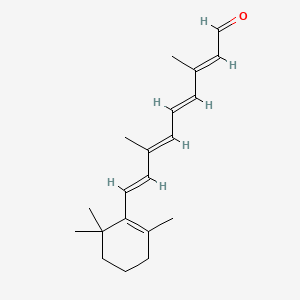
Identifiers
Functions
Hazards


Where is retinal used, and what role does it play in each application?
Retinal is used primarily in cosmetics as a skin-conditioning agent and anti-aging active, and it functions biologically as the active component of the visual cycle. In cosmetics, it appears in face creams, eye creams, serums, masks, and even makeup products, where it is positioned as a retinoic acid precursor for skin rejuvenation. Its role is to deliver retinoid activity, often encapsulated in lipid nanoparticles to improve stability and skin delivery. It is also a human metabolite of retinol, with known metabolites including tretinoin, supporting its role in retinoid pathways.
Which product or formulation problem does retinal address?
Retinal addresses the formulation problem of delivering retinoid benefits—such as skin rejuvenation and anti-aging effects—while potentially improving stability and skin delivery through encapsulation. In commercial products, it is used to target wrinkles, loss of firmness, and uneven skin texture, as seen in products named for wrinkle plumping and illuminating effects. It also solves the challenge of incorporating a retinoic acid precursor into diverse vehicles, including creams, serums, and sunscreens, by being compatible with lipid nanoparticle systems that enhance its delivery.
What supports the main commercial or clinical uses of retinal?
The main uses of retinal are supported by its established biological role as a vitamin A derivative and active component of the visual cycle, its presence as a human metabolite of retinol, and its commercial adoption in over 80 products across 27 brands. Patent applications describe retinal as a retinoic acid precursor for skin rejuvenation, with formulations using lipid nanoparticles to improve stability and delivery. However, no clinical trial data or regulatory approvals for specific efficacy claims are provided in the evidence.
Which formulation trade-offs should researchers consider for retinal?
Researchers should consider retinal's trade-off between efficacy and stability: it is a reactive aldehyde that may require encapsulation to prevent degradation and improve skin delivery, as shown in lipid nanoparticle patents. Concentration ranges in patents vary from 0.01% to 5%, with lower ranges (0.01–0.5%) used in combination with peptides and growth factors, suggesting that higher concentrations may increase irritation risk. Co-ingredients like antioxidants (tocopherol) and stabilizers (cholesterol, lecithin) are commonly used, but no safety or irritation data are available to guide maximum use levels.
What are the physicochemical properties of Retinal?
| Property | Value | Category |
|---|---|---|
| Physical Description | Solid | Appearance |
| Melting Point | 63 °C | Handling Relevant Properties |
| Collision Cross Section | 170.1 Ų [M+H]+ [CCS Type: DT; Method: single field calibrated with Agilent tune mix (Agilent)], 165.39 Ų [M+H-H2O]+ [CCS Type: TW; Method: calibrated with polyalanine and drug standards], 172.42 Ų [M+H]+ [CCS Type: TW; Method: calibrated with polyalanine and drug standards] | Analytical Properties |
| Standard non-polar | 2466 | Analytical Properties |
| XLogP3 | 6.2 | Computed Molecular Properties |
| Exact Mass | 284.214015512 | Computed Molecular Properties |
| Monoisotopic Mass | 284.214015512 | Computed Molecular Properties |
| Topological Polar Surface Area | 17.1 | Computed Molecular Properties |
| Complexity | 522.0 | Computed Molecular Properties |
| Hydrogen Bond Donor Count | 0 | Computed Molecular Properties |
Which formulation benchmark best contextualizes retinal, and what differs?
A relevant formulation benchmark is the lipid nanoparticle (LNP) system described in a patent for retinal, which uses lecithin, cholesterol, and lauric acid to encapsulate retinal at 0.5–5% for improved stability and skin delivery. This differs from simpler emulsion-based products that may not provide the same protection against degradation. Another benchmark is the use of retinal at 0.01–0.5% in combination with peptides and growth factors, indicating a trend toward lower concentrations for enhanced tolerability. These approaches highlight the importance of delivery systems in retinal formulation.