PET hydrolase mutant publications increased from 14 in 2023–2024 to 64 in 2025–2026, while modified PETase publications rose from 8 to 30. The race is moving beyond finding enzymes that degrade plastic toward making them stable, fast, and compatible with industrial processing.
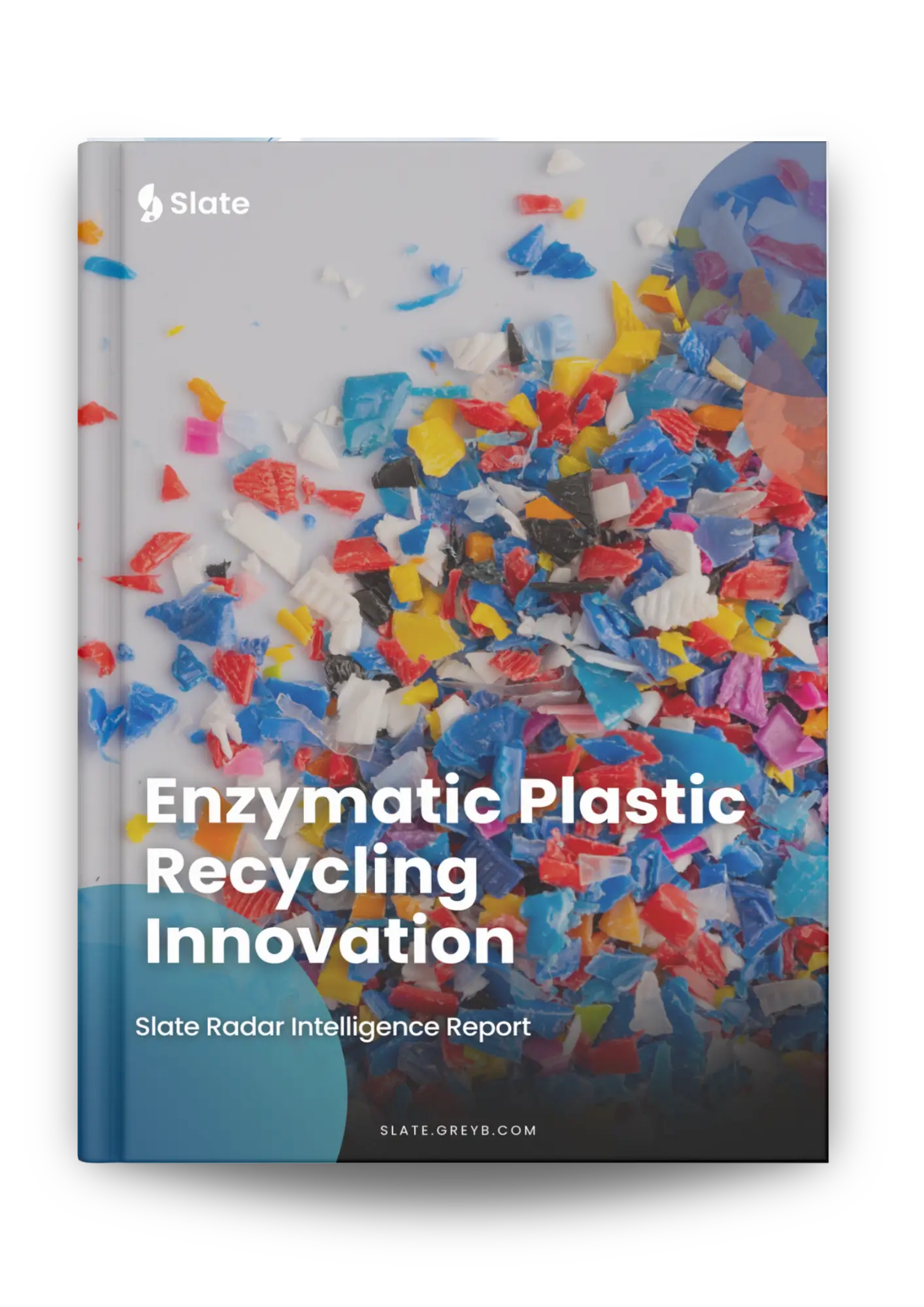
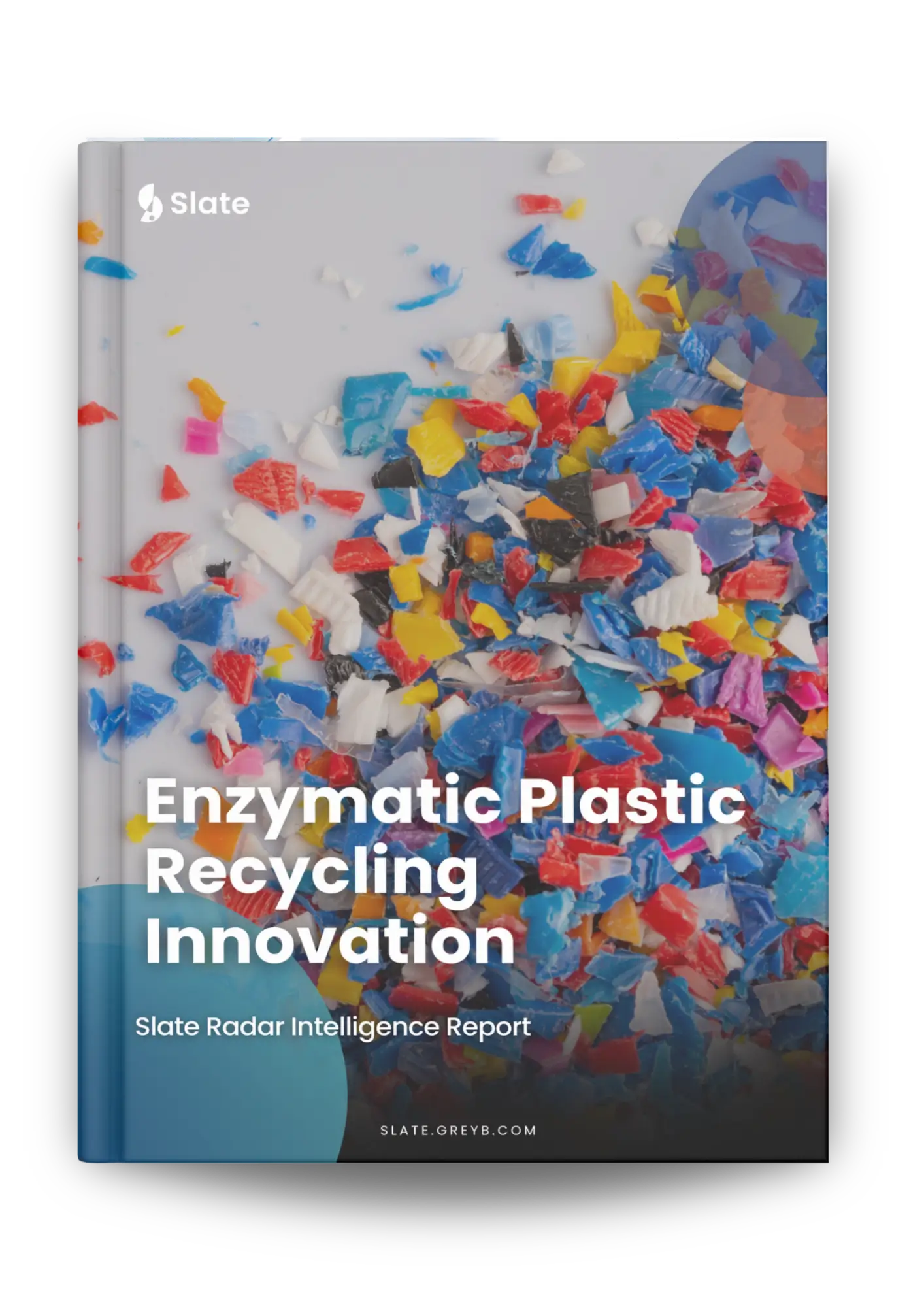
We analyzed 423 innovation records across 18 research clusters to identify where enzymatic recycling is becoming crowded, which companies and institutions are building strong positions, and where significant R&D gaps remain.
What’s Driving Change in Enzymatic Plastic Recycling?
Industrial requirements are changing what counts as a useful plastic-degrading enzyme.
- Enzyme stability is replacing enzyme discovery as a key technical hurdle. R&D is concentrating on catalysts that can maintain activity under acidic, alkaline, high-temperature, and continuous-processing conditions.
- Non-PET plastics are forcing hybrid recycling approaches. Polyamides and polyolefins increasingly need thermal or mechanical pretreatment before enzymes can efficiently reach resistant polymer bonds.
- Different end-of-life models are emerging. Industrial monomer recovery is developing alongside programmed degradation, where biological agents are embedded directly into selected materials.
What’s Inside the Report?
Is the window for foundational PET enzyme IP closing?
See where rapid growth in hydrolase mutants and sequence-engineered PETases is creating increasingly dense technical positions.
Which enzyme properties are becoming essential for industrial scale?
Track R&D around pH stability, thermostability, salt tolerance, immobilization, and process-compatible enzyme variants.
Why are polyamides and polyolefins still difficult to process enzymatically?
Understand how pyrolysis, amorphization, foaming, oxidation, and other pretreatments are being combined with biological degradation.
Where are the biggest competitive gaps outside PET?
Compare activity in polyurethane, nylon, polyethylene, polypropylene, rubber, and biopolymer recycling and identify areas where established enzymatic recycling players remain less active.
Which organizations are building concentrated technical positions?
Follow activity from Samsara Eco, Carbios, Kimberly-Clark, Nanjing Tech University, the Chinese Academy of Sciences, Covestro, Repla, VTT, and other emerging participants.
The 18 Research Clusters We Analyzed
- Engineered PET hydrolase mutants via site-directed amino acid sequence substitution (78 innovations)
- Enzymatic depolymerization of polyethylene terephthalate via hydrolase and cutinase catalysis (54 innovations)
- Polyethylene terephthalate hydrolases via bacterial, metagenomic, and mutant enzyme sequences (42 innovations)
- Modified PETase esterase polypeptides via sequence identity and variant engineering (38 innovations)
- Plastic-degrading microorganism strains via Bacillus, Pseudomonas, and Rhodococcus species isolation (33 innovations)
- Enzymatic biodegradation, oxidation, and depolymerization of polyolefin-derived polymers and plastics (27 innovations)
- Polyester and polyamide depolymerization via biological enzymes, foaming, and thermal processing (24 innovations)
- Polyurethane degradation via urethanase, hydrolase, and carbamate enzyme mutant proteins (22 innovations)
- Enzymatic polymer degradation via embedded biological entities and hydrolytic catalysts (21 innovations)
- Plastic depolymerase enzymes via heat-resistant, alkaline-resistant, and broad-spectrum protein variants (15 innovations)
- Engineered enzyme complexes via fusion proteins, scaffolding, and encapsulated extracts (14 innovations)
- Polyhydroxyalkanoate depolymerization via PHADase enzymes for post-consumer biopolymer recycling (13 innovations)
- Esterase and lipolytic enzyme variants for acidic polyester and PET degradation (13 innovations)
- Polyamide depolymerization via multi-stage degradation, ammonolysis, and monomer recovery processes (9 innovations)
- Engineered polypeptides for amide bond hydrolysis in polyamide nylon polymers (6 innovations)
- In vitro enzymatic conversion of thermoplastic polymers into bioplastic polymers (5 innovations)
- Rubber material degradation via metabolite compositions and biodegradable byproduct production (5 innovations)
- Enzymatic depolymerization of polyester plastics via acidic condition process control (4 innovations)
Key Trends You Can’t Ignore
PET enzyme IP is becoming crowded quickly.
Site-directed PET hydrolase publications increased more than fourfold between the 2023–2024 and 2025–2026 periods, raising the importance of differentiated sequences and freedom-to-operate strategies.
Industrial stability is becoming the new performance benchmark.
Nanjing Tech University and the Chinese Academy of Sciences are among the organizations concentrating on pH-stable, salt-tolerant, and thermally robust enzymes.
Non-PET recycling remains a different technical problem.
Polyamides and polyolefins increasingly depend on hybrid thermo-enzymatic processes, making pretreatment technology as important as enzyme performance.
Polyolefins remain an important R&D gap.
Carbios, Samsara Eco, and Nanjing Tech University are absent from the report’s polyolefin biodegradation cluster, where smaller specialists are pursuing oxidative enzyme pathways.
Programmed degradation is creating a second recycling model.
Carbiolice and Carbios are developing approaches that integrate biological agents into materials themselves, with publication activity in this direction accelerating 220%.
Multi-enzyme systems are gaining momentum.
Activity in fusion proteins, immobilized enzymes, microbial consortia, and other engineered complexes increased 267% over the 2024 baseline, pointing toward more integrated catalyst systems.
Download the full Enzymatic Plastic Recycling Innovation Landscape
Get detailed access to the complete 18-cluster analysis, company and institution activity, representative innovations, emerging IP concentrations, market context, and strategic implications across PET, polyurethanes, polyamides, polyolefins, biopolymers, and other difficult-to-recycle materials.