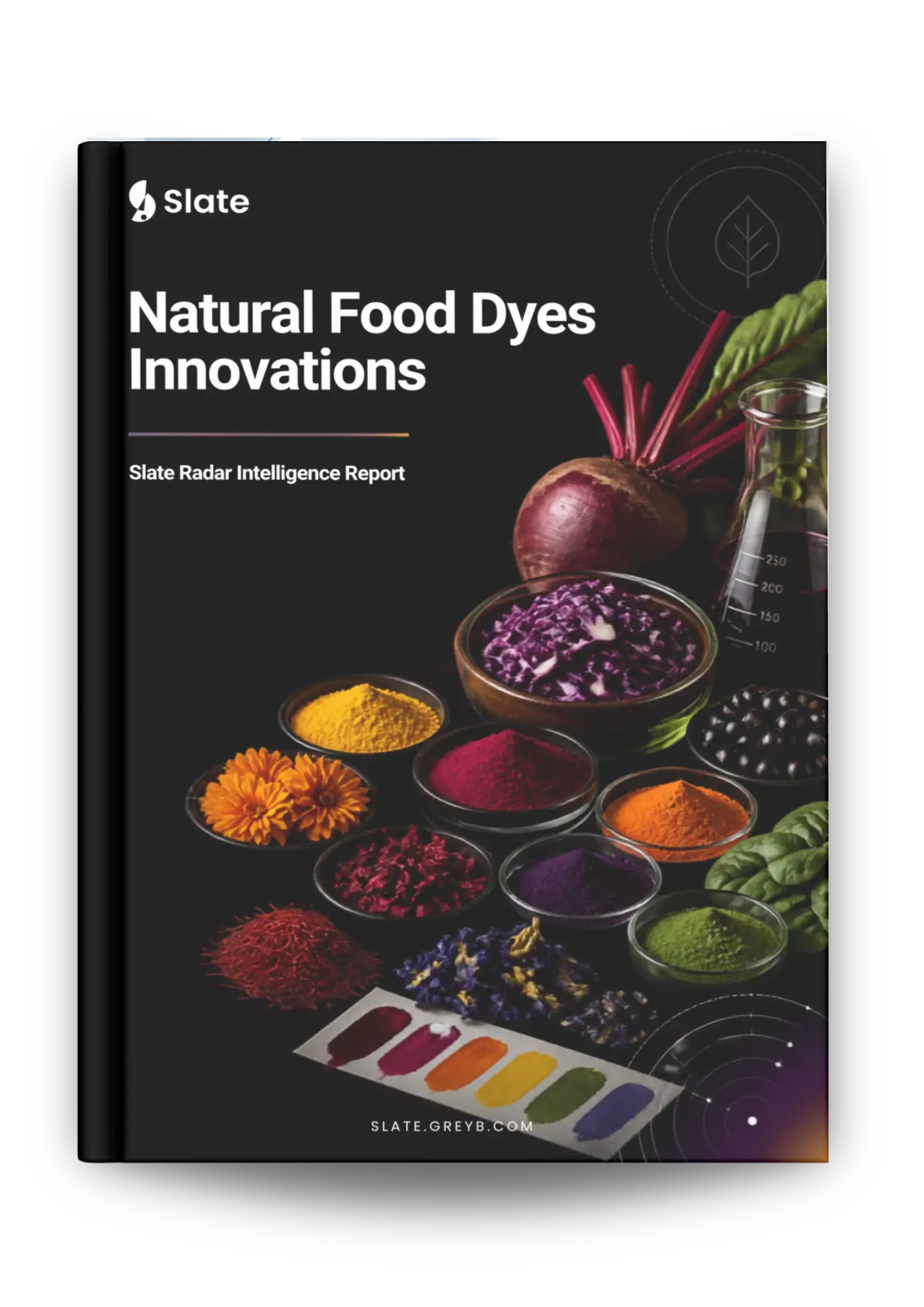
Natural food colors are entering a new phase of competition. The biggest innovations are no longer centered on discovering new botanical sources; they’re focused on making natural pigments behave like synthetic ones. Across stabilization chemistry, encapsulation, microbial production, and molecular engineering, companies are solving the technical limitations that have prevented natural dyes from replacing artificial colors at scale.
The innovation landscape shows how deliberate this transition has become. Companies are investing in technologies that improve heat resistance, pH stability, oxidation tolerance, processing durability, and controlled color release.
We analyzed 300+ innovations across 19 technology clusters to identify where the industry is concentrating R&D investment, which technical challenges are being solved first, and where competitors still have opportunities to build differentiated IP.
Four Signals from Natural Food Dyes Innovation Stand Out
Stabilization technologies are replacing extraction as the industry’s primary innovation focus.
The largest concentration of innovation is no longer directed toward identifying new pigment sources. Instead, researchers are engineering antioxidant systems, colloidal structures, protein cages, and encapsulation platforms that protect existing pigments from degradation.
Encapsulation is becoming the industry’s performance platform.
Recent innovations show growing investment in multilayer encapsulation, core-shell particles, emulsions, and controlled-release systems that improve thermal stability, light resistance, and shelf life.
Microbial production is changing how natural pigments will be sourced.
Several innovations focus on microbial biosynthesis, fermentation platforms, and precision agriculture to reduce dependence on seasonal crop production. Companies are beginning to manufacture them using scalable biological production systems that improve consistency and reduce supply-chain volatility.
Molecular engineering is redefining what qualifies as a “natural” color.
Acylation, enzymatic modification, and molecular tailoring are producing pigments with significantly better stability while remaining compatible with clean-label expectations. These approaches blur the traditional distinction between naturally extracted colors and engineered natural ingredients, creating new regulatory and commercial questions for ingredient suppliers.
What’s Inside the Report?
Why stabilization chemistry is becoming the industry’s biggest competitive moat
Discover how antioxidant systems, protein cages, hydrophilic colloids, and encapsulation technologies are outperforming traditional pigment extraction as the primary focus of innovation.
Which companies are shaping the future of natural color technology
Analyze innovation activity across companies including Givaudan, Oterra, Cargill, Chenguang Biotech, Döhler, Sensient, and emerging biotechnology firms to understand where competitive leadership is developing.
How microbial production could reshape pigment supply chains
Explore how fermentation platforms, engineered microorganisms, and precision agronomy may reduce dependence on crop variability while improving manufacturing scalability.
Why molecular engineering is becoming a regulatory challenge
Assess how enzymatic modification and pigment tailoring improve functionality while raising new questions around clean-label positioning and future regulatory interpretation.
Where the industry’s white spaces still exist
Identify technology gaps across thermal stability, oxidation resistance, high-acid beverage applications, and next-generation delivery systems that remain underexplored within current innovation activity.
Patent and innovation intelligence across every research cluster
Review detailed innovation analysis, technology mechanisms, representative patents, publication trends, and commercial implications across all major research areas.
Major Emerging Clusters
Natural food dye innovation is increasingly concentrating around four strategic technology platforms.
Performance Stabilization: Antioxidant systems, protein cages, hydrophilic colloids, and interfacial engineering that dramatically improve pigment durability.
Advanced Encapsulation: Core-shell particles, multilayer microcapsules, emulsions, and controlled-release delivery systems designed for commercial food processing.
Next-Generation Production: Fermentation, microbial biosynthesis, precision agriculture, and alternative manufacturing routes that improve consistency and supply resilience.
Molecular Pigment Engineering: Acylation, enzymatic modification, and molecular tailoring that extend stability while maintaining clean-label positioning.
Key Strategic Questions Answered
- Is competitive advantage shifting away from botanical sourcing toward proprietary stabilization technologies?
- Will encapsulation platforms become the defining intellectual property layer for future natural color ingredients?
- Can microbial pigment production reduce agricultural risk while improving manufacturing economics?
- How will molecularly engineered natural pigments influence future clean-label regulations?
- Which technology areas remain relatively uncontested, creating opportunities for ingredient companies to establish differentiated IP before the next wave of commercialization?
Download the Full Innovation Landscape Report
Access the complete Natural Food Dye Innovation Landscape Report to explore all 19 research clusters, detailed innovation analysis, company benchmarking, technology maturity assessment, representative patents, publication trends, and strategic opportunities shaping the future of natural food colors.