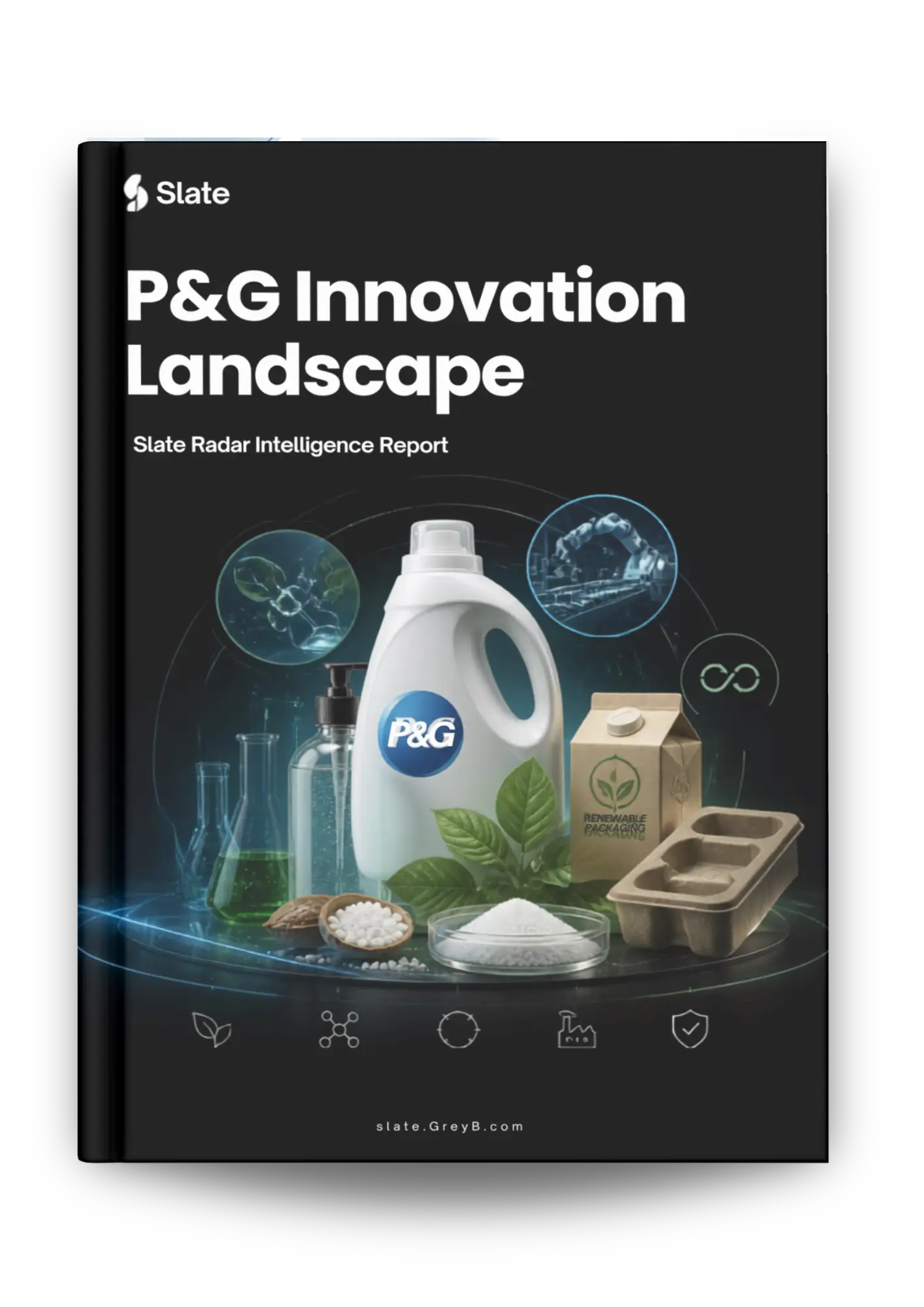
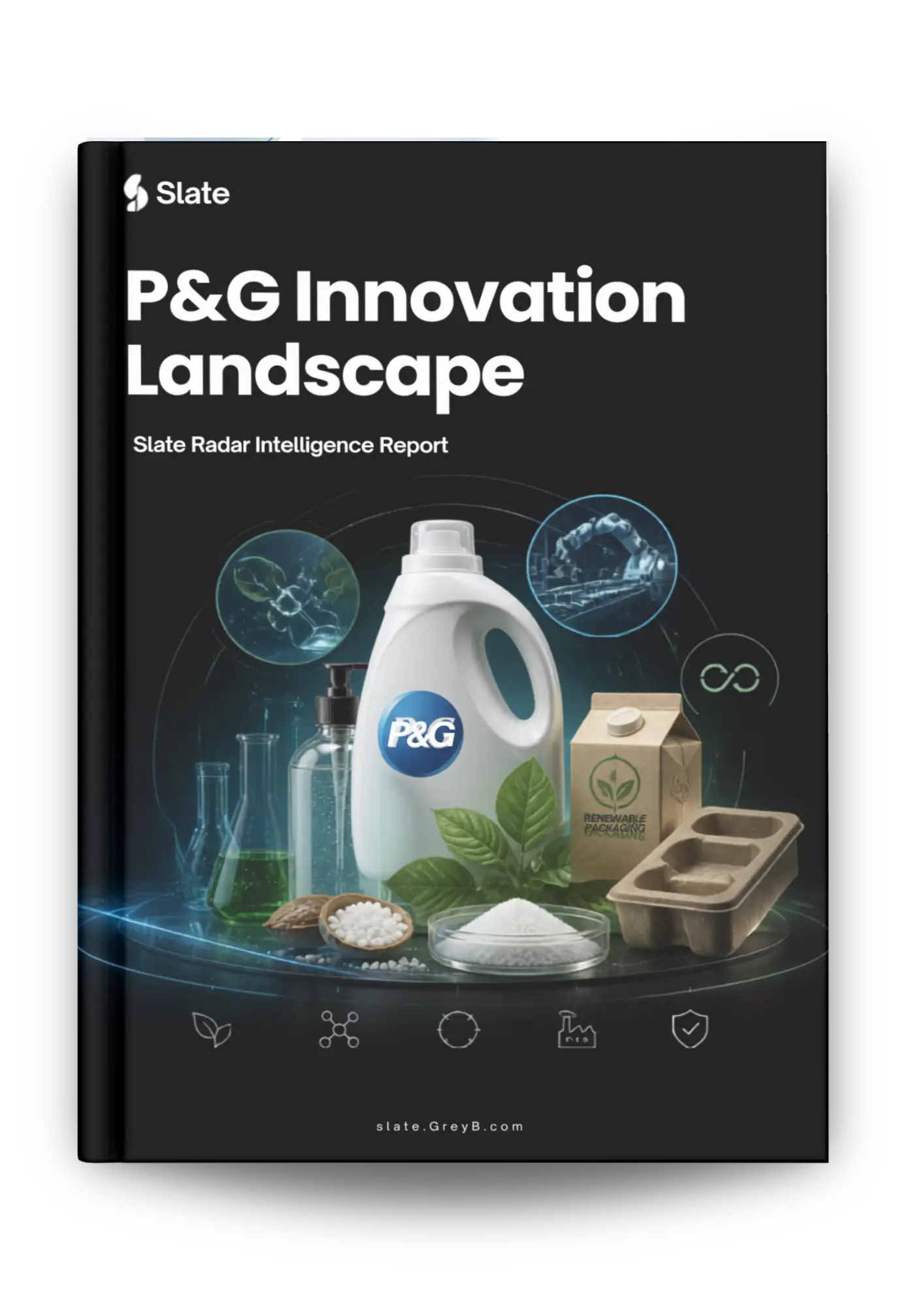
Publications in P&G’s core/shell delivery cluster rose 98% from 2024, while modular personal care device activity increased 173%. The larger signal is easy to miss: P&G is not treating sustainability as a packaging project.
This report maps 2,817 innovations across 27 R&D clusters to show how formulation of IP, solid-state formats, smart hardware, and material recovery are changing the cost of competing.
Key Signals from P&G Innovation that Stand Out
P&G is responding to regulatory pressure, margin demands, and changing consumer expectations at the same time. Its answer is to make product performance harder to separate from the chemistry, device, and manufacturing system behind it.
- Shipping water is becoming a structural disadvantage: Solid sheets, particles, and unit-dose formats can reduce transport weight and plastic use, while competitors without rapid-dissolution IP remain tied to liquid-heavy supply chains.
- Sustainable claims now depend on technical performance: Bio-derived surfactants and polymers must match traditional chemistry in hard water, cold cycles, storage, and controlled release. This raises the barrier for low-cost clean-label products.
- Hardware is becoming the gateway to recurring revenue: Wear sensing, imaging, diagnostics, and smart dispensing can connect consumers to proprietary replacement heads, cartridges, refills, and personalized recommendations.
What’s Inside the Report?
- Why Is P&G Moving Product Value Out of the Bottle? See how porous dissolvable sheets, concentrated particles, and water-soluble carriers could reduce logistics exposure without giving up liquid-like performance.
- When Does a Grooming Tool Become a Data Platform? Understand how Braun and Gillette are using sensors, wear detection, modular connectors, and machine learning to protect replacement cycles.
- Can Sustainable Chemistry Defend Premium Pricing? Examine how glucan derivatives, graft copolymers, chitosan shells, esterquats, and renewable surfactants maintain efficacy while meeting new material expectations.
- Which R&D Areas Are Receiving the Most Attention? Compare 27 clusters spanning dispensing systems, cleansing chemistry, absorbent products, laundry platforms, oral care, digital diagnostics, and circular materials.
- How Is P&G Reducing Dependence on Virgin Inputs? Explore solvent extraction, hydrothermal treatment, recycled polyolefins, non-wood fibers, and manufacturing methods designed to protect material quality.
- Where Could the Strategy Break Down? Assess the risks linked to retailer adoption, consumer education, health-data scrutiny, higher feedstock costs, specialized equipment, and capital-intensive recycling systems.
The 27 R&D Clusters Behind the Strategy
The report maps P&G’s innovation across 27 technology clusters shaping its future product and R&D strategy.
- Flexible, fiber, and polymeric dispensing containers (295 innovations)
- Surfactant systems for hair, scalp, and personal cleansing (215 innovations)
- Absorbent article architecture and fluid-management cores (213 innovations)
- Modular personal care devices with detachable heads and handles (205 innovations)
- Absorbent chassis, elastic belts, and garment-like structures (173 innovations)
- Shaving cartridges, blade coatings, and handle integration (148 innovations)
- Core/shell delivery particles and water-soluble carriers (143 innovations)
- Graft copolymer, surfactant, and enzyme systems for laundry (139 innovations)
- Stabilized stannous-ion oral care compositions (138 innovations)
- Spray-dried and free-flowing particulate laundry detergents (107 innovations)
- Additional 17 clusters covering unit-dose films, smart volatile dispensers, digital skin imaging, auto-dosing dishwashing, tissue structuring, laser marking, deodorants, tampon applicators, recycled polymers, and hotmelt adhesives (1,041 innovations)
Key Trends You Can’t Ignore
Solid-State Delivery Is Becoming a Logistics Strategy: P&G’s core/shell delivery publications rose from 48 to 95, a 98% increase. Multilayer sheets with 80–100% open-cell content can carry concentrated actives while dissolving quickly.
Smart Hardware Is Turning Consumables Into Closed Ecosystems: Publication activity in modular personal care devices increased 173%, while digital imaging and pixel-analysis activity rose 86%. Sensors can detect blade wear, handling pressure, device orientation, and user conditions.
Sustainability Is Moving Inside the Formula: P&G is using bio-derived glucans, graft copolymers, chitosan shells, biodegradable esterquats, and renewable surfactants to protect performance. This makes environmental compliance harder to copy because the advantage sits in precise molecular combinations, not a visible package claim.
Upstream Circularity Is Becoming Supply Security: Solvent extraction and hydrothermal processes aim to recover high-purity polyethylene and polypropylene from difficult waste streams. Similar work in tissue uses non-wood fibers and engineered web structures to retain softness and strength.
Premium Positioning Is Shifting From Products to Systems: Across dispensing, laundry, grooming, oral care, and hygiene, P&G is linking chemistry to proprietary hardware and manufacturing processes. This can make third-party refills, compatible parts, and generic formulations less effective.
Download the Full Innovation Landscape Report
Access the complete 27-cluster analysis, representative innovations, publication shifts, market context, second- and third-order consequences, and links to detailed technology and patent reports.