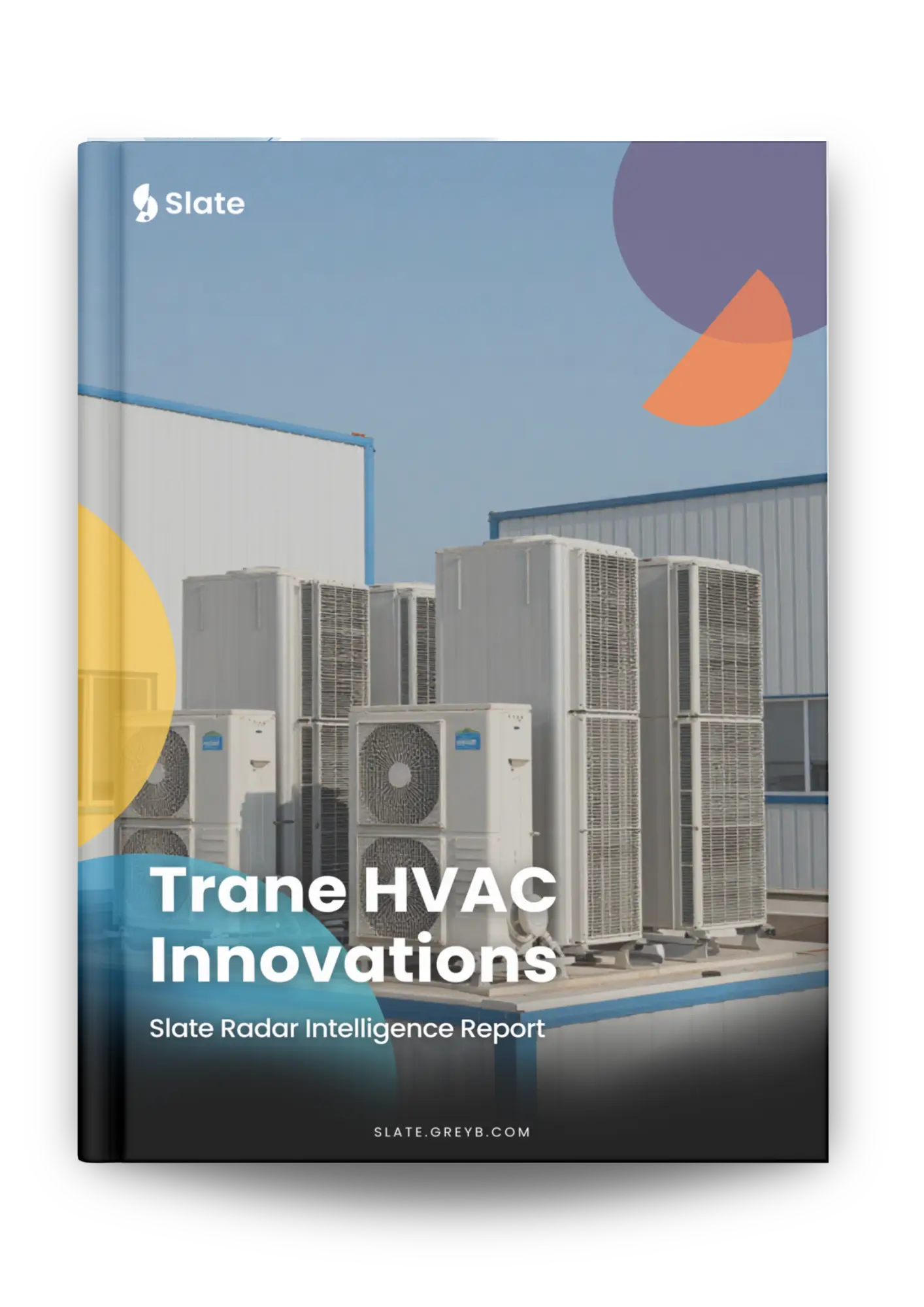
Trane’s 2024–2026 patent activity is not just about better compressors or lower-GWP refrigerants. Across 322 innovations, the stronger signal is a shift toward software-governed, multi-stage HVAC architectures where performance, safety, servicing, and grid response are managed as one system.
The tension is clear: the industry is still reading the low-GWP transition as a refrigerant substitution problem, while Trane appears to be rebuilding the entire HVACR stack around control logic, power electronics, multi-loop thermal routing, and service dependency.
We analyzed Trane’s innovations to show where the company is creating technical lock-in, which suppliers may be displaced, and which HVAC capabilities now deserve separate tracking.
Signals from Trane’s Filings Stand Out
Multi-stage architecture is becoming the real platform layer
Trane’s largest cluster contains 48 innovations around multi-stage compression, heat exchange, hydronic routing, autocascade liquid-vapor separators, wet-injection bypass lines, and concentration-based superheat control.
Power electronics are being folded into thermal performance
The 14-innovation VFD cluster shows Trane using DC link voltage control, phase-shifting transformers, leakage-current reduction, GFCI compatibility, and harmonic heat shunting into the refrigerant or water circuit.
Refrigerant safety is being attacked from two sides
Trane is filing on low-GWP refrigerant blends using R32, CF3I, R1225ye(E), R227ea, and R125 while also redesigning housings with compartmentalized compressor chambers, ventilation valves, leak sensors, and vacuum-assisted recovery carts.
HVAC units are becoming grid-aware assets
Trane’s building automation filings cover stepped demand response, firmware management, cybersecurity scanning, occupancy-based load shedding, and microgrid operation. That changes the unit’s role from comfort equipment to an energy-management node, with direct consequences for utility relationships, building contracts, and service ownership.
What’s Inside The Report?
Where is Trane building its low-GWP moat?
A breakdown of how multi-stage refrigerant circuits, low-GWP blends, leak mitigation, and recovery systems work together instead of competing as separate strategies.
Which HVAC components are becoming harder to substitute?
A cluster-level view of compressors, valves, VFDs, heat exchangers, air handlers, sensors, bearings, and refrigerant circuits where proprietary geometry or control logic raises the replacement barrier.
How is Trane turning HVAC controls into a service-lock layer?
Analysis of sensor fusion, remote diagnostics, Bluetooth technician access, firmware updates, demand response, and model-based control systems that tie performance to Trane’s software stack.
Where are passive and hybrid cooling systems entering the portfolio?
A look at radiative films, thermosiphon cooling, heat pipes, metal-organic frameworks, and modular cold-chain systems that move beyond conventional vapor compression.
Which suppliers should track Trane’s architecture shifts now?
A practical readout for refrigerant suppliers, compressor manufacturers, VFD providers, controls vendors, sensor companies, service-tool makers, and building automation firms.
The 20 Major Patent Clusters We Analyzed
The report maps Trane’s 322 innovations into 20 clusters, showing where the company is deepening existing HVAC strengths and where it is building categorically different capabilities.
- HVACR Refrigerant Circuit Control via Multi-Stage Compression, Heat Exchange & Hydronic Routing (48 patents)
- Heat Pump Thermal Exchange via Multistage Cascade, Stirling & Reversible Circuits (31 patents)
- HVAC System Control via Sensor Fusion, Remote Diagnostics & Mode Switching (28 patents)
- HVACR Air Handler Assembly via Fan Housing, Cabinet & Mounting Body (26 patents)
- HVACR Refrigerant Circuit Control via VFD, Multi-Stage Compression & Thermal Feedback (20 patents)
- Compressor Shaft Support via Gas, Magnetic, Foil & Lubricant Bearings (18 patents)
- Vapor Compression via Scroll, Screw & Centrifugal Intermediate Injection Mechanisms (17 patents)
- Air Handling via Desiccant Drums, Heat Exchangers & Chilled Water Circuits (16 patents)
- Radiative & Thermosiphon Cooling via Radiation Films, Heat Pipes & Chambers (16 patents)
- Shell and Tube Heat Exchange via Microchannel, Fin & Bundle (15 patents)
- Fluid Flow Control via Reversing Valves, Throttling Devices & Connectors (15 patents)
- Variable Frequency Motor Drive via DC Bus Voltage & Harmonic Control (14 patents)
- Building Automation Control via Network Security, Firmware Management & Demand Response (12 patents)
- Compressor Fluid Management via Oil Separation, Phase Distribution & Cavity Routing (11 patents)
- Refrigerant Leak Mitigation via Compartmentalized Housing, Ventilation & Sensor Monitoring (9 patents)
- Acoustic Damping via Metamaterial Stacks, Nested Jackets & Vibration Insulation Devices (6 patents)
- Low GWP Refrigerant Blends via R32, CF3I & R1225ye(E) Compositions (6 patents)
- Climate Control Fluid & Air Management via Tubing, Pumps & Dampers (6 patents)
- Refrigerant Circuit Management via Vacuum Pump Suction, Discharge & Lubricant Separation (5 patents)
- Airflow Management via Fan Assemblies, Inlet Filters & Outlet Panels (3 patents)
Key Strategic Questions Answered
- Which Trane HVAC clusters are most likely to become platform-level moats rather than individual product improvements?
- Where is Trane replacing mechanical overdesign with real-time control logic, sensor fusion, and firmware-managed performance?
- Which compressor, valve, VFD, refrigerant, and heat exchanger suppliers face the highest risk of being designed out of future systems?
- How does Trane’s A2L strategy split between chemical suppression, mechanical isolation, leak detection, and service recovery tools?
- Where could Trane’s architecture increase lifecycle switching costs for commercial building owners and industrial heat pump customers?
- Which patent clusters indicate movement toward performance-as-a-service, grid participation, or closed-loop maintenance contracts?
- Which emerging areas should competitive intelligence teams track before they show up as commercial product launches?
Download the Full Report
Download the full Trane Innovation Landscape Report to access the complete 2024–2026 analysis of 322 innovations across 20 major clusters and 4 emerging signals. Inside, you get the cluster map, representative innovations, strategic implications, second- and third-order consequences, and supplier-level risk signals across refrigerant circuits, heat pumps, VFDs, controls, refrigerants, and building automation.