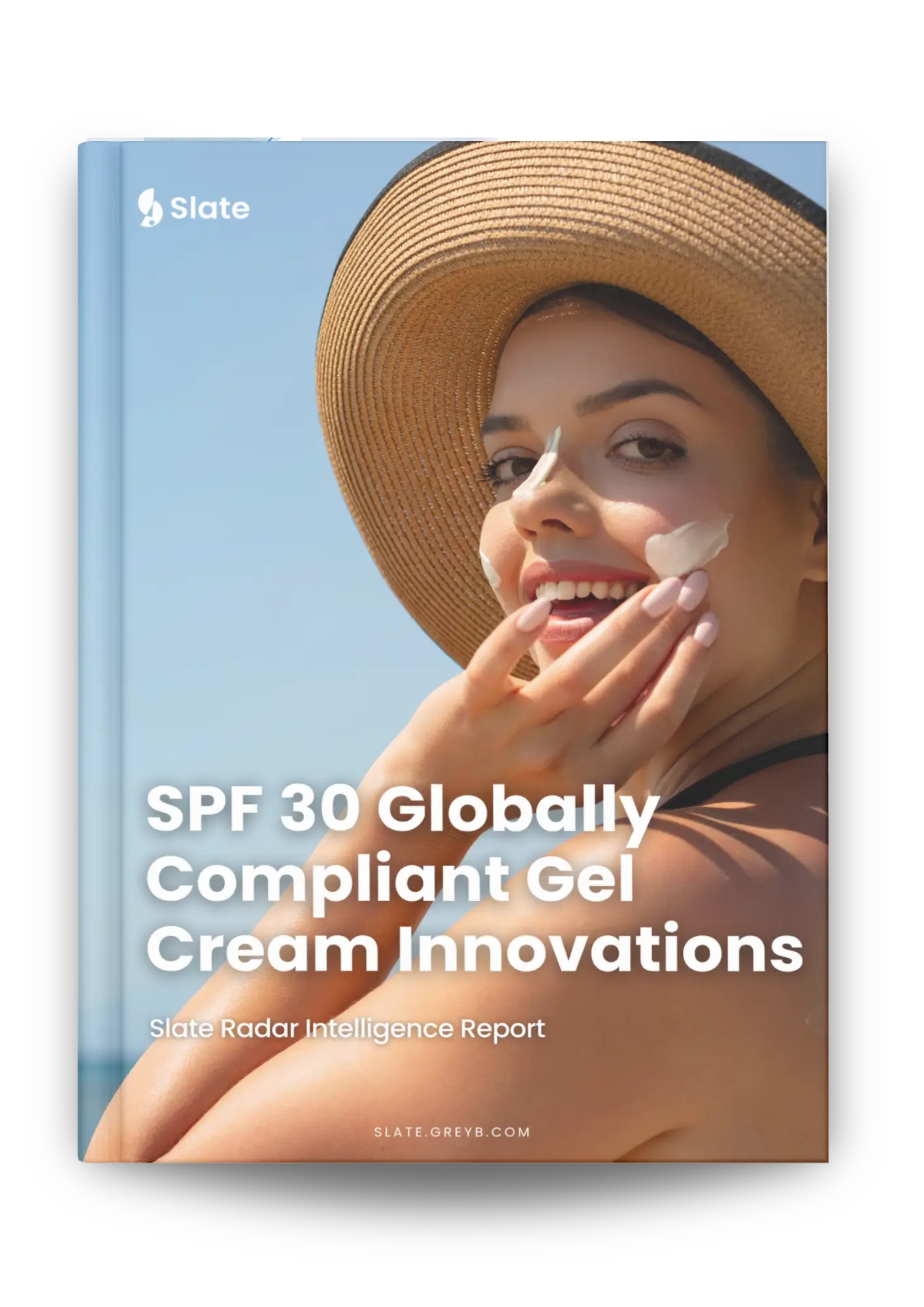
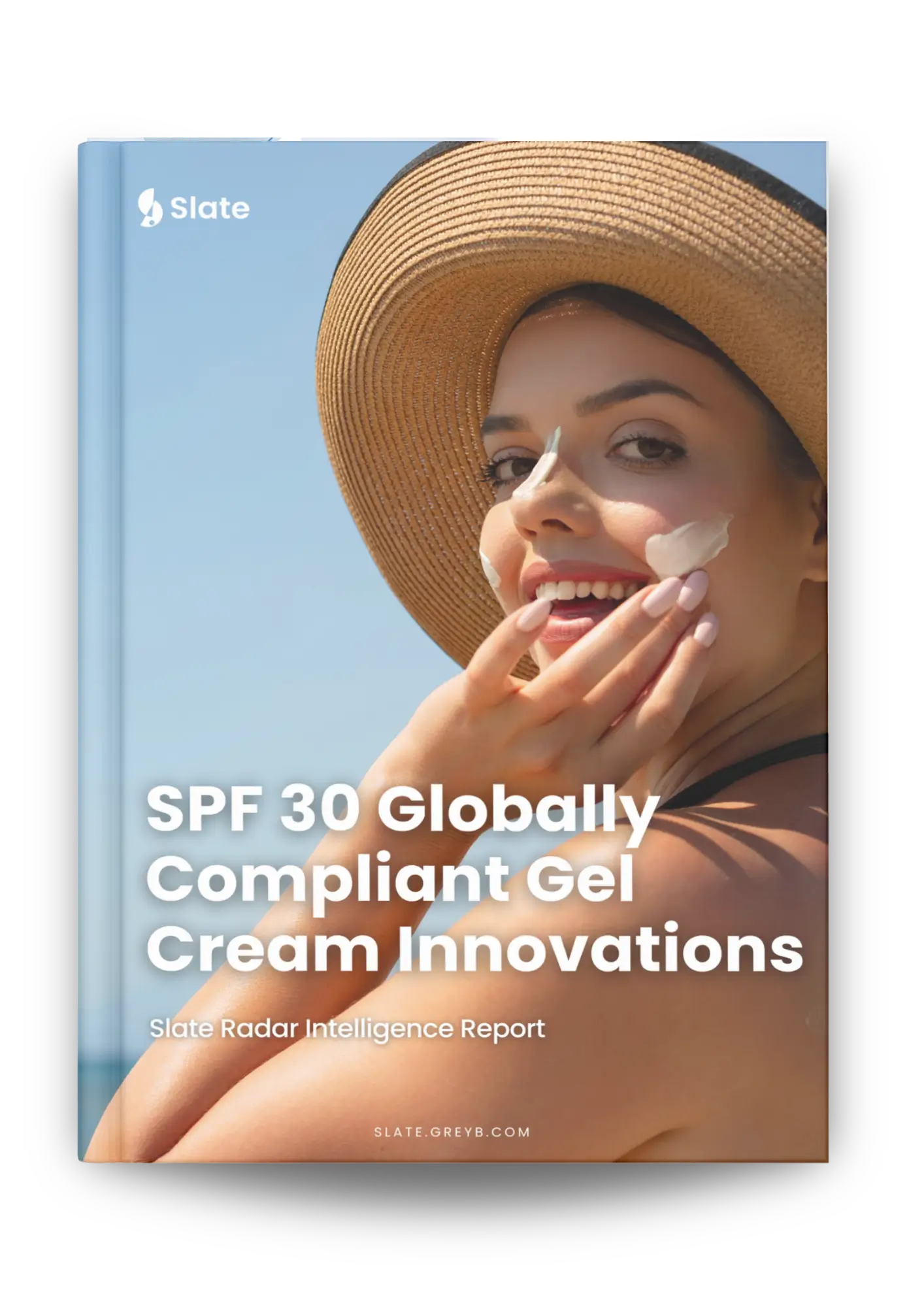
EMT-related innovation rose from 11 publications in 2023–2024 to 55 in 2025–2026. This sharp increase signals a wider move toward UV-filter systems designed for globally compliant sunscreen formulations.
But selecting an effective UV filter is no longer the hardest part. Formulators must keep high filter loads stable, transparent, and non-greasy without causing crystallization, white cast, or heavy textures. The competitive advantage is shifting toward the polymers, gelators, emulsion structures, and particle-engineering methods that make high-SPF protection feel like premium daily skincare.
We analyzed 1,471 innovations across 23 research clusters to identify where this new formulation advantage is forming.
Key Signals Shaping Global Sun Care Formulation
Regulatory alignment, premium sensory expectations, and environmental pressure are changing which technologies create defensible SPF 30 gel-creams.
- Global-first formulas are replacing regional portfolios: BEMT-centered systems can reduce formulation duplication, but they make polymer compatibility and supply security more strategically important.
- The sensory barrier has moved into the oil-polymer interface: Companies that cannot suspend high UV-filter loads without greasiness, whitening, or instability will struggle to compete in daily-wear formats.
- Alternative architectures are becoming commercially relevant: Biopolymer hydrogels, Pickering emulsions, and anti-aggregation mineral systems offer routes around crowded conventional stabilization IP.
What’s Inside the Report?
- Is BEMT becoming the default architecture for global SPF 30? See why publication activity is concentrating around photostable triazines and which stabilization technologies are becoming essential to make them usable in gel-creams.
- Where is the most direct development route already crowded? Map L’Oréal’s concentration across organic and inorganic photoprotection clusters and identify alternative formulation paths with lower IP density.
- Can natural polymers weaken the silicone advantage? Examine lignin, melanin, cellulose nanofibers, marine polysaccharides, and hybrid film-formers that combine structural stability with UV support.
- Is the mineral-white-cast trade-off finally being removed? Review anti-aggregation oils, surface treatments, micronization, and particle scaffolds designed to make TiO₂ and ZnO compatible with transparent formats.
- Which suppliers gain power as stabilization becomes the bottleneck? Understand why pre-stabilized dispersions, specialized gelators, modified polymers, and high-precision particle processing may capture more value than standalone filters.
- Where are incumbents absent despite rising activity? Identify underdeveloped clusters where smaller ingredient companies, material specialists, and Asian formulators could establish an early position.
The 23 Research Clusters We Analyzed
The landscape spans established emulsion routes, emerging bio-based structures, advanced particle systems, and multifunctional product formats.
- Oil-in-water sunscreen compositions using UV filters and emulsifiers (361 innovations)
- Natural polymer and nanocomposite hydrogel formulations for UV protection (69 innovations)
- Bemotrizinol and organic UV-filter systems for keratinous materials (66 innovations)
- Core-shell microcapsules and nanoparticles using polymeric, starch, and silica matrices (66 innovations)
- Sunscreen stabilization using oil-phase thickeners and gelling agents (62 innovations)
- BEMT, DHHB, and inorganic UV-filter systems for topical sunscreens (59 innovations)
- Physical UV-attenuating systems using solid inorganic metal oxides (44 innovations)
- Glycerin-modified organosilicon elastomer gels using oil or emulsion swelling (27 innovations)
- Pickering emulsions using hydrophobized powders, metal oxides, and cellulose nanofibers (16 innovations)
- Oil-in-water and water-in-oil emulsions using UV absorbers and scattering agents (194 innovations)
- Aqueous and oil-in-water photoprotection using organic UV-screening agents (80 innovations)
- Inorganic powder dispersions using oil-in-water and water-in-oil emulsion systems (44 innovations)
- Metal oxide and silica particle integration for UV-filter boosting (34 innovations)
- UV-absorbing cosmetic compositions using inorganic filters and organic active agents (33 innovations)
- Silicone elastomer gel blends for organic sunscreen formulations (29 innovations)
- Lignin and melanin sunscreen materials using encapsulation, modification, and self-assembly (27 innovations)
- Film-forming compositions combining silicones, polymers, and UV blockers (16 innovations)
- Dual-function sunscreens combining insect-repellent and cooling agents (124 innovations)
- Oil-in-water and water-in-oil emulsion systems for sunscreen cosmetics (48 innovations)
- Oil-in-water and water-in-oil emulsion systems using UV-filter integration (25 innovations)
- Water-in-oil emulsions using an oily continuous phase for keratinous materials (20 innovations)
- UV-filter compositions using fatty-acid dextrin esters and C15-C19 alkanes (19 innovations)
- Micronized UV-filter oil-in-water emulsions using panthenol and hydroxyacetophenone (8 innovations)
Key Trends You Can’t Ignore
BEMT is standardizing the filter. The vehicle becomes the differentiator:
BEMT-focused activity increased sharply across two major clusters. As filter selection converges, advantage moves to the gelling agents, solvents, polymer networks, and boosters that prevent crystallization, maintain transparency, and preserve a lightweight feel.
L’Oréal is narrowing the obvious routes to market:
The company holds 72 of 79 publications in one organic photoprotection cluster and 34 of 43 in a major physical-attenuation cluster. Competitors following conventional organic or mineral stabilization paths may face denser IP, making alternative hydrogels, Pickering systems, and supplier partnerships more important.
The SPF sensory gap is becoming a structural-chemistry problem:
The largest cluster contains 361 innovations, with 229 linked to greasy-residue challenges. Oil-phase thickening, polymeric networks, waxes, silica, and cellulose are increasingly replacing heavy surfactant systems, shifting formulation value toward rheology and interfacial control.
Natural polymers are a white-space opportunity, not yet an incumbent stronghold:
L’Oréal, Shiseido, DSM, Kao, and Beiersdorf are absent from the report’s natural-polymer and nanocomposite hydrogel cluster. Smaller innovators working with lignin, melanin, cellulose nanofibers, botanical extracts, and marine polysaccharides have an opportunity to define the clean-label stabilization standard before larger players commit.
Mineral protection is moving toward prestige aesthetics:
Publication activity in physical UV-attenuation systems rose from 3 innovations in 2023–2024 to 41 in 2025–2026. Anti-aggregation oils, surface modification, and tightly controlled particle sizes are reducing white cast, but they also raise the equipment and processing threshold for brands and manufacturers entering the category.
Download the full SPF 30 Globally Compliant Gel Cream Innovation Report
Get access to the 23-cluster technology map, company and patent-positioning signals, representative formulation innovations, and the supply-chain and R&D consequences attached to each technical route.