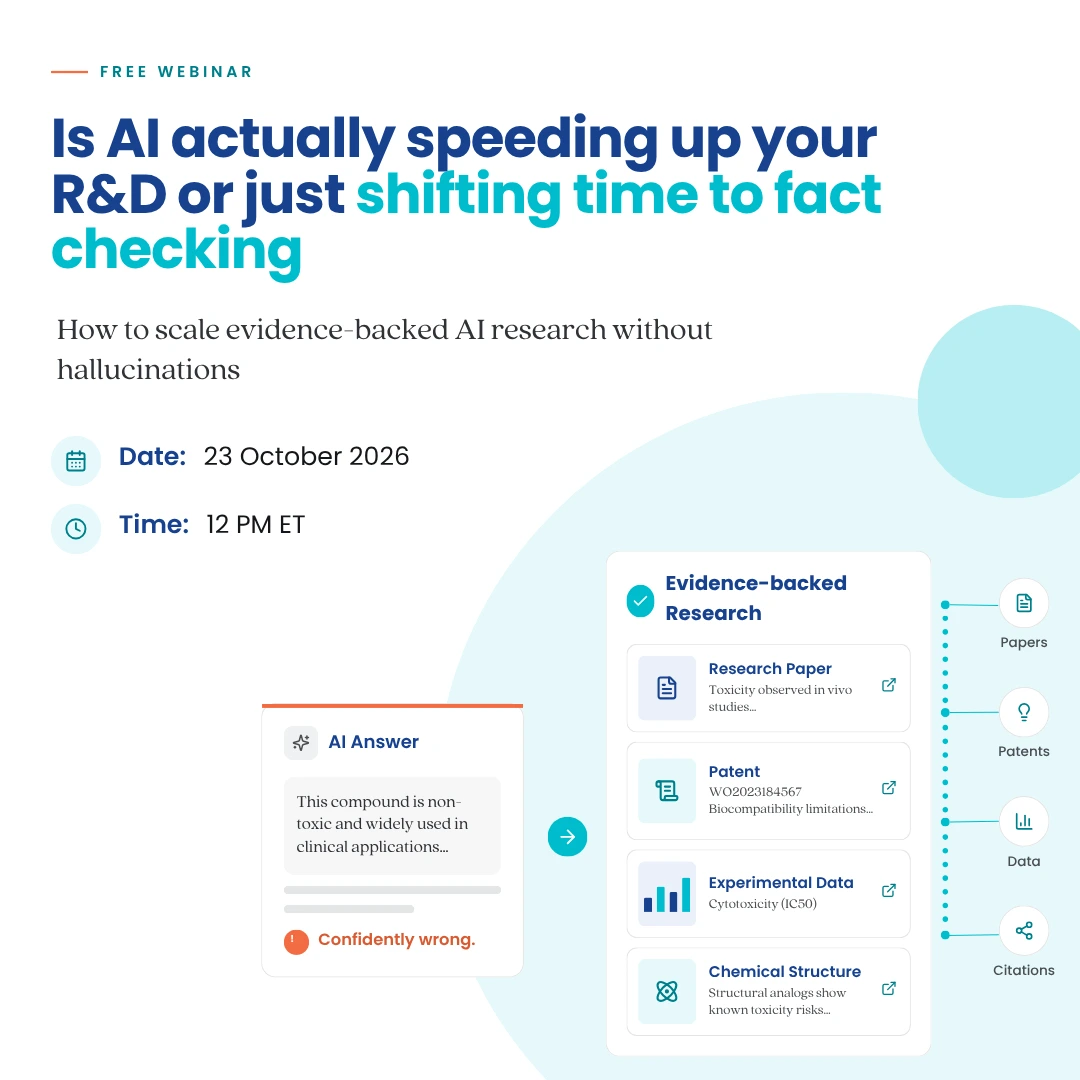
R&D teams are already using ChatGPT, Copilot, and Claude to review literature, summarize papers, and scout new technologies. The answers come back in seconds and read well, but they are often wrong in ways that are hard to spot.
Every major AI now offers a deep research mode that produces long reports with inline citations, and teams treat those citations as evidence. But in the review process many don’t hold up. AI tools invent papers that don’t exist, source fake citations, and fabricate DOIs. The problem gets worse on less-studied topics, which is exactly where R&D teams do most of their work.
Every answer has to be fact checked before anyone acts on it. Researchers have to go back to the original papers, patent databases, and regulatory websites to verify sources, trace the background of everything, and validate whether conclusions are scientifically accurate. The time saved on search is spent again on verification.
Fake citations are only the visible problem. Conclusions drawn from one study, conflicting results merged into one answer, and early-stage research presented as ready to scale are harder to catch. Better prompts and newer models haven’t fixed this.
This webinar will explore where AI falls short in scientific research, what it costs your team, and how to build more reliable AI-assisted research workflows for technology scouting, opportunity assessment, and go/no-go decisions.
78–90%
of citations produced by AI were hallucinated during a scientific literature synthesis benchmark
81%
of AI-generated summaries strip away context that changes the decision the original source would have supported
12%
improvement in answer correctness when AI was combined with specialized scientific retrieval and self-review
You’ll get answers to
- What R&D teams should do next when AI is confidently wrong
- How to prevent ChatGPT and Copilot from drawing risky, isolated research conclusions that threaten commercial product development
- A practical framework for scaling AI across R&D that kills fake citations, fabricated DOIs, or hidden scientific risk
- Difference between AI that generates answers and AI that supports evidence-backed defensible research decisions
- Why switching to a better AI model or prompt engineering does not fix incomplete, oversimplified R&D intelligence and what actually does
- How to find out if the promising technology is actually proven, or AI has compressed early-stage research into a scale-ready opportunity
- What faster AI research is actually costing your scientists in verification time
- Why AI pilots often fail to move beyond experimentation in R&D teams
Join the webinar to see where AI can accelerate R&D without adding verification burden, how to build a reliable AI-assisted research process, and what AI must get right before your team can trust it with real decisions.
Register today!

