
In 2018 alone, more than 56 billion coffee capsules were discarded worldwide, with the vast majority ending up in landfills where they may take hundreds of years to decompose. As environmental concerns about single-use packaging grow, coffee pods are being questioned about their sustainability.
Nestlé is responding to this with targeted R&D investments in biodegradable capsule technologies. This is more than a green branding exercise. It is a calculated response to evolving consumer expectations, emerging regulatory pressures, and growing evidence that compostable materials offer the most sustainable lifecycle profile.
According to a study by Wageningen University & Research, compostable capsules outperform other packaging formats when measured across material circularity and greenhouse gas emissions due to their ability to biodegrade and reintegrate into the ecosystem naturally.
With sustainability becomes a critical purchase driver with evolving consumer sentiment, Nestlé’s recent innovations signal a strategic pivot to safeguard market share and outperform its competitors.
Latest Research & Innovations in Biodegradable Capsules by Nestlé
Nestle’s strategy on biodegradable capsules for sustainable packaging focuses on creating eco-friendly alternatives to traditional coffee pods. It is categorized into key technical domains such as cellulose-based materials, compostable adhesives, barrier function layers, pulp-based molding techniques, and more.
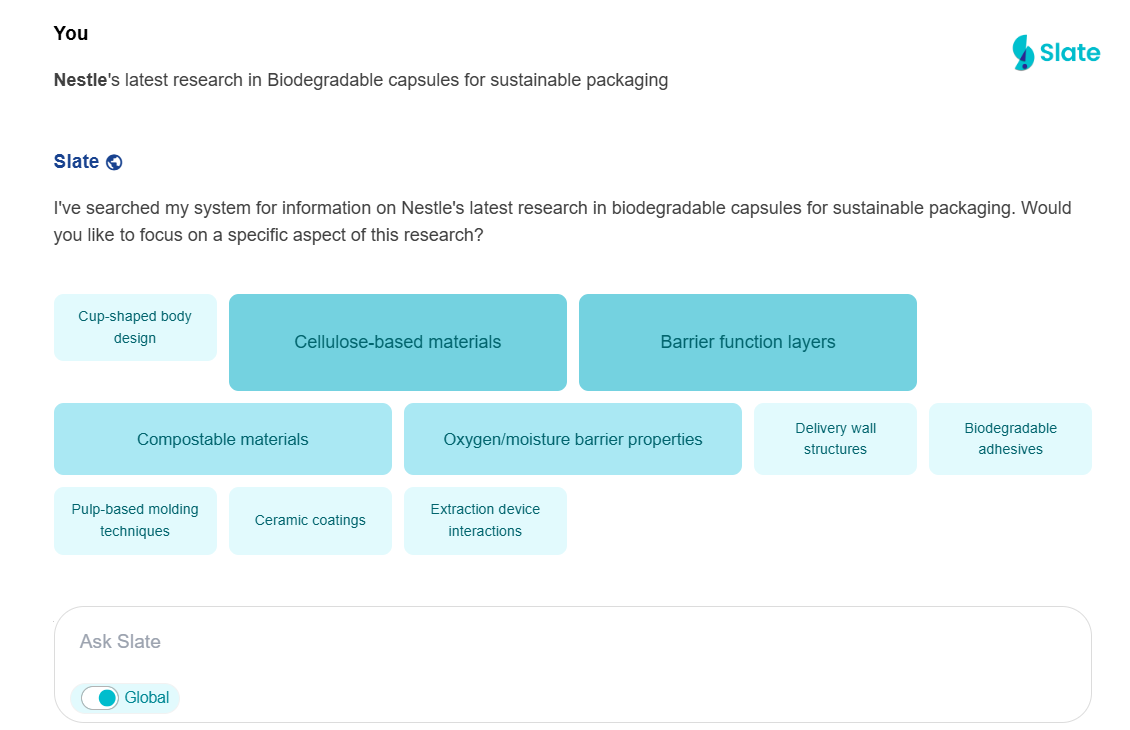
To better understand the broader landscape of biodegradable capsule technologies, researchers often rely on advanced tools that distill complex scientific and patent information into actionable insights. One such approach is using AI-powered platforms like Slate, it helps you find competitors’ advancements in their focus research area and identify emerging trends.
Slate distills complex patent and scientific literature into organized, actionable insights and allows researchers to compare all potential solutions across custom parameters with citations.
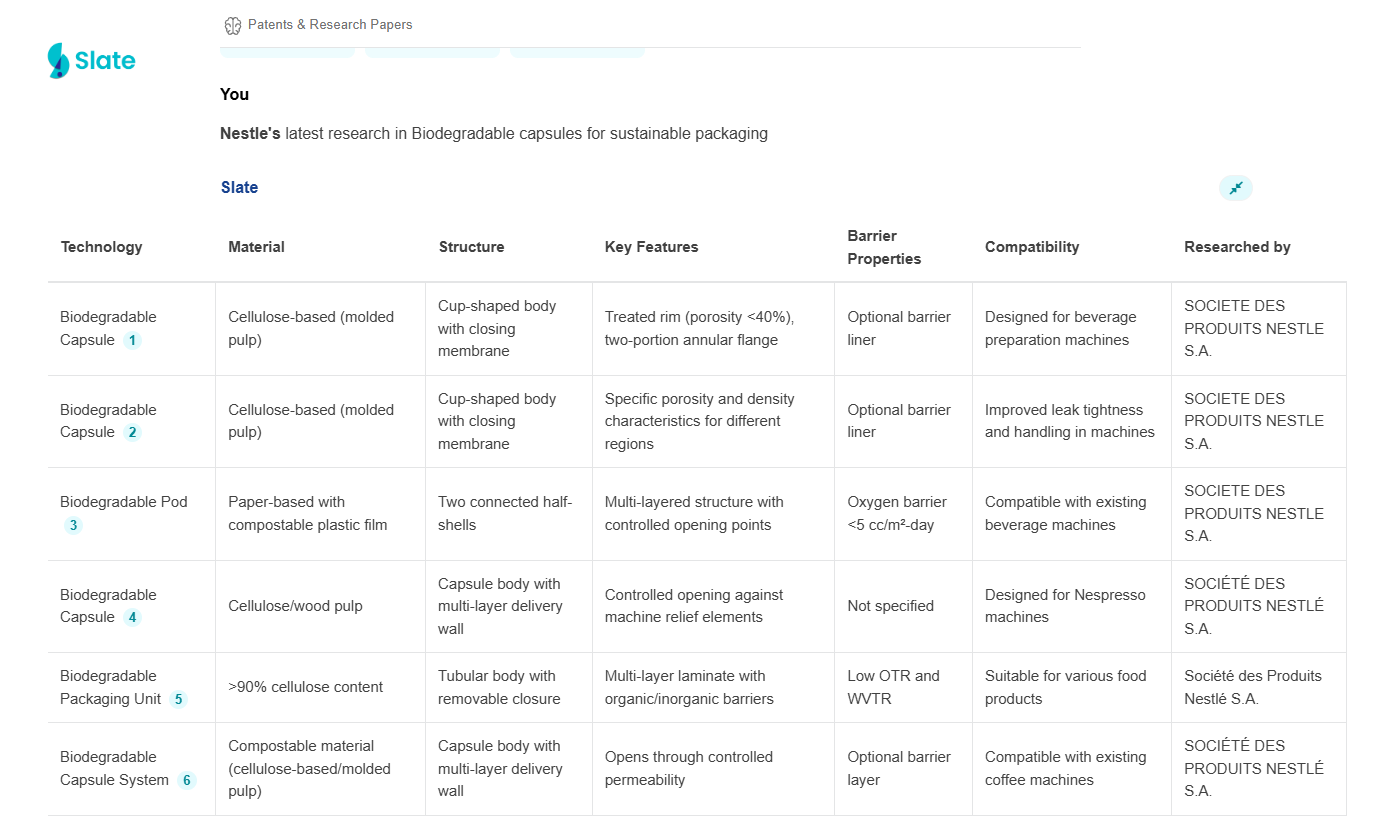
This structured approach enables researchers to quickly select and explore specific elements of Nestlé’s sustainability innovations, making it easier to track developments, align strategic initiatives, and identify potential areas for future research collaboration or competitive benchmarking.
Let’s explore the key themes and features identified from the research in detail:
1. Capsule Structure and Materials
The materials used in Nestlé’s biodegradable capsules play a pivotal role in achieving both sustainability and functionality. The company has invested in designing a coffee capsule that maintains the user-friendly characteristics of traditional pods, such as ease of use and compatibility with coffee machines.
Cellulose-Based Body
Nestlé’s biodegradable capsule is constructed from cellulose-based materials, a naturally occurring polymer derived from plant cell walls. The capsules are designed with a cup-shaped body made from cellulose-based materials, such as molded pulp, a sustainable and biodegradable alternative to the commonly used plastic and aluminum capsules. This structure includes a bottom wall, tubular side wall, annular flange, and an outwardly extending rim portion. This shift to cellulose-based capsules significantly reduces the environmental footprint of coffee pods by enabling the capsule to decompose naturally without contributing to long-term plastic waste.
Multi-Layered Design
Nestlé’s biodegradable capsules are built with a sophisticated multi-layered design to ensure they perform just like traditional capsules without compromising quality or function. The layers include:
- Primary Paper-Based Layer: This layer contains strategically placed holes, ensuring that the capsule opens in a controlled manner during the brewing process.
- Secondary Barrier Layer: Designed to protect the coffee from oxygen and moisture and ensure that the flavor remains intact. It also helps preserve the capsule’s integrity during storage and handling.
- Tertiary Filter Layer: This layer is engineered to facilitate proper filtration while remaining compostable.
These layers are made from biodegradable materials like PLA, PBS, and cellulose fibers. These multi-layered structures provide an optimal balance between environmental responsibility and practical use, ensuring that the capsules are both efficient and sustainable.
2. Functional Features
Beyond the material choices, Nestlé has designed the capsules with several key functional features to maintain performance while enhancing sustainability.
Porosity and Density Control
In the capsule design, specific regions such as the annular flange and rim portion are engineered with controlled porosity and density. This design improves the sealing of the capsule, ensuring that it is leak-tight and interacts effectively with existing coffee machines. The adjustments made to these specific regions also enable easier ejection from coffee machines, making the capsules as convenient as their non-biodegradable counterparts.
Delivery Wall Design
The delivery wall of the capsule is specifically crafted to open under pressure without tearing. This is achieved using a combination of carrier layers, adhesive, and an optional barrier layer. This innovative design ensures that even compostable materials can be used while maintaining the same level of efficiency and durability that consumers expect from a coffee pod.
3. Environmental and Performance Benefits
Nestlé’s biodegradable capsules have several environmental and performance benefits that will likely shift the industry paradigm.
Biodegradability and Compostability
The primary environmental benefit is the biodegradability and compostability of the capsules. As global waste management practices become more stringent and consumer demand for sustainable products increases, biodegradable and compostable packaging becomes a key selling point. Using cellulose and bioplastics reduces the environmental impact by ensuring that these capsules can break down naturally over time, unlike the traditional plastic and aluminum pods which often end up in landfills.
Compatibility with Existing Machines
Another significant advantage of Nestlé’s innovation is that these new biodegradable capsules are designed to be compatible with existing coffee preparation machines. This eliminates the need for consumers or businesses to invest in new, specialized equipment, which would be a major hurdle in the widespread adoption of sustainable coffee pods. This compatibility ensures that Nestlé can offer an eco-friendly alternative without requiring substantial changes to the consumer experience.
Track Nestlé’s Next Innovation in Sustainable Packaging
Nestlé’s investment in biodegradable coffee capsules represents a significant step forward in the quest for more sustainable packaging in the food and beverage industry. By combining cutting-edge research in biodegradable materials with practical design solutions, Nestlé addresses environmental concerns and enhances its products’ functionality.
This development sets a new benchmark for theTo remain competitive, companies must closely monitor competitors’ research and evaluate emerging technologies, then adapt their product strategies accordingly. AI-powered platforms like Slate can help R&D teams gain structured, timely insights by analyzing complex patent and scientific data into actionable intelligence, supporting informed decisions and uncovering opportunities for innovation and competitive differentiation.
With Slate – an external innovation discovery platform
- Access consolidate Nestlé’s latest packaging R&D and innovations from diverse sources (patents, research reports, and scientific literature) into one actionable view
- Explore new packaging solutions with detailed performance and environmental impact data
- Monitor competitors’ latest material innovations, packaging strategies, and technology trends to inform your R&D roadmap
- Get data-backed answers to your packaging innovation questions via Slate’s AI research assistant

