
The European Union banned TPO (Trimethylbenzoyl diphenylphosphine oxide), a widely used photoinitiator in most gel nail polishes, citing concerns over its potential health risks. Brands are scrambling to reformulate their products and find a new, safer, and compliant substitute for TPO without escalating production costs.
The decision to ban stems from growing concerns over TPO’s classification as a Category 1B CMR (carcinogenic, mutagenic, or toxic to reproduction) substance. For R&D teams, the challenge is not just to replace TPO, but to do so with alternatives that deliver the same durability and gloss.
Leading players in the industry have already reformulated TPO-free gel options or locked in contracts with startups that can develop it on scale. Act quickly to gain a competitive edge by adopting innovative alternatives and positioning your brand as a leader in safe, high-performance nail products.
This article discusses TPO alternatives that deliver the same high-performance curing, durability, and aesthetics without compromising on safety or compliance.

Alternatives to TPO for Gel Nail Polish
Replacing TPO requires a deep understanding of its role and the properties of suitable alternatives. R&D teams have to search across hundreds of scientific journals, patents, regulatory filings, industry reports, and databases to gather comprehensive data on potential alternative ingredients.
Traditional research is slow, but AI can accelerate this by analyzing vast data, spotting patterns and insights that inform ingredient selection and formulation strategies.
Using Slate, our proprietary AI R&D intelligence tool for cosmetics, we identified the most viable TPO alternatives for gel nail polish.
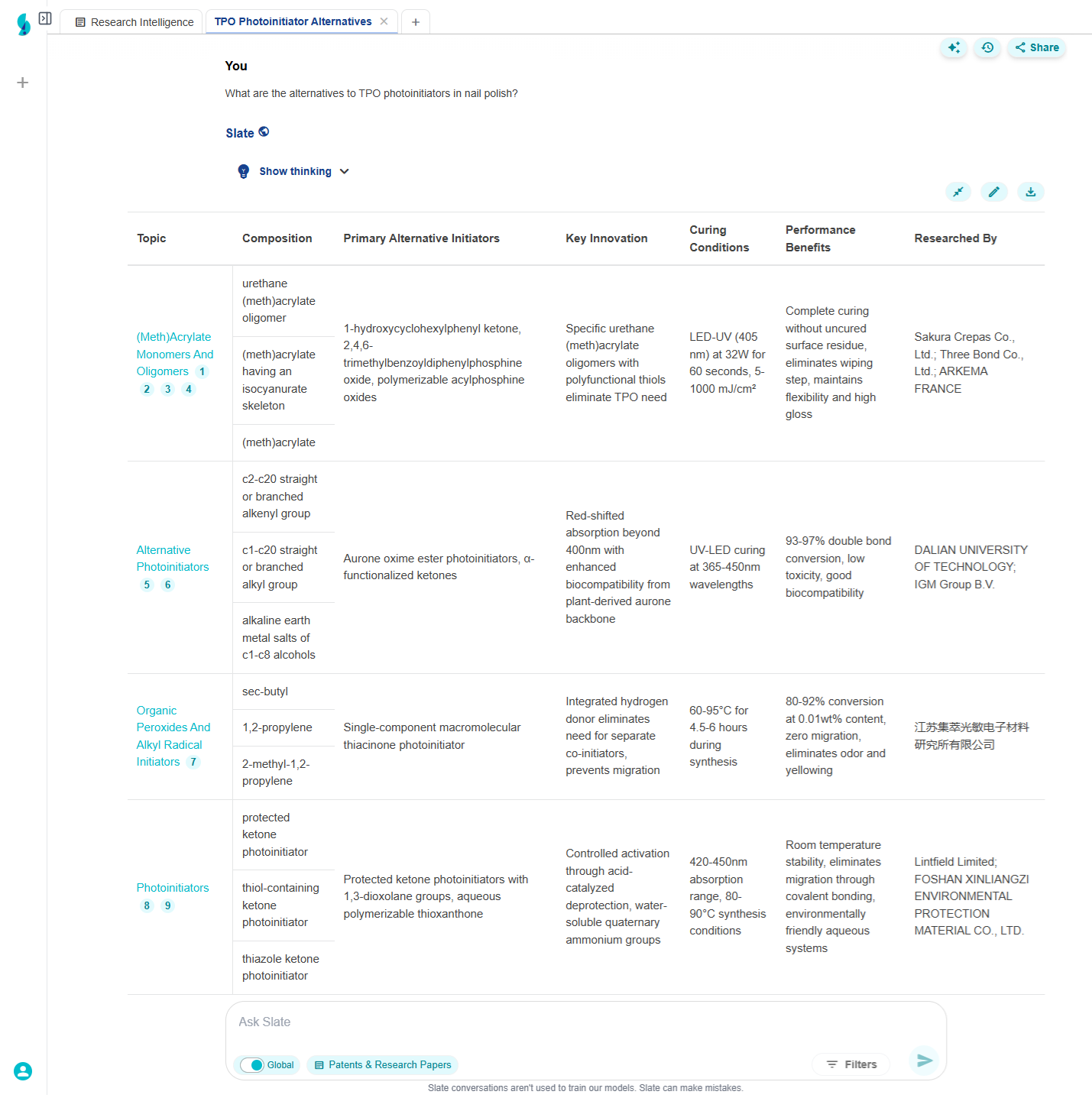
Access the full research on TPO alternatives here.
1. Ethyl (2,4,6-trimethylbenzoyl) phenylphosphinate (TPO-L)
TPO-L is considered the most direct and common replacement for TPO. Despite its similar name, TPO-L is a distinct molecule with a more favorable safety profile that complies with current EU regulations.
Performance: TPO-L offers excellent curing efficiency, particularly in systems with a high pigment load. It’s known for providing a quick cure with minimal yellowing, a critical factor for clear top coats and light-colored polishes. Its broad absorption spectrum (up to ~400 nm) makes it compatible with both UV and LED lamps. Typical loadings: 0.3–5 %.
Considerations: While a strong performer, formulators must still conduct compatibility and stability testing to ensure it integrates seamlessly with existing monomer and oligomer systems.
2. Hydroxycyclohexyl Phenyl Ketone (HCPK)
This photoinitiator is another effective alternative. It’s a solid, crystalline powder that is well-established in the UV-curing industry.
Performance: HCPK is a highly reactive photoinitiator that provides rapid surface curing and strong hardness. It’s particularly effective in clear or lightly pigmented formulations. HCPK is valued for its non-yellowing properties with λmax of ~333 nm, making it less effective with 395–405 nm LED-only lamps unless paired with a sensitizer or co-initiator.
Considerations: Formulators may need to use a co-initiator to improve the curing depth and overall efficiency of the system. Its higher melting point requires careful formulation to ensure it dissolves completely and doesn’t crystallize in the polish over time, which can affect product shelf life and performance.
3. Bis(2,4,6-trimethylbenzoyl)phenylphosphine oxide (BAPO)
Another highly effective photoinitiator often used in nail systems, BAPO offers a strong absorption profile for fast curing.
Performance: BAPO is known for its strong absorption between 350–420 nm and excellent through-cure capabilities, making it suitable for thicker layers and pigmented systems. It generally exhibits good non-yellowing properties.
Considerations: While effective, BAPO’s regulatory status should always be closely monitored, as the landscape for photoinitiators can evolve. Its interaction with other formulation components should be thoroughly evaluated.

4. Other Advanced and Emerging Alternatives
The industry’s response to the TPO ban has catalyzed the development of new solutions beyond the most common replacements.
Next-Generation Photoinitiators: These include newer phosphine oxide-based molecules like TMO (Trimethylbenzoyl-Bis(4-methylphenyl)phosphine oxide), specifically engineered to offer a similar performance to TPO but with a significantly improved safety profile.
Polymeric Photoinitiators: These are high-molecular-weight photoinitiators that are less likely to migrate out of the cured nail polish film and potentially cause skin sensitization or irritation. This enhanced safety profile makes them an attractive option for brands prioritizing consumer safety. An example would be Omnipol TPO, which is a high-molecular-weight version of a TPO-like molecule with low migration potential.
Blended Systems: Many formulators are finding success by combining multiple photoinitiators to create a synergistic effect. A blend might include a surface-curing initiator with a through-curing initiator to optimize performance across different polish shades and thicknesses.
Formulation Challenges and Best Practices
Simply swapping TPO for an alternative isn’t a “plug-and-play” solution. The unique chemical properties of each photoinitiator will impact the entire system. R&D teams must be prepared to address the following:
UV and LED Lamp Matching: Salon lamps typically peak at 365 nm and 405 nm. Selecting a PI or PI blend that aligns with these wavelengths ensures curing efficiency.
Rheology and Viscosity: The new photoinitiator might alter the viscosity of the formulation, requiring adjustments to the ratio of monomers and oligomers to maintain the desired application properties.
Pigment and Curing Efficiency: Different photoinitiators absorb light at different wavelengths, so formulators must ensure the new system cures effectively through pigmented layers, especially in dark or opaque shades. This may require adjusting the photoinitiator concentration or adding a sensitizer. For example, Aurone oxime ester photoinitiators offer “red-shifted absorption beyond 450 nm,” enhancing curing performance, as noted in Slate’s output table.
Stability and Shelf Life: New formulations must undergo rigorous stability testing to ensure the product remains consistent over time. Factors like light exposure in retail packaging and storage conditions can trigger premature curing or changes in viscosity. The “organic peroxides and alkyl radical initiators” mentioned in the table with “integrated hydrogen donor” aim to prevent migration and improve stability.
Regulatory Documentation: The EU ban underscores the importance of staying informed about global regulations. R&D teams should proactively monitor the status of ingredients and prepare the necessary documentation to ensure compliance not just in the EU, but in other markets like the UK, which is expected to follow suit.
Get Future-Ready with Ingredient Intelligence
The TPO ban is a significant regulatory challenge, but it also presents a valuable opportunity for innovation. It’s a call for accelerated, data-driven innovation that requires a proactive approach. Navigating the complex landscape of alternative photoinitiators, their performance characteristics, and ever-evolving regulations requires a level of intelligence and efficiency that manual research simply cannot provide.
This is where Slate gives your R&D team a strategic edge. It is an AI-powered research platform designed for cosmetic scientists and R&D leaders, helping you:
- Find and validate alternatives instantly with data-backed insights.
- Track industry trends and competitors to stay ahead.
- Access in-depth ingredient intelligence on safety, efficacy, and cross-industry applications.
With Slate, you can identify, compare, and validate photoinitiators in minutes instead of weeks, turning compliance into an opportunity to lead the next generation of safe, high-performance nail products.