
Protein bar manufacturers have spent years improving ingredients, flavors, and nutritional profiles. However, one part of the product has remained largely unchanged, which is how the bar holds together.
Traditional protein bars often depend on binders such as syrups, fats, and other structuring ingredients to achieve the right texture and stability. Precision extrusion offers a different approach by using controlled mechanical processing to create fibrous structures without relying on these traditional binders.
Using Slate, we analyzed patent activity, scientific research, and innovation signals across protein bar manufacturing to understand where the technology landscape is moving. The analysis reveals a shift from traditional binder-based forming methods toward precision extrusion, with equipment manufacturers and technology developers leading innovation in next-generation texturization.
This article explores what these hardware innovations reveal about the future of protein bar manufacturing, why adoption has not accelerated yet, which companies are building the critical technologies, and what food R&D teams need to consider as extrusion moves toward commercial scale.
Why Food Companies Are Missing the Manufacturing Shift Behind New Protein Textures
The 34 precision extrusion hardware innovations identified in this analysis are largely coming from equipment manufacturers, research institutions, and specialized technology companies rather than major food brands.
General Mills, Louis Dreyfus Company, Arla Foods, and Fonterra are absent from this hardware innovation cluster. Their innovation efforts are concentrated in areas such as protein blends, extraction chemistry, ingredient optimization, and formulation.
General Mills has 15 innovations focused on protein blends and extraction chemistry, while Louis Dreyfus Company has 9 innovations focused on extraction with no identified extrusion hardware activity.
Meanwhile, equipment-focused innovators are advancing the mechanical technologies required to create new protein textures. Clextral has developed diverging-branch nozzle systems for high-moisture extrusion that help maintain protein hydration during shear. Planted Foods has created controllable valves that regulate protein flow and support fiber alignment. TNO has developed modular shear channels that orient protein fibers, while DST Holding has explored high-shear systems that create texture without chemical additives.
Chinese companies are approaching technology from a different angle. Shandong Qiteng Biotechnology and Henan Shuguang are developing systems focused on improving throughput and production reliability for soy-based fibrous proteins, including twin-screw cutting systems and integrated puffing equipment.
This creates two distinct innovation paths. European companies and startups are focused on controlling the science of texture formation, while Chinese manufacturers are optimizing extrusion for large-scale production.
The absence of major food brands from extrusion hardware innovation suggests that the industry is still developing the capabilities required to combine ingredient science with mechanical texturization.
Why Precision Extrusion Has Not Yet Replaced Traditional Protein Bar Manufacturing
The technology behind precision extrusion is already available. The challenge is scaling it to match the cost, speed, and flexibility of traditional protein bar manufacturing.
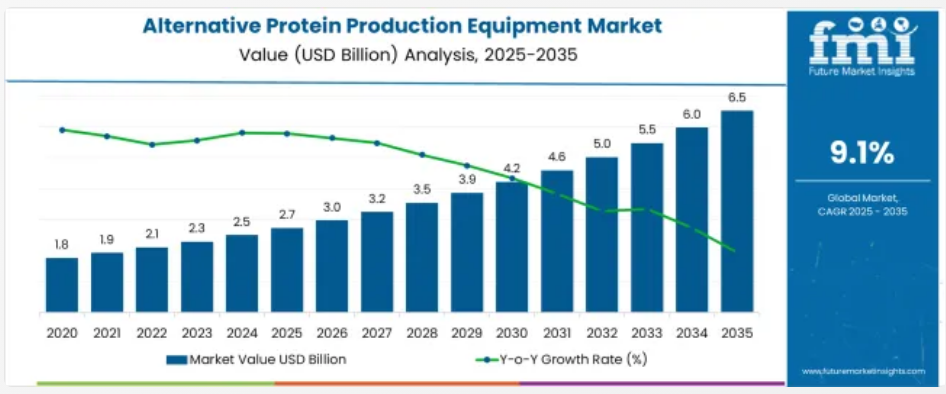
Capital intensity remains one of the biggest barriers. Precision extrusion systems require specialized twin-screw equipment with rheology-control components such as advanced nozzles and valves. These systems require higher upfront investment compared with conventional cold-press or depositor lines. The alternative protein production equipment market is projected to reach $6.5 billion by 2035, highlighting increasing investment in specialized processing infrastructure.
Throughput remains another challenge. Many high-moisture extrusion systems were developed for fibrous meat alternatives, where production requirements differ from high-speed protein bar manufacturing. This creates a cost-per-unit gap that precision extrusion must overcome before it can replace established binder-based production lines.
Formulation flexibility is also a limitation. Extrusion performance depends heavily on protein properties such as moisture content, viscosity, and thermal behavior. Current systems are often optimized for specific protein isolates, meaning switching between pea, soy, whey, or hemp can require process adjustments and equipment changes.
Together, these challenges create a gap between technical capability and commercial adoption. Precision extrusion can deliver binder-free textures, but reaching mainstream protein bar production requires closer integration between equipment developers, ingredient suppliers, and food manufacturers.

Why Equipment Companies Could Control the Next Generation of Protein Textures
Major CPG companies continue investing in areas such as protein extraction, ingredient purity, shelf-life improvement, and formulation strategies. However, advanced extrusion requires capabilities that sit outside traditional food R&D functions, including mechanical engineering, rheology simulation, and food-contact material design.
As a result, specialized players are building expertise around the equipment and process controls required for next-generation protein textures. Their innovations in nozzles, valves, and shear systems could create a future where specific textures become linked to proprietary processing technologies.
For food brands entering the binder-free protein segment, this creates a strategic decision. Companies without internal extrusion capabilities may need to rely on equipment partnerships, licensing agreements, or contract manufacturing relationships to access these textures.
The next stage of adoption will depend less on proving that extrusion works and more on building partnerships between equipment innovators that control processing technology and food companies that control formulation, distribution, and consumer relationships.
Why Academic Research Is Ahead in Combining Protein Chemistry and Extrusion Technology
The integration of protein chemistry with extrusion expertise remains an emerging capability. Northeast Agricultural University is the only entity identified across the innovation landscape that spans high-purity protein extraction, protein blending, and twin-screw extrusion hardware.
This suggests that full-stack optimization, where the ingredient and the mechanical process are designed together, remains largely concentrated in academic and pre-commercial environments.
Most industrial players continue to focus on specific parts of the value chain. Companies such as General Mills and Arla Foods show significant innovation activity, but their efforts remain concentrated within individual technical areas rather than across the complete extraction-to-extrusion pathway.
Academic institutions such as Politeknik Kesehatan Kemenkes Semarang and Sebelas Maret University appear in related binder-integrated forming research, focusing on functional ingredients and indigenous raw materials.
The industry is therefore still in a knowledge-building phase. The expertise needed to co-optimize protein ingredients and mechanical processing has not yet fully transferred from research institutions into commercial R&D programs.
Companies looking to build extrusion capabilities may need to develop this knowledge through partnerships, licensing, recruitment from research groups, or long-term internal development.
Why The Future of Protein Texture Depends on Advanced Mechanical Control
The precision extrusion patent cluster highlights three core mechanical capabilities that differentiate this technology from traditional protein forming methods.
The first is protein preservation during extrusion. Continuous high-moisture extrusion systems maintain hydration and reduce protein denaturation during shear. Clextral’s diverging-branch nozzle technology enables controlled flow splitting while reducing turbulence during processing.
The second is protein flow control. Rheology-controlling valves regulate viscoelastic flow and help maintain fibrous structures during die extrusion. These controls allow manufacturers to influence final texture by managing how protein structures align.
The third is fiber orientation. Modular shear channels physically align protein fibers to create directional structures within the plant-based matrix.
Additional innovations are expanding possible product formats. Co-extrusion systems with rhombus-shaped diverters allow manufacturers to combine protein layers with fillings, while multi-set roller pressing mechanisms enable layered protein bar structures.
These developments explain why precision extrusion differs from conventional forming methods. By controlling moisture, shear, and protein alignment, extrusion can create fibrous textures without relying on traditional binders such as sugars or fats.
However, extrusion systems remain highly specialized. The selected equipment determines the textures a manufacturer can achieve, the protein ingredients it can process, and the level of dependence on a specific technology provider.

Why Scale Will Determine Who Wins the Extrusion-Based Protein Race
The alternative protein equipment market is entering a growth phase, expanding from $2.7 billion in 2025 to $6.5 billion by 2035. The twin-screw food extruder market is also projected to reach $552 million by 2034.
This growth indicates that extrusion infrastructure is moving closer to commercial scale, but the economic advantage will not be distributed evenly across the market.
Companies focused on high-volume products are likely to prioritize extrusion for manufacturing efficiency and reduced dependence on traditional binders. Chinese equipment developments focused on reliability and production consistency align with this requirement, while European and startup innovations focused on texture precision may create value for premium brands seeking differentiation.
Large manufacturers with dedicated production capacity, optimized protein supply chains, and sufficient volumes could achieve competitive economics by late 2026. Smaller brands relying on external manufacturing partners or flexible ingredient sourcing are more likely to adopt through contract extrusion models as the ecosystem matures around 2028–2029.
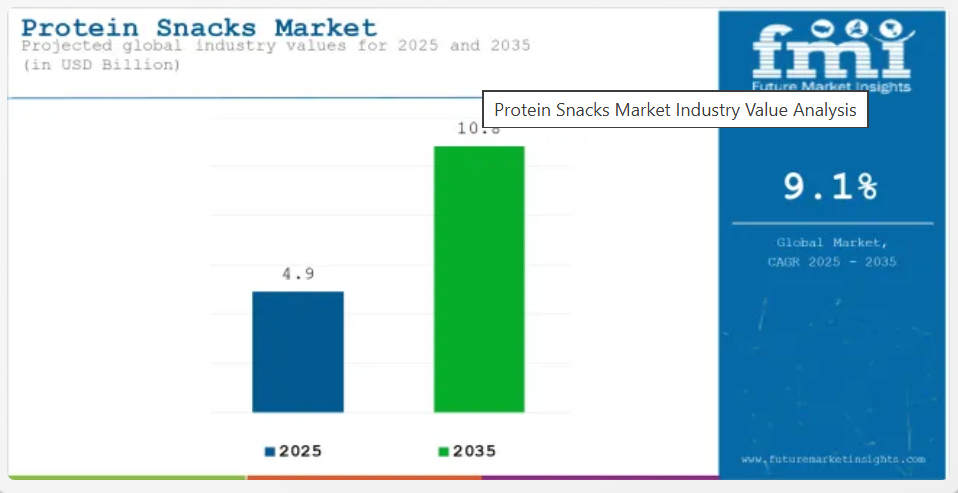
The growing protein category provides additional motivation. The high-protein snacks sector is projected to reach $42.1 billion by 2034, while the protein snacks market is expected to grow from $4.92 billion in 2025 to $10.83 billion by 2035.
As extrusion becomes more accessible, competitive advantage may shift from owning equipment itself to owning the formulation knowledge, supply relationships, and consumer proposition built around extrusion-enabled products.
Why R&D Teams Need an Extrusion Strategy
Companies evaluating extrusion adoption should begin by assessing where their current capabilities align with this emerging manufacturing model. This includes understanding whether existing formulations, ingredient supply chains, and production assets can support extrusion-based processing or require redesign.
The transition will require capabilities beyond traditional formulation expertise. Organizations will need to evaluate whether to build internal knowledge through hiring and development, partner with equipment providers, or leverage external manufacturing networks.
Companies should also reassess the long-term role of existing binder-based production systems as extrusion-based products become more commercially competitive. Organizations that prepare early will be better positioned to capture manufacturing advantages and establish differentiated product positioning as the market evolves.
Find the Technologies That Will Shape Your Next Protein Platform
The next breakthrough in protein bars may not appear first as a finished product. It may emerge through a patent filing, a research breakthrough, a startup building new processing capabilities, or an equipment supplier developing the next manufacturing platform.
SLATE, an AI-Powered R&D tool for F&B helps R&D teams uncover these early signals and turn them into actionable innovation intelligence.
With Slate, researchers can:
- Track emerging technologies across patents, scientific literature, and industry developments to identify new approaches in protein processing, texturization, and manufacturing.
- Map competitors and technology leaders to understand who is investing in ingredients, equipment, processing methods, and next-generation protein platforms.
- Identify potential partners and acquisition targets by uncovering startups, academic institutions, and companies developing relevant capabilities.
- Analyze patent landscapes and white spaces to understand where innovation is accelerating, where competitors are building IP, and where opportunities remain open.
- Connect research signals to commercial activity by linking scientific breakthroughs, patent filings, company activity, and market movements in one view.
For protein innovation teams, staying ahead requires more than tracking new products. It requires understanding the technologies and capabilities that will define the next generation of products.

Frequently Asked Questions
What is precision extrusion in protein bar manufacturing?
Precision extrusion uses twin-screw systems with specialized nozzles and valves to mechanically texturize protein isolates into fibrous structures without synthetic binders. Unlike traditional cold-press methods that rely on sugar syrups or fats to hold ingredients together, extrusion controls moisture, shear, and flow rates to create meat-like textures and maintain structural integrity through the physics of the protein matrix itself.
Why haven’t major food brands adopted extrusion technology yet?
Major CPG brands like General Mills and Arla Foods are absent from the 34 extrusion hardware innovations because equipment R&D requires mechanical engineering and rheology expertise outside their core competencies. They are concentrating innovation in extraction chemistry and formulation instead, creating a strategic divide where equipment vendors control texturization IP while food brands control distribution, necessitating licensing or partnership negotiations that delay mass-market adoption until 2027-2028.
How much does extrusion-based protein bar production cost compared to traditional methods?
Extrusion systems require significantly higher capital investment than cold-press or depositor lines, with the alternative protein equipment market reaching $6.5 billion by 2035. Current throughput is lower than high-velocity traditional lines, creating a cost-per-unit penalty. Large-scale manufacturers with captive lines and vertically integrated protein supply could reach cost parity by late 2026, while mid-sized manufacturers relying on equipment leasing likely won’t reach parity until 2028-2029.
Can existing protein bar production lines be retrofitted for extrusion?
Retrofitting is limited because extrusion requires twin-screw systems with rheology-controlling nozzles, valves, and modular shear channels that are fundamentally different from cold-press or depositor equipment. The technology is also formulation-locked: die and screw configurations are optimized for specific protein isolates (pea, soy, whey), making it difficult to switch between protein sources without significant downtime, unlike traditional lines that offer more formulation flexibility.
Which protein isolates work best with extrusion technology?
Extrusion performance is highly sensitive to the specific protein isolate’s moisture content, viscosity, and thermal behavior. Twin-screw cooling die configurations are optimized for individual plant isolates like pea protein, as documented in recent engineering studies. Successful extrusion requires co-optimization of the protein isolate and mechanical process, meaning commodity isolates may not perform well without specifications tailored to extrusion rheology.
What are the clean-label benefits of extrusion over traditional binders?
Extrusion eliminates the need for synthetic binders like sugar syrups, glycerin, or fat-based adhesives by creating structural integrity through mechanical texturization. The continuous high-moisture extrusion process maintains protein hydration and physically orients fibers into anisotropic structures, allowing brands to achieve clean-label positioning by removing chemical additives from ingredient lists while maintaining shelf-stable texture and mouthfeel.
Who are the leading equipment manufacturers for protein bar extrusion?
Clextral dominates with diverging-branch nozzle systems for continuous high-moisture extrusion, Planted Foods has developed controllable valves for viscoelastic flow control, and TNO has created modular shear channels for fiber orientation. Chinese manufacturers like Shandong Qiteng Biotechnology and Henan Shuguang focus on industrial throughput optimization for soy-based applications. European and startup IP targets texture physics while Chinese systems optimize reliability and scale.