What happens when clean-label protein extraction becomes an IP problem rather than an ingredient-sourcing problem?
Using Slate, we analyzed innovation activity across plant protein extraction to understand where companies are investing, which processing routes are gaining attention, and where technical white spaces remain. The analysis found that relevant aqueous and ethanol-based research grew from 62 publications in 2024 to 152 across 2025 and 2026, an increase of 145 percent within the analyzed dataset.
Moving beyond hexane is only one part of the challenge. The harder problem is developing extraction processes that can deliver cleaner taste, strong protein recovery, useful functionality, and commercially viable processing at the same time.
As more of this process knowledge becomes protected through patents and specialized manufacturing know-how, downstream food companies may have fewer options to differentiate through formulation alone.
In this article, we look at what the patent and research landscape reveals about aqueous, ethanol, and hexane-based extraction, where the biggest technical gaps remain, and what these shifts could mean for R&D teams choosing their next protein processing strategy.
Why Clean-Label Plant Proteins Are Moving Beyond Hexane
Hexane remains widely used in oilseed processing for a simple reason. It removes oil efficiently and works at industrial scale. But for plant protein developers, its role is becoming harder to ignore as alternative extraction routes improve and regulatory scrutiny increases.
Hexane is still an authorised extraction solvent in the EU under defined conditions and residue limits. However, EFSA is currently re-evaluating its safety as an extraction solvent after concluding in 2024 that updated information on exposure, residues, impurities, and toxicology was needed. The reassessment is expected to continue through 2027.
That makes the shift away from hexane less about an immediate regulatory ban and more about reducing future processing and formulation risk.
Recent patent activity shows how companies are approaching this transition.
Louis Dreyfus Company has filed a sunflower protein concentrate process that combines conventional defatting with a later ethanol-water extraction step. Its published patent application describes treating de-oiled sunflower flour with a 30 to 70 percent ethanol-water solution under controlled temperature and pH conditions.
The interesting point is not that ethanol simply replaces hexane.
It shows that companies are redesigning individual stages of protein processing to improve the final ingredient while preserving protein functionality. Louis Dreyfus reports producing sunflower protein concentrates with roughly 55 to 70 percent protein while maintaining properties such as foaming, gelation, and emulsification.
For R&D teams, this changes the evaluation criteria. The question is no longer whether hexane works. It clearly does.
The more useful question is whether the current extraction route can deliver the sensory quality, protein functionality, regulatory resilience, and clean-label positioning the next generation of products will require.
As those requirements tighten, extraction processes that rely less on conventional solvent-intensive routes could give ingredient suppliers more flexibility than simply competing on cost and yield.
How Extraction Methods Shape Plant Protein Taste and Functionality
Aqueous and ethanol-based extraction may both reduce dependence on conventional solvent-heavy processing, but they solve different R&D problems.
Water-based processes are often designed around protein recovery and functionality. Ethanol becomes more useful when the challenge shifts toward removing compounds that contribute bitterness, astringency, undesirable aromas, or poor color.
Phenolic compounds, aldehydes, ketones, saponins, and other components can influence how an isolate tastes and performs in a finished product. A 2024 review of plant protein flavor chemistry found that aqueous ethanol can remove several of these compounds. Studies covered in the review showed that ethanol treatments reduced unwanted volatiles in lentil and pea proteins, while aqueous ethanol also lowered phenolic content in soybean and sunflower protein ingredients.
This means higher protein recovery is not the only target. R&D teams also need to protect solubility, emulsification, foaming, texture, and sensory quality during extraction.
Burcon NutraScience shows how aqueous processing is being developed around these requirements. Its hemp protein patent uses an aqueous calcium salt solution followed by pH adjustment and optional concentration and diafiltration. The resulting protein is designed to have a neutral or near-neutral pH with reduced salt content.
The process shows why aqueous extraction cannot simply be described as mixing protein with water. Salt concentration, pH, separation, membrane processing, and drying all influence what the final protein can do.
GEA has developed a process that combines high-shear steam infusion with spray drying for non-mammalian proteins. The technology is designed to produce a dried protein with functional properties such as higher viscosity when redispersed in water. Slate identified five GEA innovations around this processing area.
This is important for protein bars and other formulated foods because a high-purity isolate has limited value if drying damages the functionality needed for texture, binding, emulsification, or mouthfeel.
CoryPro Ingredients is developing concentrates and isolates from cluster bean or guar meal, a by-product of guar gum production. Its protein concentrate contains around 80 percent protein, while its isolate reaches more than 90 percent. The company positions both around low flavor and applications including nutrition bars, beverages, and plant-based dairy products.
Aqueous processing can support strong protein recovery and functional preservation, but additional separation steps may be needed to remove flavor-active compounds. Ethanol can be effective at removing off-flavors and phenolics, but solvent concentration and processing conditions can also alter protein solubility, emulsification, and foaming behavior. Research on sunflower protein has documented this trade-off directly.
So the decision is not as simple as choosing aqueous extraction for yield and ethanol extraction for taste. The more useful question is which process delivers the best balance of protein recovery, sensory quality, functionality, processing complexity, and cost for the final application. For protein bar developers, that balance can determine whether an isolate merely meets the protein target or actually works in the finished product.

Why Plant Protein Extraction IP Is Concentrating Upstream
The technology behind high-quality plant protein ingredients is becoming concentrated upstream.
Our Slate analysis found relevant extraction and processing IP clustering around five ingredient companies including Louis Dreyfus Company, Burcon NutraScience, Roquette, Arla Foods, and Fonterra. Louis Dreyfus Company alone appeared across nine relevant innovations in the analyzed dataset.
This does not mean these five companies control every route to plant protein extraction. It does suggest that important process knowledge is accumulating with ingredient processors rather than the food brands buying their proteins.
Extraction performance depends on more than access to peas, sunflower, hemp, or other raw materials. Companies also need the processing knowledge, equipment, operating conditions, and intellectual property required to turn those crops into proteins with the right purity, taste, and functionality.
Building that capability independently can require substantial investment.
Roquette’s pea protein facility in Manitoba offers a useful example. The plant represents an investment of around C$600 million and can process approximately 125,000 metric tons of yellow peas each year.
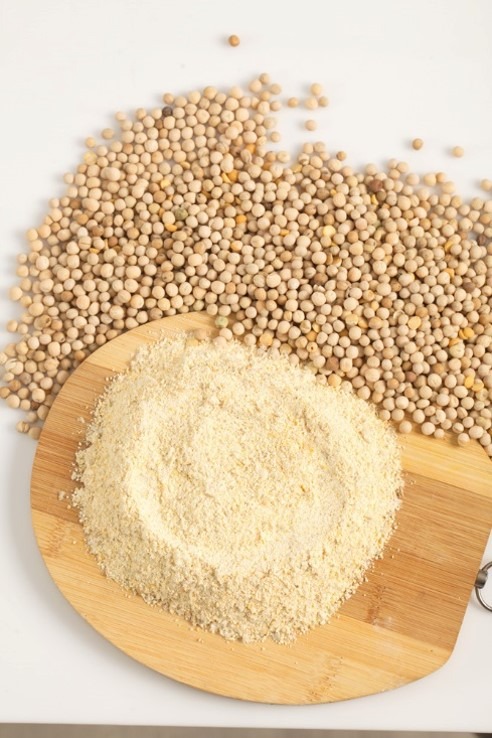
Of course, not every protein extraction project requires investment on that scale. But it shows how difficult it can be for a downstream food company to reproduce mature ingredient-processing capabilities internally.
This changes the strategic options available to R&D teams.
A company without its own extraction technology can source an established ingredient, work with a processor on a co-development program, license relevant technology where available, or invest in building internal capabilities.
Each route creates a different trade-off.
Licensing can provide faster access to protected technology but may introduce royalties or operating restrictions. Supplier partnerships reduce the need for internal infrastructure but can increase dependence on external process capabilities. Building internally offers more control, although the technical development, equipment, and scale-up requirements can be much higher.
The risk is therefore not simply that a handful of processors own more patents.
It is that the most useful extraction know-how may sit increasingly upstream, giving ingredient companies greater influence over which protein characteristics downstream manufacturers can access and at what cost.
For food companies, this makes extraction IP worth monitoring alongside ingredient price and availability. Knowing where patents are concentrating can help R&D, procurement, and business development teams identify where supplier dependence is increasing and where alternative technologies or partnerships may still be available.
How Plant Protein Extraction Balances Off-flavor Removal and Protein Yield
Plant proteins can bind tightly to compounds responsible for beany, grassy, bitter, or astringent notes. These include aldehydes, ketones, phenolics, saponins, and bitter peptides. Some interactions are reversible and can be disrupted during processing. Others bind more strongly to the protein, making selective removal difficult without also changing the protein itself.
Alcohol washing can reduce undesirable flavor compounds, but the treatment can also change the protein. Research on pea proteins found that ethanol and isopropanol washing reduced volatile compounds while some functional properties, including solubility, declined after treatment. Other studies have similarly found that alcohol washing must be optimized for each protein source because concentration and processing conditions influence both flavor removal and protein performance.
That makes the real target more demanding than producing a neutral-tasting isolate.
The process has to remove enough flavor-active compounds while preserving the properties food manufacturers need, including solubility, emulsification, foaming, gelation, digestibility, and usable protein recovery. Recent reviews of plant protein processing continue to identify this balance between extraction efficiency, purity, structural integrity, and functionality as an area that needs further optimization.
This is also opening white space beyond conventional aqueous and ethanol processing.
Researchers are exploring selective adsorbents, ion-exchange resins, supercritical carbon dioxide, high-pressure processing, ultrasound, enzymes, and hybrid extraction systems. For example, studies reviewed in the literature found that adsorbent resins can remove selected aldehydes and other volatile compounds, while supercritical carbon dioxide combined with ethanol has been tested for reducing off-flavors in pea and soy protein systems.
For R&D teams evaluating suppliers, this creates a more useful question than asking whether an isolate has a neutral flavor.
Ask what was removed to achieve that flavor, how much usable protein was recovered, and what happened to solubility and other functional properties after processing.
Pilot-scale testing becomes important here because a protein that performs well in a supplier specification may behave differently once it enters a bar, beverage, or other finished formulation.
The opportunity is therefore not simply better flavor removal.
It is a process that can selectively remove unwanted compounds while keeping protein recovery, functionality, processing cost, and sensory performance within commercially useful ranges. The company that closes more of those trade-offs at the same time could create a far more defensible plant protein ingredient.
How R&D Teams Should Evaluate Plant Protein Extraction Suppliers
Supplier evaluation should go beyond protein content and price. R&D teams should ask how the protein is extracted, which solvents and processing aids are used, what residual solvent specifications apply, and how much functionality is retained after processing.
Aqueous and ethanol-treated isolates should also be tested side by side at comparable protein concentrations to understand differences in taste, solubility, texture, and any additional flavor-masking requirements.
The second question is how dependent your formulation is on the supplier’s proprietary processing capability. Review whether critical extraction technology is owned internally, licensed, or accessed through another processor.
If the ingredient is central to product differentiation, R&D, procurement, and business development teams should compare the cost and flexibility of long-term sourcing, co-development, licensing, and eventually building internal capability. The right choice depends on how difficult that extraction performance would be to replace if the supplier relationship changed.
How Slate Helps R&D Teams Find Plant Protein Extraction Opportunities
For most R&D teams, finding information is not the difficult part. The harder part is working out what matters.
A researcher looking at plant protein extraction may need to move between patents, scientific papers, company websites, technical disclosures, and supplier information just to understand whether a technology is promising. This is where Slate is designed to help researchers work faster without losing the evidence behind the answer.
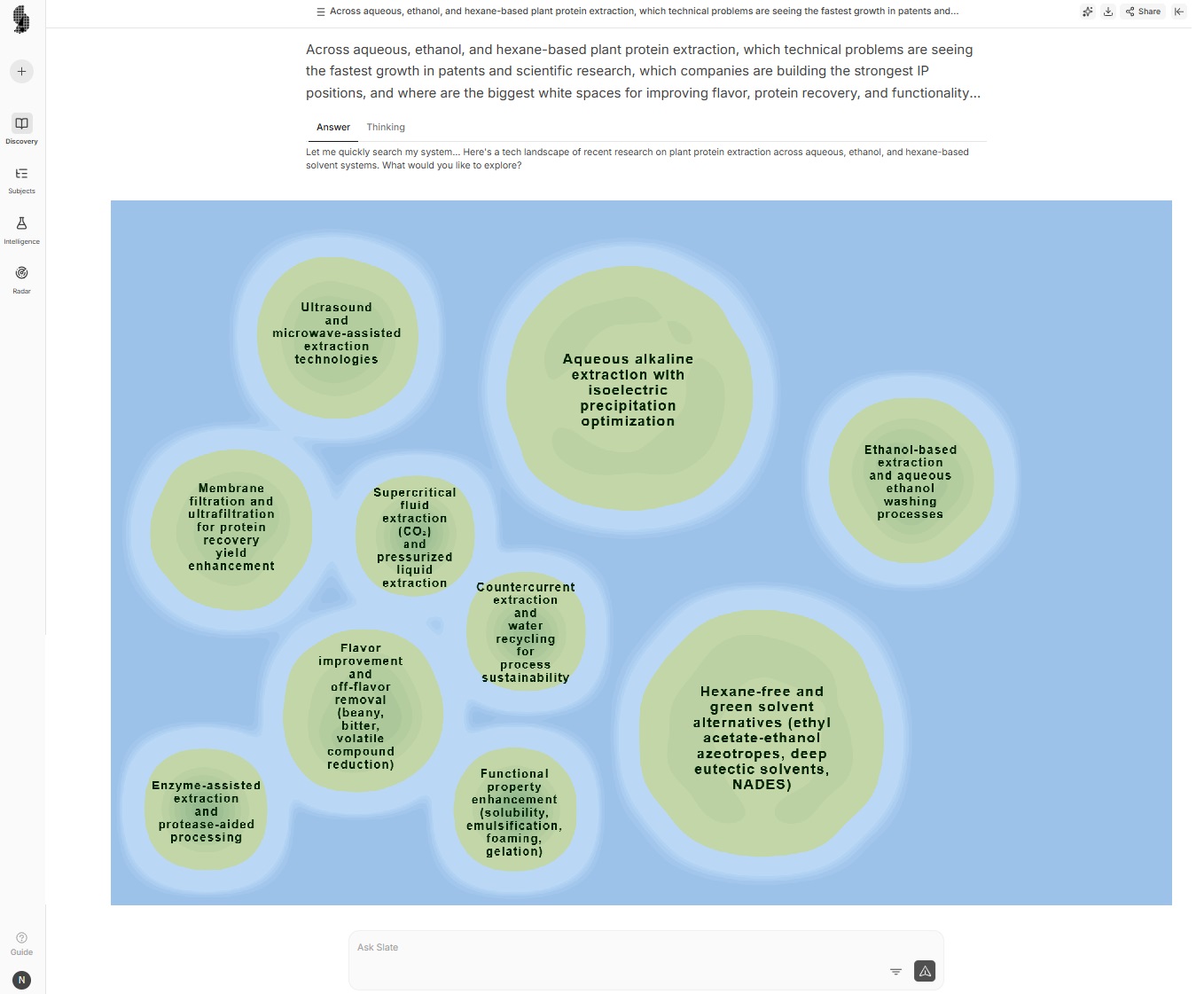
With Slate, an AI-powered R&D intelligence platform for F&B and innovation teams can
- Search patents and scientific literature together rather than repeating the same research across multiple databases.
- Trace findings back to patents and publications so technical conclusions can be checked before they influence an R&D decision.
- Compare competing technologies based on their mechanisms, reported performance, limitations, and development activity.
- Identify technical white spaces by finding problems that remain unresolved and approaches that have received relatively little attention.
- Map companies, startups, suppliers, and patent owners working on a specific technical problem.
- Track technology momentum across new patents, publications, companies, and research activity instead of relying on a static landscape.
- Ask deeper follow-up questions without rebuilding the research process each time the investigation moves in a new direction.
Slate helped us pull together relevant innovations, group them by extraction approach, and see which methods have real momentum behind them, which ones keep hitting the same limitations, and where the open technical gaps still are.
The benefit for a researcher is not simply getting more results. It is spending less time assembling evidence manually and more time deciding which technologies deserve deeper investigation, which companies are worth evaluating, and where the next R&D opportunity could emerge.

Frequently Asked Questions
What is the main difference between aqueous and ethanol protein extraction?
Aqueous extraction uses water, often with salt assistance, to maximize protein yield and is best for high-volume, cost-sensitive applications. Ethanol extraction uses alcohol-water mixtures to selectively remove off-flavors and anti-nutritional factors, delivering superior sensory profiles but lower protein recovery. The choice depends on whether your priority is cost per gram of protein or organoleptic quality in the final product.
Why is hexane extraction no longer used for clean-label protein bars?
Hexane leaves residual solvent traces that require declaration on ingredient labels, automatically disqualifying products from clean-label positioning. Consumer perception issues and tightening retailer standards have made hexane-based processing a categorical exclusion from premium protein bar segments, not a compromise that can be managed with better purification.
Which companies control the IP for hexane-free protein extraction?
Five ingredient processors dominate high-purity extraction IP: Louis Dreyfus Company controls ethanol-based sunflower protein methods, Burcon Nutrascience holds salt-assisted hemp extraction patents, and Roquette Freres, Arla Foods, and Fonterra maintain significant positions in pea, dairy, and aqueous processing technologies. This consolidation means most protein bar manufacturers do not own the extraction chemistry they depend on.
Can you achieve both high protein yield and neutral flavor in a single extraction process?
No current extraction method achieves both at industrial scale. Ethanol extraction delivers clean flavor but sacrifices 15-25% of extractable protein. Aqueous methods maximize yield but require multiple ultrafiltration passes to remove phenolic compounds and off-notes. This yield-flavor trade-off remains the active frontier of R&D, and suppliers claiming both are likely using post-extraction masking agents that compromise clean-label claims.
How much does it cost to build captive protein extraction infrastructure?
Industrial-scale high-purity extraction infrastructure requires hundreds of millions in capital expenditure for steam infusion systems, ultrafiltration equipment, and solvent recovery loops, plus years of scale-up to reach cost parity with established processors. This capital intensity creates a high barrier to entry and explains why most protein bar manufacturers rely on specialized ingredient processors rather than building vertical extraction capabilities.
What should I ask my protein supplier to verify they can support clean-label products?
Request documentation of hexane-free processing with residual solvent testing below 10 ppm, side-by-side sensory data comparing their aqueous versus ethanol isolates at equivalent protein concentrations, and evidence of either proprietary extraction IP or documented licensing agreements with the five dominant processors. Without this documentation, you are dependent on commodity isolates that will not support differentiation in premium clean-label segments.