Ask AI which technologies could solve your R&D challenge, and you will likely get a convincing list. Now ask which ones you should stop considering.
That second question is harder. It requires checking technical constraints, comparing conflicting research, identifying patent barriers, and understanding where the evidence is still weak.
Yet these are exactly the decisions R&D teams make before committing resources to a new technology.The real test of AI in R&D is not how many possibilities it finds, but how effectively it helps narrow them down.
In this guide, we will explore what separates AI-generated research from research that supports real R&D decisions, how to evaluate the reliability of AI recommendations, and how tools like Slate help researchers compare evidence, identify risks, narrow down technologies, and stay informed about new developments.
AI Can Speed Up Research, but Can It Improve R&D Decisions?
AI is already saving R&D teams hours of work. It can summarize scientific papers, draft technical reports, and help researchers explore unfamiliar technologies in seconds. But there is a difference between using AI to complete a research task and relying on it to decide what to pursue next.
Consider a researcher exploring biodegradable packaging. Asking AI to summarize 20 scientific papers is one thing. Asking it to identify which coating technology deserves six months of development is another.
The first task requires organizing information. The second requires evaluating evidence, checking technical constraints, and ruling out unsuitable options.
Here is how the two differ:
| Comparison Criteria | Generating research content | Supporting R&D decisions |
| Typical tasks | Summarizing papers, drafting reports, brainstorming ideas | Selecting technologies, evaluating feasibility, identifying risks |
| What matters most | Speed, clarity, and relevance | Evidence quality, technical fit, and reliability |
| What AI needs to do | Find, organize, and explain information | Compare evidence, test constraints, and eliminate weak options |
| Cost of mistakes | Additional editing or verification | Wasted experiments, delayed projects, and costly development decisions |
| Where general AI helps | Quickly producing useful first drafts and summaries | Providing initial insights, but requiring deeper validation before decisions |
The Real Value of AI in R&D Is Knowing What to Rule Out
Finding potential solutions is often the easy part of R&D. The real challenge is figuring out which ones are worth pursuing.
Think about a formulation scientist evaluating ten ingredients for a new product. All ten might look promising in published research. But some may fail under the required processing conditions, others may be too expensive to scale, and a few might raise regulatory concerns.
The scientist needs to narrow the list to the two or three ingredients worth testing, with clear evidence supporting each choice.
The same applies to technology scouting. Finding emerging technologies is useful, but R&D teams also need to assess their technical readiness, commercial potential, and patent risks before investing.
This is where research platforms like Slate, an AI-powered R&D intelligence platform can help. It evaluates potential solutions against technical constraints, examines supporting and conflicting evidence, and helps researchers identify which options are worth pursuing and which can be ruled out.
For R&D teams, eliminating unsuitable options early means fewer wasted experiments, lower development costs, and more resources directed toward promising technologies.
Two Ways AI Can Lead R&D Research Off Track
AI-generated answers can look convincing even when they miss important details. For R&D teams, these gaps are not always easy to spot, especially when the response includes technical explanations and supporting references. Here are two common ways this happens.
1. It overlooks important technical constraints
R&D questions rarely come with simple requirements. Consider a PFAS-free barrier coating that must be heat-sealable below 120°C, meet food-contact regulations in the EU and US, and remain compatible with paper recycling.
A general-purpose AI assistant might recommend materials that meet some of these conditions but overlook others. The answer may sound technically correct, even though the suggested materials do not satisfy every requirement. This creates a false sense of confidence. Researchers may end up spending time evaluating solutions that should have been ruled out much earlier.
2. It changes its answer when challenged
Have you ever questioned an AI recommendation and received a completely different answer? An assistant might initially recommend a technology as the best option. But when you question its feasibility, it may agree and suggest another, without presenting any new evidence. The problem is that both answers can sound equally convincing.
For R&D teams, a recommendation should hold up when questioned. If the conclusion changes, there should be new evidence or a clear reason behind it. The real risk is not just getting an incorrect answer. It is making an R&D decision without realizing that the answer was never properly validated.
More Research Does Not Always Mean Better Evidence
You ask AI to explore a new technology. Within minutes, it generates a detailed report with relevant studies, potential applications, and competitor activity. It may even highlight market opportunities.
It looks like hours of research have been completed. But how much of it actually helps you make a decision?
A single patent could change whether a technology is commercially viable. A recent regulatory update might rule out a promising material. Or a study with conflicting results could raise questions about its performance.
Yet these critical findings can get buried in pages of AI-generated content, given the same importance as everything else. Now the researcher has to review the entire report, identify the findings that matter, and verify the evidence before making a decision.
AI may have reduced the time spent gathering information, but it has not necessarily reduced the work needed to evaluate it. For R&D teams, the real value comes from knowing which findings matter, how they affect the available options, and what needs further investigation.
The Real Cost of Getting R&D Decisions Wrong
An AI-generated recommendation might look convincing today. The problems often appear weeks or months later. Imagine spending months testing a promising formulation, only to discover that it cannot meet manufacturing requirements. Or reaching the pilot stage before finding a competitor’s patent that limits commercialization.
These are not just research setbacks. They mean wasted experiments, delayed product launches, and R&D budgets spent on directions that could have been ruled out earlier.
The bigger risk is that AI-generated answers can create confidence before the evidence has been properly checked. For R&D teams, the costliest mistakes are often the ones that go unnoticed until significant time and resources have already been invested.
Why General-Purpose AI Struggles With Complex R&D Research
These problems are closely linked to how general-purpose AI assistants work. They are designed to generate useful responses, summarize information, and answer questions quickly. But complex R&D research requires deeper analysis, careful evidence checks, and an understanding of technical limitations.
Here is where the gaps appear.
1. It generates answers without verifying the science
AI can explain a chemical process or summarize a patent in seconds. But a convincing explanation does not mean the underlying science has been verified. For example, a patent claim containing the phrase “consisting essentially of” has a specific legal meaning. A simplified AI summary might miss that distinction and change how a researcher understands the patent’s scope.
Technical research requires more than summarizing text. It requires checking the original evidence and preserving details that affect the conclusion.
2. It may miss critical details in research documents
Important findings are not always in a paper’s abstract or a patent’s summary. They may appear in experimental tables, patent claims, drawings, or sections discussing limitations. General-purpose AI assistants that rely mainly on search snippets and abstracts can overlook these details.
Even when full documents are available, AI models can miss relevant information buried in lengthy technical material. For R&D teams, that missing detail could be the difference between a promising technology and one that is unsuitable for development.
3. It may favor agreement over challenging assumptions
When researchers ask AI to evaluate a technology they believe is promising, the response may focus heavily on supporting evidence. Conflicting studies, technical limitations, or reasons the technology might fail may receive less attention.
This tendency can become more apparent when an AI assistant changes its recommendation after a researcher challenges it, even without new evidence. A reliable research process should test the original assumption, examine opposing findings, and explain why a conclusion is supported.
4. Access to more data does not automatically improve research quality
Connecting an AI assistant to patent databases or scientific literature can improve the information available to it. But access alone is not enough.
The system still needs to identify relevant documents, connect findings across sources, compare conflicting evidence, and evaluate each result against the research question. Without that process, researchers may simply receive longer answers with more citations, while the important gaps remain.
For R&D teams, reliable AI research depends on more than access to scientific data. It also requires a structured process for evaluating evidence and knowing when a conclusion is strong enough to act on.
What R&D Teams Should Expect From AI Research Tools
A useful AI research tool should do more than provide convincing answers. It should help researchers evaluate options, identify risks, and make decisions backed by evidence.
Here are five capabilities that matter most.
- Narrow down the options. Identify which technologies are worth pursuing, which should be ruled out, and the evidence behind each decision.
- Consider every technical constraint. Evaluate solutions against all requirements, including performance, processing conditions, cost, and regulatory compliance.
- Examine complete research documents. Look beyond abstracts and summaries to assess patent claims, experimental results, tables, and technical limitations.
- Challenge the initial findings. Search for conflicting studies, contradictory evidence, and potential risks that could change the recommendation.
- Make findings easy to verify. Link conclusions to specific patents, research papers, and supporting evidence so researchers can check them.
These capabilities turn AI from a tool that simply gathers information into one that helps R&D teams evaluate what is worth pursuing. The goal is not to replace scientific judgment, but to give researchers stronger evidence for making decisions.
How Slate Helps R&D Teams Move From Research to Decisions
R&D teams need more than an AI assistant that finds information. They need a system that understands technical problems, evaluates possible solutions, and helps them decide what to pursue.
That is why we built Slate, an AI-powered R&D intelligence platform designed to help researchers move from exploring possibilities to making evidence-backed decisions.
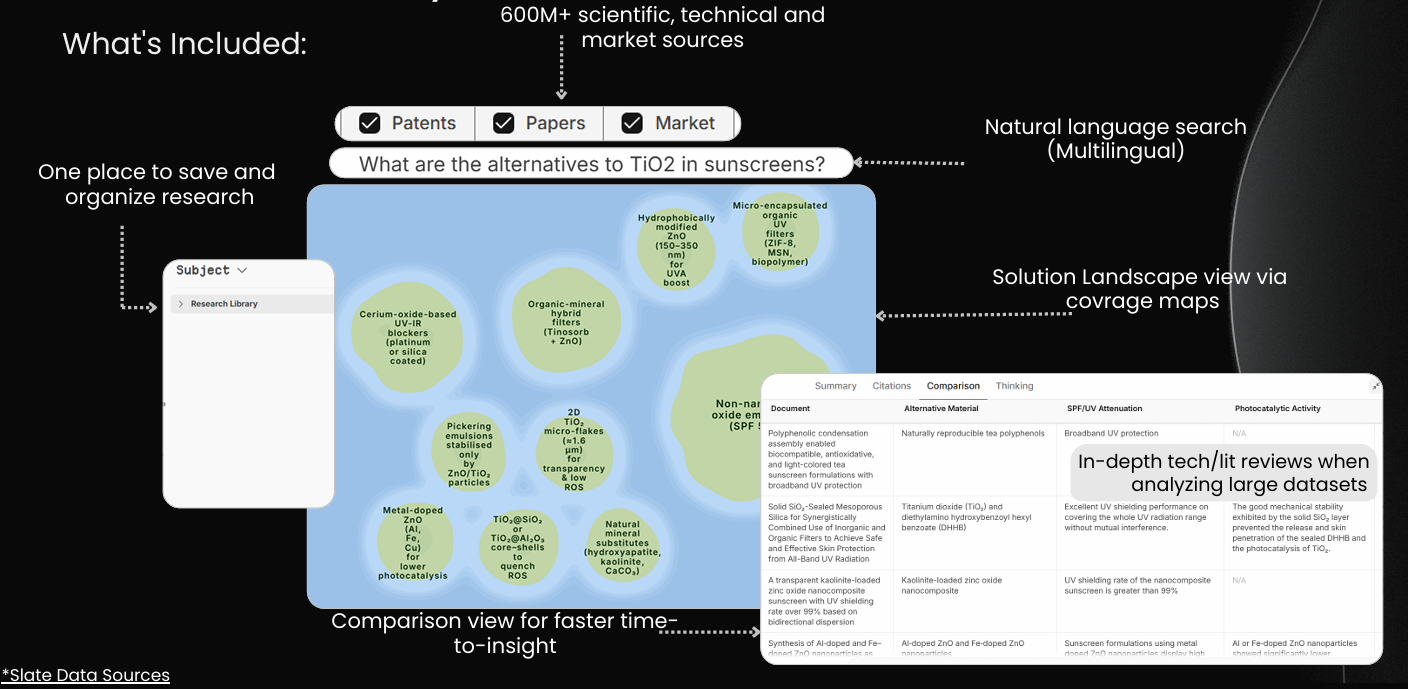
At its core is Research Agent, which works like a dedicated research team. You bring your R&D challenge, and it breaks the problem into smaller questions, brings in specialized AI agents, and connects findings from patents, scientific literature, and other technical sources. The result is a clearer view of what works, what does not, and which directions are worth pursuing.
Here is what makes Slate useful for R&D teams.
- Research built around your problem. Research Agent breaks complex questions into smaller tasks and creates a research plan before investigating potential solutions.
- Multiple constraints evaluated together. Compare technologies against processing conditions, performance requirements, regulatory restrictions, and other technical needs without losing sight of the original question.
- Scientific and patent evidence in one place. Explore research papers, patent claims, regulatory information, competitor activity, and supplier intelligence without switching between multiple research tools.
- Supporting and conflicting evidence. See what supports a technology, what challenges its claims, and where the evidence is still too weak to draw a conclusion.
- Clear reasons to pursue or reject options. Compare potential solutions, identify technical and commercial risks, and narrow the field before committing resources to development.
- Findings you can verify. Trace research conclusions back to their supporting papers, patents, and other sources rather than relying on AI-generated explanations alone.
- Research that evolves with your questions. Add constraints, challenge recommendations, investigate competitors, or explore suppliers within the same research thread. Research Agent retains the context as the investigation develops.
You do not need to decide which agent to use or build a complex series of prompts. Research Agent coordinates the investigation while your team focuses on evaluating the findings.
With Slate, the goal is not to give researchers another long report to review. It is to help them understand what the evidence supports, what remains uncertain, and which R&D directions deserve their attention.
Better R&D Decisions Start With Better Research Data
Even the most advanced AI cannot give reliable recommendations without access to the right evidence. A technology might look promising in scientific papers but face patent restrictions, regulatory challenges, or manufacturing limitations. Researchers need to examine these signals together before deciding whether it is worth pursuing.
Slate brings this information into one research platform, combining scientific literature, patents, regulatory records, company intelligence, ingredient data, and other sources relevant to R&D decisions.
Here is the data available through Slate.
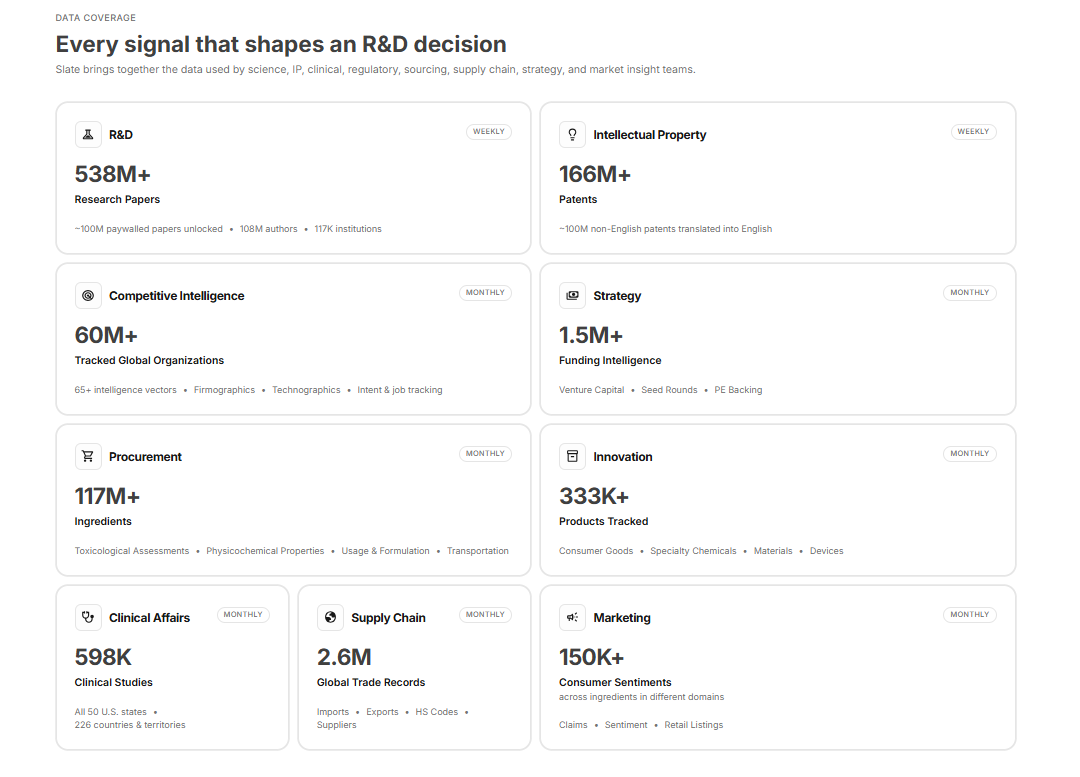
But having access to millions of records is only useful if researchers can find and connect the evidence that matters. This is where Slate comes into play. That experience has helped shape how Slate approaches research questions, connects findings across different sources, and evaluates supporting and conflicting evidence.
For example, a researcher evaluating a new ingredient can explore its scientific performance alongside patent activity, regulatory requirements, potential suppliers, and competing products. The value is not simply having more data. It is being able to connect that data to the R&D decision at hand.
How Slate Turns Research Into Decisions You Can Trust
Finding relevant information is only the first step. Slate helps R&D teams evaluate that information, compare possible solutions, and identify which directions are worth pursuing.
Here is how it addresses the five requirements of reliable R&D research.
| What R&D teams need | How Slate helps |
| Know what to pursue and what to reject | Research Agent evaluates potential solutions, highlights their strengths and limitations, and helps narrow down options with clear reasons for each recommendation. |
| Evaluate every technical constraint | Breaks complex research questions into individual requirements and examines them across scientific literature, patents, and other relevant sources. |
| Look beyond abstracts and summaries | Specialist agents examine patent claims, experimental results, tables, and technical details to uncover evidence that shorter summaries may miss. |
| Find evidence that challenges a recommendation | Compares supporting and conflicting findings, identifies research gaps, and distinguishes established results from claims that need further validation. |
| Verify findings before making decisions | Connects findings to relevant patents, scientific papers, and source references so researchers can examine the evidence themselves. |
The difference is in what researchers get at the end. Rather than another list of promising technologies, Slate helps teams understand which options meet their requirements, where the risks lie, and what deserves further investigation.
From a Research Question to an R&D Action Plan
How does this work when an R&D team faces a real technology challenge?
In a recent investigation, a coatings supplier wanted to understand what had changed in its technology landscape over the past 12 months and whether emerging innovations threatened its existing product.
Using Slate’s AI R&D platform, the researcher started with this question. Research Agent created a research plan, identified what evidence was needed, and began investigating. When its initial findings revealed gaps in the market analysis, it carried out further research to address them.
The investigation then moved deeper. Within the same conversation, the researcher was able to:
- Analyze competitor patents to understand potential threats.
- Benchmark the existing product against emerging alternatives.
- Assess technology readiness to identify which innovations were closer to commercial use.
- Explore potential partners for future development.
- Compare three development routes based on the available evidence.
The outcome was more than a technology landscape report. The researcher had a clearer view of which directions deserved investment, which needed further validation, and which two could be ruled out for now.
Throughout the investigation, Research Agent maintained the context, linked findings to their sources, and highlighted where evidence was still limited.
One research question had developed into an actionable R&D plan, without restarting the investigation at every stage.
Slate Radar Keeps Track of What Changes in Your Research Area
R&D decisions do not end once a research report is complete. New patents get filed, competitors change direction, regulations evolve, and emerging technologies move closer to commercialization.
Keeping track of these changes across multiple sources can take considerable time. That is where Slate Radar comes in.
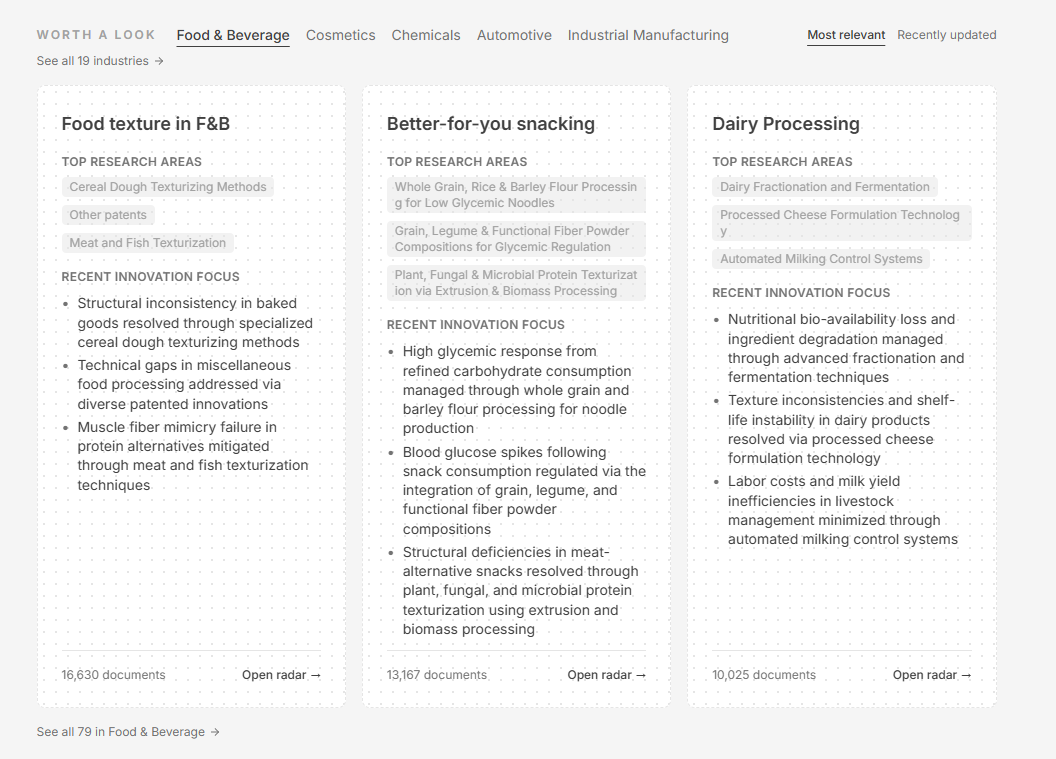
While Research Agent helps you investigate a specific problem, Radar monitors developments that could affect your research and innovation priorities.
With Radar, R&D teams can:
- Track competitor activity. Spot new patent filings, research developments, and changes in technology focus.
- Monitor emerging technologies. Identify new players, growing research activity, and shifts in patent filing trends.
- Stay informed about regulatory changes. Follow updates that could affect ingredients, materials, or product development.
- Connect signals across sources. Identify patterns that may not be obvious when patents, papers, and company activity are reviewed separately.
- Investigate important developments. Use Research Agent to explore what a new signal means for your technology or R&D strategy.
The two work together. Radar helps you spot what is changing, while Research Agent helps you understand what those changes mean and whether they require action.
What Changes for R&D Teams Using Slate?
Here is how Slate can improve the way teams research, evaluate, and monitor technologies.
| Common R&D research challenges | How Slate helps |
| Research is scattered across patents, papers, regulatory databases, and company sources. | Brings relevant R&D evidence together so teams can investigate a problem without searching each source separately. |
| Researchers spend hours deciding what to search and which tools to use. | Research Agent plans the investigation and coordinates specialist agents based on the research question. |
| AI-generated recommendations require extensive manual verification. | Links findings to supporting sources and distinguishes established evidence from claims that need validation. |
| Promising technologies are identified without fully examining their limitations. | Compares supporting and conflicting evidence to help teams identify risks and rule out unsuitable options. |
| Research context gets lost when moving between different tools or questions. | Keeps the investigation in one thread, allowing researchers to add constraints and explore new directions. |
| Important competitor or technology developments are discovered too late. | Radar monitors relevant patents, research, regulations, and company activity to surface changes. |
| Research findings remain buried in reports or conversations. | Helps turn research findings into reports and dashboards that teams can use to communicate decisions. |
The biggest change is how research connects to decisions. Research Agent helps teams evaluate what is worth pursuing, while Radar keeps them informed as the evidence and technology landscape evolve.
Use Slate Within the AI Tools Your Team Already Knows
Your R&D team may already use Microsoft Copilot, Gemini, or Claude for everyday research tasks. But what if those same tools could access scientific papers and patent data directly?
With Slate MCP (Model Context Protocol), they can.
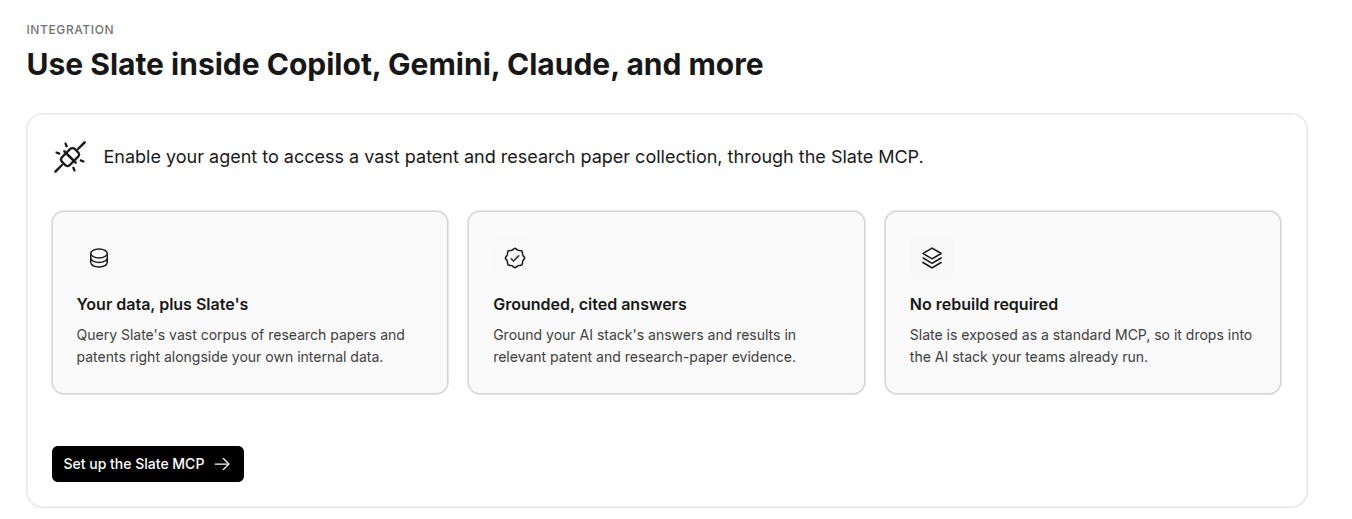
MCP is an open standard that connects AI assistants to external tools and data sources. Slate uses it to make its patent and scientific research data accessible within compatible AI assistants.
Here is what this means for your R&D workflow.
- Combine internal and external research. Work with your company’s internal information alongside Slate’s patent and scientific literature data in the same conversation, where your assistant supports both connections.
- Get answers backed by evidence. Ask technical questions and receive findings linked to relevant patents and research papers, making it easier to verify important claims.
- Keep your existing AI workflows. Connect Slate to compatible AI assistants without requiring your team to move all its work to another platform.
- Create better research documents. Draft technical summaries, project updates, and research reports using retrieved scientific evidence rather than relying only on the assistant’s existing knowledge.
Use Slate MCP when you want to access scientific and patent evidence within the AI assistant your team already uses. Research Agent can coordinate specialized research tasks, compare technologies, and evaluate competing evidence. Radar can then monitor new developments that may affect your decisions. The choice depends on how your team works and how complex the research question is.
Your existing AI assistant can help you write and organize information. Slate brings in the research evidence needed to evaluate it and make more informed R&D decisions.
Three Simple Ways to Test Your AI Research Tool
How reliable is the AI tool your R&D team currently uses? You can find out with three practical tests.
- Check whether it follows every requirement. Give AI a research question with five specific constraints, such as performance, cost, processing conditions, regulatory compliance, and scalability. See whether its recommendations meet all five, with supporting evidence for each.
- Challenge its recommendations. Ask why a suggested technology is the best option or question its feasibility. Does AI defend its recommendation with evidence, acknowledge uncertainty, or simply change its answer to agree with you?
- Verify the original sources. Select three important findings and ask for the exact patent claims, research papers, or experimental results supporting them. Check whether the references exist and actually support the conclusions.
A reliable AI research tool should do more than give convincing answers. It should help you understand why a recommendation holds up, where the evidence is weak, and what still needs verification.
Better R&D Decisions Start With Better Evidence
AI can help you find promising technologies faster. But the real value comes from knowing which ones are worth pursuing and which should be ruled out.
That is what we built Slate to help R&D teams do. It brings together scientific research, patent intelligence, and technical evidence to help researchers evaluate options before committing time and resources.
Have a research question your team is working on?
Bring us a technology you are evaluating, a competitor’s recent development, or a technical challenge you are trying to solve. We will explore it with you in Slate and show you how Research Agent can help turn the available evidence into clearer R&D decisions.