Generic AI vs. Slate: What a Global CPG Manufacturer Found When They Ran the Same R&D Brief Through Both
How the R&D team discovered that confident AI output and decision-grade intelligence are not the same thing when it comes to committing R&D budget.
The Situation
R&D team needed to map technology and ingredient landscape before a stage-gate decision
Before committing R&D budget, the team at a global consumer goods manufacturer needed answers to questions that would directly affect investment, regulatory, IP, and product strategy.
What mechanisms were scientifically validated? Who held the relevant IP? What had competitors already launched? Where were the genuine white spaces?
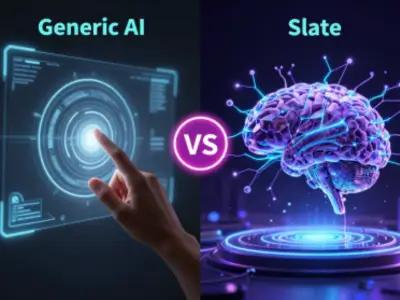
They ran two parallel research exercises: one using a leading general-purpose AI and one using Slate. The team gave both tools an equivalent brief and compared the results. What they found changed how they thought about AI-assisted research. The outputs weren’t just different in style. They differed in truthfulness.
“Before I could act on a single recommendation in the AI report, I had to verify whether the foundations were real. That’s fact-checking at scale rather than research.”
— Senior R&D Scientist, Global Consumer Goods Manufacturer
What the Generic AI Produced
The general-purpose AI report arrived first. On first reading, it was impressive. Twenty-five technology concepts, organised by mechanism and delivery format. Technology Readiness Levels assigned to each. Supplier names. Academic contacts. Patent numbers cited throughout. It read like a senior analyst had spent weeks in the literature.
Standard R&D due diligence began turning up problems. Not minor inconsistencies. Foundational errors, stated with the same fluent confidence as everything else in the report.
The Hallucination Registry: What the Generic AI Got Wrong
Generic AI Claim | What Is Actually True | Risk to R&D Decision-Making |
| A clinical meta-analysis cited as covering 13 randomized controlled trials | The actual paper (Hemilä & Chalker, 2015, Cochrane) analysed three RCTs on the active ingredient. Not thirteen. | The entire clinical substantiation rationale for one technology category was built on an evidence base overstated by more than four times. Any regulatory or investment submission using this figure would collapse under scrutiny. |
| A P&G patent cited as covering ‘mentholated lotion tissue’ (US6475501B1) | The patent covers antiviral tissue using water-soluble metal ions (aluminium, copper). No menthol. No lotion. | Fundamental mischaracterisation of a competitor’s IP position. Anyone using this for freedom-to-operate analysis or competitive positioning would draw incorrect strategic conclusions. |
| A market entrant flagged as an ‘emerging player’ in an active ingredient category | The company’s products in this ingredient category were recalled by the FDA in 2009 following hundreds of reports of permanent nerve damage. Their product line in this space no longer exists. | The recall is the primary safety precedent for an entire technology sub-category. Understating it as a ‘controversial past’ and framing the company as a going concern is a material risk to any ingredient strategy in this area. |
| A major research institution listed as an active collaboration partner across six technology areas | The research centre in question closed in 2017 upon its founder’s retirement. It no longer exists. | Six partnership recommendations, each specific and actionable, would lead to outreach to a retired emeritus professor and a defunct centre. An immediate credibility loss in the field. |
| Five patent numbers cited as relevant IP across multiple technology areas (e.g., EP3575469A1, WO2007147689A1, EP2310020B1, EP1680219B1, EP2272510A2) | Cross-check against EPO and WIPO databases: two patents do not exist; two describe entirely unrelated technologies (electrode manufacturing, woven filament production); one covers anticancer chemistry. | These are the citations that would be sent to the IP team for FTO analysis. Every one of them is either fabricated or misattributed. The verification burden falls entirely on the reader. |
| A leading consumer tissue product described as the global category leader, named incorrectly throughout | The product is a US-only SKU and is not sold in European or Asian markets. Its legal product name was also incorrect, misrepresenting the manufacturer’s regulatory positioning strategy. | For a team operating in European markets, a US-only benchmark framed as a global reference point produces a fundamentally skewed picture of the competitive landscape and what is commercially validated. |
| A clinical figure (‘40–80% premium’ for a product subcategory) stated as an established commercial fact | No market data source cited. The figure cannot be verified. | Unverifiable market sizing is indistinguishable from hallucinated market sizing. A CFO or business development director reviewing this would require independent verification before any commercial model could be built. |
The Core Problem With Generic AI Research
What Slate Delivered
Slate’s Intelligence report was generated from a single query. No follow-up prompts. No scope refinement. No instruction to “also consider regulatory aspects” or “now check competitive intelligence.” One query, one pass.
The output was structurally different from the Generic AI report in one decisive respect. Every claim was anchored. Patent numbers linked to real filings. Clinical data cited with DOIs, publication dates, and p-values. Competitive moves sourced from launch records and filing dates. Market data traced to named research firms with publication years.
Slate surfaced intelligence the Generic AI couldn't reach
- Current competitive signals. A verified 2024 competitor product launch surfaced, with the manufacturing method cited and traceable to the specific patent used. The Generic AI’s training data hadn’t captured it.
- IP landscape currency. Jurisdiction-specific patent filing activity from Asian competitors in the same technology space, with exact filing dates. Early signals of a competitive move that a training-data-bounded system couldn’t reach.
- Novel innovation opportunity. Six distinct whitespace areas in the patent landscape where no existing IP was identified. The Generic AI report didn’t cover any of them.
- Decision-grade technical depth. Production-level formulation specifications drawn from primary research: precise particle sizes, encapsulation efficiencies, bioavailability ratios. Numbers a formulation team can actually use, not just reference. Examples from the output: chitosan nanoparticle at 172 ± 0.4 nm with 90.5% encapsulation efficiency; bromelain nanocarrier at 259.73 ± 16.51 nm with 2.89-fold bioavailability improvement; lotion deposit basis weight at 11 to 30 g/m2 per deposit.
- Claim-level regulatory clarity. The analysis mapped to specific CFR sections, EU doctrine, and enforcement case precedents by case number. Claim-level precision that legal and regulatory teams could work from directly.
- Clinical evidence currency. A clinical RCT with p-values of 0.0008 and 0.0089, cited with a 2025 DOI for a key ingredient category that is current, specific, and verifiable.
- Mechanism diversity. An olfactory stimulation pathway as a distinct biological route to the same functional outcome through a completely different biological pathway, with a 2022 clinical study cited by DOI.
"Slate report is the sharper strategic instrument. It tells me things I actually need before committing R&D budget. The organisational capability gap section was particularly valuable. It also highlighted I'd need regulatory expertise we don't currently have."
— Head of R&D, Global Consumer Goods Manufacturer
The Evidence Quality Scorecard
Dimension | Generic AI | Slate |
| Source traceability | ●●○○○ Needs verification | ●●●●● Fully auditable |
| Patent intelligence | ●●○○○ Plausible, unverified | ●●●●● Search-validated |
| Scientific literature | ●●●○○ Plausible, unverified | ●●●●● Cited from source |
| Competitive intelligence | ●●○○○ Static / generic | ●●●●● Current and specific |
| Regulatory precision | ●●●○○ Directional guidance | ●●●●○ Claim-level precision |
| Manufacturing fit | ●●○○○ Conceptual only | ●●●●○ Decision-grade detail |
| Investment decision support | ●○○○○ Requires validation first | ●●●●● Stage-gate ready |
| Risk transparency | ●●○○○ Overconfident in places | ●●●●● Transparently bounded |
What this difference actually means
The Generic AI report has value at the right stage of the research process. Its breadth across technology concepts is useful for early horizon scanning and briefing a technology team on the option space. The TRL framework and three-tier prioritisation give a reasonable first filter.
The R&D team’s experience with both reports gives a clear view. The Generic AI report is useful for early ideas. It can help brief a technology team, explore possible options, and decide what to study next. However, any citation from the report must be checked independently before it is used in legal, investment, or regulatory work. In the end, the report creates extra verification work and can’t be used as a decision-grade analysis.
The Slate output is described by the team as something they could take directly to a stage-gate review. The sourcing is explicit, the regulatory analysis is claim-level, the competitive intelligence is current, and the uncertainty is flagged honestly rather than papered over with confident language.
Slate surfaced something the Generic AI couldn’t: a business trade-off inside the client’s own organisation. It showed that this product innovation would compete with nearby, higher-margin categories. It also mapped the minimum market share needed to make the idea viable, the highest price premium possible under each claim strategy, and the expected payback period using the client’s actual financial baseline.
It then flagged the specific regulatory expertise the client doesn’t have and would need before a particular ingredient strategy could be executed.
Those aren’t observations a general-purpose AI can generate. They require integrating live IP and regulatory intelligence with the client’s known commercial context. Slate sits inside your R&D workflows; it’s like having a dedicated researcher in your team who already knows your field, company, competitors, technologies that matter, and where the market is moving. Slate understands what’s at stake in the decision, and won’t let you walk into a boardroom missing the question that will sink you.
“The Generic AI report is an excellent formulation reference. But it was written in a vacuum. It doesn’t know what our lines can do, doesn’t grapple with our actual production constraints, and its strategy section is generic. The Slate report is the one I’d take to the investment committee.”
— Head of R&D, Global Consumer Goods Manufacturer
The R&D team ran this comparison to find a better AI for research. What they found was a sharper question: not which AI gives better answers, but what does it actually cost when the answers are wrong?
In R&D, the cost isn’t a corrected footnote. It’s a stage-gate decision made on fabricated evidence. A freedom-to-operate analysis built on patents that don’t exist. A regulatory submission that collapses the moment a reviewer checks the source.
The question most R&D teams ask is: how do we move faster?
The better question is: how do we move faster without betting the decision on something we haven’t verified?
Speed built on accurate intelligence compounds. Speed built on hallucinated citations corrects slowly, expensively, and usually at the worst possible moment.
Confidence is not the same as accuracy. The R&D teams that will win the next decade aren’t the ones with the most AI. They’re the ones who learned the difference between an AI that sounds certain and an AI that has earned it.
Accelerate Your Innovation Discovery with Slate
Get a demo and explore how leading R&D teams use Slate to streamline discovery, stay ahead of competitors, and drive innovation.
- 14-day free trial
- No credit card required
- SOC 2 Compliant

Slate Eliminated 30% Redundant Research by Fixing State-of-the-Art Discovery Gaps for a Leading Dairy Company

How Slate Accelerated Technology Landscape Reviews for a Global Beauty Brand

A UK Consumer Goods Giant Accelerated Technology Trend Discovery by 40%

Slate Eliminated 30% Redundant Research by Fixing State-of-the-Art Discovery Gaps for a Leading Dairy Company
See Slate in Action
Get a demo and explore how leading R&D teams use Slate to streamline discovery, stay ahead of competitors, and drive innovation.

