Cashmere alternatives are no longer difficult to find. From yak and alpaca to engineered fibers and recycled blends, suppliers can offer materials that look and feel close to the original.
The harder question for a premium knitwear brand is which alternative qualifies for a specific product without losing the cost, quality, or sourcing advantage that justifies the switch.
Cashmere’s scarcity starts with biology. Johnstons of Elgin reports that one goat produces roughly 200 grams of cashmere per year, compared with around 3 kilograms of wool from a sheep. The usable cashmere comes from the fine undercoat collected during the annual molt.
But limited supply is only one part of the challenge. A replacement fiber still has to survive the entire manufacturing journey, from dehairing and dyeing to spinning, knitting, and finishing, while maintaining the softness, loft, and appearance expected from premium knitwear. A lower-cost raw material does not automatically create a lower-cost garment if it requires additional blending, tighter process control, or more finishing.
For sourcing teams, this changes the evaluation process. The goal is not to find the fiber that feels closest to cashmere in a small swatch. The goal is to qualify a material route that can consistently deliver the right garment, through suppliers that match the brand’s cost structure, lead times, quality standards, and compliance requirements.
Softness Alone Does Not Qualify a Cashmere Alternative
A fiber can feel soft in isolation and still fail when it becomes a finished sweater.
The final garment experience depends on more than the fiber itself. Yarn construction, knit structure, and finishing processes all influence how a material feels and performs. In a study of 17 knitted samples made with cashmere, yak, camel, wool, and polyester, researchers found that yarn combinations and fabric structures changed both tactile perception and warmth retention.
This is why two materials with similar fiber-level claims can produce very different garments. A supplier may highlight fiber fineness, softness ratings, or a promising development swatch, but those factors only show part of the picture.
The evaluation needs to move further down the value chain. The important questions are whether the yarn spins consistently, whether the knit maintains its intended surface after brushing, whether color and handle remain stable across batches, and whether the garment still delivers the expected look and feel after use. The right alternative is not the softest fiber on paper. It is the one that performs reliably through the entire manufacturing process and in the final product.
| Sourcing implication: Do not qualify a cashmere alternative at fiber level. Qualify it at finished-garment level against a defined product. |
Three Material Routes Solve Different Sourcing Challenges
The cashmere alternative market becomes easier to evaluate when materials are viewed as different sourcing solutions rather than direct replacements. Natural, engineered, and hybrid routes each solve a different problem, and each comes with its own trade-offs.
Natural Routes Preserve Premium Character
Yak, alpaca, fine wool, and other animal-fiber options can help brands stay closer to the traditional premium knitwear experience. These materials can support qualities such as warmth, breathability, and a natural-fiber positioning.
Cashmere natural alternatives are not interchangeable. Each material creates a different balance between softness, supply availability, price positioning, and sustainability narrative.
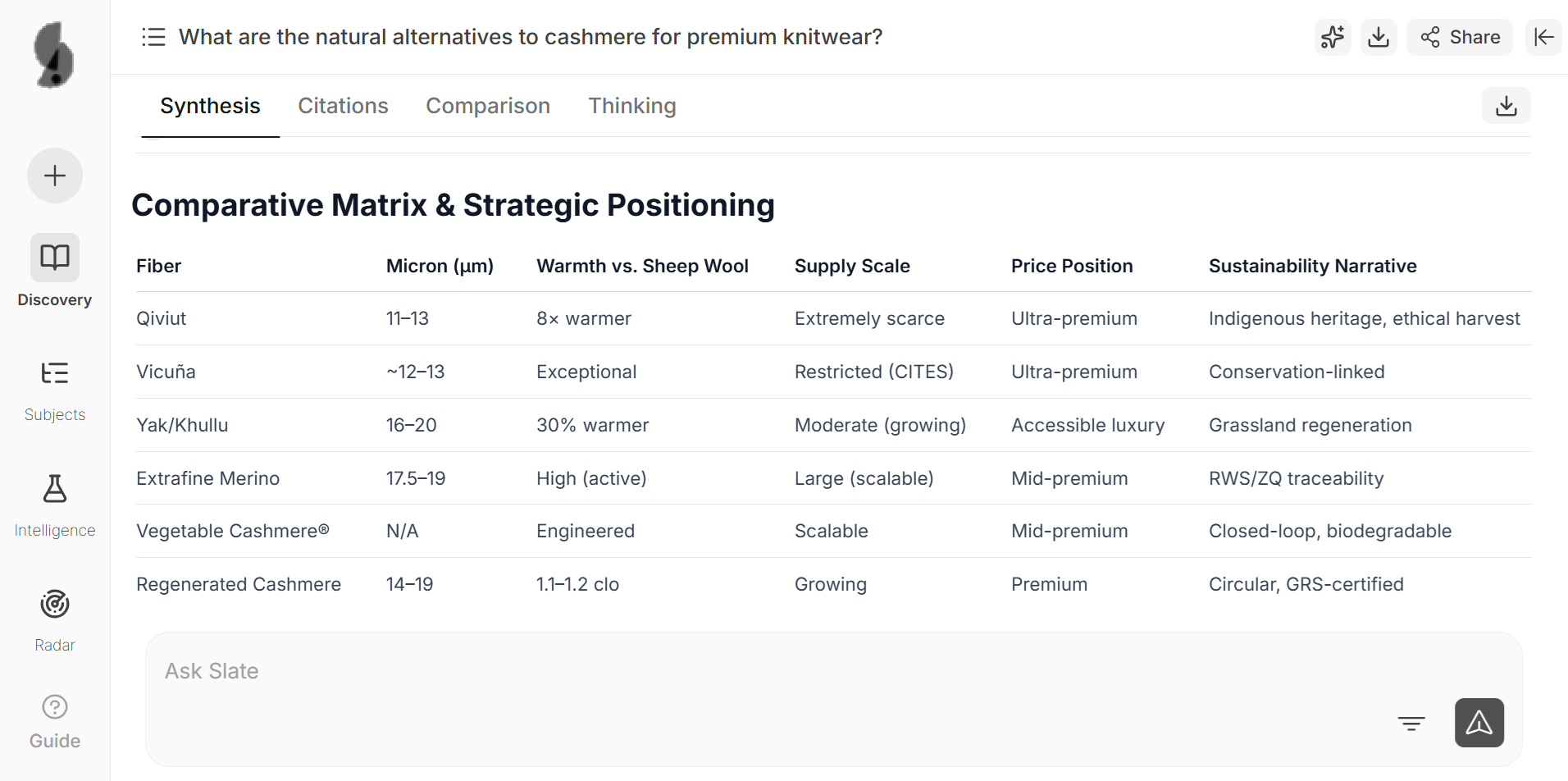
The comparison highlights why sourcing decisions cannot rely on softness alone. A rare fiber such as vicuña may deliver exceptional luxury positioning but cannot support large-scale sourcing. Other options, such as yak or extra-fine merino, may offer a different balance between performance, availability, and commercial feasibility.
This is where supplier qualification becomes critical. A material that appears suitable at the fiber level still needs to be evaluated for consistency, processing requirements, production capacity, and the ability to meet the specifications of a finished garment.
Engineered Routes Improve Control and Consistency
Engineered acrylics, regenerated fibers, and synthetic blends give suppliers greater control over factors such as fiber length, strength, and repeatability. This can create opportunities to improve cost efficiency, production consistency, and performance characteristics such as pilling resistance.
The challenge shifts from sourcing control to garment performance. A material can be technically soft but still feel too uniform, too smooth, or unlike the premium texture customers expect from cashmere-based products.
Hybrid Routes Balance Performance with Complexity
Hybrid yarns are often attractive because they combine different strengths. A natural fiber component can contribute softness and warmth, while an engineered component can improve durability, consistency, or cost stability.
The trade-off is that blends can introduce new challenges around recycling, traceability, and material transparency. This does not make hybrid routes unsuitable. It means sourcing teams need to define exactly what the blend is expected to improve and whether that benefit justifies the added complexity.
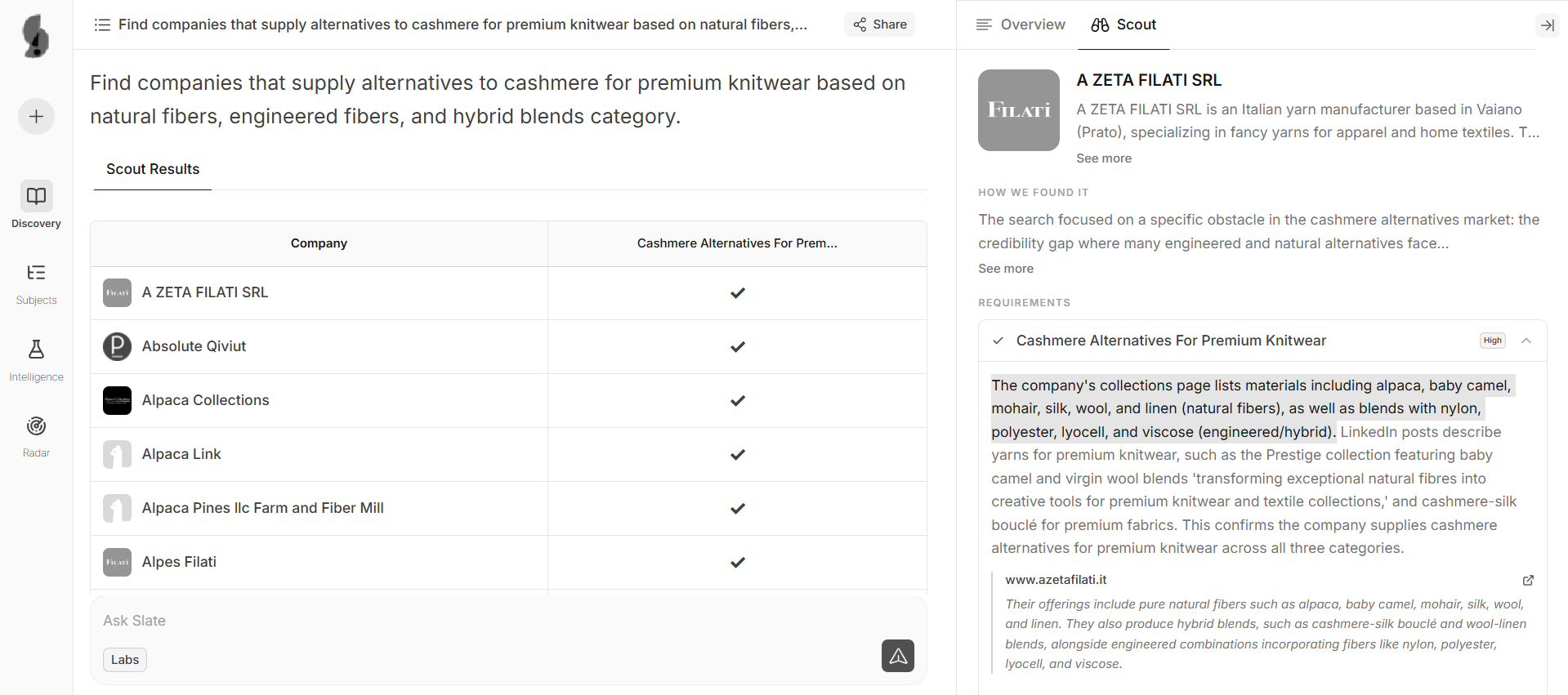
Once the material routes are clear, the next step is identifying suppliers working within each route. The sourcing team can use Slate Scout to map a list of companies offering natural, engineered, and hybrid cashmere alternatives and see what each supplier is actually developing.
Pilling and Recycled Content are Connected by the Same Hidden Constraint
Pilling is not just a surface-level issue. It is closely linked to fiber characteristics that determine how a garment performs over time.
Research on cashmere knitwear has linked shorter fiber content with higher pilling, while other studies have shown that fiber friction also influences pilling behavior. Brushing can improve softness and create a fuller surface, but it can also increase the amount of loose fiber exposed to friction during wear.
This becomes more important when recycled content is introduced. Mechanical recycling reduces fiber length before the material is spun into new yarns, which can affect durability and processing performance. A 2025 study on industrial recycled-wool fabrics found that after another mechanical recycling cycle, woven fabrics retained an average of 84% of their mean fiber length, while recycled knitted fabrics retained 72%. The study also noted that yarn production typically requires fiber lengths of around 20 to 30 mm.
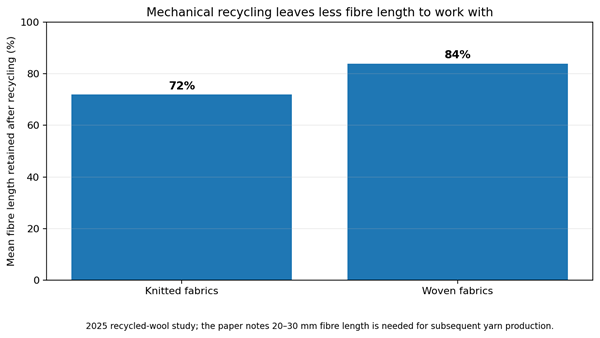
Figure 2. Mean fiber-length retention after mechanical recycling. Source: Glasper et al., 2025.
For sourcing teams, this means recycled content, finishing choices, and product lifespan cannot be evaluated separately. A higher recycled percentage may look positive on paper, but the final yarn and garment construction determine whether the product can maintain its appearance and performance.
This does not mean recycled cashmere or recycled wool should be avoided. The better approach is to define how much recycled content a specific yarn and finishing process can support while still meeting requirements for pilling resistance, appearance, and wear life.
Why One Standardized Hybrid Blend Will Not Work for Every Product
A sourcing team could reasonably ask why not choose one proven hybrid blend and standardize it across the product range. If a material is cost-effective, performs well enough, and works with existing manufacturing processes, a single solution may seem like the simplest path.
The challenge is that a fiber blend is not the final product. The same material can behave differently depending on yarn construction, knit structure, gauge, and finishing process. The 17-sample knit study discussed earlier found that yarn combinations and fabric structures significantly influenced tactile perception and warmth retention. This product-level dependence makes a universal blend attractive from an operational perspective but risky from a product perspective. It may be over-engineered for one application and unable to meet the requirements of another.
There is also a sourcing risk in relying on a single alternative route. Standardizing one blend can recreate the same dependency problem that brands are trying to solve with cashmere. A smaller portfolio of qualified materials may require more management, but it allows sourcing teams to match materials to specific product needs, whether that is premium feel, cost efficiency, brushed textures, or improved circularity.
The goal is not to find one replacement fiber for every product. It is to build a material strategy where each route has a clear purpose.
| The argument: A route portfolio is not indecisive. It stops one material compromise from being forced across products that need different things. |
A Fiber That Runs in a Mill Is Not Automatically Ready for Scale
A new fiber can be technically compatible with current equipment and still affect production performance. It may change yield, waste levels, shade consistency, development timelines, or the amount of supplier support required to achieve the intended garment feel. These factors depend on the supplier, yarn construction, and manufacturing process, so they need to be validated with the actual mill rather than assumed from general material claims.
Conventional wool processing provides a useful reference, but it should not be treated as a benchmark for every alternative route. A life-cycle study using primary processing data from 15 large wool processors in China and India, covering around 15% of Australian wool production, reported net fiber mass loss of approximately 2–3% in a conventional wool garment process. Even an established fiber system has measurable conversion losses, which means new alternatives should prove their own production economics.
The validation process should happen through a same-spec comparison. Evaluate the alternative at yarn or garment level and track trial yield, sample lead time, batch consistency, finishing requirements, and any changes to the supplier’s standard process.
A fiber is only a cost advantage if it remains one after the full production process is considered.
Why Sustainability Evidence Belongs in Material Qualification
Sustainability can no longer be treated as a separate review after a material has already been selected. It increasingly influences which sourcing routes are commercially viable.
For brands evaluating natural cashmere alternatives, the question is not only whether a fiber has a better sustainability story. The question is whether evidence can support that claim across the full product lifecycle.
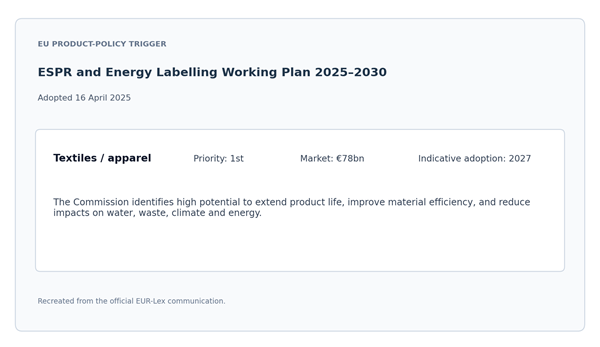
This is becoming more important as regulations move closer to product-level accountability. The EU’s 2025–2030 Ecodesign for Sustainable Products Regulation (ESPR) working plan ranks textiles and apparel as the top priority product group among final products, with a market size of €78 billion and an indicative timeline of 2027 for new requirements. The plan highlights textiles as an area with high potential for improving product lifetime, material efficiency, and reducing impacts related to water, waste, climate change, and energy consumption.
The European Commission’s Product Environmental Footprint approach also evaluates impacts across the full lifecycle, including raw materials, production, logistics, use, and end of life. This means a fiber does not automatically become the better choice simply because it belongs to a certain material category.
Durability is an important part of this assessment. A material with a lower impact profile can lose its advantage if the garment wears out faster and needs to be replaced more often. In a wool sweater life-cycle study, reducing garment use from 109 wears to 15 wears increased environmental impacts and resource use by 5.8 to 6.8 times, while extending use to 400 wears reduced impacts by 49% to 68%.
Traceability and certification also need closer attention. The Sustainable Fiber Alliance Chain of Custody Standard v1.1 came into effect in March 2025, and the organization later acknowledged implementation weaknesses in parts of its certification system during 2022 to 2024. For sourcing teams, this reinforces the need to evaluate certifications as evidence systems that support supplier decisions rather than as standalone sustainability signals.
A material should not be approved because it has the right sustainability label. It should be approved because its origin, processing, durability, and end-of-life pathway can be verified.
| Sourcing implication: Origin, chain of custody, processing, durability, and end-of-life evidence should be part of supplier qualification, not a separate sustainability review at the end. |
A Practical Framework for Qualifying Cashmere Alternatives
The value of a cashmere alternative is not proven by the material itself. It is proven when the material works for a specific product, supplier network, and business requirement.
A Head of Sourcing can turn the evaluation process into four practical steps:
1. Define the product before selecting the material
Start with the product category, not just the fiber. Choose two or three product types, such as a fine-gauge sweater, a brushed sweater, or an accessory. Define which cashmere qualities each product needs to maintain and which limitation the alternative needs to solve.
2. Compare sourcing routes, not individual fibers
Start by building a supplier landscape across natural, engineered, and hybrid routes rather than searching for one direct cashmere replacement. Tools such as Slate can help sourcing teams identify companies working on each route and review available evidence on their materials, partnerships, development activity, and applications before deciding which suppliers warrant direct evaluation.
Then ask shortlisted suppliers to propose complete material routes against the same garment specification. Compare them based on yarn or garment cost, trial yield, development timeline, batch consistency, lead time, and any changes required in finishing.
3. Test after the process that creates the risk
A first-touch swatch is not enough for approval. If a product relies on brushing, evaluate performance after brushing and wear testing. If recycled content is a goal, assess fiber or yarn quality after the agreed wash and wear process.
4. Build an evidence pack before making a sourcing claim
Before approving a material route, collect information on origin, chain of custody, processing, durability, and end-of-life options. If the evidence is incomplete, treat the material as a development trial rather than a finished sustainability solution.
After these steps, the shortlist will usually become smaller. That is not a limitation. It is the goal. The outcome should not be one universal cashmere replacement. There should be a clear role for each material route and a focused list of products where the supplier can prove the economics and the garment can prove the performance.
The Strongest Alternative is the One that Survives Execution
Cashmere is unlikely to disappear from premium knitwear, and replacing it across every product category is probably not the right goal.
A better approach is to decide where cashmere still delivers unique value and where a qualified alternative can solve a specific product challenge. Natural routes can help maintain premium character. Engineered routes can create more flexibility in cost and consistency. Hybrid routes can combine performance benefits when a single material cannot meet every requirement.
The right choice depends on the product, the supplier, and the role the material needs to play. A sourcing team does not need one universal replacement. It needs a set of qualified options that can deliver the right balance of feel, performance, cost, and sustainability.
Finding those qualified options starts with knowing which suppliers are actually developing these materials and whether they can support the requirements of a commercial product.
Finding the Right Suppliers Requires More Than a Material Match
The challenge for sourcing teams in finding cashmere alternatives is not discovering that alternatives exist. Natural fibers, engineered materials, and hybrid blends are already being explored across the textile industry.
The harder question is identifying which companies are developing materials that can meet the requirements of a specific product, at the scale and consistency required for commercial production.
Before starting supplier discussions or mill trials, teams need visibility into who is developing each material route, what evidence supports their claims, how mature the technology is, and where these materials have already been applied.
This is where research intelligence platforms can help. Slate, an AI-powered R&D intelligence platform helps sourcing teams build this understanding by connecting supplier activity, material technologies, patents, research, and company developments in one place. Teams can use it to identify relevant suppliers, compare material approaches, and create a focused shortlist for deeper evaluation.
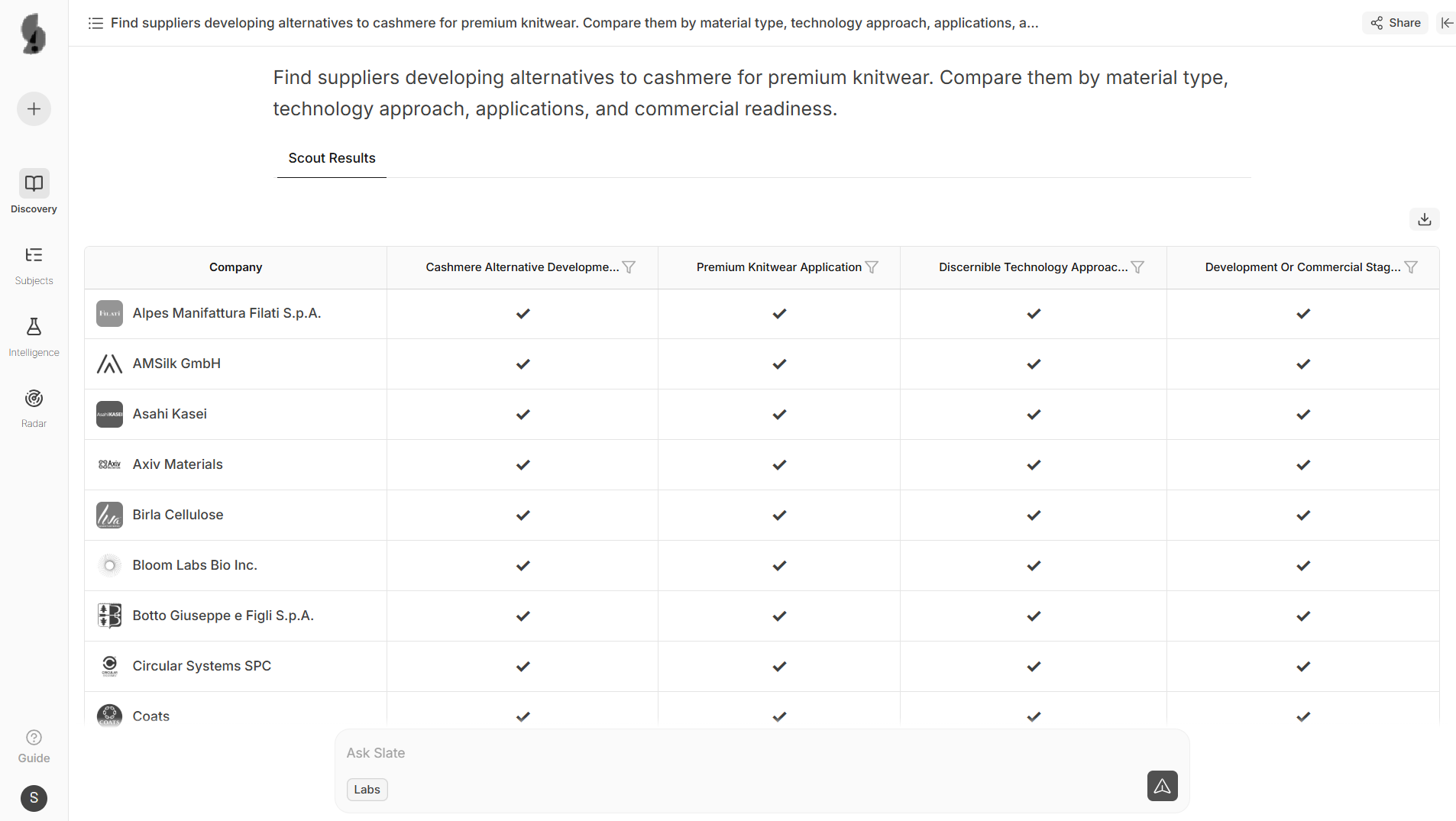
The goal is not to replace supplier qualification. It is to help teams enter those conversations with better context and evaluate the right companies faster.