Ask any AI tool about a new technology, market opportunity, or innovation space, and the first answer often looks comprehensive. Continue exploring, and 45 minutes later, you may have collected dozens of insights, opened multiple tabs, and built a long list of possibilities. Yet the key question remains unanswered: Should your team invest in this opportunity, build capabilities internally, partner with others, or wait for more evidence?
The problem is not that the tool failed. It did exactly what it was built to do. Every answer opens new paths to explore, and AI keeps taking you deeper into the next question. It feels productive, but exploration alone does not always lead to a clear decision.
But the challenge appears when the discussion moves from exploration to decision-making. Someone asks, “What do we actually recommend?” and the output is often a longer briefing document that highlights more opportunities, risks, and considerations without helping the team decide what to do next.
This is what research overload looks like in 2026. The challenge is no longer finding information. It is identifying what information matters for your organisation, your capabilities, and your constraints, while filtering out everything that is interesting but unlikely to influence a real business decision.
Why More Information Does Not Always Lead to Better R&D Decisions
The problem becomes more complex for R&D teams because more information does not automatically create more clarity.
A researcher may start with a simple question – Should we enter this category? The AI answers thoroughly and the answer contains three sub-questions. Each sub-question reveals new opportunities, technologies, competitors, and uncertainties. By the end of the process, the researcher understands the space far better than before, but the original decision remains unresolved.
This is the gap that matters. Does this opportunity fit your existing capabilities? Can you manufacture it at the right cost? Does it align with your regulatory position? Is the market timing right? These factors are rarely included in the initial prompt, so AI cannot account for them.
This is where generic AI tools reach their limitations. They are designed to answer the question you ask, not uncover the question that would actually guide a resource allocation decision. Finding that question requires understanding your business context, technical constraints, and strategic priorities.
The result is often a research document that is accurate, detailed, and full of insights. However, it still requires significant work before it can support a decision. Someone must filter the information, connect it to business realities, and determine what action makes sense. That translation from information to action is where meaningful R&D decisions are made.
How AI-Powered Research Helps R&D Teams Focus on What Matters
Most research processes start by asking: What do we know about this topic? SLATE, an AI-powered R&D intelligence platform starts with a different question: What matters for this specific decision?
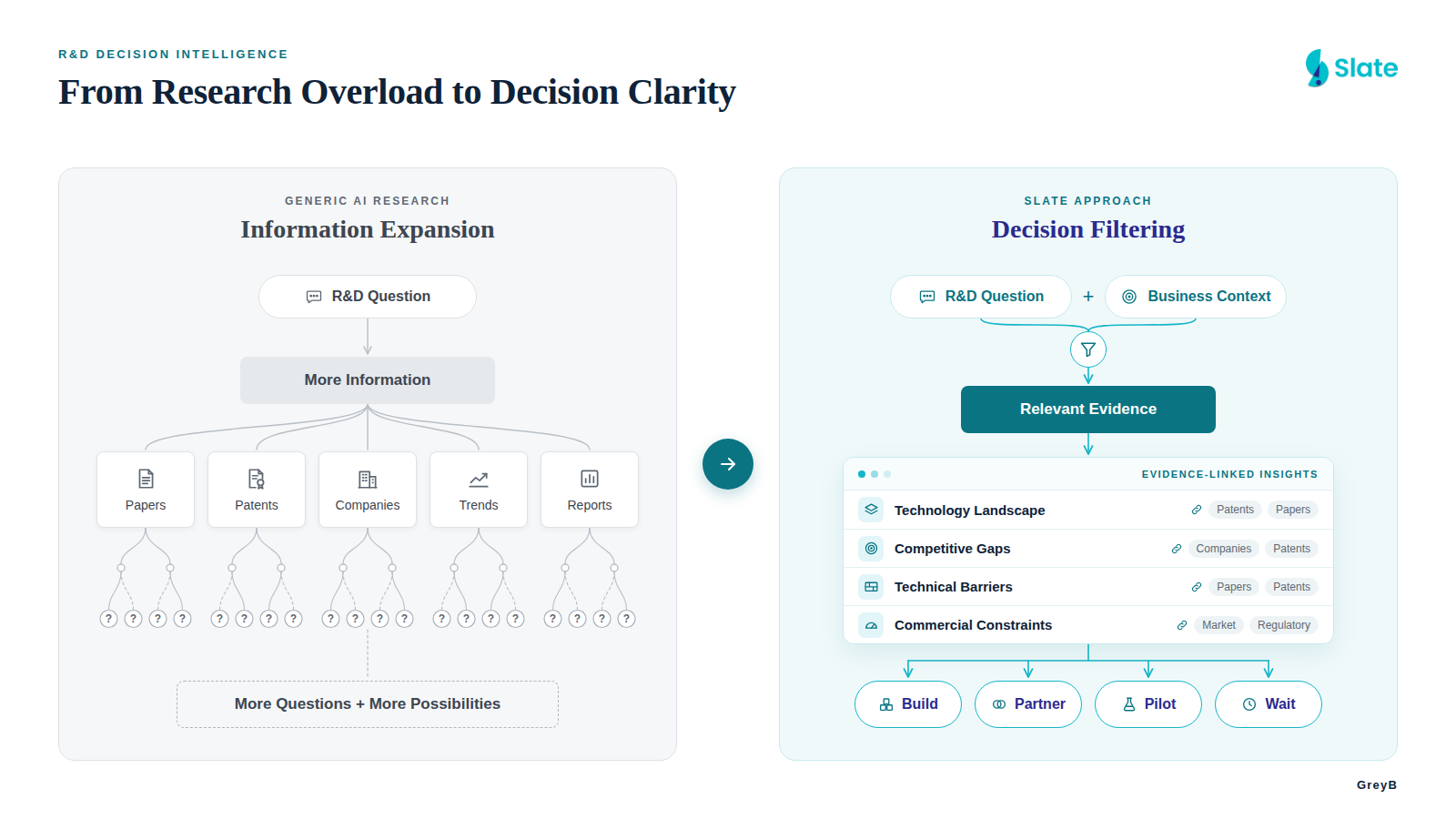
The approach applies relevant constraints to the research process and maps the opportunity around those factors. It then further creates a focused view of the landscape rather than a larger collection of information.
When a researcher brings a trend or technology area to SLATE, it helps narrow the landscape by:
- Mapping where innovation activity is concentrated across patents, research papers, companies, and technologies.
- Identifying crowded areas where competitors have already built strong positions.
- Highlighting underexplored spaces where fewer companies are active.
- Revealing technology gaps and areas where new approaches are emerging.
- Filtering out directions that are already saturated or less relevant to the company’s objectives.
Slate reduces the noise and helps researchers focus on areas where decisions can actually be made.
The next step is turning research into evidence-backed insights. Every claim is linked to its source, allowing researchers to see what information shaped the conclusion and why specific sources mattered. This transparency helps teams decide what to trust, what requires deeper investigation, and what can be set aside.
The same approach applies to comparisons. Slate creates structured comparisons based on the criteria that matter for the decision, allowing researchers to evaluate technologies, companies, or approaches through an auditable framework without spending days manually collecting and organising information.
The value is not in finding more information. It is in removing what does not help answer the decision at hand. By filtering, focusing, and prioritising relevant insights, Slate helps teams move from research to action.
How R&D Teams Can Evaluate Emerging Trends Before Investing
Let’s take an example of F&B food trends:
At IFT this year, five trends dominated conversations across the industry: GLP-1 companion nutrition, postbiotics, precision fermentation, food-as-medicine, and upcycled bioactives. These topics have been discussed extensively for the past few years.
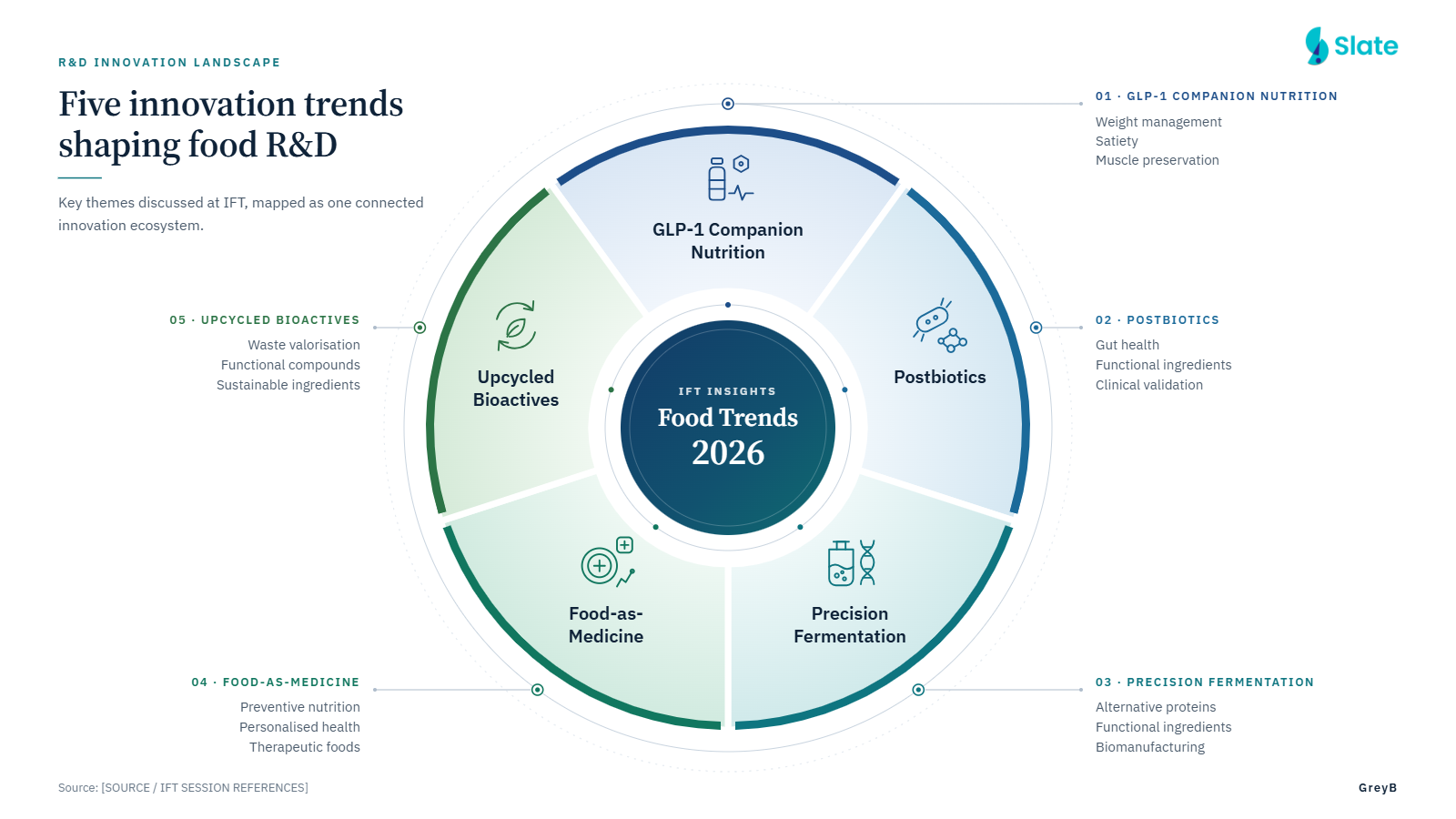
The question that many R&D teams still need to answer is different: Which of these opportunities can our organisation realistically pursue?
A trend may look promising on paper, but commercial success depends on factors such as existing capabilities, cost structure, regulatory position, and technical readiness. Without evaluating these constraints, teams may invest time and resources into opportunities that do not fit their current position.
We analysed these five trends through Slate before IFT with this decision-making lens. The output was not another trend summary. It was a constraint map showing what determines commercial viability, what barriers teams need to overcome, and where opportunities are genuinely open versus where they only appear attractive.
The analysis narrowed the landscape significantly.
GLP-1 companion nutrition shows strong market potential, but protein economics remains a key challenge. Whey isolate, where much of the clinical evidence is concentrated, currently costs significantly more than commodity soy protein under shortage conditions. For companies with limited margin flexibility, the opportunity may be real, but the economics may not work today. Understanding this before starting formulation work can prevent costly delays.
Postbiotics face a clinical evidence challenge. Probiotic research cannot automatically support postbiotic efficacy claims because the inactivation process changes the bioactive profile of the ingredient. Companies looking to make strong claims may need dedicated clinical trials, which can require multiple years of investment before meaningful data is available.
Precision fermentation faces regulatory timing considerations. Companies developing new ingredients need to account for evolving GRAS pathways and the time required to complete safety assessments. A delayed regulatory strategy can create challenges for ingredients that are still moving through development.
Upcycled bioactives face a standardisation challenge. Variability in raw materials makes consistent efficacy claims difficult. However, companies that solve measurement and standardisation challenges could create long-term advantages as the category develops.
This is what research looks like when it starts with constraints rather than possibilities. The trends remain the same, but the decision becomes clearer because the analysis reflects what each opportunity means for an organisation with specific capabilities, limitations, and commercial goals.
The report below goes beyond identifying emerging trends. It helps R&D teams understand which opportunities are worth pursuing and which ones require more evidence before investment.
Download: Five Mega Trends Shaping the Future of Food and Beverage, a Slate R&D Intelligence Report.