What if some of the most important research shaping personalized maternal nutrition is happening outside the R&D labs of companies like Nestlé and Bayer?
An analysis generated using Slate reveals an interesting pattern. Ahmadu Bello University in Nigeria appears across five nutritional diagnostic research clusters, while Nestlé, despite contributing 44 innovations in reproductive health formulations, appears in just one.
And Ahmadu Bello University is not alone. Research institutions across Ethiopia, Brazil, and Tanzania are investigating how to identify nutritional deficiencies, assess maternal health risks, and understand why nutritional interventions succeed or fail.
This reveals a potential gap in personalized maternal nutrition. While companies are developing sophisticated nutritional formulations, universities are advancing the research needed to identify who needs these interventions and why. For R&D teams, the opportunity lies in connecting these two areas.
In this article, we explore which academic institutions are advancing maternal nutrition diagnostics, how their research differs from corporate formulation innovation, and where the biggest R&D white spaces are emerging. We also examine the opportunities for companies to connect nutritional assessment, bioactive formulations, and digital health technologies to develop more personalized maternal nutrition solutions.
Why Are Universities Leading Maternal Nutrition Diagnostics?
The research landscape reveals an interesting difference in how universities and nutrition companies approach maternal health innovation.
Universities are exploring a wider range of nutritional diagnostic technologies, while companies are concentrating their efforts on specific formulations.
Academic research covers several aspects of maternal health, from serum analysis and anemia management to hormonal monitoring. Meanwhile, companies such as Nestlé and Heilongjiang Feihe Dairy are focusing on reproductive health formulations involving human milk oligosaccharides (HMOs) and probiotic combinations using Lactococcus lactis and Bifidobacterium.
This difference matters because developing an effective nutritional product is only part of the challenge. Researchers also need to identify who needs the intervention and which nutritional indicators can help guide its use.
Consider two examples from academic research.
Researchers at the University of São Paulo and the Tanzania Food and Nutrition Center have investigated mid-upper arm circumference (MUAC) as a practical way to assess nutritional status, particularly where BMI measurements are difficult to obtain.
Similarly, research associated with the University of the Faroe Islands and Aalborg University has explored thyroglobulin as a biomarker of iodine status. Unlike urinary iodine measurements, which mainly reflect recent iodine intake, thyroglobulin may provide additional information about how the thyroid responds to iodine availability over time.
These approaches address nutritional assessment questions that are different from the formulation technologies being developed by Nestlé and Feihe Dairy.
| For R&D teams, this creates an opportunity, but also a challenge: |
| If you are developing personalized maternal nutrition products, the research needed to identify and assess your target population may be spread across universities in different countries.This means looking beyond established ingredient suppliers to identify relevant academic research, understand which technologies have patent protection, and explore partnerships that can connect nutritional diagnostics with formulation development. |
Why Aren’t Nutritional Diagnostics and Formulations Developing Together?
Developing a nutritional formulation is one thing. Knowing exactly who will benefit from it is another.
This is where personalized maternal nutrition faces an important research gap. Although diagnostic technologies and bioactive formulations are advancing, there is limited evidence connecting specific nutritional assessments to the right interventions.
Take Nestlé’s research into specific probiotic strains for maternal anxiety and 2′-fucosyllactose (2′-FL), a human milk oligosaccharide studied for its effects on maternal and infant gut microbiota. Heilongjiang Feihe Dairy is also exploring complex bioactive formulations for reproductive and maternal nutrition.
These innovations show how companies are investigating targeted nutritional interventions. But they raise an important question.
How do researchers determine which women are most likely to benefit from a particular formulation?
Identifying a nutritional deficiency or health risk is only the first step. Researchers still need clinical evidence showing which ingredients are appropriate for that condition, at what dosage, and for which population.
For example, a probiotic formulation may demonstrate promising effects in clinical research, but its patents may not specify the physiological indicators needed to identify suitable recipients.
This missing connection between nutritional assessment and formulation selection creates challenges for product development.
Companies may need additional clinical studies to establish these relationships, validate them across different populations, and demonstrate meaningful health outcomes. This can increase development costs and extend time-to-market.
| For R&D Teams, the opportunity lies in building that missing connection |
| Collaborating with academic institutions could help companies use existing population-level research to guide clinical trials and develop more targeted interventions. The alternative is to build these diagnostic and validation capabilities internally, which may require considerable time and investment.The next opportunity in personalized maternal nutrition may therefore come from combining existing diagnostic knowledge with bioactive formulations, rather than developing either technology in isolation. |
Why Are Emerging Markets Driving Maternal Nutrition Research?
A nutritional supplement may work well in clinical trials, but what happens when women cannot access it regularly, do not understand how to take it, or follow dietary practices that affect its effectiveness?
These are some of the challenges researchers in Nigeria, Ethiopia, India, Indonesia, and Tanzania are trying to solve.
Unlike research focused primarily on developing new formulations, these studies examine the real-world factors that determine whether nutritional interventions actually reach and benefit women.
Government Medical College Bhavnagar and the Indian Council of Medical Research have studied how cultural and socioeconomic factors affect the use of take-home nutritional rations. Sanskriti Samvardhan Mandal has also investigated how nutritional awareness and local dietary practices influence intervention outcomes.
The research landscape shows particularly strong activity in Indonesia.
According to the underlying Slate analysis, Indonesian institutions account for 43% of publications in the analyzed anemia management cluster. Their research includes comparing video-based nutrition education with traditional leaflets and exploring dietary guidance that encourages vitamin C consumption alongside iron-rich foods to improve iron absorption.
Indonesia also contributes 40% of the analyzed adolescent nutritional assessment research, including studies exploring mobile-based education through platforms such as WhatsApp.
Another important development is the Minimum Dietary Diversity for Women (MDD-W), a standardized indicator used to assess dietary diversity among women of reproductive age. It helps researchers evaluate whether populations are likely to consume a sufficiently diverse range of micronutrient-rich foods.
What makes this research valuable is its focus on what happens beyond the formulation itself.
Even an effective nutritional product may deliver limited real-world benefits if women cannot access it, consume it consistently, or follow the recommended dietary guidance.
This creates an important consideration for companies planning to expand into India, Indonesia, or Sub-Saharan Africa.
Product development cannot rely on ingredient efficacy alone. Companies also need to understand local dietary patterns, adherence barriers, and the practical conditions influencing nutritional outcomes.
Regional universities and public health institutions are valuable partners because their research often draws on direct engagement with local populations and healthcare systems.
For R&D teams, the opportunity is to combine effective formulations with locally validated nutritional assessments and adherence strategies.
This could help companies develop maternal nutrition solutions that work beyond controlled clinical settings and better reflect the needs of the populations they intend to serve.
Why Are Maternal Nutrition Diagnostics Difficult to Develop In-House?
Developing a nutritional diagnostic method takes more than laboratory research. Companies need to prove that it works reliably across different populations, dietary habits, and healthcare settings.
That is what makes some university-led research difficult to replicate.
A diagnostic threshold validated in one population may not work equally well in another. Differences in nutritional status, ethnicity, environmental conditions, and access to healthcare can influence how researchers interpret clinical measurements.
Studies investigating population-specific nutritional screening thresholds show why companies cannot always apply the same criteria across countries. Researchers need local data to determine whether a measurement accurately identifies women at risk.
A particularly interesting example comes from Brazil.
A 2025 study involving 199 pregnant women found that participants with insufficient urinary iodine levels had better dietary quality scores and consumed more fruits and vegetables than those with adequate iodine levels.
This challenges the assumption that women following healthier diets are necessarily getting enough of every micronutrient. However, the findings reflect an association in one population and need further validation.
The broader lesson for maternal nutrition R&D is that diet quality alone may not reliably identify every nutritional deficiency. Companies developing personalized interventions need to understand how dietary patterns, biomarkers, and local conditions interact.
What makes this research difficult to replicate?
Building reliable diagnostic frameworks often requires access to large or representative populations, repeated measurements, locally validated thresholds, and clinical expertise.
Companies expanding into multiple regions may also need separate validation studies to establish whether existing methods work for their target populations.
These studies can involve ethics approvals, healthcare partnerships, participant recruitment, and long-term monitoring, depending on the research question.
For commercial R&D teams, replicating this work internally can add considerable time and cost to product development.
| This makes academic partnerships an important opportunity |
| Rather than repeating existing population studies, companies can work with universities and public health institutions to access relevant expertise, evaluate existing evidence, and identify the additional validation needed for commercial applications. Not every academic diagnostic method requires a patent license. Some are published openly, while others may involve protected technologies, proprietary datasets, or specialized research expertise. For R&D teams, the important decision is understanding which diagnostic capabilities can be built internally, which require further validation, and where academic collaboration could accelerate development. Getting that balance right could help companies develop personalized maternal nutrition products with stronger scientific evidence while avoiding unnecessary duplication of research. |
Could Digital Platforms Become the Next Opportunity in Maternal Nutrition?
What if the next breakthrough in personalized maternal nutrition is not a new supplement, but a platform that helps women receive and follow the right nutritional intervention?
This is an emerging opportunity highlighted by the research landscape. Digital health technologies could connect nutritional assessments, personalized recommendations, and ongoing support in ways that standalone supplements cannot.
Research institutions in Indonesia are already exploring parts of this approach.
Politeknik Kesehatan Kementerian Kesehatan Jakarta II and the University of Indonesia have investigated digital approaches to nutritional education and intervention delivery. Other studies have examined virtual reality (VR) for nutrition education among adolescents and compared video-based guidance with traditional educational materials.
These approaches suggest that researchers are looking beyond nutrient delivery to understand how technology can improve engagement and adherence.
But the bigger opportunity lies in bringing these capabilities together.
Imagine a digital platform that uses validated nutritional assessments to help healthcare professionals identify a woman’s nutritional needs. It could then support an appropriate intervention through personalized dietary guidance, supplement reminders, and progress monitoring.
Such a system would connect three activities that are often managed separately.
- Nutritional assessment to identify deficiencies and health risks.
- Intervention selection to match nutritional needs with clinically supported formulations.
- Ongoing monitoring to track adherence and determine whether further evaluation is needed.
For nutrition companies, this could create new opportunities beyond selling individual products.
A platform that manages assessments, recommendations, and follow-up interactions may also develop valuable capabilities in patient engagement and outcomes monitoring.
This raises an important competitive question. Who will control the relationship between nutritional assessment and product delivery?
Ingredient manufacturers could develop integrated services themselves, partner with digital health companies, or supply formulations to third-party platforms.
Digital health developers, meanwhile, could potentially build these services without owning the underlying ingredient technologies or diagnostic patents.
There is not yet enough evidence to conclude which business model will capture the most commercial value. However, the opportunity is worth investigating.
For R&D and innovation teams, digital health capabilities may become just as important as formulation expertise when developing personalized maternal nutrition solutions.
The next step is to identify technologies that can connect clinically validated assessments with product recommendations and sustained nutritional support, while ensuring that these systems meet the necessary clinical, privacy, and regulatory requirements.
Why Has Maternal Nutrition Diagnostic Research Remained Fragmented?
With so much valuable diagnostic research coming from universities, why have nutrition companies not brought these technologies together through acquisitions or licensing?
One reason is that academic research does not always fit traditional commercialization models.
Many nutritional assessment methods are published in scientific journals rather than protected by patents. This makes the findings accessible to researchers and companies, but also limits opportunities to secure exclusive rights over the underlying methods.
Geographic differences create another challenge.
The Slate research landscape identified 55 publications on menopausal monitoring across 23 countries. This highlights how widely research activity can be distributed, with institutions investigating health indicators relevant to different populations.
For companies looking to develop personalized maternal nutrition products, bringing together such research is not as simple as acquiring a single technology.
A diagnostic method developed for one population may need further validation before being used elsewhere. Companies must also navigate different healthcare regulations, university technology transfer processes, and clinical research requirements.
There is also a difference in what universities and companies are trying to achieve.
Public health institutions such as the Indian Council of Medical Research often focus on improving nutritional outcomes and addressing population-level health challenges. Commercial R&D teams must also consider product scalability, regulatory approval, profitability, and market demand.
These different priorities can make conventional acquisition or licensing arrangements less suitable. However, fragmented research does not necessarily mean companies need to acquire every technology.
Published methods may be available for use without patent licensing, while other innovations may require agreements covering intellectual property, proprietary datasets, or specialized expertise.
This creates opportunities for different types of collaboration, from joint clinical studies to technology licensing and research partnerships.
For R&D and corporate development teams, the opportunity is to identify which research findings can be used directly and which require deeper collaboration.
Rather than waiting for universities’ research portfolios to consolidate, companies can build partnerships around the specific diagnostic capabilities their product development programs need.
This approach could help them access valuable scientific expertise while developing the clinical evidence required to turn academic findings into commercially viable maternal nutrition solutions.
Who Will Shape the Future of Personalized Maternal Nutrition?
As personalized maternal nutrition evolves, an important question remains. Will nutrition companies bring diagnostic research and formulation technologies together, or will digital health platforms become the link between them?
Both possibilities could change how maternal nutrition products are developed and delivered.
Companies that successfully combine validated nutritional assessments with targeted formulations could offer more personalized interventions. But digital health providers may also enter this space, connecting academic research with existing nutritional products through their own platforms.
In that scenario, supplement manufacturers could increasingly become product suppliers, while platform providers manage nutritional recommendations, ongoing monitoring, and customer relationships.
For R&D teams, the opportunity is to identify where these connections are still missing and decide which capabilities to develop internally, acquire, or access through partnerships.
The companies that can turn fragmented research into clinically validated, practical solutions may be better positioned to shape the next generation of personalized maternal nutrition.
Find Untapped Maternal Nutrition R&D Opportunities with Slate
Finding these opportunities requires looking beyond individual patents, scientific publications, or competitors.
Slate helps R&D and innovation teams explore how research activities, technologies, and organizations connect across the maternal nutrition landscape.
With Slate, teams can identify academic institutions working on relevant diagnostic technologies, track corporate formulation innovations, discover potential research partners, and investigate gaps between existing scientific capabilities.
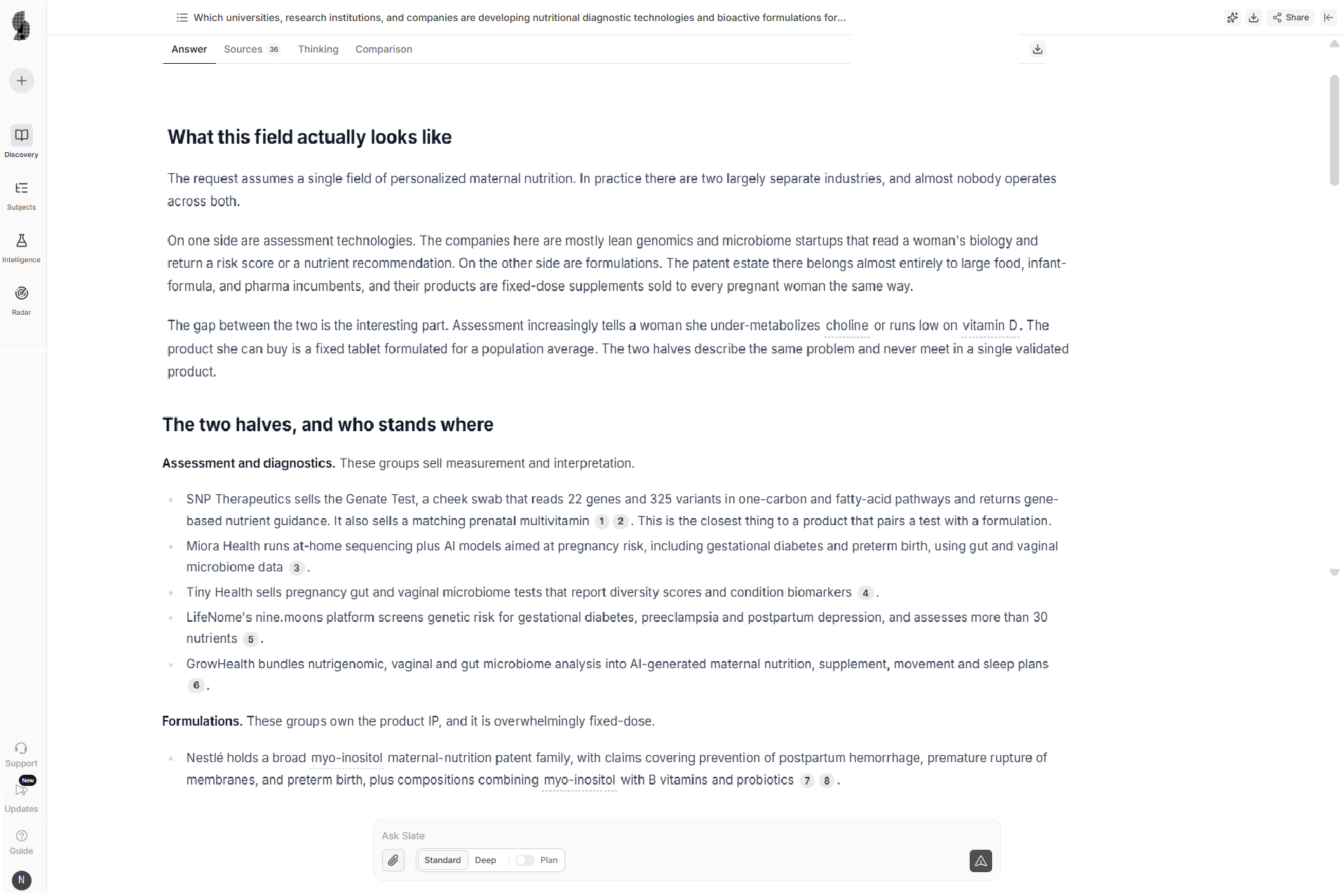
The goal is to move beyond knowing what others are researching to understanding where your next innovation opportunity could emerge.
Explore Slate to discover research gaps, emerging technologies, and potential partners that could shape your maternal nutrition R&D strategy.
Frequently Asked Questions
1. Why don’t companies like Nestlé develop maternal nutrition diagnostics in-house?
Developing reliable diagnostics requires population-specific clinical data, specialist expertise, and validation studies. Companies may find it more practical to collaborate with universities that already have relevant research experience rather than reproduce existing work.
2. Can universities patent nutritional diagnostic frameworks?
Yes, universities can patent eligible diagnostic inventions. However, commonly used assessment methods, published clinical findings, and naturally occurring biomarkers are not automatically patentable. Protection depends on the invention and applicable patent laws.
3. Which academic institutions are active in maternal nutrition diagnostics?
The Slate research landscape highlights Ahmadu Bello University, Jimma University, the University of São Paulo, Aalborg University, and several public health institutions. Their research covers nutritional assessment, biomarker evaluation, and population-specific health monitoring.
4. Can existing probiotic or HMO formulations support personalized maternal nutrition?
Potentially, clinical evidence must establish which populations benefit from specific ingredients, formulations, and dosages. Existing formulation patents alone do not demonstrate that an ingredient is suitable for a particular nutritional condition.
5. What should companies evaluate before licensing university-developed diagnostic technologies?
Companies should examine patent ownership, legal protection, clinical validation, freedom to operate, and suitability for their target markets. They should also determine whether licensing is necessary or whether a research collaboration would be more appropriate.
6. How can companies protect innovations that combine diagnostics with nutritional formulations?
Depending on patent eligibility, companies may seek protection for novel technical methods, devices, formulations, or integrated systems. Proprietary software, datasets, and clinical know-how may also provide competitive advantages.
7. Can diagnostic methods validated in one country be used in another?
Not automatically. Companies must assess whether differences in population characteristics, nutritional patterns, and healthcare settings affect diagnostic accuracy. Additional local validation may be necessary before clinical or commercial use.