On paper, protecting probiotics in yogurt looks like a solved problem. Academic labs have spent years developing microencapsulation coatings, nanoemulsions, and protein-based carriers to shield sensitive bioactives through processing, storage, and digestion. The patents are not there.
When Slate analyzed the patent and research landscape, the bioactive-protection cluster held just one published patent. Traditional probiotic fermentation accounted for 582 innovations. Major dairy companies focused on fermentation, membrane processing, protein fortification, and enzymatic modification, not dedicated encapsulation.
This article examines that gap through patents, research, processing approaches, and company activity. It covers where bioactive protection is gaining traction, where scale-up remains difficult, and which approaches offer the most practical path to commercialization.
Why Dairy Leaders Are Reworking the Yogurt Matrix Instead of Encapsulating Bioactives
Yili and Mengniu are investing in membrane processing, protein modification, and fermentation systems that fit existing dairy lines. Mengniu uses membrane separation to isolate milk fractions for Bifidobacterium cultivation. Yili has explored enzymatic protein modification in high-solids formulations.
Brightdairy and Arla follow a similar logic in protein fortification. Their work on ultrafiltration, reverse osmosis, and concentrated dairy matrices points to a shared strategy: improve stability and functionality by changing the yogurt base itself, not by adding a separate protective carrier.
China leads industrial-scale fermentation activity, while newer delivery concepts remain mostly academic. Northeast Agricultural University’s polymerized whey protein nanoemulsion for CoQ10 is one example. It works as a delivery system, but sits closer to formulation and protein engineering than to a standalone encapsulation platform.
A carrier that performs well in the lab still has to survive existing processing steps, run at industrial throughput, meet regulatory requirements, and hit cost targets. That is why the stronger near-term signal comes from technologies that work with the dairy matrix and current infrastructure.
Microencapsulation vs. Nanoparticle Delivery: How Each Protects Yogurt Bioactives
The two approaches are often grouped together, but they solve the problem in opposite ways.
Microencapsulation builds a physical barrier around the bioactive, typically 1 to 1,000 micrometers in size. Its priority is survival through isolation. Aristotle University’s bacterial cellulose system, derived from coffee waste, shows how this works. It acts as both a rheological stabilizer and a protective carrier, separating sensitive compounds from the yogurt’s acidity and processing stress.
Nanoparticle delivery works at the nanoscale, with carriers under 100 nm that interact with the yogurt matrix instead of isolating from it. Propolis-carboxymethyl cellulose Janus nanoparticles stabilize at the oil-water interface. Moringa and black seed oil nanoemulsions aim for controlled release and better bioavailability, not just survival. Put simply, microencapsulation treats the yogurt base as hostile territory, while nanoparticles try to engineer compatibility with it.
Co-microencapsulated grape pomace and flaxseed oil combine a physical barrier with targeted delivery, while whey protein nanoemulsions rely on the protein matrix instead of an external carrier.
This overlap is why it treats both as a single cluster, and why the industry appears to see them as interchangeable research bets, not distinct competitive moats.
Neither has settled the question that matters most: can it keep bioactive counts stable through a 21- to 45-day refrigerated supply chain at a cost mainstream dairy can absorb? For R&D teams, the deciding factors should be manufacturing capital expenditure and regulatory pathway, not lab-scale efficacy alone.
Why Lab-Scale Encapsulation Fails at Industrial Scale in Yogurt Production
Yancheng Jianqiao Dairy and Sichuan Xuebao Dairy Group hold 43 filings on high-shear mixing of viscous additives, yet none address encapsulation compatibility. The silence is telling. High-shear mixing can break microencapsulated particles, and nanoparticles can aggregate under pasteurization heat. The patent record shows manufacturers solving real production problems, and bioactive protection is not on that list.
Other manufacturers keep bioactives viable without novel carriers. Yili’s low-frequency ultrasonic processing modifies texture in fortified matrices without breaking cell structures. Brightdairy reaches 26.8% solids through membrane concentration, creating a high-protein environment that protects bioactives through reduced water activity.
Regulation adds a second barrier. Janus nanoparticles lack GRAS status, so any product using them faces years of safety validation. Coffee-waste cellulose offers sustainability credentials but has no established use precedent in dairy, which creates labeling risk and undercuts clean-label positioning.
For R&D teams evaluating an academic spinout with a breakthrough encapsulation claim, ask for pilot-scale data showing bioactive survival after pasteurization and homogenization in batches of at least 500 liters. Bench-scale results alone mean you are funding their scale-up learning curve, not licensing a proven platform.

Why Academic Patent Ownership Makes Encapsulation Licensing Risky for Dairy R&D
The sole patent in the bioactive-protection cluster belongs to Aristotle University of Thessaloniki. When foundational IP sits with universities rather than corporations, a company scaling these methods may face overlapping patents from several institutions, none of them tested in litigation.
Industrial IP looks different. Brightdairy Industry and Arla Foods lead protein fortification with 95 patents and 179% acceleration. Their claims have been refined through prosecution and validated at commercial scale, which gives clearer freedom to operate and more predictable licensing terms.
Academic patents serve a different purpose. They are often filed to establish priority, and they tend to cover composition-of-matter claims that describe the lab result. They often lack the manufacturing process claims needed to block competitors. For teams evaluating a nanoparticle delivery license from a European university, budget for extra IP clearance costs and possible delays to commercialization.
The Northeast Agricultural University nanoemulsion appears in the fermentation cluster, not the bioactive-protection cluster. If researchers struggle to separate protective delivery from standard formulation, the richness of the academic record may signal fragmentation, not a mature, investable technology landscape.
Protein Matrix Engineering: The Practical Alternative to Encapsulation in Yogurt
A third path is emerging. Instead of adding an external protective carrier, manufacturers are turning the dairy base itself into the carrier through polymerization and cross-linking.
Yili’s protein glutaminase enables enzymatic cross-linking in high-solids environments, converting existing whey protein concentrate into a functional carrier. Yili’s emulsified sodium carboxymethyl cellulose does double duty, replacing traditional stabilizers while carrying actives. Re Milk’s recombinant beta-lactoglobulin polymerization follows the same logic, modifying familiar proteins instead of introducing pharmaceutical-grade delivery platforms. Brightdairy’s ultrasonic dispersion of red yeast rice takes a mechanical route, improving the poor water solubility of functional additives without a novel carrier.
The approach has three practical advantages. It has far more patent precedent than microencapsulation, with roughly 100x more filings. Whey protein is GRAS, so the regulatory pathway is clear. And it runs on current processing equipment, with no external encapsulation vendors required.
This may also reframe the microencapsulation versus nanoparticle debate. The industry appears to be solving bioactive protection through incremental changes to proven ingredients, not new delivery platforms. That would explain why the bioactive-protection cluster holds a single patent while protein fortification keeps growing. Protein-matrix engineering depends on whey protein, so it does not address plant-based or non-dairy yogurts.
Upcycled Carriers in Yogurt: Can Waste Streams Turn Encapsulation Into a Sustainability Play?
Plant-based formats are where encapsulation may still earn its place. Upcycled carriers point to a different role for microencapsulation: not precision delivery, but waste valorization. Apricot kernel oil press cake protein extraction turning agricultural byproducts into functional additives that offer protection and sustainability credentials at once.
Plant-based yogurt shows 11.8% CAGR, with the coconut segment reaching 14.3%. These premium segments can absorb higher carrier costs when paired with a sustainability story. Consumers are more likely to pay for probiotics protected by an upcycled carrier than by generic encapsulation, which makes this a brand play as much as a technical one.
The risk is process development. Industrial-scale production of these carriers has little precedent, so early adopters absorb the scale-up burden. For teams with plant-based or upcycled claims on the roadmap, the marketing differentiation may justify the cost. For mainstream yogurt, the economics do not change.
The open question is whether a technology that loses on industrial cost-efficiency can win on consumer narrative, and whether that niche viability can scale to industrial volumes.
See Where a Technology Really Stands Before You Commit R&D Budget
Bioactive protection in yogurt shows how misleading a literature search can be. The academic research looks rich, but the patent record holds a single filing. Slate surfaced that gap by reading patents, papers, and company activity together.
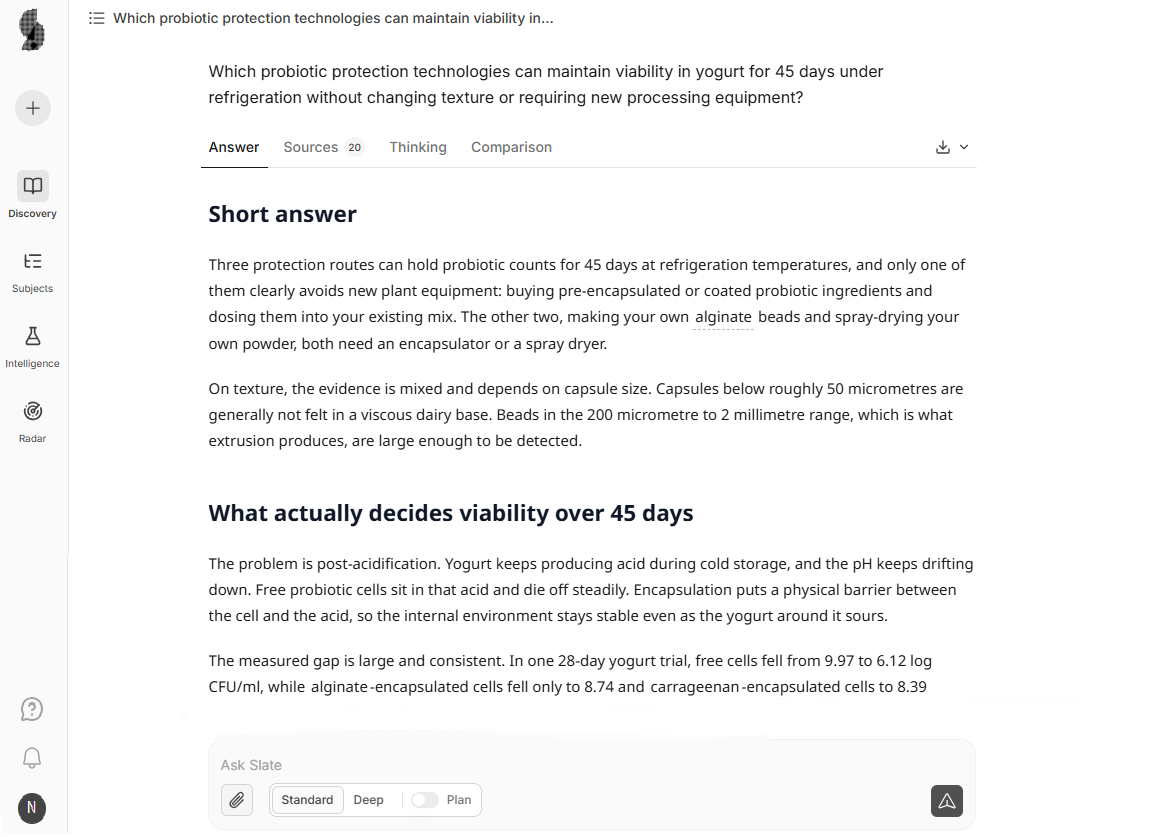
Slate, an AI-powered R&D intelligence platform, helps R&D teams answer the question that comes after “Does it work in the lab?”: who is developing it, how mature is it, and is it worth testing at scale?
With Slate, you can:
- Separate hype from traction. Map patents and publications together to see whether a technology is still research-heavy or moving toward industrial use.
- Follow the companies. Identify which dairy players, ingredient suppliers, and startups are working on related solutions.
- Compare approaches side by side. Weigh microencapsulation, nanoemulsions, membrane processing, and protein matrix engineering on the same evidence base.
- Find white spaces. Spot areas where academic research is growing but company adoption is still limited.
- Trace the evidence in one place. Follow patents, papers, companies, inventors, and institutions without searching each source separately.
- Shortlist with confidence. Rank candidates for validation by technical maturity, competitive activity, and signs of commercial readiness.
Stop funding technologies that only work on paper. Try Slate and see what the evidence says before you scale.

Frequently Asked Questions
What is the main difference between microencapsulation and nanoparticle delivery for probiotics?
Microencapsulation isolates bioactives behind a physical barrier (1 to 1,000 micrometers). Nanoparticle delivery uses sub-100 nm carriers that interact with the yogurt matrix for controlled release and better bioavailability.
Why aren’t major yogurt manufacturers filing patents on bioactive protection?
The record shows one filing versus 582 in traditional probiotic fermentation. Processing stress and regulatory hurdles push manufacturers toward membrane concentration and enzymatic modification instead.
Is protein matrix engineering more effective than microencapsulation for protecting probiotics?
In dairy yogurt, it is the more practical option today, with more patent precedent, a clear GRAS pathway, and compatibility with existing equipment. It does not apply to plant-based yogurts.
What are the regulatory challenges for using nanoparticle delivery in yogurt?
Novel carriers such as Janus nanoparticles lack GRAS status, so safety validation can take years. They can also trigger “with added X” labeling that undermines clean-label positioning.
Can upcycled carriers compete on cost with traditional methods?
Not on cost alone. They suit premium plant-based lines, where sustainability claims can justify higher pricing.
How do I verify a vendor’s bioactive protection claims before licensing?
Ask for end-of-shelf-life probiotic counts across multiple commercial-scale batches, plus survival data after pasteurization and homogenization. Reject freeze-dried or lyophilized benchmarks, which skip real thermal and shear stress, and confirm GRAS status or use precedent for any novel carrier.