What if the AI answers every question you ask perfectly, and the real opportunity sits in a question you never thought to ask?
A senior R&D leader at a skincare brand put this to the test. She wanted a cooling sensation on skin that lasts for hours, not the sharp hit-and-fade of a menthol product. General-purpose AI responded within seconds with menthol, menthol derivatives, and evaporative solvents. Every option was correct, and every one was already familiar to her.
Her takeaway was simple: “I would never be asking the questions.”
Her point was not that the answer was wrong. Any tool can only answer what it is asked, and the questions we ask are shaped by what we already know. The routes we have never heard of stay out of reach, because nothing prompts us to look for them.
We call this the unknown-unknowns problem. We’ve heard it from enough leaders, across enough industries, to believe it is the quiet cost behind most late-stage surprises.
In this post, we’ll walk through what these leaders told us, why standard tools keep the problem hidden, what it costs, and how to go after it deliberately. Let’s get started!
What Are Unknown Unknowns in R&D & Why Can’t You Search for Them?
Unknown unknowns are the options, risks, and routes your team doesn’t know exist. You can’t search for them because search starts with a question, and you can’t ask about something you’ve never heard of. The two ideas below show why this matters so much in R&D.
Wrong Answer vs. Missing Answer: Which Is Riskier?
A wrong answer announces itself, at least to the right person. Say an AI-generated report blurs a human volunteer trial with an in-vitro result. A scientist who knows the field will catch it quickly. That’s verification, and expertise solves it.
A missing answer is a different story. The branch never appeared, so there’s no error to spot and nothing to check. You can’t flag what you never saw.
Even verification comes at a price. A study of 415 AI practitioners, “The Fast and the Spurious”, found that the time AI saves often gets handed back in checking. Errors also compound, which forces costly rollbacks later.
Why Do Experts Feel the Problem Most?
An expert’s value lies in judgment, but judgment can only be applied to options that are already visible. Evaluating a set of candidates is the skill; generating the full set is a different problem, and no amount of seniority solves it.
One R&D leader described the gap precisely. He doesn’t need a tool that confirms what he knows. He needs a collaborator far more capable than himself, one that surfaces a wide range of possibilities he hasn’t considered, so that he can apply his expertise to deciding which are worth pursuing.
He also pointed out that comparing AI tools fairly is almost impossible. To test a second tool against the first, he would have to pretend he didn’t know what the first one had just taught him.
What Are R&D Leaders Actually Telling Us About Unknown Unknowns?
Across industries, the same pattern keeps surfacing. The leaders we spoke with weren’t struggling to find answers inside their own fields. What worried them was everything outside the lines of their own questions.
“Is there something in another industry that I’m not aware of?”
A scientist on a bioenergy team described the usual approach to novelty as a reverse search. You look for something new, and what you find is that it already exists. What he wanted was the opposite. He wanted to search from his own problem and learn whether another industry had already solved something close, something his team could adapt to make the work novel. That instinct matches what other R&D leaders told us. Finding a cross-industry route early usually means a small correction, while finding it late can mean a costly one.
“You can fall behind in lap two and three.”
A technology leader at an oilfield-equipment manufacturer won the first stage of his market, then watched the field change underneath him. His company files a couple of patents a year, while competitors file fifty to a hundred.
“You won the first part of the race, but this is a multi-segment race,” he told us. Staying ahead now means covering far more ground than his team can cover alone. With a lean team and no plans to add headcount, he wants it to work as a force multiplier, exploring several areas at once and scanning uncertain horizons before competitors reach them.
“Nobody finds a breakthrough by choice.”
A VP of R&D at one of the world’s largest skincare companies told us that, in his experience, nobody finds a breakthrough by choice. It happens when the right person is in the right place, talking to the right people and looking in the right direction, and no team can plan for that alignment. This is what makes unknown unknowns a structural problem rather than a failure of effort. You can’t schedule a surprise, but you can widen the places you look, and that is where the opportunity sits.
“Pharma already solved it.”
One company set out to build a nicotine pouch that releases on a specified timeline in the mouth, and it could not find a supplier anywhere inside the tobacco industry. A broader search led to one in pharma, where controlled-release delivery had been solved long ago. The team’s domain expertise was deep, and that was never the issue. The answer sat in an adjacent field they had no reason to look at, which is exactly how a blind spot works.
Why Do Generic AI Tools Keep Unknown Unknowns Hidden?
General-purpose AI tools are built to return the answer most people would give, which is the opposite of what an R&D team needs to find what it doesn’t already know. Two mechanisms explain why.
Why Does the Popular Answer Win?
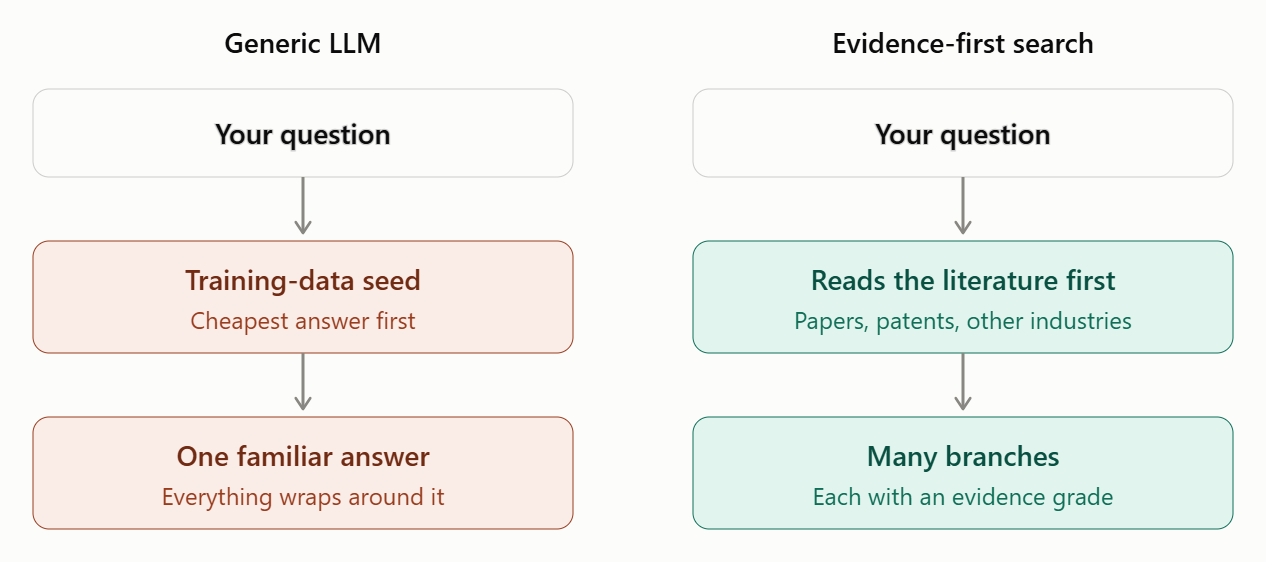
General-purpose models are probabilistic, so most of the time they return the most common solution. Their training data and the open internet both reward popular signals, which means weak signals such as a niche patent or an obscure supplier get buried. In R&D, the edge usually sits in exactly those weak signals, so the tool works against the people using it.
What Is the “Seed Thought” Problem?
A generic model first answers from what it has already learned, because that is the cheapest thing to retrieve. That first answer becomes the seed, and everything that follows is built around it. Layer a keyword-driven pass on top, and the result depends on the words in your question rather than the concept behind it. The more precisely you phrase the question, the more tightly the answer stays inside what you already know.
How Does Slate Surface Unknown Unknowns?
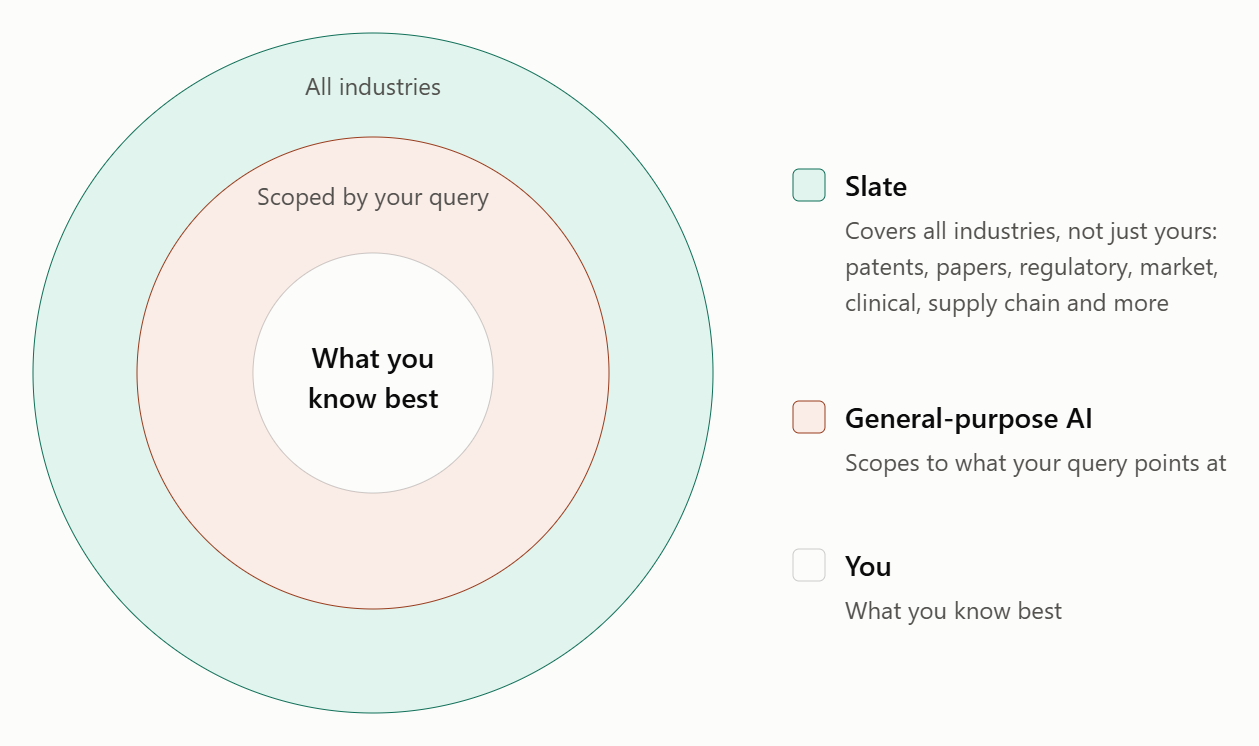
Slate, an AI-powered R&D intelligence platform starts from the problem and reads outward, showing you what sits beyond the questions you know to ask. The sections below cover how it does that and why you can trust what it returns.
What Did Slate Find for the Skincare Team?
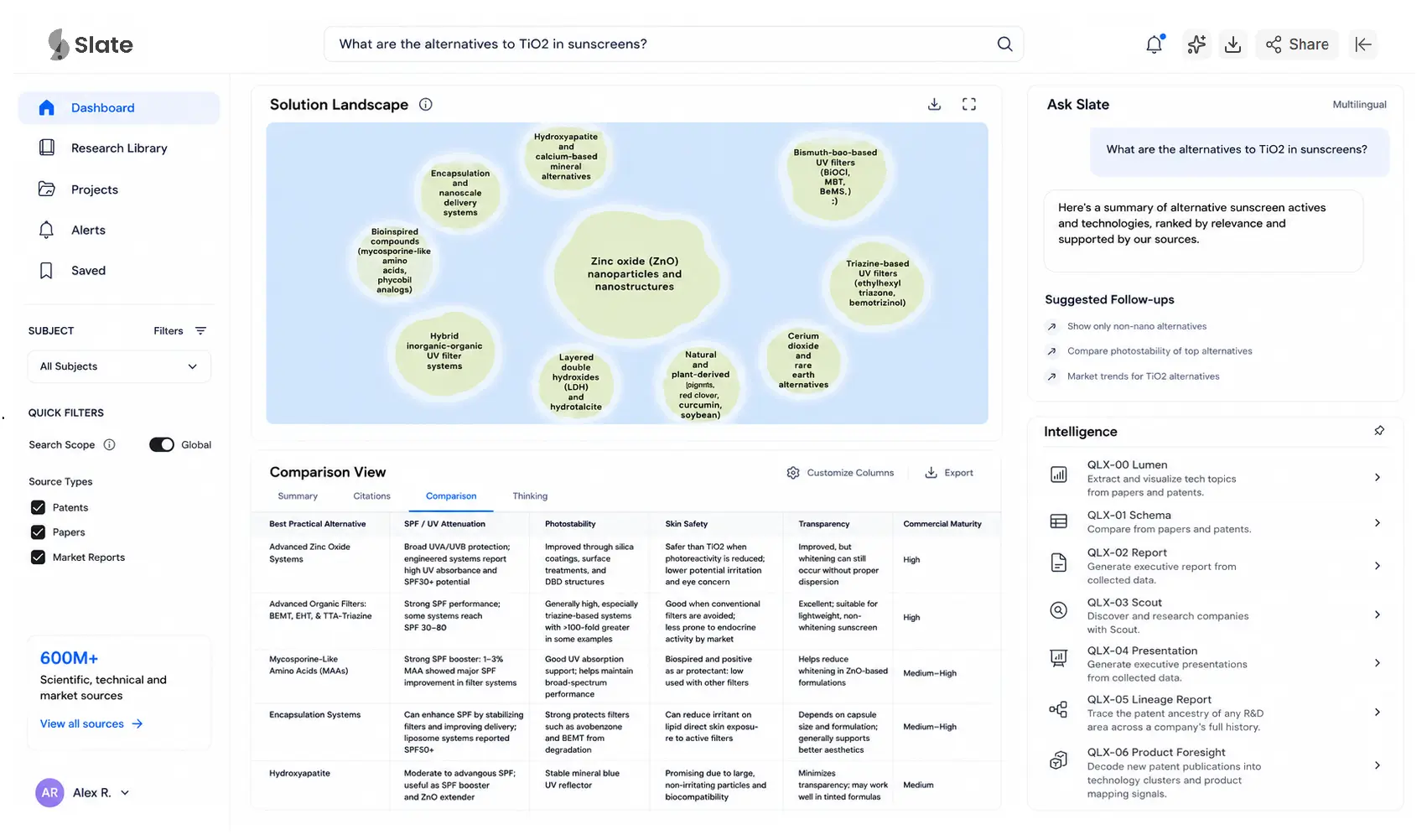
For the same skincare team we described earlier, Slate came back with routes from fields she doesn’t work in. These included dissolution cooling from confectionery, phase-change materials from performance textiles, encapsulated release from pharma, and evaporative hydrogels from wound care, among others.
Each route comes with the effect it can deliver, how long that effect lasts, and whether anyone has actually built it or it exists only on paper. Slate then helped her see which of these would matter most, based on her company’s current capabilities.
Does Slate Map the Territory Before It Answers?
Yes. When you ask a question in plain language, Slate first builds an understanding of the concept behind it. It answers the core value and mechanism of your question rather than matching its keywords, so nothing goes unnoticed because of how you happened to phrase it.
Can You Ask it Directly for the Unknown Unknowns?
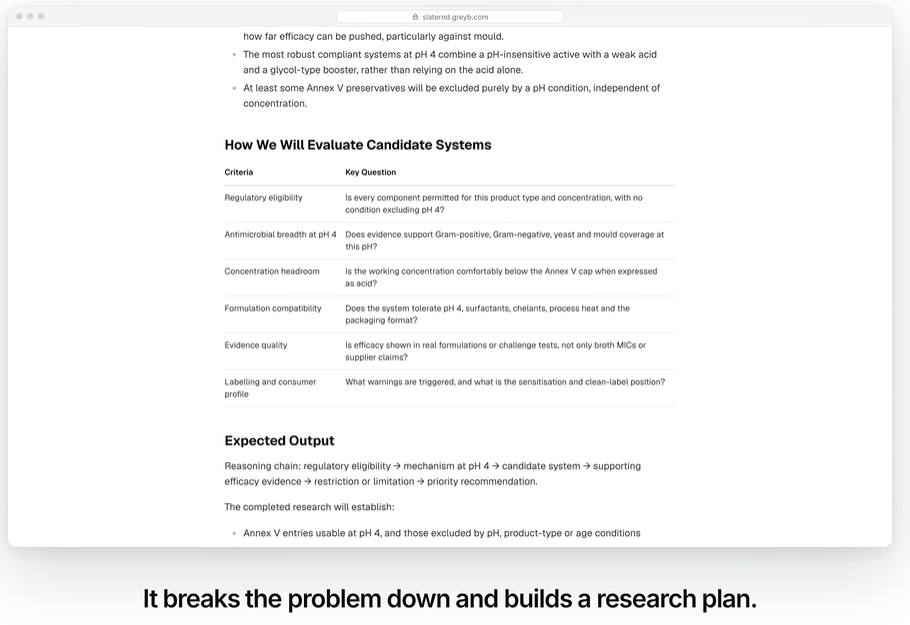
You can. For a leader weighing a technology bet, Slate’s plan branches into maturity, operational risk, and regulatory and IP risk. It also adds a dedicated branch for the unknown unknowns that could flip the entire recommendation. For an ethanol-process question, it went further and mapped adjacent and disruptive applications beyond the core use.
What If You Don’t Have a Question Yet?
Some opportunities never reach you because you never think to ask about them. Slate Radar closes that gap by watching a technology or competitor around the clock and surfacing what moves, so new routes find you instead of the other way around.
How Do You Know What to Trust?
Each option carries an evidence grade, such as lab, prototype, or commercial, and Slate places the studies that cut against an option next to the ones that support it. Every claim traces back to a source, along with the thinking trail that shows which decisions led to the conclusion. This removes the classic black-box problem of AI, because you can see how an answer was reached and not just what it was.
Won’t More Options Just Mean More Work?
It’s a fair challenge, and we’ve heard it directly from the people doing the work. An open-innovation lead at a materials company told us that scouting was never the hard part. The real effort comes afterward, in answering the questions that decide whether an option survives – will it work, is it too expensive, and can we actually implement it?
A procurement lead at a building-materials company raised a different concern. At first glance, she said, this didn’t look so different from an agent she could build herself to track her suppliers, and she felt the difference would come down to depth.
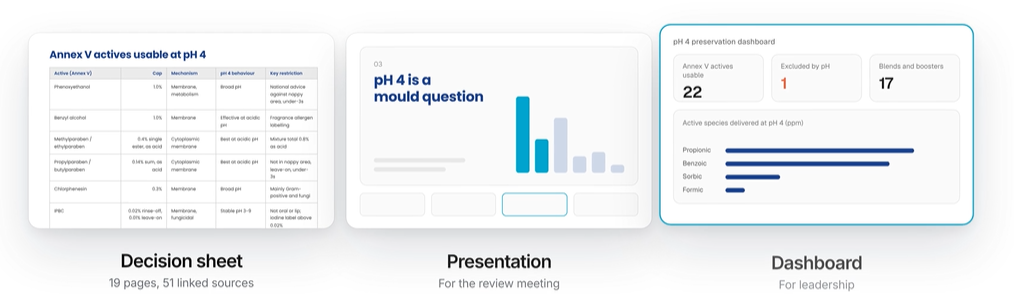
Both points are right, and they are the reason grading and traceability matter more than sheer volume. A weak route should be easy to drop in a matter of minutes, with the reason attached, so lab time goes only to the strong ones. Slate also maps every option against your company’s profile, checking it against your capabilities and suggesting what makes the most sense for your roadmap.
How Can You Test Whether an AI Tool Surfaces Unknown Unknowns?
A demo question won’t tell you much. Use one where you already hold the ground truth:
- Pick a past project where the winning approach came from outside your industry.
- Ask the same open question in your current tools and in Slate, with no hints.
- Check which tool surfaced that route, and what evidence was behind it.
How Do You Make the Case Internally?
For leadership: Start with last year’s projects that were restarted or stopped. Count how many were stopped over something that could have been known in week one, then multiply that by the team-months each one consumed. The result is the cost of a single missed branch, and it makes the value of earlier visibility easy to see in your own numbers.
For IT and procurement: Your data stays protected. Uploads and chats never enter the public repository, each user’s workspace is isolated, and you own both your inputs and your outputs. Slate can also run behind your firewall and connect through API and MCP, so it fits into your existing environment. We can send you the full written details.
See What Your Current Tools Missed
Bring one open problem, or one past project where the answer came from another industry. We’ll run it through Slate, and you’ll see which branches your current tools missed, each with its evidence grade. No slides.