What happens to the idea you spot in a paper outside your field?
Say you’re reading for one project and a methods section catches you. It might solve a problem another team has been stuck on for a year. You make a note. A week later, it’s still a note, because chasing it means a budget line you don’t have, a paywalled paper and time you’ve already promised to plan.
The idea doesn’t fail. It just runs out of road. On most R&D teams this happens far more often than you’d guess, and it never shows up anywhere you can see it. Here’s where those ideas go, what losing them costs and what a few companies have done about it.

What Happens When an R&D Team Tries to Fund an Unplanned Idea?
A technology leader at an oilfield equipment company shared a similar experience with us. At his company, the R&D budget is decided once a year. Any new idea that comes up later has to compete for a small contingency fund, and getting that money approved is rarely easy.
“The contingency money has been extremely difficult to get executive buy in,” he explained. “We had one that is approved, but then when we go to exercise, they’re like, no, let’s hold off.”
Think about what this means for a researcher. You identify a promising idea, convince others it is worth exploring, and even get initial approval. But when it is time to actually spend the money, everything stops.
The problem is not always a lack of good ideas. Sometimes, even approved ideas struggle to get the resources needed to test whether they could work. And for researchers, that can mean months of potential progress lost before the work even begins.
Why Do So Many Promising R&D Ideas Never Get Tested?
In our conversations with R&D teams, two common challenges kept coming up. Neither involves someone directly rejecting an idea. But both can stop promising research from moving forward before anyone gets a chance to test it.
Does the Idea Fit This Year’s Budget?
For smaller R&D teams, every new expense matters. When the annual budget is already allocated, exploring something unexpected means taking money away from something else.
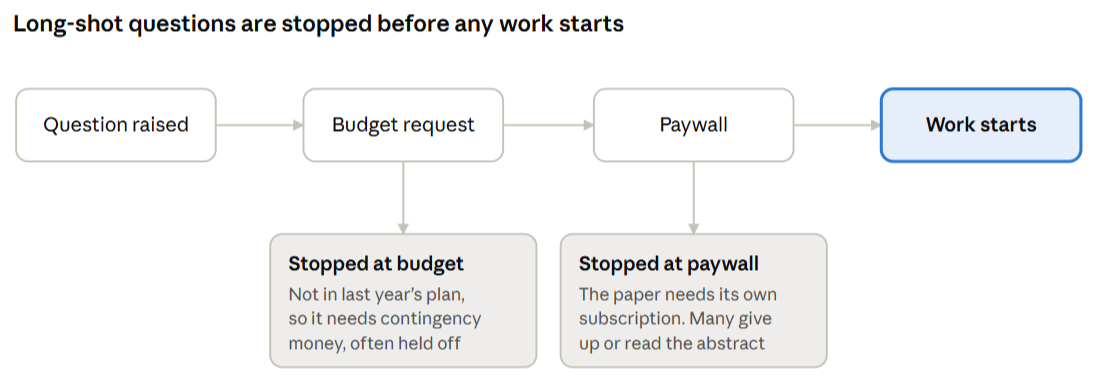
A research lead at a consumer products company explained this challenge to us. He manages a team of six to eight researchers and has to consider how much of the yearly budget any new investment would use.
Speaking about a new research tool, he said, “I’m not sure it’s worth spending that much percent of the yearly budget on for, like, 6 people, 8 people.”
His concern makes sense. With limited resources, R&D heads have to prioritize what their teams need most. But this creates a problem for ideas that were never part of the original plan. Even when something looks promising, it has to compete with projects that already have funding. And often, the planned work wins before anyone has the chance to find out whether the new idea is worth pursuing.
Why Do Promising Ideas Keep Losing to Planned Projects?
When R&D budgets are tight, every new idea comes with a question – Is it worth the investment?
For projects already in the plan, teams usually have a clear answer. They know what they want to achieve, how much it might cost, and what results to expect.
But a new research idea is different. Its potential is still uncertain, and finding out whether it works requires time and money. When researchers have to justify that investment before they can even explore the idea, sticking to planned work becomes the easier choice.
What Does Research Tell Us About This?
This problem has also been studied by management researchers.
Nitin Nohria and Ranjay Gulati examined 264 departments across two multinational companies. They found that having too few spare resources, which researchers call organizational slack, can discourage innovation. When teams have no extra time or budget to experiment, they become less willing to explore ideas with uncertain outcomes.
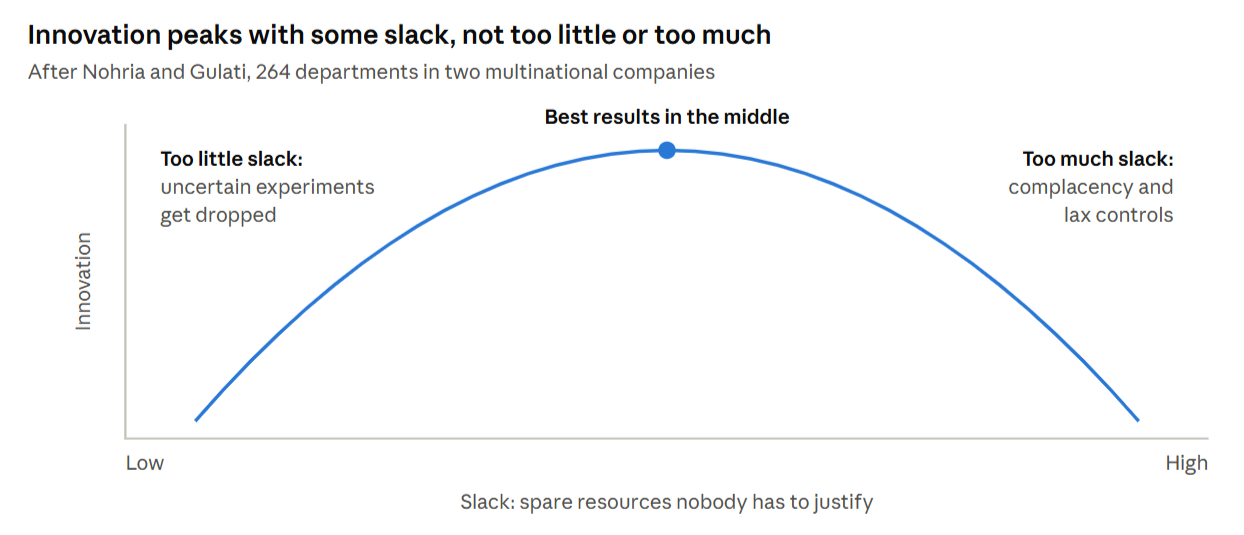
However, the study also found that having too many spare resources can create problems. It can lead to complacency and weaker financial discipline.
The lesson is not that R&D teams need unlimited budgets. They need enough flexibility to explore promising ideas without having to justify every small experiment as a major investment.
But What Happens When Researchers Simply Have No Time?
Even when funding is available, finding time to explore an idea can be just as difficult.
The technology leader from the oilfield equipment company raised this concern during our conversation. He explained why he prefers a full-year pilot rather than a short trial: “We don’t look at it for two months. We start actively building, we get just a few things, and then all of a sudden your license is out.”
His experience shows how easily a new initiative can get delayed when existing projects take priority. By the time researchers find the time to properly evaluate a tool or technology, the trial period may already be over.
Research by Gary Hamel and Michele Zanini points to a similar problem. Their respondents reported spending around 28% of their working time on activities such as reports, meetings, and approvals. That is more than one working day every week.
For researchers already managing experiments, deadlines, and planned projects, finding additional time to investigate an unexpected idea becomes difficult. So even when an idea does not require a large budget, it can still be lost simply because nobody has enough time to explore it.
What Happens When Researchers Get the Freedom to Explore New Ideas?
Some companies have found ways to give researchers the freedom to explore ideas without requiring approval at every step. One of the best-known examples is 3M. Since 1948, the company has followed its 15 percent rule, which allows employees to spend part of their paid working time exploring ideas they find interesting, even if those ideas are not part of their assigned projects.
One of its most famous products came from an experiment that initially seemed unsuccessful. Chemist Spencer Silver had developed an adhesive that was too weak for its intended applications. He spent years sharing his discovery with colleagues, hoping someone might find a use for it.
Then Art Fry, another 3M employee, came across a problem of his own. While singing in his church choir, he kept losing the paper bookmarks in his hymnal.
He remembered Silver’s adhesive and wondered whether it could hold his bookmarks in place without damaging the pages.
The next day, Fry obtained a sample and began experimenting. He could explore the idea during working hours because 3M’s policy already allowed it. That experiment eventually became the Post-it Note.
Google later adopted a similar approach with its 20 percent time policy, which has been credited with helping create products such as Gmail and Google Earth.
What makes these examples interesting is that neither company needed to remove budgets, priorities, or accountability. They simply gave employees some freedom to experiment without having to prove an idea’s commercial value before testing it.
For R&D teams, that is an important distinction. A small amount of time set aside for exploration can give promising ideas a chance to develop before anyone has to decide whether they deserve a larger investment.

What Does an Unexplored Research Idea Really Cost?
The difficult part about losing a promising research idea is that you may never know what it could have become.
Most R&D teams track projects that succeed or fail. But what about the ideas nobody had the time or budget to test? Those rarely get recorded.
Sometimes, the missed opportunity becomes clear years later, when a similar technology appears in a competitor’s patent, a new startup, or a product launch.
A strategy lead at a large packaging manufacturer explained this from an investment perspective. He believes that companies that can “figure out which European company is gonna get to the solution and identify that signal first” have the opportunity to “buy them for 20¢ and a dollar.”
His point is simple. Companies that recognize promising technologies early may be able to invest in them at a much lower cost. Those that discover the same opportunity later could end up paying significantly more or competing against a company that acted first.
For R&D teams, the cost of an unexplored idea is not just the potential innovation they miss. It can also mean losing the chance to act on an emerging technology while it is still relatively inexpensive to pursue.
How Can R&D Teams Explore More Ideas Without Increasing Their Budgets?
The examples we discussed earlier show that researchers need some freedom to explore ideas before proving their commercial value. But giving everyone extra time or a separate research budget is not always practical.
This is one of the problems we built Slate, AI-Powered R&D intelligence platform, to help solve.
What If Researchers Could Check an Idea Without Asking for More Budget?
Imagine a researcher comes across an interesting technology while working on another project. They want to know whether anyone has tested something similar, which companies are working on it, and whether the approach could solve their problem.
With Slate, they can start exploring those questions without requesting a separate budget for each search. Teams agree on their research areas in advance. Within that scope, researchers can investigate as many questions as they need, without per-question charges or token limits.
Slate brings together patents, scientific papers, regulations, and market information, with citations linking findings to their original sources.
This allows researchers to check whether an idea is worth exploring further before spending weeks building a business case around it.
What If Researchers Did Not Have to Find Every Opportunity Themselves?
Sometimes, the challenge is not finding time to investigate an idea. It is discovering that the opportunity exists in the first place.
That is where Slate Radar can help.
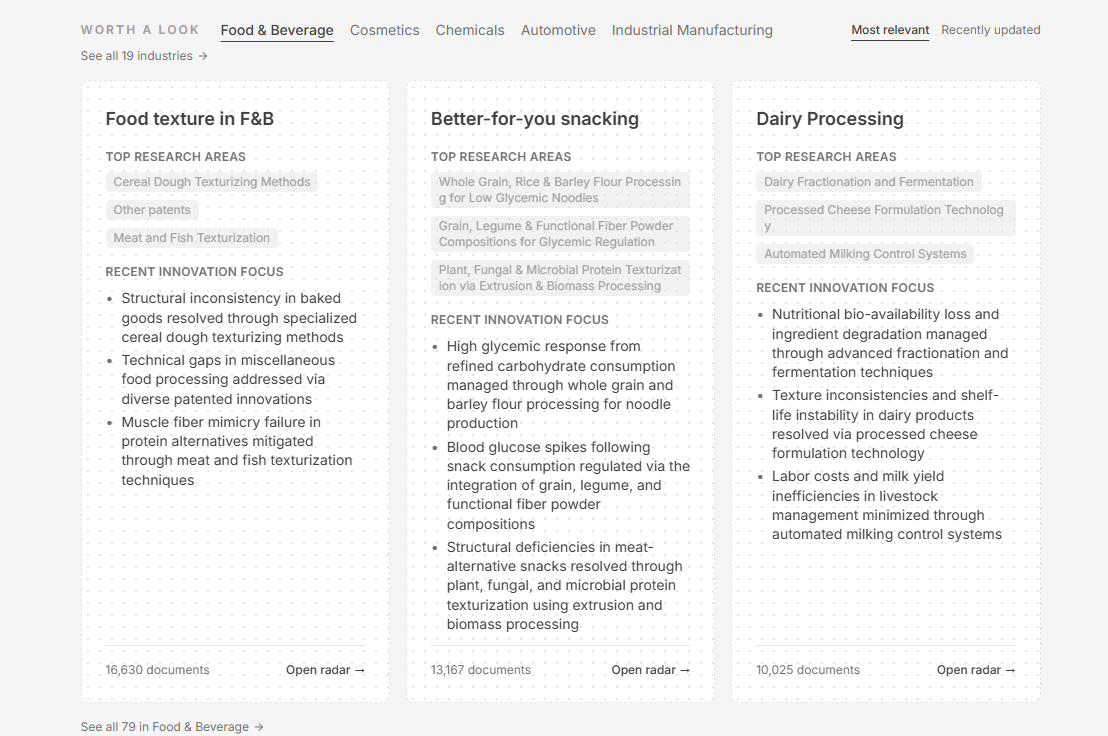
Researchers can set up Radar to monitor a particular technology or research area. It then tracks developments across patents, scientific papers, funding rounds, hiring activity, and acquisitions. When something unusual appears, Radar can flag it and provide the supporting sources.
This means researchers do not have to keep checking different sources manually or rely on remembering something they read weeks ago.
The goal is to make it easier for R&D teams to notice promising ideas early and gather enough evidence to decide whether they deserve further investment. And if your team has an idea that has been sitting unexplored for months, we would be happy to help you investigate it.
Bring us one research question. We can explore it together on Slate, look at the available evidence, and help you decide whether it is worth taking forward.