A long list of patents can tell an R&D team a lot about a technology area. But it cannot tell them whether their company should invest in it.
An R&D leader at a large materials company raised this during a recent conversation with us. His team was evaluating a new technology area. Their research tool showed patents organized by owner, filing year, and country. The information was relevant, but it did not help him decide what to do next.
“Getting 2,000 patents, it’s going to be humanly impossible to go through that in a reasonable time,” he said. Then he asked, “So what does it mean for us?”
We have heard similar concerns from R&D leaders in household care, cosmetic ingredients, and oilfield equipment. Their research tools could help them see what was happening in a technology area. They couldn’t show how these findings mattered to their business, compared with their own patents, research, and partnerships.
We call this the blank-slate problem in R&D project selection. Teams judge new opportunities without accounting for what their company has already built or invested in.
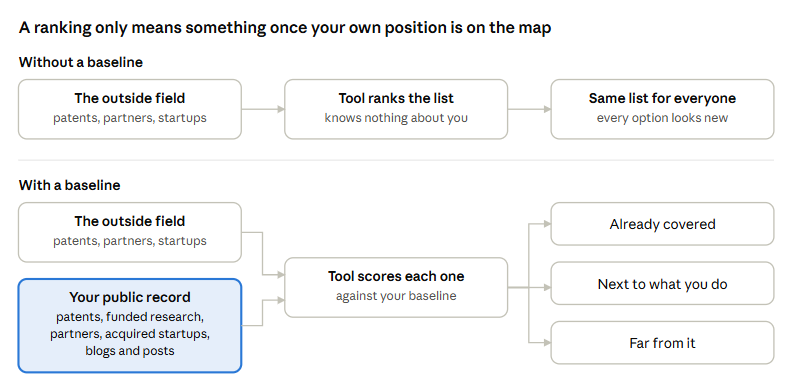
The fix starts with a company baseline. A company baseline is a record of what the business has already developed, researched, or invested in. It is built before anyone judges a new opportunity.
This article covers what R&D leaders told us, why the gap exists, and how to tell if your team has the same problem.
What Is the Blank-Slate Problem in R&D and Who Does It Affect?
The blank-slate problem happens when R&D teams evaluate new opportunities without considering what their company has already done in that area.
A research tool might show you the latest patents, emerging technologies, and competitor activity. But if it doesn’t account for your company’s own patents, research, and partnerships, it can’t tell you which opportunities make sense for your business.
We saw this at the same materials company. A competitive intelligence report recommended partnering with a design studio, but the team had already done that. As one reviewer pointed out, “We have partnered with a designer.” The recommendation wasn’t wrong. It was missing information that could have changed the advice.
This gap matters most for R&D projects meant to reach the market in three to five years. In that window, your existing capabilities, investments, and partnerships decide what is worth building. It also decides what would only repeat work you have already done.
Long-term projects are different. Teams looking ten years ahead may choose to set current capabilities aside on purpose. But for nearer-term decisions, the tool needs to know where your company stands.
If a tool would give you the same recommendations it gives your competitors, it isn’t helping you decide where to invest.
What Are R&D Leaders Telling Us About Project Selection?
“The question that I keep getting asked is what should we be focused on?”
A technology leader at an oilfield-equipment maker described his work as “looking at where we are and where we want to be”, and raising a warning when “our capability is lagging in areas that we were once strong.” He also uses reviews to keep money away from ideas that don’t fit “our wheelhouse.” Each of those calls starts from a clear picture of what the company already does well.
“I’m not getting anything additional apart from what we are already doing in terms of the chemistry, the composition, and everything.”
An R&D manager at a large household-care company, whose products lead their category, said this when asked what a new tool could add. When you are the benchmark, the useful signal sits just beside your current work, and finding it needs a clear map of that work first.
“It could be useful to convince our sales team, marketing team that, yes, there is a market out there.”
A research scientist at a specialty cosmetic-ingredients supplier said this after seeing which companies filed patents around one type of active. He already builds a baseline by hand: “I will look for the molecules that are the best sellers or the most potent on the market and inject them inside our tests.”
Three industries, one missing step. Before anyone picks a project, someone has to say where the company stands.
What Does the Blank-Slate Problem Cost Your R&D Budget?
A 2026 benchmark report from Wiley and IEEE Spectrum shows how much money is at stake. It’s based on a survey of more than 200 senior R&D professionals and sponsored by a patent-analytics vendor. It found that more than a third of organizations spend 25 to 40 percent of their R&D budget on projects that never reach the market. Nearly half of the people surveyed estimate they lose more than $1 million every time a late-stage project is canceled.
The report doesn’t break that waste down by cause, so not all of it comes from the blank-slate problem. It does show how much is on the line when a team picks the wrong projects.
Your own number is easier to find. It takes four steps:
- List the projects your team stopped or restarted in the last two years.
- For each one, ask whether a clear view of what your company already held would have flagged the problem in the first week.
- Add up the team-months spent on the projects where the answer is yes.
- Multiply by what a team-month costs you.
This is a rough estimate. It rests on hindsight and your own judgment. It still gives you a figure to compare against the cost of fixing the problem.
Why Does the Blank-Slate Problem Keep Happening?
Most research tools are good at showing what is happening in a technology area. They find patents, track competitors, and identify new research. But they struggle with a question that matters just as much to R&D teams: Where does our company stand in all of this?
The problem is that this information is rarely in one place. A company’s knowledge is spread across patents, research papers, funded projects, partnerships, and past acquisitions. Bringing it all together takes time, and most R&D teams do not have the resources to do this for every new opportunity.
Even traditional R&D scoring methods have this gap. Market size, growth rates, and patent activity are easy to measure using external data. But when it comes to assessing whether an opportunity fits the company’s existing strengths, teams often rely on personal judgment rather than evidence.
This is why R&D teams need a clear starting point before evaluating new opportunities. We call this a company baseline, a record of what the business has already developed, researched, or invested in.
A useful approach should help teams:
- Build a company baseline: Bring together existing patents, research, partnerships and investments before assessing a new opportunity.
- Verify what the company already knows: Link each finding to its source so internal experts can review it, correct gaps and add missing information.
- Evaluate opportunities in context: Compare each new idea against the company’s existing work to identify what is already covered, what builds on current strengths, and what would require new capabilities.
This changes how R&D teams assess opportunities. Instead of asking only whether a technology looks promising, they can judge whether it is worth pursuing for their own business.
How Can You Tell If Your Team Has the Blank-Slate Problem?
Look at past R&D decisions and see whether your current research tool would have helped your team make them.
Start by choosing three projects from at least two years ago:
- One that succeeded and reached its goals.
- One that was stopped after significant time or resources had been invested.
- One that duplicated or overlapped work your company had already done.
Ask your research tool to evaluate each project as a potential opportunity for your company at that time. Don’t give it any background about the projects.
Then check whether the tool picked up on your company’s existing patents, research, and partnerships. Count how many of its “new” ideas were things your team had already explored or invested in.
You can also run a quick check by answering three questions with a yes or no:
- Does your team compare new opportunities against existing projects and capabilities before discussing them?
- Is the fit score on your R&D project sheets backed by data?
- Would your research tool give different recommendations to two companies exploring the same technology?
If you answered “no” to two or more, your team is probably evaluating opportunities without enough company context.
Before investing in more research tools or adding more ideas to your pipeline, make sure you have a clear picture of what your company already knows and can do.
Should You Connect a Tool to Your Internal Data?
If the problem is that research tools do not know enough about your company, connecting them to internal data seems like the obvious solution. But that is not always the easiest place to start.
Two Ways to Build Your Company’s Research Baseline
The first approach is to connect a tool to your internal systems, including lab records, project files, and research reports.
This gives the tool access to information that competitors cannot see. But it also requires IT support, system integration, and security approvals.
During one of our conversations, a senior scientist at a large chemicals and life-sciences company explained that even when a vendor has security certifications, “it has to go through [our security] filters.”
The second approach is to start with what your company has already made public.
Patents, funded research, partnerships, acquisitions, and published articles can reveal a great deal about where a company has invested and what capabilities it has built.
Since this information is public, teams can build an initial baseline without connecting internal systems or sharing confidential research.
For R&D decisions three to five years ahead, this can be a useful starting point. It also shows how competitors and potential partners might view your company’s strengths.
What Happens If the Public Baseline Is Incomplete?
Public information cannot tell the full story. It misses unpublished research, confidential projects, and partnerships that have not been announced. It can also contain errors or outdated information.
That is why teams need to see and verify the evidence behind each finding.
During another discussion, a team lead at a large materials company described how his experts had to review an AI-generated report line by line. Their concern was that “we’ll have to question and double-check everything.”
A useful baseline should therefore show its sources and let internal experts correct errors or add missing context.
Teams can start with public information, test whether it helps them make better decisions, and then decide if adding internal data is worth the extra integration work and security review.
Can Your Existing AI Assistant Build the Same Baseline?
It depends on two things. Can the assistant read your internal files? Can it read outside research?
An assistant connected only to internal files can help you find past projects, reports, and technical knowledge. But it cannot tell you how those capabilities compare with new technologies, competitor activity, or outside research. An assistant with only web access sees the outside but not your company.
To close the gap, one tool has to do both and put the results side by side. Searching internal documents alone does not do that.
The important distinction is between having access to information and using it to support an R&D decision.
A reliable assessment still needs to connect related findings across sources, identify which company capabilities are relevant, account for gaps, and explain why a particular action is worth considering.
For example, a tool might find that the company owns patents related to an emerging technology.
The next questions are whether those patents are still relevant, whether they cover the proposed application, and whether the company has the expertise needed to develop it.
An AI-generated answer that treats a patent count as proof of technical strength could produce the wrong conclusion.
Teams should be able to trace important findings to their sources, question the interpretation, and add information the system does not have.
The goal is not to give the AI tool access to every internal document. It is to provide enough verified context to make the assessment useful.
How Slate Helps R&D Teams Avoid the Blank-Slate Problem
Finding promising technologies is only part of R&D project selection. Teams also need to know whether those technologies fit what their company has already developed, researched, or invested in.
This is where SLATE, an AI Agent for R&D comes in.
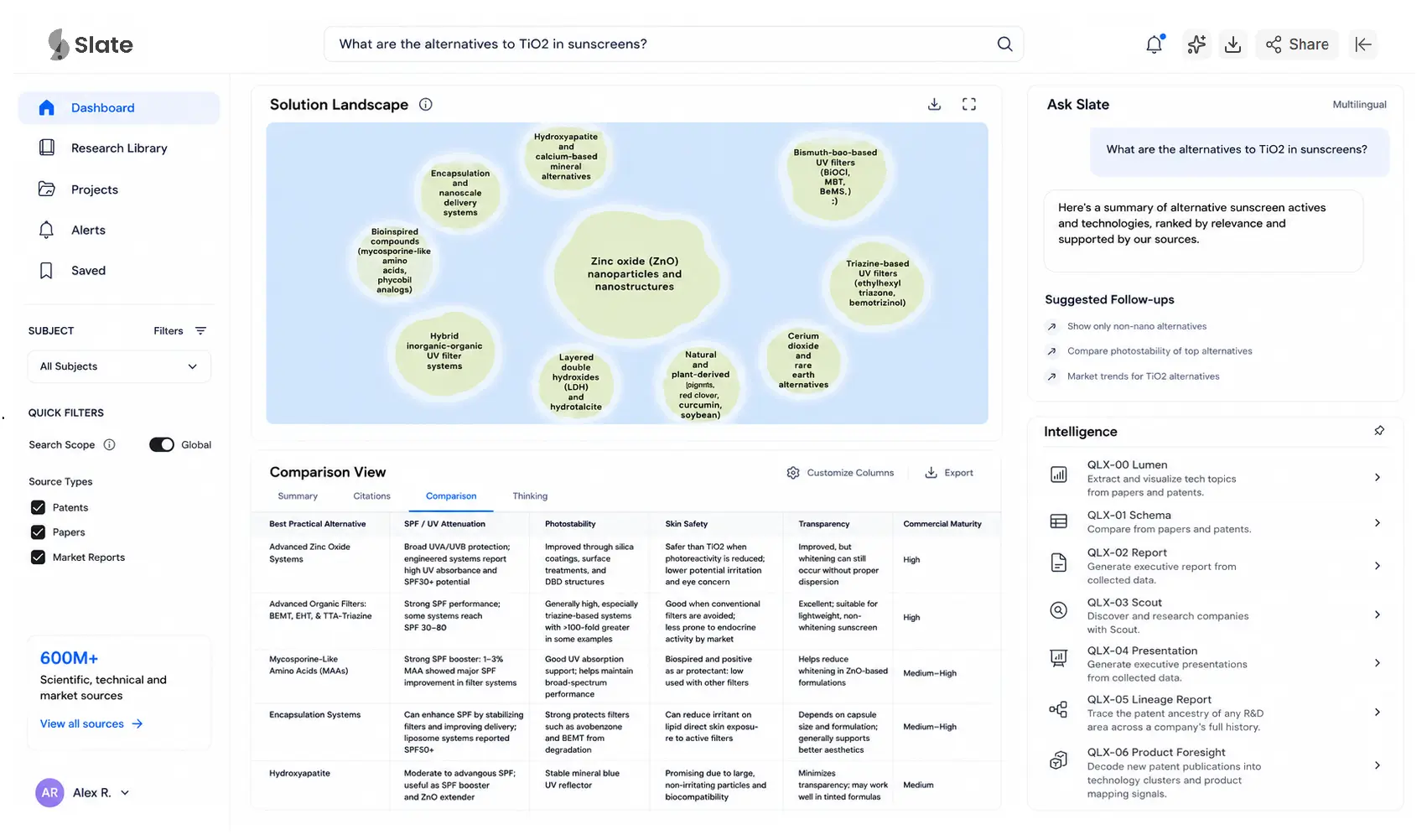
Slate uses publicly available information to build a picture of your company’s existing capabilities. It brings together patents, funded research, partnerships, acquisitions, publications, and other public records into a knowledge base that helps put future research questions in context.
Since it starts with public data, teams can assess opportunities without connecting their internal systems.
Consider the R&D leader who received a list of 2,000 patents and asked, “So what does it mean for us?”
With a company baseline in place, Slate can help answer that question by assessing:
- Technology fit: Does this opportunity build on your company’s existing strengths and expertise?
- IP position: What patents does your company already hold, and where are the gaps?
- Strategic relevance: How closely does the opportunity align with your company’s known research and investment priorities?
- Investment potential: Is there enough evidence to explore the opportunity now, or does it need more research?
But an R&D decision made today may need to change as new technologies emerge, competitors file patents, or research findings challenge earlier assumptions.
Slate Radar helps teams keep track of these developments. It monitors new patents, research, and other relevant activity so teams can spot changes that may affect their R&D priorities.
Together, the company baseline and Radar help teams answer two questions. Where does our company stand today, and what is changing that could affect our next R&D decision?
Slate also links findings to their sources. Your experts can review the evidence, correct errors, and add what the public record misses.
The goal is not to replace an R&D leader’s judgment. It is to give them the evidence and company context they need to make better project selection decisions.
Test It on a Project You Already Know
The leaders in this article were all asking some version of the same question: “So what does it mean for us?” Most tools can’t answer it, because they don’t know where your company stands.
The quickest way to see this for yourself is to use a decision your team has already made. Pick one project you stopped late, or one idea a tool once called new that your team had already worked on. You know how that story ended, so you don’t have to take anyone’s word for the result.
Slate is built for this. It builds your company’s baseline from public data first, then weighs the opportunity against it. Bring that one project to a 30-minute working session, and we’ll run it through Slate with you. You’ll leave knowing whether your current way of ranking projects would have caught the problem early.