Most large R&D organizations already have AI. What many still cannot answer is whether it has changed an important R&D decision.
Across the same organization, one team may use AI to scan scientific literature, another to investigate patents, and an innovation team to explore new technologies or companies. Six months later, there may be plenty of AI activity, with more searches, faster summaries, and quicker access to information.
But the real question is whether AI is changing what teams choose to test, stop, prioritize, or invest in next.
That is where AI starts creating real value in R&D. The opportunity is not just to get answers faster, but to help researchers understand what is already known, trust the evidence behind it, connect external intelligence with internal knowledge, and reach better technical decisions sooner.
The Best AI Use Cases Start With Problems Researchers Already Need to Solve
Imagine a formulation team needs to replace an ingredient that may become difficult to use. The alternative cannot simply perform the same function.
It may need to work under specific processing conditions, meet cost targets, remain compatible with the existing formulation, avoid new regulatory issues, and stay clear of problematic intellectual property.
A researcher could ask AI for a list of alternatives and receive an answer within seconds. But that list is not the R&D decision.
The real question is which alternatives still look credible after all those constraints are considered together. This distinction changes how organizations should introduce AI into R&D.
A broad instruction such as “use AI more” gives researchers little reason to change an established research process. Researchers already have experiments, deadlines, project reviews, and technical problems competing for their time.
A better starting point is what we call a burning question. It is a problem the researcher already wants solved.
For one team, that could be identifying an alternative material with a specific combination of thermal and mechanical properties. For another, it could be understanding which biological pathways are creating new opportunities for a product category. Another team may want to know why a promising technology has generated significant academic interest but very little commercial activity.
Once the question matters, the AI evaluation becomes meaningful. The team can see whether the system found evidence they did not know about, whether it connected information that normally required separate searches, whether the interpretation survived technical scrutiny, and whether the result helped them decide what to investigate next.
This gives large organizations a much stronger way to evaluate AI. Do not start with the tool. Start with the technical problem the team would have needed to solve anyway.
Before Researchers Trust AI in R&D, Test It on the Questions They Know Best
Once researchers have a real R&D problem to explore, the next step is not to trust the AI because its answer looks convincing. It is to test the system on questions where the researcher already knows what a good answer should look like.
A scientist who has spent ten years working on a technical area already knows things an AI system should be expected to find. They know which papers shaped the field, which terminology creates misleading search results, which apparently promising approaches failed, and which technical limitations are easy to overlook.
Those questions make excellent tests.
If the AI misses information the scientist considers fundamental, the team has learned something important about the system before trusting it with an unfamiliar problem.
But known questions are only one part of a useful pilot. The next test should involve an active problem the researcher does not already know how to solve.
That shows whether AI can find useful evidence beyond the researcher’s existing knowledge. Then the system should be challenged again.
Give it a question where studies disagree. Use terminology that changes meaning between industries. Add a constraint that makes several obvious solutions irrelevant. Ask about an approach where performance depends heavily on experimental conditions.
Now the organization is testing something more important than whether AI can produce a polished answer.
It is testing whether the system knows where the evidence becomes uncertain.
- Does it preserve conflicting findings?
- Does it retain the conditions under which a result was achieved?
- Can the scientist trace an important conclusion back to the evidence supporting it?
- Does it recognize when the available evidence is too weak to justify a conclusion?
- And when it gets something wrong, can the researcher see why?
These questions matter because R&D teams do not need AI to sound knowledgeable. They need to understand when it deserves to influence a technical decision.
Why AI in R&D Can Still Be Wrong When the Sources Are Real
When people talk about AI reliability in R&D, the conversation often starts with hallucinations. But fabricated papers or citations are only the easiest errors to catch. A source can be completely real and still lead the researcher to the wrong conclusion.
The paper exists, the authors are real, and the experiment happened. However, the answers can still be misleading.
An effect may have been demonstrated at a concentration that would never work in the final product. The study may use a substrate that behaves differently from the one the R&D team is working with. A paper could report an improvement in one property while showing deterioration in another that matters commercially. An in-vitro result could also be presented as evidence of finished-product performance even though the study never established that.
Nothing was invented. But the decision built on top of the research could still be wrong.
That is why reliable AI in R&D requires more than attaching citations to an answer. Researchers need to know whether the source is relevant to their problem, whether it actually supports the claim being made, whether important experimental conditions have been preserved, and whether conflicting evidence has been considered.
Early AI evaluations should involve a lot of this checking. Over time, the objective should change. Researchers should spend less time asking: “Is this information real?” And more time asking: “What does this information mean for our problem?”
That shift is where AI starts becoming more useful for R&D. Researchers spend less time validating whether information exists and more time deciding how the evidence should influence the next technical decision.
Why Internal R&D Knowledge Is the Missing Piece in Enterprise AI
An AI system may find several papers suggesting that a particular polymer family could improve the performance a team is trying to achieve. Based on the published evidence, the opportunity looks promising.
But somewhere inside the organization, that same polymer family may already have been tested three years earlier. It improved the target property, but created a processing problem serious enough to stop development.
The researcher who ran those experiments has moved to another team. The findings sit in an old spreadsheet and a project presentation that nobody involved in the current work has seen.
From the AI system’s perspective, the opportunity still looks attractive. From the organization’s perspective, part of the question has already been answered.
This is where large R&D organizations have an advantage that public AI cannot easily replicate. Their value does not come only from having access to more papers, patents, or external data. It also comes from everything their researchers have already learned.
Over time, companies build up experimental results, formulation knowledge, scale-up experience, supplier interactions, customer requirements, manufacturing constraints, unsuccessful projects, technical reports, and project decisions that may never become part of the public scientific record.
And some of the most useful knowledge is often about what did not work.
- A material performed well in an assay but degraded in the finished formulation.
- A process improved performance on the bench but could not be reproduced at pilot scale.
- A technical route worked but was too expensive to pursue.
- A supplier changed a grade and the original result could never be recreated.
These findings may never appear in a scientific paper, but each one can change what an R&D team should do next.
[IMAGE: External knowledge + internal R&D knowledge → stronger technical decision]
This is why the longer-term opportunity for enterprise AI goes beyond improving external search. The real value comes from connecting what the outside world knows with what the organization has already learned through its own research.
That combination is much harder for competitors to copy. Two companies may have access to the same papers and patents, but they do not have the same experimental history, failed attempts, or technical experience.
AI in R&D Works Better When It Connects Research Across Sources
Most difficult R&D questions cannot be answered from a single source. A team evaluating an emerging manufacturing technology. Scientific literature may explain why the approach works. Patents may show how companies are attempting to implement it. Company activity can reveal who is investing. Product information can show whether commercialization has started. Regulatory information may expose constraints that could affect adoption. Looking at any one of those sources can produce a technically correct but incomplete picture.
Researchers therefore spend a considerable amount of time moving between information systems and gradually building a mental model of the field.
AI can reduce that burden. But only if it does more than make each individual search faster. The larger opportunity is connecting evidence across those searches.
A researcher should be able to move from a technical mechanism to the companies working on it, understand how their approaches differ, see what has been protected, identify what has reached commercial development, and determine which technical limitations are still unresolved.
That connected view matters because R&D decisions rarely depend on a single finding. They depend on how several pieces of evidence change one another.
A technology with strong academic evidence looks different once manufacturing complexity is considered. An apparently open technical area looks different once relevant patent claims are reviewed. A promising material looks different when regulatory restrictions limit how it can be used.
This is where AI starts becoming more useful for R&D. It moves beyond finding information and helps researchers understand how different pieces of evidence fit together before they make the next technical decision.
AI Can Find R&D Whitespace. Researchers Still Need to Know Why It Exists
One of the most useful things AI can do in innovation research is spot areas where very little activity seems to exist. Once you look across patents, papers, companies, and technical approaches, the pattern becomes clearer. Some areas are crowded with activity, while others appear almost untouched.
That empty space can look exciting, but it does not automatically mean there is an opportunity. Say there is strong research around Technology A and Technology B, but hardly anyone seems to be combining them. It is tempting to assume nobody has noticed the connection yet. But there may be a good reason why the space is empty.
The combination could be physically unstable, too expensive to manufacture, difficult to commercialize because of regulation, or covered by IP that is not easy to find through conventional searches. It could also solve a problem customers are simply not willing to pay for.
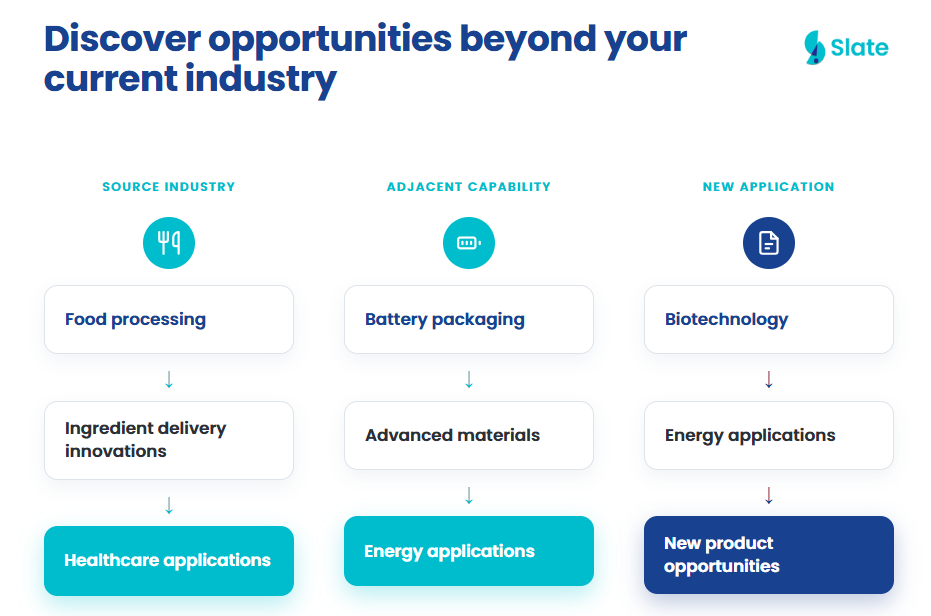
This is where AI needs to do more than point to a gap. It can help researchers understand what sits around that gap and why it may exist in the first place. What makes the direction worth exploring? Which assumptions does it depend on? Are there technical or commercial barriers already visible? What is still unknown? And what would the team need to investigate before committing experimental resources?
Seen this way, whitespace is not the answer. It is a starting point. AI can surface an underexplored direction, but researchers still need to determine whether that gap represents a genuine opportunity or a problem others have already discovered and decided not to pursue.
AI in R&D Creates Value When It Changes What the Team Does Next
Imagine two R&D teams using AI. The first produces ten detailed technology reports in a month. The reports take less time to create, cover more information, and look comprehensive. People read them, but none of the findings changes what the team does next.
The second team investigates only three questions.
- AI could surface prior work and a manufacturing constraint, helping the team rule out a weak technical route before committing time to experiments.
- Promising research may depend on conditions that do not match the company’s application, giving the team a reason to deprioritize it.
- AI might reveal an unexpected technical connection that helps researchers design a more focused experiment.
The second team produced fewer outputs, but it may have created far more R&D value. That is why measuring AI only through productivity can give organizations an incomplete picture. Hours saved, searches completed, and reports generated can show that people are using AI, but they do not show whether it is improving the research itself.
R&D ultimately moves through decisions. Teams decide which opportunities deserve investigation, scientists choose what to test next, technical reviews determine whether a problem can be overcome, and projects move forward, change direction, or stop. Investment follows those decisions.
The AI Metrics That Matter More Than Time Saved in R&D
Suppose a research task used to take eight hours and AI now completes much of that work in two. Saving six hours is an obvious benefit, and it is one of the easiest ways to show that an AI tool is improving productivity.
But for an R&D team, the more important question is what happens because those six hours were saved.
If the researcher simply produces more reports, the organization has increased output. If that extra time allows the researcher to explore another credible direction, identify a problem before an experiment begins, or design a better first experiment, the impact is much closer to what R&D is trying to achieve.
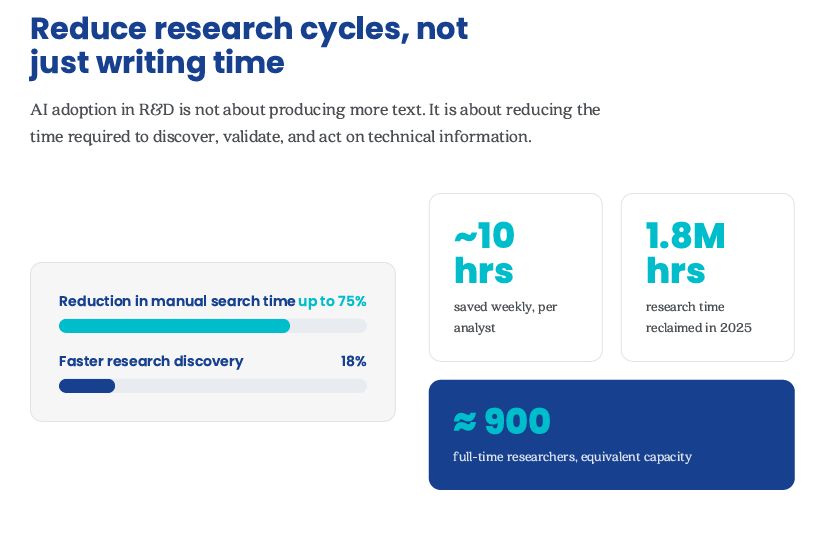
This changes what organizations should measure when evaluating AI. Instead of stopping at hours saved or searches completed, they can look at whether researchers found important work they would otherwise have missed, rejected a weak opportunity earlier, or identified a technical constraint before it became expensive to solve later.
They can also ask whether promising signals were recognized sooner, whether the first experiment became more focused, whether project reviews became clearer about what was known and unknown, and whether the same research capacity produced more credible ideas.
These outcomes are harder to fit into a standard AI adoption dashboard because they do not always produce a simple productivity number. But they say much more about whether AI is actually improving R&D.
Time saved tells you that AI made the work faster. What happens next tells you whether it made the research better.
AI in R&D Should Free Scientists to Focus on the Work Only They Can Do
Before researchers reach a genuinely new idea, they spend a lot of time understanding what is already known. They search for relevant work, read papers and patents, compare different approaches, reconcile terminology, look for previous attempts, and piece together evidence from different sources.
AI can take on much more of this work. It can search across information that would take an individual researcher much longer to review, organize evidence around a technical problem, and connect signals across papers, patents, companies, products, and other sources.
But once that information is assembled, the harder questions begin.
What does this evidence mean for our project? Which result deserves more attention? Which assumption looks weak? Why did an earlier approach fail? Does our manufacturing experience change how we should interpret the published research? And which unusual result is worth another experiment?
These are questions where experienced scientists bring context that AI does not automatically have. They understand what their organization can realistically develop and manufacture. They know which experimental details can change an outcome, remember previous failures, and recognize when an attractive technical result will be difficult to reproduce outside the lab.
They also know the realities around science. A customer requirement may rule out an otherwise promising solution. A manufacturing constraint may make a technically strong approach impractical. Several ordinary findings may become interesting only because an experienced researcher recognizes the connection between them.
This knowledge does not compete with AI. It is what makes AI-generated intelligence useful. The more AI can handle the work of searching, organizing, and connecting existing evidence, the more scientists can focus on interpreting that evidence and deciding what deserves to be tested next.
What Mature AI Adoption in R&D Looks Like Inside Large Organizations
The difference between early and mature AI adoption in R&D is not just the number of researchers using it. In the early stage, researchers tend to use AI on their own. They summarize papers, ask technical questions, compare documents, or explore topics they are less familiar with.
The next stage starts when AI becomes part of repeatable research workflows. Technology landscapes can be built faster, prior work can be identified earlier, and researchers can compare more evidence across a broader set of sources.
But the bigger shift happens when AI becomes connected to the context behind R&D decisions. External research is considered alongside internal knowledge. Important conclusions can be traced back to supporting evidence. Different types of technical information are brought together, and researchers get a clearer view of what is known, what is uncertain, and what needs to be investigated further.
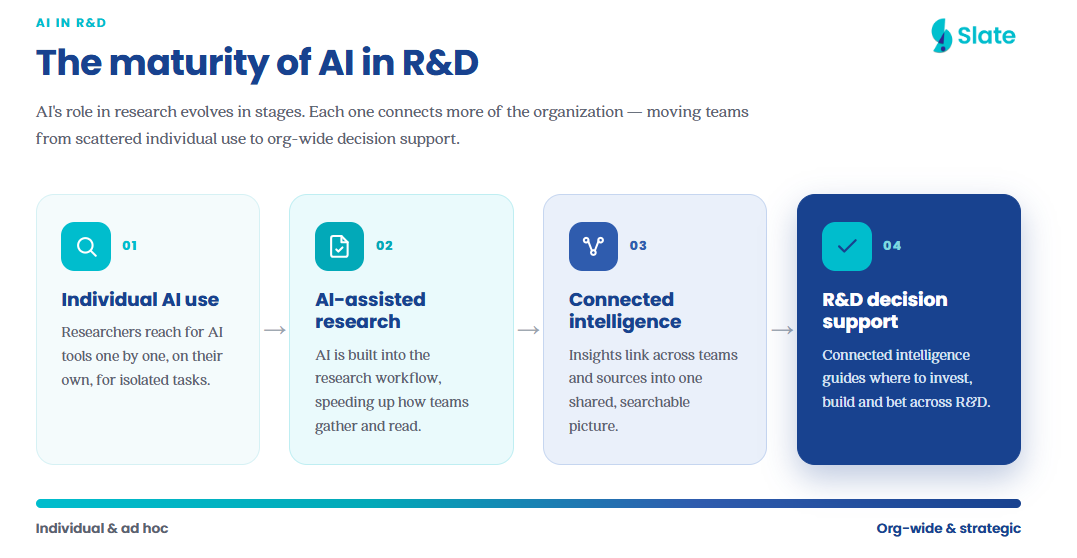
At that point, AI starts becoming part of decisions the organization is already making. Should this idea move into experimentation? Should this technical direction receive more resources? Is there enough evidence to begin a development program? Is the apparent whitespace worth exploring? Or should the team stop this path before spending another development cycle on it?
When AI starts influencing decisions like these, adoption is no longer measured by how often researchers open a tool. It becomes visible in how research moves through the organization.
Why R&D AI Needs to Go Beyond Answering Scientific Questions
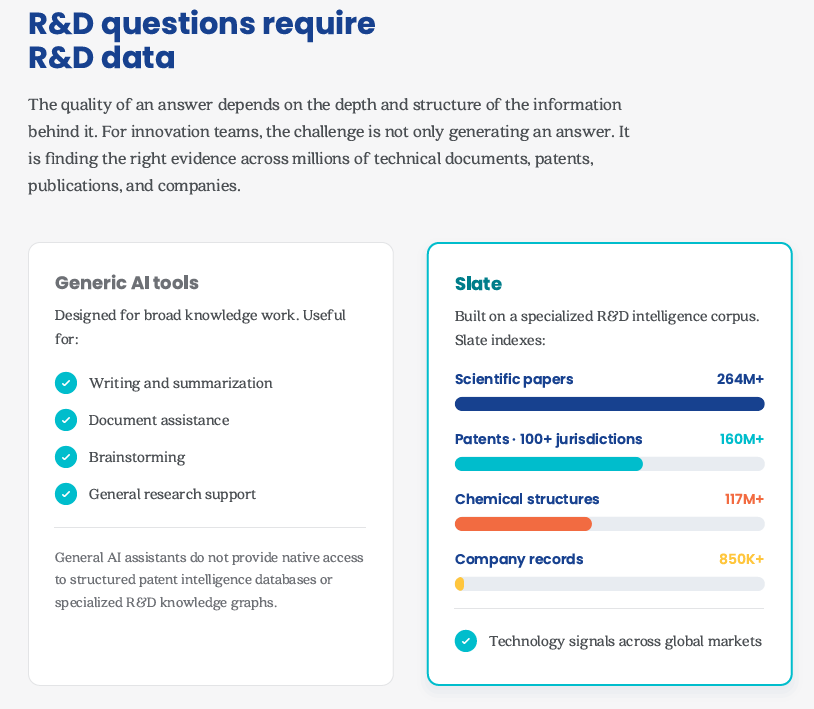
For R&D teams, a useful AI system needs to do more than answer a scientific question well. It needs to show researchers the evidence around that answer and help them understand how different pieces of information fit together.
That means connecting research across papers, patents, companies, technologies, and other technical sources instead of treating every search as a separate task. Researchers should also be able to trace an important finding back to the evidence behind it rather than accepting a generated conclusion without knowing how it was reached.
Just as important, the system should make uncertainty visible. Researchers need to see where evidence is strong, where studies disagree, where important gaps remain, and where another investigation is needed before a decision can be made.
This is the direction we are building Slate around. Slate,an AI-powered R&D intelligence platform is designed to help researchers investigate technical questions across scientific research, patents, companies, technologies, and other innovation signals while keeping the supporting evidence connected to the findings.
The goal is not to replace scientific judgment. It is to reduce the work researchers spend reconstructing what is already known so they can focus more of their time on interpreting what that knowledge means for the problem in front of them.
That is where AI can create more value in R&D. Not simply by producing an answer faster, but by helping researchers reach the point where their own scientific judgment matters sooner.
How R&D Leaders Should Measure AI Before Scaling It
Large organizations will keep adding AI across their research environments. The more important question is no longer whether researchers will use it, but whether it is improving the way R&D decisions are made.
That means looking beyond the easiest adoption metrics. It is useful to know how many researchers are using the system, how many hours it saves, or how many reports it can produce. But those numbers do not tell you whether the quality of the research has improved.
R&D leaders should also ask:
- Are researchers finding important evidence they would previously have missed?
- Can they understand how a technical conclusion was reached?
- Is internal R&D knowledge being connected with external research?
- Are weak technical directions being identified and stopped earlier?
- Are researchers reaching stronger experimental questions sooner?
- Is AI improving decisions about what deserves to be tested next?
These questions get much closer to the real value of AI in R&D. They show whether the technology is simply making existing work faster or actually improving how research moves from information to action.
That is the point where AI stops being another productivity tool and starts becoming part of how R&D intelligence is created.
The goal is not to make scientists ask AI more questions. It is to give them better evidence and context so they can decide which scientific question is worth asking next.