Scalp care is attracting innovation from three very different directions. Beauty companies are developing microbiome-focused ingredients and peptides. Traditional hair care companies continue to improve surfactants and conditioning systems. Electronics companies are building devices that could change how scalp treatments are applied.
So which technology is actually gaining ground? We asked Slate to investigate the patent landscape behind these competing approaches.
Slate analyzed patent activity across biological scalp treatments, conditioning chemistry, and scalp care devices. It compared publication growth, company portfolios, technical approaches, and areas where relatively few solutions appear to exist. One result stood out.
Microbiome modulation is growing, but conventional conditioning chemistry is not disappearing. From 2021 to 2026, the Slate analysis found cationic surfactant-related publications rising from 628 to 1,159. Bio-active and prebiotic formulation activity also grew, including a 33% increase identified between 2023 and 2026.
The more useful question for R&D teams may therefore be less about which chemistry replaces the other. It is about where each technology is becoming difficult to replicate, and whether device-led delivery could create another competitive layer around both.
Why Are Microbiome Scalp Care and Synthetic Surfactants Growing Together?
At first glance, microbiome scalp care may look like a replacement for traditional conditioning chemistry. The patent landscape suggests otherwise.
The two areas are solving different problems.
Biological scalp technologies focus more on microbial balance, dandruff, follicle activity, inflammation, and hair growth. Conditioning technologies are still centered on hair-fibre performance, including smoothness, manageability, deposition, shine, and resistance to humidity.
That helps explain why innovation in both areas is growing at the same time.
Unilever has 309 innovations in botanical and fermented extracts, including approaches such as trehalose-based microflora management. At the same time, the company has 222 publications in cationic surfactants for hair conditioning.
L’Oréal shows an even wider split, with 94 botanical extract innovations compared with 687 publications in cationic surfactants.
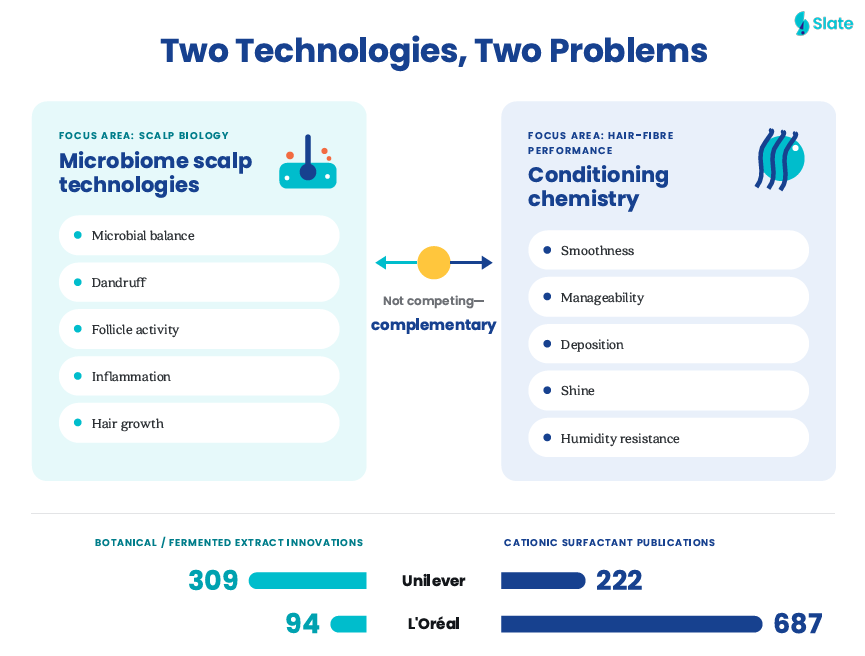
For R&D teams, means microbiome scalp care and conditioning chemistry should not necessarily be treated as competing technology choices. They may require different formulation platforms, validation methods, and technical capabilities. The bigger challenge is building products that can address scalp biology without compromising the conditioning performance consumers already expect.
Where Is Microbiome Scalp Care Becoming Harder to Copy?
The strongest competitive advantage in microbiome scalp care is moving beyond the ingredient itself.
Using a probiotic, prebiotic, or fermented extract is relatively easy to replicate. What is harder to copy is the biological system around it, including the fermentation process, peptide sequence, mechanism of action, delivery method, and supporting clinical evidence.
Unilever’s trehalose-based prebiotic work shows how this can create differentiation. Its patent describes a system in which trehalose works with Staphylococcus hominis to inhibit Malassezia restricta, a microorganism associated with dandruff. The value lies in the defined biological interaction, not simply in adding a prebiotic ingred vcient to the formulation.
Caregen is building a different type of advantage through peptide engineering. Slate identified 67 relevant publications focused on peptide-driven follicle stimulation. Several of its patents describe synthetic peptides designed to influence human follicle dermal papilla cells and pathways linked to hair growth.
BASF also has a strong position in biological scalp and skin technologies, with 58 publications in the analyzed landscape covering areas such as probiotic strains and polysaccharide-rich extracts.
This suggests that biological scalp care is becoming more technically layered. Future formulations may combine fermented ingredients, peptides, and other actives that work through different cellular or microbial pathways.
Examples such as Alteromonas-derived ferments combined with hexapeptides show how multiple biological inputs can be brought together for tissue repair and related skin functions.
For R&D teams, this changes where differentiation is likely to come from.
Sourcing the same ingredient as a competitor may no longer be enough. More defensible positions could come from proprietary fermentation processes, peptide sequences, validated mechanisms, ingredient combinations, and delivery systems that improve stability or scalp exposure.
| The R&D White Space |
| Companies could investigate formulations that combine microbiome modulation with follicle-targeted peptides rather than treating them as separate platforms. There may also be opportunities around ingredient stabilization, controlled release, scalp residence time, and formulations that preserve the activity of sensitive biological ingredients. The important question is no longer only which ingredient performs best. It is which combination of ingredient, mechanism, delivery system, and evidence can remain differentiated after competitors enter the same category. |
Why Are Synthetic Hair Care Technologies Still Growing?
L’Oréal’s portfolio includes 687 innovations in cationic surfactants. Its work includes cationic amidoamines combined with sebacic acid copolymers for concentrated formulations and performance under demanding conditions such as high humidity.
Henkel is exploring another route through alternative materials and lower-water formats. Its work includes propanediol caprylate in hair care formulations and solid conditioning systems designed for reconstitution by the user. These formats can reduce the amount of water transported in finished products, which is relevant because conventional shampoos often contain more than 70% water.
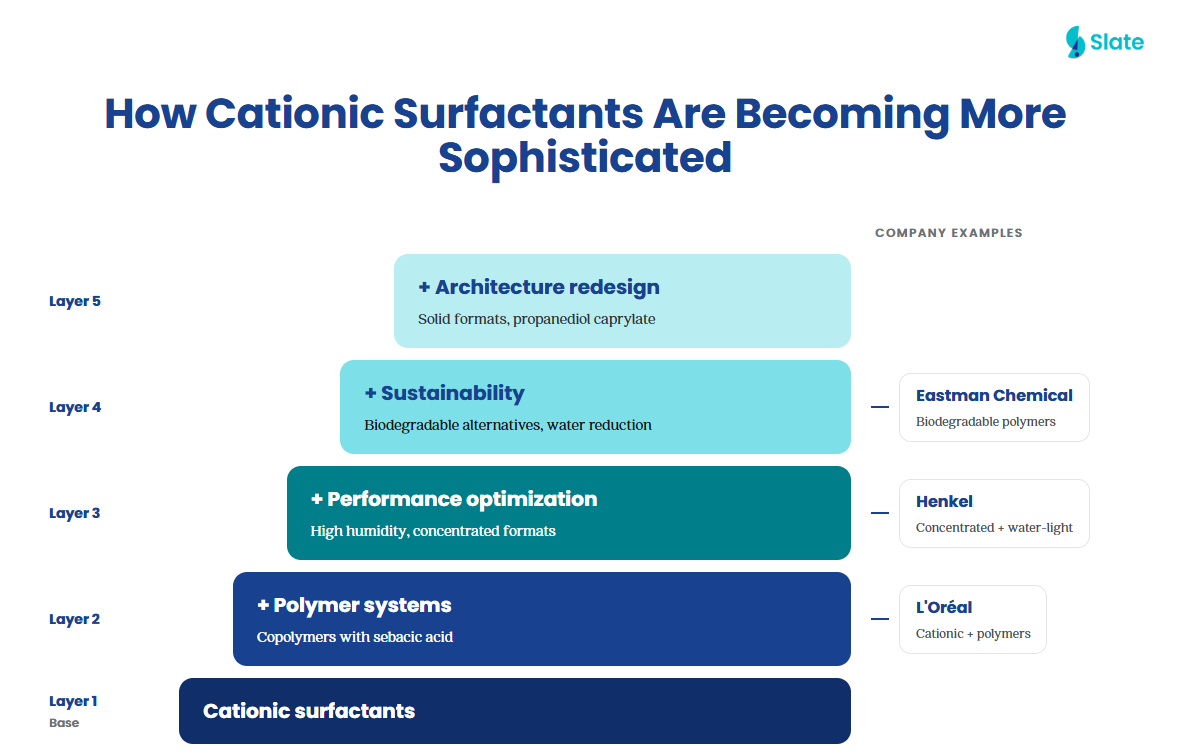
Eastman Chemical is addressing polymer sustainability through biodegradable cellulose esters. These materials are being developed as alternatives to persistent plastic-based particles while retaining useful functional properties.
Together, these approaches show where synthetic conditioning R&D is becoming more sophisticated.
The innovation is no longer limited to changing the surfactant itself. Companies are also reworking polymers, product concentration, water content, biodegradability, and formulation architecture.
For R&D teams, the next opportunity may lie in the remaining performance gaps. These include reducing water and energy use further, improving biodegradability without affecting sensory performance, simplifying formulation systems, and developing bio-based materials that can perform reliably within established conditioning platforms.
| Where the Opportunity Moves Next |
| A sustainability claim alone may become less differentiated if established formulation suppliers can deliver biodegradable materials, concentrated products, lower-water systems, and improved environmental profiles while retaining familiar sensory performance.The harder R&D challenge will be achieving both.A successful formulation may need lower environmental impact and performance that consumers can notice immediately. |
Could Scalp Care Devices Become More Important Than the Formulation?
Beauty and ingredient companies are no longer the only players shaping how scalp treatments are developed and delivered. LG Electronics and Panasonic have filed patents around dedicated scalp care systems, while Dyson is building a broader portfolio across hair care devices, airflow control, comb architectures, and liquid delivery.
Slate identified a 125% increase in publication activity around liquid-dispensing comb systems from 2024 to 2025–2026.
LG Electronics stands out with 20 innovations. Its patents include modular scalp care devices with detachable treatment heads, app connectivity, and systems designed to apply chemical solutions directly to the scalp.
Panasonic has also developed scalp care devices that combine mechanical stimulation with mist delivery.
Dyson contributed 13 publications in the analyzed landscape. Its filings are broader than dedicated microbiome scalp treatment, but its work in airflow, comb systems, and liquid delivery shows capabilities that could support more controlled topical application.
Anshen Electrical Technology has developed infrared atomizer systems for hair dryers with detachable oil reservoirs and controlled airflow channels. These approaches move treatment beyond simple topical application and toward more precise, device-controlled delivery.
That changes the role of formulation science.
If a device can control dose, contact time, application pattern, airflow, temperature, or treatment frequency, product performance may depend increasingly on how well the formulation works with the delivery system.
A highly effective active can still underperform if it is applied inconsistently or does not reach the scalp in the intended dose.
For formulation companies, the longer-term risk is that hardware providers start controlling the consumer interface.
If device manufacturers build closed systems around proprietary heads, cartridges, or compatible formulations, biological and synthetic products could become dependent on the hardware platform used to deliver them. In that model, formulation companies risk losing some control over product access, application conditions, and the consumer relationship.
This creates a new area for R&D teams to watch.
The opportunity is not only to improve the formulation or the device separately. It is to design both to work together, including viscosity, dose accuracy, atomization, ingredient stability, scalp coverage, and repeatable application. The companies that understand this interaction early may be better positioned as scalp care moves from passive application toward more controlled treatment systems.

Could Scalp Care Become Two Different R&D Markets?
Scalp-focused technologies are moving closer to biological and dermatological endpoints. Microbiome modulation, anti-dandruff systems, peptides, and follicle-targeted treatments increasingly depend on measures such as microbial balance, inflammatory response, follicle activity, and other biological outcomes.
Hair conditioning follows a different development path. Performance is still judged through physical properties such as smoothness, shine, combability, deposition, manageability, and resistance to humidity.
The growing skinification of scalp care makes this distinction more important.
Products that make stronger physiological or treatment-related claims may require deeper biological evidence and longer validation. Depending on the claim, formulation, and market, some may also face different regulatory requirements from conventional cosmetic products. Conditioning products, by comparison, are usually evaluated through cosmetic performance and claims substantiation.
Expertise in surfactants, polymers, and fibre conditioning does not automatically translate into fermentation biology, microbial science, peptide signalling, or follicle research. The reverse is also true. A company with strong biological scalp expertise may still struggle to deliver the sensory performance expected from mainstream hair care.
These capabilities are therefore difficult to transfer from one side of the market to the other.
The challenge becomes greater for products that promise both scalp treatment and high-performance conditioning. A single product may need biological efficacy, formulation stability, strong hair feel, compatible delivery, and evidence to support both sets of claims.
That makes hybrid scalp-and-hair products less of a single formulation problem and more of a capability-integration challenge.
Larger companies may be able to build or combine both capability sets. Smaller players are more likely to specialize in one technical area or rely on partnerships to fill the gaps.
So far, the 2021–2026 patent landscape does not point to these two paths merging into one technology platform. It suggests that biological scalp treatment and hair-fibre conditioning will continue to develop in parallel, while the most difficult opportunity sits at the point where the two need to work together.
Where Are the Most Important Scalp Care White Spaces?
The Slate analysis points to several gaps that are more useful than simply asking whether microbiome ingredients or surfactants will win.
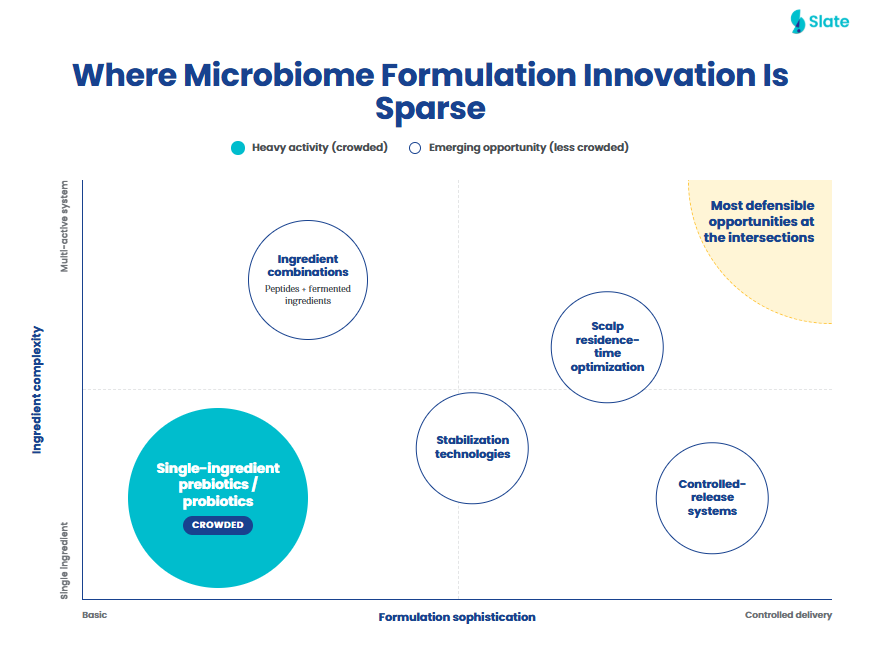
Device-Compatible Biological Formulations
Many biological actives are developed for conventional topical application. There is room to investigate formulations specifically engineered for atomizers, dispensing combs, cartridges, or other controlled-delivery systems. Compatibility could involve viscosity, particle size, ingredient stability, dose accuracy, and preservation of biological activity.
Better Links Between Delivery and Biological Response
Device patents and formulation patents are often developed separately. A bigger opportunity may sit between them. R&D teams could investigate whether a specific application pattern, dose, treatment frequency, temperature, or scalp contact time improves the response to peptides, prebiotics, fermented ingredients, or other actives.
Stable Biological Ingredients
Live microorganisms and sensitive biological materials bring formulation challenges that conventional surfactants do not. Shelf stability, preservation, moisture, temperature exposure, packaging, and delivery conditions can all affect performance. Technologies that solve these limitations may become more defensible than another ingredient claim.
Products That Treat the Scalp Without Compromising Hair Feel
This remains one of the more practical formulation problems. A scalp serum may improve the scalp but leave residue on the hair. A conditioning product may improve fibre feel while doing little for scalp biology. Formulations that can address both outcomes without compromise deserve closer attention.
Standardized Scalp Efficacy Endpoints
The scalp care category uses a wide mix of endpoints, from microbial abundance and dandruff scores to follicle measurements and subjective consumer assessments. More consistent measurement could make it easier to compare technologies and substantiate increasingly specific biological claims.
What Should Scalp Care R&D Teams Watch Through 2028?
Three questions deserve regular monitoring.
Where is biological IP becoming more specific?
Track whether companies are moving from broad botanical and microbiome claims toward patented strains, defined peptides, fermentation processes, biological targets, and clinically supported mechanisms.
How quickly is conventional conditioning chemistry improving?
Watch biodegradable polymers, concentrated systems, water reduction, new surfactant architectures, and other approaches that improve environmental performance without sacrificing sensory benefits.
Who is connecting formulations with hardware?
Monitor partnerships and patents that combine diagnostic sensing, dosing, atomization, cartridges, apps, and treatment formulations.
The third area may be particularly important because delivery hardware can create an additional layer of differentiation around otherwise similar formulations.
Understanding what thousands of patents collectively say about where a technology is moving is much harder. That is what Slate helped uncover in this analysis.
Slate, an AI-powered R&D intelligence platform for cosmetics brings patents, scientific literature, company activity, and other R&D signals into one research workflow. For scalp care teams, this means they can move beyond individual patent searches and examine the wider innovation landscape.
With Slate, R&D and innovation teams can:
- Track technology momentum by comparing how patent and research activity is changing across microbiome modulation, peptides, surfactants, delivery systems, and scalp care devices.
- Map competitor portfolios to see which companies are building capabilities across biological scalp treatments, conditioning chemistry, and hardware-led delivery.
- Identify emerging white spaces by finding technology combinations where research activity is increasing but patent ownership remains limited.
- Compare competing technical approaches to understand how different companies are solving the same scalp care problem through ingredients, formulations, biological mechanisms, or devices.
- Spot technology convergence by tracking where areas such as peptides, microbiome modulation, controlled delivery, diagnostics, and hardware are beginning to overlap.
- Connect patents with scientific research to see whether an emerging technical direction is supported by publications, experimental evidence, and broader R&D activity.
- Monitor new entrants and competitive moves before they become obvious through commercial product launches.
For R&D teams, this provides a clearer view of where competitors are building capability, where technical boundaries are starting to blur, and where there may still be room to develop something difficult to copy.
Rather than manually piecing together hundreds of patent searches, papers, and company signals, Slate helps teams investigate the landscape from one place and focus their attention on the opportunities that matter.

Frequently Asked Questions
What Is Microbiome Scalp Care?
Microbiome scalp care uses prebiotics, postbiotics, fermented ingredients, peptides, or microbial metabolites to influence scalp microorganisms and related biological processes.
Are Microbiome Ingredients Replacing Synthetic Surfactants?
No. Slate’s patent analysis shows both areas are growing. Microbiome technologies focus more on scalp health, while synthetic surfactants continue to support conditioning, smoothness, and hair-fibre performance.
Why Are Peptides Becoming Important in Scalp Care?
Peptides can target specific biological pathways linked to follicle activity and hair growth. Caregen, for example, has filed patents around peptides that act on dermal papilla cells.
Are Synthetic Surfactants Becoming Obsolete?
No. Patent activity in cationic surfactants increased between 2021 and 2026, showing continued R&D around conditioning performance and more sustainable formulations.
Why Are Electronics Companies Developing Scalp Care Devices?
Devices can improve how treatments are delivered through controlled dosing, misting, airflow, stimulation, and targeted scalp application. LG and Panasonic have already patented scalp care systems using such approaches.
What Are the Biggest Scalp Care Opportunities for R&D Teams?
Key opportunities include device-compatible microbiome formulations, peptide delivery systems, stable biological actives, and products that improve scalp health without compromising hair feel.
Which Companies Should Scalp Care R&D Teams Monitor?
Key companies include Unilever, L’Oréal, Caregen, LG Electronics, and Panasonic. Each is active in different areas such as biological scalp care, conditioning chemistry, peptides, or delivery devices.
How Can Patent Intelligence Identify Scalp Care White Spaces?
Patent intelligence can reveal fast-growing technologies, crowded areas, emerging competitors, underprotected combinations, and gaps between scientific research and commercial patent activity.