
Barrier packaging has long relied on materials such as EVOH, PVDC, PET, and aluminum foils to maintain product stability and safety.
However, regulatory pressure on halogenated polymers, recyclability challenges of multilayer films, and sustainability commitments by FMCG giants are driving the need for novel mineral and additive-based solutions.
The current R&D frontier lies in nanostructured minerals, hybrid fillers, and bio-derived additives that provide equivalent or superior barrier performance while enabling mono-material recycling and reducing environmental impact.
This article serves as a critical technical review, detailing the mechanisms, challenges, and strategic outlook for integrating these new materials into next-generation barrier packaging.
Emerging Minerals and Additives Driving Innovation in Barrier Packaging
Identifying the optimal functional barrier additive for a specific polymer and product requires cross-referencing hundreds of scientific papers, global patent filings, industry reports, and evolving regulatory data. This deep, high-velocity technology scouting is essential to ensure a product is both performant and compliant.
Relying on databases for finding and analyzing each solution could take weeks. Also, it leaves the research vulnerable to missing a potential solution.
In navigating this complex landscape of overwhelming data, R&D teams now rely on AI to find the technical solutions faster.
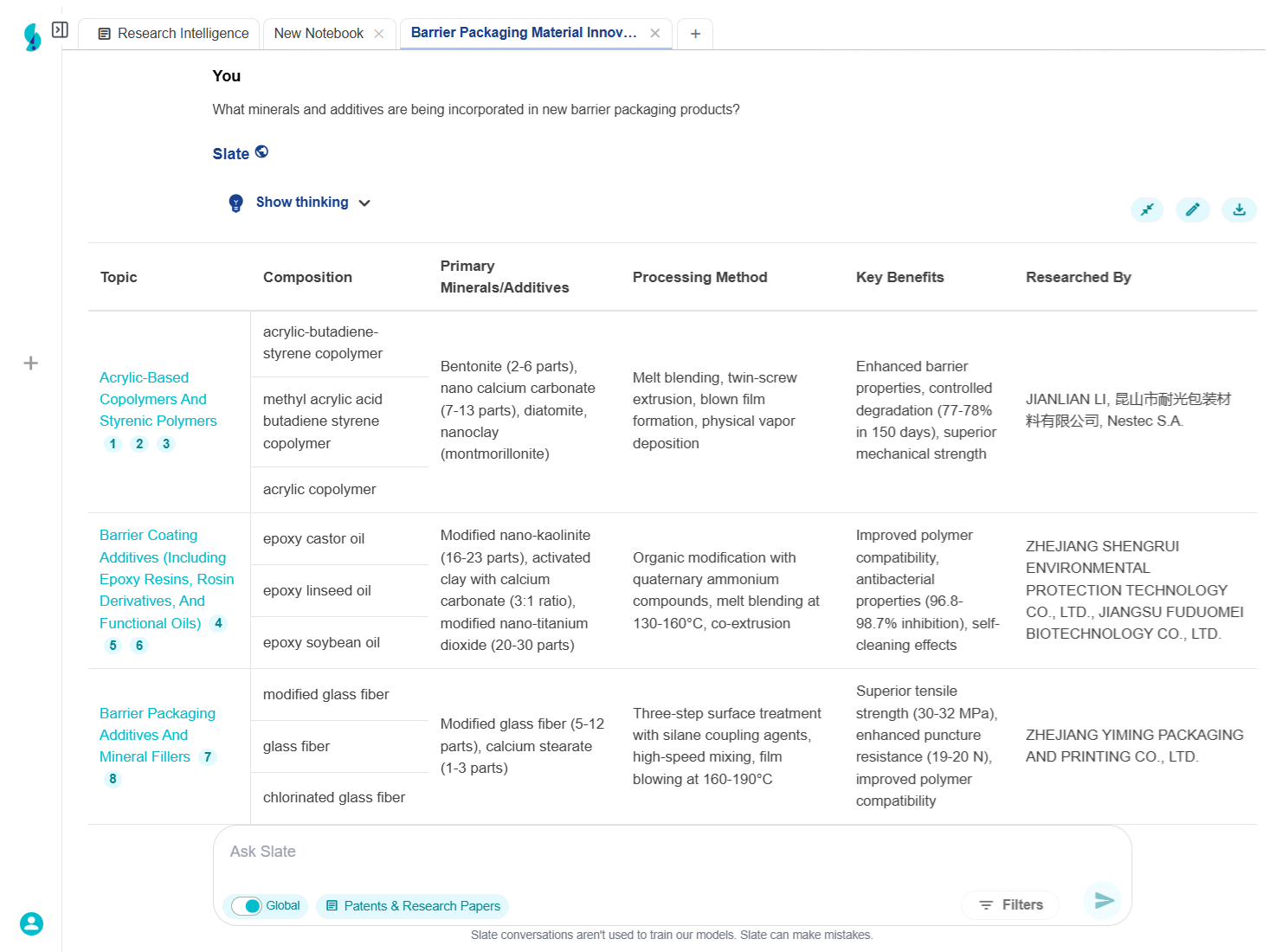
We used Slate, our proprietary AI R&D intelliegence platform for packaging to find the emerging minerals and additives that are being incorporated in new barrier packaging products.
The most impactful advancements in passive barrier technology are driven by layered silicate and two-dimensional (2D) materials.
1. Layered Silicates (Clay Nanocomposites)
Mechanism: Platelet-like silicate layers create a “tortuous diffusion path,” drastically reducing gas permeability. Achieving true exfoliation of the 1 nm thick platelets creates the extensive physical maze necessary to enhance the barrier. Oxygen Transmission Rate (OTR) reductions of up to 60–90% have been reported at filler loadings as low as 3–5 wt%.
Challenges: Achieving true exfoliation versus mere intercalation (stacks of platelets separated by polymer chains) is the primary hurdle. This requires meticulous organo-modification of the clay surfaces to ensure compatibility and favorable interfacial energy with the hydrophobic polymer.
Adoption: Actively researched in PET bottles for carbonated beverages and in polyolefin-based pouches. Coca-Cola’s early trials with nanoclay-based bottles demonstrated shelf-life improvements, though scaling remains a challenge due to dispersion uniformity. But, they shifted focus to another material innovation called the PlantBottle™ with 30% monoethylene glycol (MEG) derived from sugarcane residue and 70% terephthalic acid (bPTA) derived from oil-based sources.
2. Graphene Oxide (GO) and Graphene Nanoplatelets (GNP)
Mechanism: GO, a single-atom-thick 2D material, offers the theoretical ultimate in barrier enhancement. Its platelets offer an aspect ratio far exceeding that of nanoclays. GO nanosheets provide near-impermeable layers to gases with OTR reductions by up to 98% when integrated into PET.
Application: While direct polymer nanocomposites are advancing, GO is proving highly effective in ultra-thin barrier coatings on substrates like PET or BOPP for providing a flexible, high-barrier layer that is more resistant to cracking than ceramic oxide coatings (SiOx).
Adoption: GO is currently in the pre-commercial/advanced pilot stage. Its application is predominantly focused on replacing SiOx or AlOx layers in flexible packaging where flexibility and barrier retention after flexing are critical.
Challenges: Major hurdles include the cost of high-purity GO feedstocks, ensuring long-term regulatory approval for its nanoscale form in food contact, and scaling up the coating deposition process to match existing high-speed film lines.
3. Engineered Talcs and Calcium Carbonates (GCC)
Mechanism: Newer generations of High Aspect Ratio (HAR) talcs and engineered kaolins are crucial for reducing Water Vapor Transmission Rate (WVTR). Being naturally hydrophobic and platy, talc aligns in the polymer matrix, serving as an effective water vapor impediment.
Application: Functionalized CaCO₃ (surface-treated nanoparticles) are being engineered to act synergistically with biopolymers (PLA, PHA) to enhance barrier without compromising compostability.
Adoption: These are widely adopted, mature materials. They serve a strategic role as cost-optimization aids, allowing formulators to displace more expensive polymer resins while maintaining or improving mechanical integrity and specific barrier attributes.
Challenges: Managing viscosity during compounding and ensuring the Critical Pigment Volume Concentration (CPVC) is not exceeded, which would compromise the polymer matrix integrity.
4. Bio-based Nanocellulose (CNF, CNC)
Mechanism: Derived from plant matter, these cellulose nano-structures form an extremely dense network through powerful inter-fibrillar hydrogen bonds. This minimizes the polymer’s free volume, it exhibits OTR values below 1 cc/m²·day under dry conditions, outperforming EVOH in some studies.
Application: A strong candidate for paper-based flexible packaging, aligning with brand goals to replace plastics. It is highly valued for sustainable, fiber-based packaging (e.g., for grease and oxygen barrier in molded pulp trays).
Adoption: Companies like Stora Enso and UPM are developing hybrid coatings (nanocellulose + waxes or inorganic fillers) to overcome moisture sensitivity.
Challenges: The critical challenge is the material’s severe hydrophilicity. It rapidly loses barrier performance at >60% RH and severely limits its use in high-humidity environments, necessitating an effective, often hydrophobic, protective topcoat for most commercial applications.
5. Chitosan
Mechanism: A polysaccharide derived from chitin, Chitosan forms robust, low-permeability films, typically applied as aqueous coatings. Coatings of 20–30 µm have shown up to 95% reduction in oxygen permeability compared to neat films.
Application: Beyond simple barrier function, Chitosan naturally exhibits antimicrobial properties, offering a potential dual-function solution (active protection + passive barrier) valuable for fresh food and wound care applications.
Adoption: Still constrained by cost and shellfish-derived sourcing, though fungal-based chitosan is emerging as an alternative. Commercial adoption is niche, mainly in fresh produce and specialty food coatings including edible films and some pharmaceutical packaging where its antimicrobial and biocompatible nature is a premium feature.
Challenges: Scaling is hampered by the raw material supply chain variability and its pH sensitivity, which limits the polymer systems it can be directly compounded with.
Advanced Functional Additives (The Performance Modifiers)
Beyond passive barrier enhancement through structural modification, R&D teams are leveraging active chemical species to manage the package environment.
1. Active Oxygen Scavengers
Mechanism: These additives react chemically with oxygen that permeates the package or remains in the headspace, effectively eliminating it. They transition the barrier from passive (slowing permeation) to active (consuming permeants).
Examples:
- Iron-based: Highly effective, low-cost, but often used in sachets or opaque films due to color.
- Organic/Polymer-based (Poly-methaxylylene adipamide – MXD6 derivatives, or specialized polyolefins): These are incorporated directly into the polymer layer. They undergo a catalyzed oxidation reaction, often initiated by UV light exposure post-extrusion, which consumes the oxygen.
Formulation Insight: The choice of catalyst (typically a Cobalt salt) and the use of an oxidation moderator (anti-oxidant) are critical to control the reaction rate and prevent premature consumption of the scavenger during processing or storage of the raw film.
Adoption: Oxygen scavengers are a highly commercialized active packaging technology, widely used in PET beer bottles, juice containers, and oxygen-sensitive food pouches.
2. UV/Light Blocking Agents
Mechanism: Polymer degradation, particularly for high-barrier films, can be catalyzed by UV light, creating micro-cracks and increasing permeability over time. Furthermore, UV exposure degrades light-sensitive contents like vitamins A and D in milk, and certain pharmaceuticals.
Examples: Specialized inorganic pigments (carbon black for opaque applications) and nano-metal oxides (TiO2, ZnO) are engineered to absorb or reflect specific wavelengths, ensuring content integrity and barrier layer stability.
Adoption: These are mature, standard additives in most opaque or colored packaging. The R&D focus today is on developing transparent or near-transparent UV blockers that maintain package visibility while providing full spectral protection, often using sophisticated nano-metal oxide dispersions.
Formulation and Processing Challenges for R&D Teams
The shift to nanocomposites and active systems introduces significant technical hurdles that require careful management by formulation scientists and process engineers:
Dispersion and Exfoliation: Poor dispersion leads to particle agglomeration, which creates stress points, acts as a path for gas diffusion, and severely compromises the film’s optical, and mechanical properties.
Rheological Trade-offs: High loadings of high-aspect-ratio fillers dramatically increase the melt viscosity of the polymer. This impacts extruder throughput, compounding energy, and necessitates adjusting processing windows to avoid excessive shear that could damage the delicate nanofiller structure.
Migration and Safety Compliance (The Regulatory Chasm): Proving zero or near-zero detectable migration of the nanoparticle itself is mandatory for market entry into food/pharma contact. Regulatory bodies (FDA, EFSA) apply heightened scrutiny to all nanomaterials, requiring extensive, product-specific analytical testing like ICP-MS, TEM analysis of simulants. The cost and time required for this approval process represent a significant barrier to entry.
Future Outlook: Where R&D Should Focus
Hybrid Architectures
The most promising direction for barrier packaging is the development of hybrid systems that integrate inorganic fillers (silica, nanoclays) with bio-derived additives (nanocellulose, chitosan). These combinations exploit the synergistic effects of different materials:
- Silica and clays provide mechanical strength and low gas permeability.
- Nanocellulose contributes excellent oxygen barrier properties.
- Chitosan adds antimicrobial functionality, supporting active packaging.
Recent studies show that silica–nanocellulose hybrids can achieve OTR reductions of over 90% compared to neat films, while maintaining recyclability and biodegradability. For R&D teams, the challenge lies in optimizing dispersion, interfacial adhesion, and moisture resistance, while also ensuring compatibility with high-speed packaging lines.
Smart Coatings
Smart coatings that dynamically adjust permeability in response to humidity, temperature, or product chemistry are gaining traction. Research is exploring stimuli-responsive polymers, nano-encapsulated actives, and phase-changing materials that allow packaging to “breathe” selectively.
The development of self-healing barrier coatings, which can repair micro-cracks during handling, is another frontier. These solutions demand cross-disciplinary collaboration between polymer chemistry, nanotechnology, and food science — a key R&D opportunity.
Multifunctional Barriers
The future is in single-layer systems combining a passive mineral/bio-filler barrier with an active chemical additive (O2 scavenging) to simplify structures and enhance recyclability.
Sustainability Imperative
Prioritizing fillers that perform in mono-material polyolefin films or, specifically, those that successfully reinforce inherently poor-barrier bioplastics (PLA, PBAT) without compromising compostability or recyclability.
| Key Strategic Area | R&D Focus | Cost-Benefit Consideration |
| Multifunctional Barriers | Developing single-layer systems that combine a passive mineral barrier (tortuosity) with an active chemical additive (scavenging). This eliminates complex, non-recyclable multi-material structures. | Higher initial raw material cost (e.g., GO/scavenger masterbatch) is offset by simplified film structure and better recyclability (mono-material PE/PP). |
| Hybrid Architectures | Utilizing the distinct strengths of both inorganic and bio-based materials (e.g., Nanoclay in a hydrophobic layer for WVTR and Nanocellulose in a coating for OTR) within a recyclable A/B/A structure. | Requires sophisticated interfacial adhesion chemistry between layers; payoff is a high-performance barrier with minimal dependence on multi-polymer structures like EVOH. |
| Smart Coatings | Developing thin, functional coatings that provide barrier properties and integrate sensors (e.g., O2 indicators, temperature trackers) or release agents (antimicrobials). | Significant initial development cost; value realized through brand protection, reduced product loss, and enhanced consumer engagement via intelligent packaging features. |
| Sustainability & Circularity | Integration of fillers into certified bioplastics (PLA, PBAT) to overcome their inherently poor barrier properties, or enhancing mono-material films for easier recycling stream sorting. | Materials must perform post-conversion (folding, heat-sealing) without barrier loss, a common failure point for highly mineral-loaded films. |
| Processing Innovation | Shifting from conventional compounding to in-situ polymerization or solution casting for ultimate nanofiller exfoliation, minimizing necessary filler loading and maximizing performance-to-cost ratio. | Investment in new capital equipment or licensing of specialized processing technologies is required. |
There is a significant increase in patent filings around nanocellulose hybrid coatings and 2D barrier materials like graphene, and MXenes over the past five years, signaling the next wave of commercial innovation.
Moreover, the industry is shifting towards mineral and additive-based barrier solutions. It is not just about replacing existing polymers, it’s about redefining packaging architectures to be recyclable, multi-functional, and future-ready.
By monitoring material science breakthroughs and pilot-scale applications, innovation leaders can position themselves ahead of regulatory changes and consumer demands, while creating packaging that truly bridges performance and sustainability.
This is where Slate gives your R&D team a strategic edge. It is an AI-powered R&D intelligence platform that helps you find emerging technologies and identify the white spaces in the industry.
With Slate, you can identify, compare, and validate functional barrier materials in minutes instead of weeks, turning compliance into an opportunity to lead the next generation of high-performance barrier packaging.

