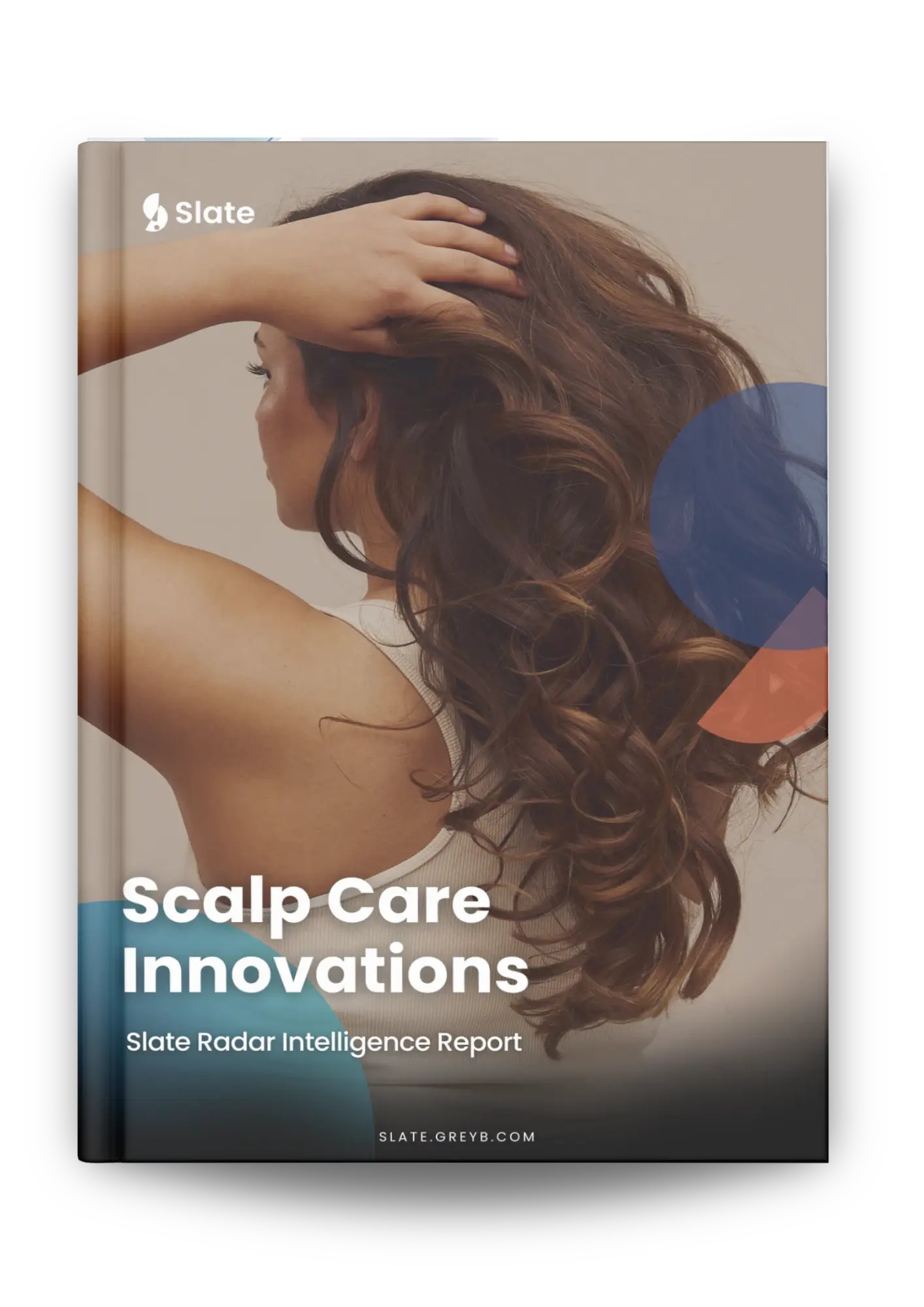
Scalp care is entering a new phase. Products are moving beyond traditional formulations and incorporating AI-based analysis, smart sensors, biological insights, and precision delivery systems.
This convergence is changing how companies approach scalp innovation. Future scalp care products may not only deliver active ingredients but also analyze consumer data, personalize treatments, and adapt delivery based on individual scalp conditions.
For R&D teams, this creates a new strategic question. When a product can measure biological signals, recommend interventions, and influence treatment decisions, where does cosmetic innovation end and medical technology begin?
Patent activity across the scalp care landscape shows increasing investment in hardware-enabled platforms, bio-active ingredients, and personalized treatment systems. As these technologies advance, companies must evaluate how product design, validation requirements, regulatory pathways, and commercialization strategies may evolve.
To understand where the industry is heading, we analyzed patent filings, scientific publications, and company innovation activity using Slate. The analysis reveals how companies are approaching the intersection of cosmetics, biology, and technology, and highlights the emerging white spaces that could shape the next generation of scalp care products. Let’s get started!
When Do Smart Scalp Care Devices Become Medical Devices?
Companies are developing smart devices that can monitor scalp conditions, analyze biological signals, and personalize treatment recommendations using real-time data.
LG Electronics’ modular scalp care system is one example of this shift. The patented system combines detachable hardware components with mobile app-based protocols to analyze scalp conditions and deliver targeted nutrients based on user-specific data. This represents a broader industry trend where cosmetic products are beginning to incorporate capabilities traditionally associated with diagnostic technologies.
The key question for R&D teams is where the regulatory boundary lies.
When a product only delivers a cosmetic formulation, it remains within traditional beauty categories. However, when a device starts measuring physiological parameters, interpreting those measurements, and recommending or adjusting treatment, it moves closer to medical device territory.
Companies are developing devices that monitor parameters such as scalp moisture, temperature, sebum levels, and microbial composition. These measurements are increasingly being connected with algorithms that influence treatment selection, dosage, or application frequency.
For R&D teams, this creates an important development decision. A feature designed to improve personalization may also introduce additional regulatory requirements. If a hardware partner is building real-time diagnostic capabilities into a scalp care platform, the product may require a medical device strategy alongside cosmetic development plans.
The difference between a competitive advantage and a regulatory challenge may depend on how these technologies are designed, positioned, and validated from the beginning.
How Biological Claims Are Changing the Future of Scalp Care Innovation
Companies are developing formulations that go beyond traditional cosmetic benefits by targeting biological pathways linked to scalp health, microbiome balance, and follicle activity.
Unilever’s trehalose-based prebiotic innovation explores how ingredients can influence scalp microorganisms, including S. hominis. Caregen has developed peptide sequences designed to stimulate dermal papilla cell activity, while BASF has explored probiotic strains linked to scalp barrier restoration.
Other research efforts are targeting biological mechanisms such as Malassezia fungal activity associated with dandruff and extracts that influence follicle-related pathways.
These innovations create a new challenge for R&D teams. The same scientific depth that helps differentiate a product can also create questions around how the product should be classified and positioned.
Terms describing cellular activation, microbial modification, follicle stimulation, or biological pathway changes indicate that a company is moving beyond simple cosmetic positioning and toward mechanism-driven innovation.
For teams developing next-generation scalp products, this creates a balancing act. Strong scientific claims can support differentiation, but they also require careful consideration of regulatory strategy, evidence requirements, and market positioning.
This challenge becomes even more complex as biological ingredients are combined with precision delivery systems that control where, when, and how active ingredients reach the scalp. The convergence of advanced formulations and controlled delivery is creating a new category of scalp care innovation, where product performance and regulatory strategy are increasingly connected.

How Smart Delivery Systems Are Changing the Future of Scalp Care Products
Companies are increasingly combining bio-active formulations with precision delivery systems that control how, where, and when ingredients are applied.
This creates a new type of product ecosystem. Instead of consumers manually applying a formulation, smart devices can control dosage, application location, and treatment timing through integrated hardware.
Patent activity shows growing interest in these technologies. L’Oréal has explored ultrasonic transducer-based devices for scalp exfoliation and multi-chamber cartridge systems that combine separate active ingredients at the point of application. Other companies are developing technologies such as infrared atomizers, precision spray combs, and fluid-controlled hair treatment devices designed to improve delivery accuracy.
The growth of liquid dispensing comb systems highlights this trend. Publication activity in this technology area increased by 125% between 2024 and the 2025–2026 period, indicating growing interest in controlled delivery platforms.
For R&D teams, the challenge is that hardware integration changes more than the user experience. When a device controls dosage, delivery location, or treatment timing, it may introduce additional regulatory considerations even when the formulation itself would traditionally be considered cosmetic.
This is particularly relevant for combination products, where a device and formulation are designed to work together as a single system. In these cases, companies may need to evaluate requirements under frameworks such as 21 CFR Part 3 in the US or Article 2 of the EU Medical Device Regulation.
The strategic opportunity is significant. Hardware-enabled products can support premium pricing, stronger consumer engagement, and recurring revenue models through proprietary cartridges or ecosystems.
However, the same features that create differentiation can also increase regulatory complexity. Slate’s patent analysis shows companies exploring different strategies: some are developing platforms with medical-grade capabilities in mind, while others are designing products to remain within traditional cosmetic boundaries.
The industry has not yet converged on a single approach. The companies that succeed will need to balance product performance, regulatory strategy, and long-term commercial goals from the earliest stages of development.
How Leading Companies Are Positioning for the Future of Scalp Care Innovation
The scalp care industry is exploring multiple innovation paths, and companies are taking different approaches to navigate the evolving boundary between cosmetics, wellness, and medical technologies.
Some companies are investing in advanced biological mechanisms and hardware platforms that could require more extensive validation. Others are focusing on improving cosmetic performance while avoiding features that may introduce additional regulatory complexity.
These choices influence more than regulatory strategy. They can determine product development timelines, required infrastructure, pricing potential, and long-term competitive positioning.
Patent activity highlights this strategic divergence.
Unilever shows activity across both advanced biological ingredients and traditional cosmetic technologies, with 309 innovations related to botanical and fermented extracts and 222 focused on traditional cationic surfactants. L’Oréal follows a similar approach, with 94 innovations involving bio-active ingredients compared with 687 related to traditional keratin conditioning technologies.
Some companies are taking a more focused approach. Caregen has published 67 innovations centered around peptide-based follicle stimulation, reflecting a stronger focus on biological mechanisms. BASF has developed a significant portfolio around anti-inflammatory extracts and related bio-active technologies, including 58 publications in anti-inflammatory extracts and 51 publications in this cluster.
Meanwhile, electronics companies such as LG Electronics, Dyson, and Panasonic are entering scalp care through hardware-enabled platforms, bringing expertise in sensors, connected devices, and precision delivery technologies.
For R&D teams, these different approaches represent different strategic bets.
Building toward medical-grade solutions may require stronger clinical evidence, additional infrastructure, and longer development cycles. Remaining within traditional cosmetic boundaries may reduce regulatory complexity but could create challenges if hardware platforms begin owning personalization, consumer data, and the overall product experience.
Companies are testing different combinations of biology, hardware, and consumer experience to determine where the strongest opportunities will emerge.
For R&D leaders, the key question is not simply whether to pursue a cosmetic or medical pathway. It is understanding which capabilities need to be built, which should come through partnerships, and which emerging approaches are worth monitoring before making significant investments.
How Regulatory Differences Are Shaping the Global Future of Scalp Care Devices
As scalp care products become more technology-driven, companies face a new challenge: the same innovation may be evaluated differently depending on where it is launched.
Today, there is limited clarity around products that combine cosmetic formulations with diagnostic-like features. Regulatory approaches for combination products and smart consumer devices can vary across regions, creating uncertainty for companies developing connected scalp care platforms.
Patent activity suggests that some companies are already exploring markets with different regulatory environments. China represents 61% of filings in the liquid dispensing comb technology cluster, indicating strong activity in this area. Early launches in markets with more flexible pathways may help companies gather consumer data and establish commercial traction before expanding into regions with stricter requirements.
However, entering a market early also creates strategic risks.
A product designed around one region’s regulatory expectations may require significant redesign before entering markets such as the US or EU. Changes to claims, hardware features, validation studies, or quality systems can increase development costs and delay expansion.
This creates a key decision for R&D teams:
Should companies prioritize speed to market by launching in regions with faster approval pathways, or should they design products from the beginning for stricter regulatory standards?
A faster launch can accelerate learning and revenue generation but may create compatibility challenges later. Designing for the strictest requirements can reduce future barriers but may increase development time and add requirements that some markets do not demand.
The current uncertainty will not continue indefinitely. As regulatory frameworks evolve, they may influence which technologies gain long-term advantages, how companies value their intellectual property, and which platforms require additional investment to remain competitive.
For R&D teams, monitoring regulatory signals alongside patent and market activity will be critical when deciding where to launch, how to validate, and which technologies to prioritize.
How R&D Teams Can Navigate the Future of Scalp Care Innovation
Companies are exploring different strategies, from developing advanced cosmetic solutions that stay within existing boundaries to building technology platforms with diagnostic and therapeutic capabilities. Patent activity shows that both approaches are being pursued simultaneously, with no clear industry consensus on which model will become dominant.
Leading companies are taking different paths based on their capabilities and long-term goals. L’Oréal and Unilever are maintaining broader portfolios that combine traditional cosmetic technologies with advanced biological approaches. Biotechnology companies are focusing on targeted mechanisms such as peptides and microbiome-based solutions, while electronics companies are developing hardware platforms that integrate sensing, personalization, and controlled delivery. Each approach reflects a different view of how the category may evolve.
For R&D teams, the challenge is not predicting exactly how regulations will develop. It is understanding how competitors are positioning themselves, identifying emerging technology opportunities, and making informed decisions on what to build, partner, or monitor.
Slate helps teams track these shifts by analyzing patent language, biological claims, hardware integration patterns, and company innovation activity. By identifying early signals across the landscape, Slate enables R&D teams to evaluate opportunities, anticipate risks, and build stronger innovation strategies before market changes become obvious.
Find Emerging Scalp Care Opportunities Before They Become Market Trends
Scalp care innovation is becoming harder to track. New signals are appearing across patents, scientific publications, ingredient research, hardware developments, and competitor activity, but these insights often remain scattered across different sources.
For R&D teams, the challenge is not accessing more information. It is identifying which developments matter, understanding how technologies are converging, and deciding where to invest before competitors move.
SLATE, an AI-powered R&D intelligence tool for cosmetics helps teams connect these signals in one intelligence platform. By combining patent intelligence, scientific literature, company activity, and technology trends, Slate enables R&D teams to identify emerging white spaces, monitor competitor strategies, and understand how innovations are evolving across formulations, biological mechanisms, and delivery systems.
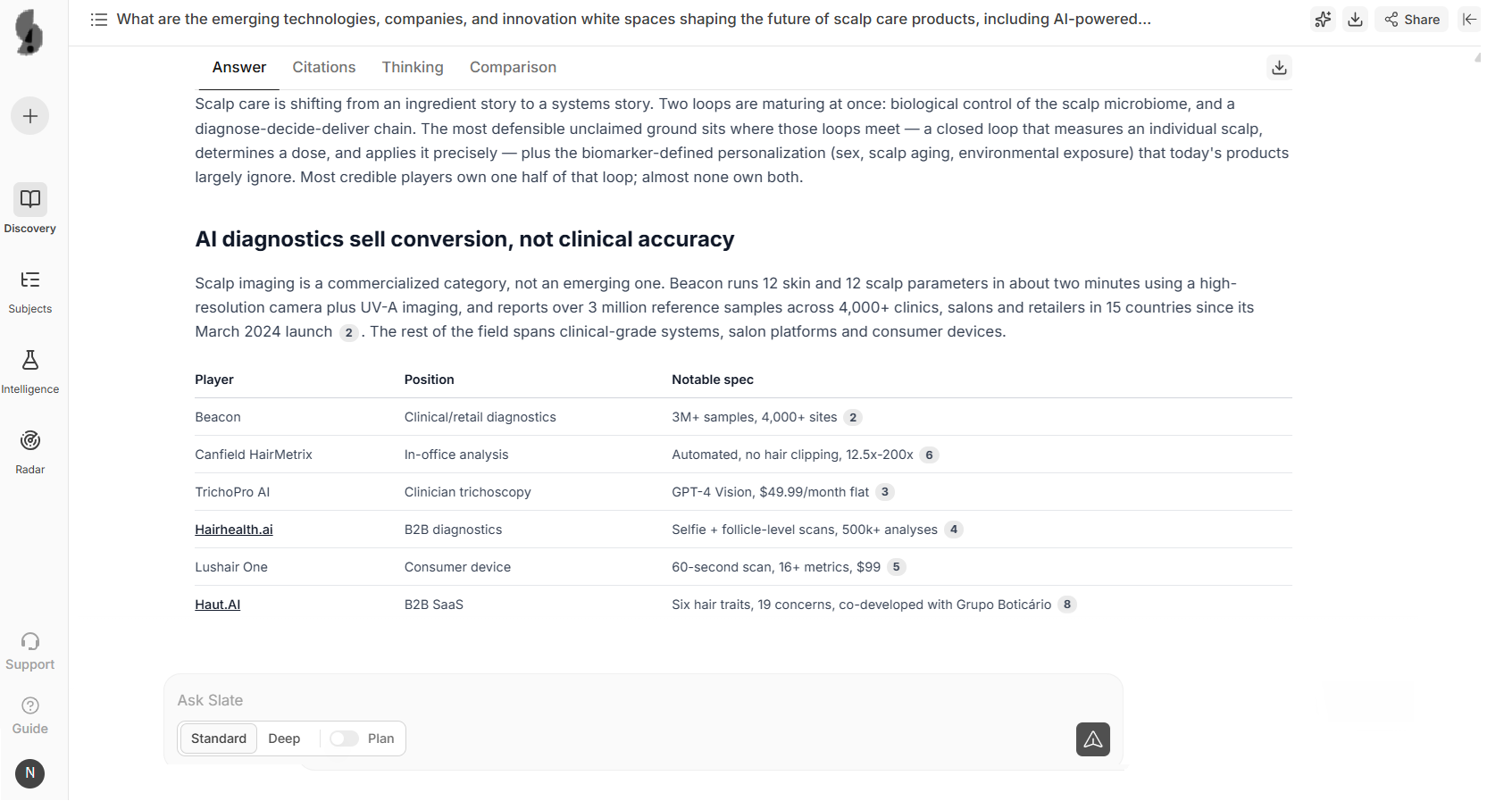
With Slate, teams can:
- Map emerging technology spaces
Identify growing areas such as microbiome-based scalp care, peptide technologies, AI-powered diagnostics, and precision delivery systems. - Track competitor innovation strategies
Understand where companies like beauty brands, biotechnology firms, and electronics manufacturers are investing and how their portfolios are evolving. - Analyze patent landscapes faster
Move beyond keyword-based searches by identifying relevant inventions, assignees, technology clusters, and innovation trends. - Identify white spaces for new product development
Discover underexplored opportunities where consumer needs, scientific advances, and technology capabilities intersect. - Monitor how claims and technologies are evolving
Track changes in patent language, biological mechanisms, and hardware integration to understand future regulatory and commercial implications. - Support build, partner, or acquire decisions
Evaluate whether emerging capabilities should be developed internally, accessed through partnerships, or monitored before investment.
When innovation cycles are accelerating, R&D teams need more than information retrieval. They need a clear view of where the market is moving and which opportunities deserve attention.
FAQs
Are scalp care devices currently regulated as medical devices?
Not uniformly. Classification depends on whether the device measures physiological parameters and recommends treatment. Devices that diagnose and treat may fall under Class I or II medical device regulations in the US and EU, while passive delivery tools remain cosmetic.
What triggers medical device classification for a scalp care product?
Measurement plus recommendation. If a device monitors scalp conditions (moisture, sebum, microbial load) and uses that data to suggest or automatically adjust treatment, it crosses into diagnostic territory under FDA and EU frameworks.
Can microbiome-modulating ingredients stay classified as cosmetics?
It depends on the claim language. If patents or marketing describe cellular activation, selective microbial elimination, or physiological alteration, regulators can argue therapeutic intent. Cosmetics are limited to surface-level benefits without biological mechanism claims.
Which jurisdictions have the most permissive regulations for scalp care hardware?
China represents 61% of liquid dispensing hardware innovations, suggesting lighter regulatory oversight. Many companies launch in China or Southeast Asia first to establish precedent before seeking FDA or EU approval.
How long does medical device certification add to product development timelines?
Class I or II certification typically adds 12 to 24 months compared to cosmetic pathways. This includes clinical validation, quality system setup (ISO 13485), and post-market surveillance requirements.
What is the difference between a cosmetic device and a combination product?
A cosmetic device delivers a formulation without altering physiological function. A combination product integrates a device and formulation where the device controls dosage, site, or timing, triggering dual approval requirements under 21 CFR Part 3 (US) or Article 2 MDR (EU).
Will the industry create a new wellness device category between cosmetics and medical devices?
Unclear. The patent data shows companies pursuing both strategies: dialing back features to stay cosmetic or designing for medical approval. No regulatory consensus has emerged, and the timeline for resolution is unknown.