The research world is full of challenges where duplication is common, differing vocabularies obscure valuable insights, even experts can overlook obvious connections. Slate was built to break through these barriers, not by making search better, but by connecting the right solutions to the people who need them.
Discovery in R&D often feels like a game of chance. You start with a question “What’s new in biodegradable coatings?” and end up tangled in endless tabs, scattered PDFs, and fragmented data. Hours later, you might find an answer or realize the real question was something else entirely.
That’s what we wanted to fix with Slate 2.0, to make discovery more inevitable and less accidental.
Over the last year, we’ve reimagined how Slate thinks, acts, and interacts with your research intent. We didn’t just redesign the interface but we rewired its intelligence. Slate can now see connections across fields, connect dots that humans might overlook, and tell you not just what’s known, but what’s possible next.
What’s New in Slate 2.0
Slate’s new version is a testament to the improvements we made over the past year based on the feedback we received from our users. Slate 2.0 is your new co-researcher that thinks and summarizes research like an expert analyst.
| You’re Trying to | Before | Now | How This Helps You |
| Move from insights to actions | Received synthesized answers from papers and patents | Agentic workflows can retrieve → analyze → synthesize → recommend | Go beyond answers: identify gaps, benchmark competitors, and get actionable recommendations for next steps. |
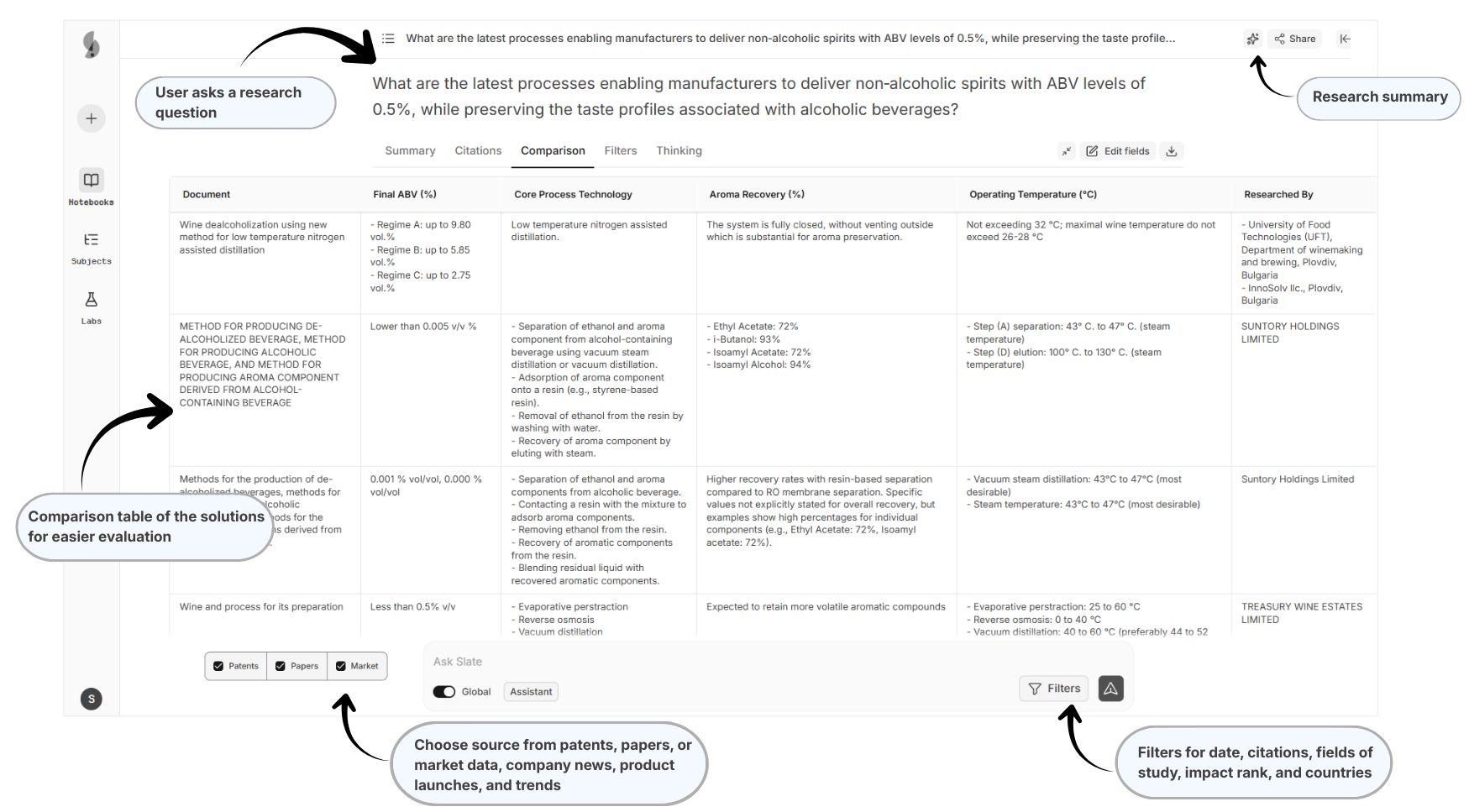
| Understand both technical and market context | Limited to research papers and patents | Includes market data, product launches, company news, trends | Make decisions with a full picture: see what’s feasible, what’s being adopted, and what’s worth pursuing. Example: “Which micro-biome skincare solutions are gaining traction in the market?” |
| Make multi-dimensional decisions | Insights were mostly technical | Combines technical, competitive, and commercial data | Evaluate R&D directions with richer context: technical feasibility, competitor activity, regulatory signals, and market trends, all in one view. |
| Act faster and more confidently | Slow, single-step query results | Answers now load under 90 seconds with multi-step reasoning | Accelerate R&D cycles, reduce blind spots, and move from discovery to decision-making with confidence. |
Slate 2.0 got an intelligence upgrade. When you ask Slate a question, it doesn’t just look for matches. It thinks through your intent and understands your research queries beyond simple keywords.
Slate 2.0 maps your question into a multi-layered reasoning process: first identifying the core technical concept, then tracing it through patents, papers, market signals, and company activity. Then, look for any very recent developments or ongoing clinical trials that might not yet be published in academic journals.
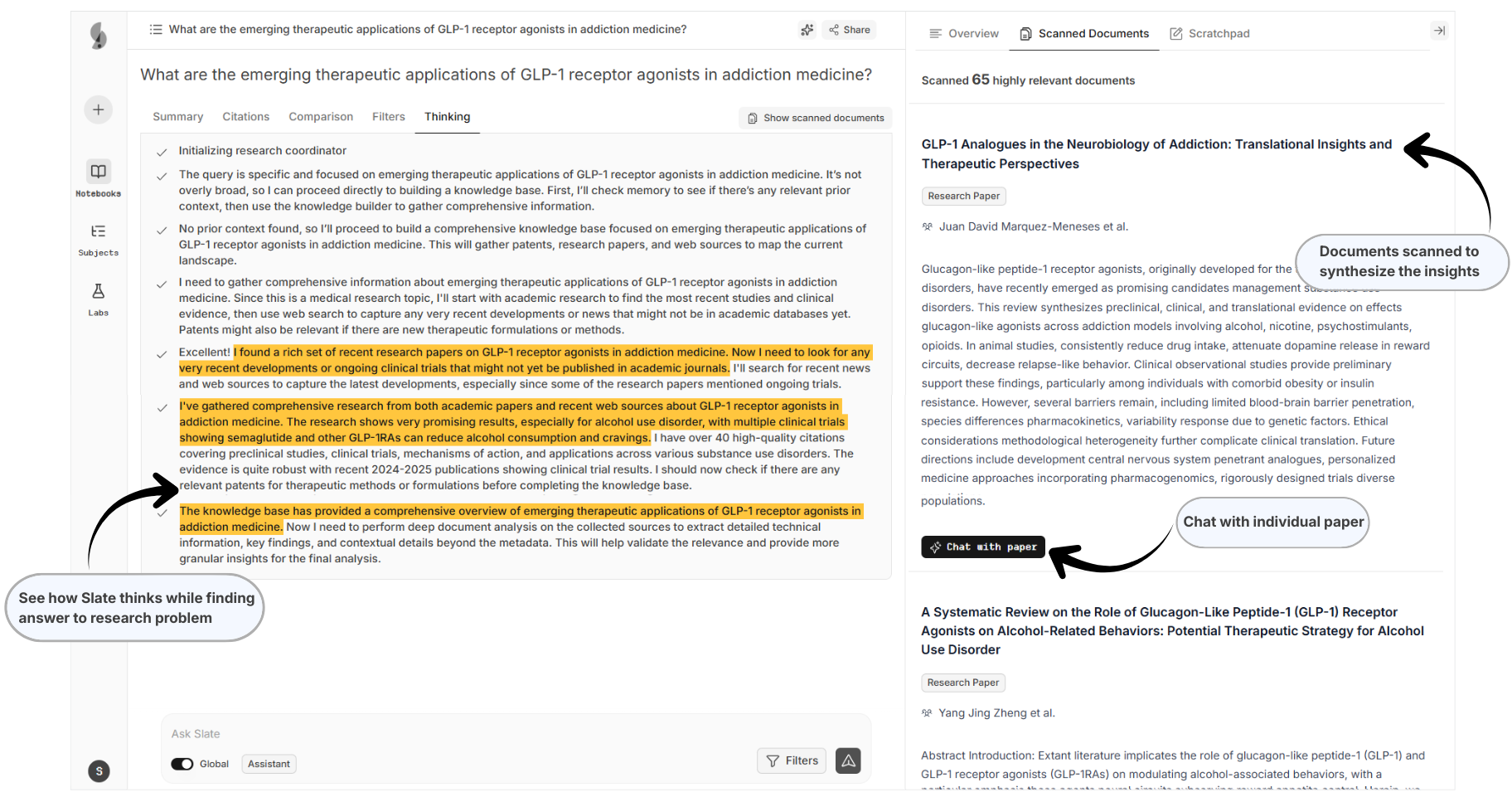
It compares trends, detects gaps, and evaluates feasibility before distilling the findings into a clear, contextual response. Slate doesn’t just summarize information. Instead, it synthesizes insights and connects the dots across fields to tell you not just what’s happening, but why it matters and where it’s heading.
With every upgrade, Slate moves closer to what modern R&D truly needs by providing an intelligent tool that goes beyond information retrieval to drive faster discovery, deeper analysis, and smarter decision-making.
A Smarter Way to Discover
Breakthroughs often arise from finding connections across fields, but traditional search engines are limited by vocabulary.
Different disciplines use different languages to describe the same underlying concepts which makes valuable insights difficult to find.
The right insights could be very easy to find but remain locked in incompatible vocabularies. This isn’t a search problem. It’s a translation problem. And translation requires understanding meaning instead of matching text.
Right now, human knowledge exists in isolated zones. Chemistry over here. Biology over there. Materials science in the basement. Each zone has its own vocabulary, its own journals, its own conferences, its own ways of describing reality. The boundaries between zones are almost impermeable.
Researchers can only find solutions that use the same terms as their problem. This siloed approach keeps valuable insights hidden in unrelated disciplines, as papers on similar problems may not share any common keywords.
Imagine starting with a question and ending with a clear direction, where insights, market feasibility, and next steps come together seamlessly in one place. That’s the promise of Slate 2.0.
Every improvement in this update is built entirely around helping you move faster from information to insight to action by unifying technical, commercial, and competitive intelligence. So you no longer need to switch between research papers, market reports, or news alerts, allowing you to focus fully on innovation.
From Search to Strategy
Breakthroughs come from finding what you didn’t know to look for. From solutions you don’t have words for. From answers filed under someone else’s questions.
But you can’t search for something you don’t have words for.
The current knowledge systems isolate research into disconnected pockets, making it difficult for researchers to find solutions that exist in different fields.
The future lies in systems that understand the structural similarities between problems in different domains. This enables faster, more efficient innovation across fields, eliminating the waste of reinventing the same solutions.
Slate 2.0 doesn’t just pull answers from the research you’re actively seeking, but understands the problems, reads across disciplines, and surfaces ideas from adjacent fields. It recognizes patterns and surface solutions solving the same fundamental problems but filled under different vocabularies.
The true power of Slate 2.0 lies not in what it finds, but in how it thinks. It now mimics the reasoning chain of an expert research analyst by pulling from data, comparing patterns, and surfacing context you didn’t even know to look for.
You no longer just “search” for information but you discover connections. And those connections are what turn research into strategy.
This is what we mean by moving from search to strategy i.e., understanding the underlying structure of the problem and recognizing patterns across silos.
The Road Ahead
Slate 2.0 is the foundation for the next generation of discovery, built with a clear goal of creating an agent that not only responds to your questions but anticipates the next one.
Innovation doesn’t wait for better search results, it moves forward through confident, informed decisions rather than waiting for better search results.
This upgrade is the base for our 2026 roadmap of how Slate helps you discover, connect, and reason across knowledge.

