
With the rising demand for a reliable protein supply, food firms face pressure to cut their climate impact while holding prices and taste steady. Livestock supply chains account for about 7.1 gigatonnes CO2e, around 14.5% of global anthropogenic greenhouse gas emissions, so even partial substitution in high-volume categories can shift footprints.
The urgency is clear in three pressure areas. First, consumers keep asking for better taste and texture in familiar formats like cheese, yogurt, and ready-to-drink protein beverages. Second, regulators are tightening expectations for safety dossiers, labeling clarity, and allergen communication for novel food ingredients. Third, cost dynamics push teams to cut downstream processing steps, raise yields, and reduce capex per kilogram.
In 2024, GFI identified 165 companies focused primarily on fermentation for alternative proteins, plus at least 210 diversified companies active in the space. That points to sustained scale-up work, not only lab research.
This analysis maps the current research landscape, the technical problem areas shaping R&D roadmaps, the critical gaps that remain, and the regulatory and scale-up constraints that decide whether a lab result becomes a shipped ingredient.
Why Precision Fermentation Is Becoming Critical in Alternative Proteins
Traditional plant proteins like soy and pea often struggle with taste and texture. They can have earthy or bitter notes that consumers dislike. They also lack the distinct properties of animal proteins during cooking. For example, plant proteins do not stretch like cheese or foam like egg whites.
Precision fermentation creates ingredients that have these exact animal traits without using the actual animal. This fills a major performance gap in the alternative protein market.
Industry leaders face high costs and limited production space. Producing proteins through fermentation can cost three to ten times as much as farming cows or chickens. To address this, researchers must develop methods to produce more protein in less time.
There is also a push for clean-label products. Consumers want fewer ingredients and less processing. Ingredients produced through precision fermentation are highly pure, which helps keep the final food label concise.
High-protein beverages require proteins that remain soluble under heat treatment, pH changes, and storage. Many plant proteins precipitate or thicken in unwanted ways. Fermentation-derived proteins can be engineered and processed to achieve specific stability targets, but this depends on both protein design and downstream purification strategies.
Conventional animal farming uses vast amounts of land and water. It also produces greenhouse gases that warm the planet. Precision fermentation uses up to 99 percent less water and 91 percent less land. These metrics make it a key tool for meeting corporate environmental goals.
Research Activity Overview
The volume of research in precision fermentation is rising steadily, and it has shifted from proof-of-concept proteins to manufacturable systems.
In Europe, publications on alternative proteins rose by about 30% per year from 2020 to 2024, with 7,784 contributions from 1,519 organizations across 89 countries. Germany leads with 368 publications, followed by the Netherlands and the UK.
Despite this momentum, plant-based proteins dominate the research landscape, accounting for roughly two-thirds of published studies. Precision fermentation and cultivated meat remain less represented in academic literature compared to their commercial visibility.
Academic research continues to drive foundational methods, particularly in host engineering, secretion, and analytical tools for product quality. Industry work dominates translation topics, process control, cost reduction, and regulatory-ready characterization. Companies are conducting more internal research to protect their proprietary information. Much of that work appears as patents and focuses on scaling the process for large-scale production rather than just in a small lab.
There is a clear shift toward new biological systems. Early research primarily used common yeast or simple bacteria such as E. coli. Now, scientists are exploring filamentous fungi and marine microbes. These new hosts can often produce more complex proteins or grow on cheaper feedstocks. We also observe a trend toward the use of artificial intelligence to design improved microbes. Instead of trial and error, computers now predict which genetic changes will work best.
Funding for this research has also shifted. While venture capital was the primary source of funding for years, government grants are now playing a larger role. Countries like Singapore, Denmark, and the United States are treating this as a matter of national security. They are investing in public research centers and open-access pilot plants. The objective is to move from the laboratory to the store shelf as quickly as possible.
The Good Food Institute reported at least 17 fermentation facilities opened or announced in 2024, including R&D centers and innovation hubs. This signals a shift toward pilot-scale iteration and scale-down models that mimic industrial fermenters.
Precision Fermentation Technologies Powering Innovation in Alternative Protein
1. Engineering hosts for high yield, secretion, and food-grade performance
Yield and consistency are the biggest problems the industry is working on. A protein that is expressed at low titer or remains intracellular rarely meets cost targets.
Work in this cluster includes:
- Choosing hosts with strong secretion pathways, often yeast or filamentous fungi
- Optimizing codons and signal peptides for secretion
- Managing proteases that degrade the target protein
- Reducing byproducts that complicate purification
Recent technical reviews indicate that success depends on growth characteristics, medium composition, and host-specific constraints, particularly at scale.
The highest cost in fermentation is the low protein yield per microbe. Researchers are using gene-editing tools like CRISPR to address this. They can turn off genes the microbe uses for its own growth and turn on genes that encode proteins. This makes the microbe more like a dedicated factory.
Advanced laboratories use robotic systems to test thousands of different microbial strains simultaneously. This accelerates the process of identifying the most productive ones.
2. Reducing purification cost without leaving sensory-active impurities
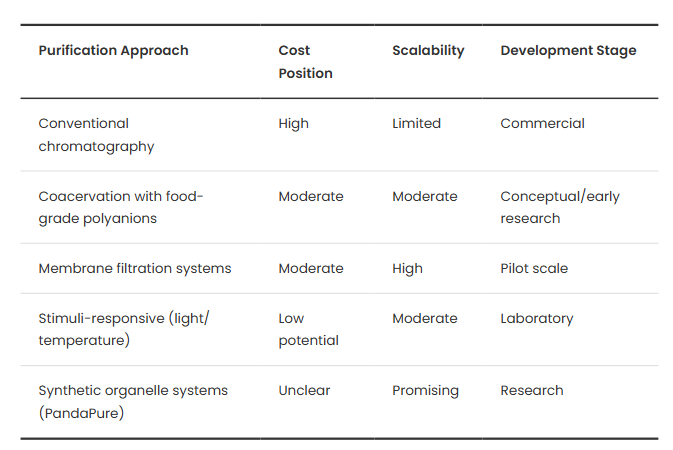
Downstream processing accounts for 50-80% of production costs for precision fermentation products, and conventional chromatography is poorly suited for bulk production of food proteins. Research is targeting cost-effective alternatives and methods for preserving harvest-phase quality.
The formation of unwanted brown byproducts that degrade the quality is one of the major challenges. Genentech has patented methods showing that keeping some oxygen present during harvest or adjusting certain cell pathways can prevent this problem and improve yields by 20% or more. Careful pH control across different production stages also helps prevent protein clumping in microbial systems such as E. coli.
Researchers are exploring routes such as secretion-based harvesting, selective precipitation, membrane filtration, and aqueous two-phase systems. They also test ways to reduce chromatography steps, since resins and cleaning validation can be costly at the food scale.
Food-safe separation methods that use natural protein properties are also being explored. Instead of aiming for extremely high purity, these methods focus on maintaining the protein’s functionality for food uses, such as foaming or thickening. Many of these ideas are still under development.
3. Prevent unwanted glycosylation and protect allergen safety
Many target proteins, such as whey and egg proteins, have well-established allergen profiles. Precision fermentation does not remove allergen risk. It can also add new risks if the host changes glycosylation or if impurities remain.
This drives research in two directions. One is host and pathway tuning to match the native protein as closely as possible. Another is analytics and safety testing to prove identity, stability, and digestibility.
Regulatory filings make this tangible. FDA GRAS notices for beta-lactoglobulin produced by Trichoderma reesei describe the manufacturing controls and specifications that support its safe use as a protein source. For egg-white proteins, filings describe the production organism and intended uses, since foaming proteins often go into many categories.
4. Host Fitness Burden and Proteolytic Degradation Through Genome-Streamlined Chassis Engineering
A key challenge in precision fermentation is the strain placed on host cells when they produce foreign proteins. This stress can slow growth and reduce output. In addition, secreted proteins may be broken down by the host’s own enzymes. To solve this, researchers are developing simplified “chassis” strains by removing non-essential genes while keeping strong production ability.
Trichoderma reesei is widely studied because it naturally secretes large amounts of protein. However, it also releases enzymes that can break down target products. By removing selected genes over multiple rounds, scientists have created cleaner strains through 11 consecutive rounds of gene deletion with lower unwanted enzyme activity. These strains showed improved production of several test proteins, including industrial enzymes and human serum albumin.
Similar work in Yarrowia lipolytica removed several protein-degrading enzymes, creating a more stable background for high protein output without relying on multiple gene copies.
In E. coli, new gene-editing tools have enabled stable integration of production systems directly into the chromosome, reducing reliance on unstable plasmids. Genome-reduced strains have shown yield improvements of up to 47% under oxygen-rich conditions and 35% under oxygen-limited conditions. These changes help redirect cellular resources toward protein production rather than unnecessary processes. Patent activity suggests growing commercial interest in such streamlined strains.
5. Making fats and minor ingredients that unlock taste and mouthfeel
Many alternative products fail on fat behavior, mouthfeel, and flavor release. Researchers are now using precision fermentation to produce fats and flavor-active molecules that help plant bases behave more like animal products. This is done by providing microbes with instructions to synthesize specific fatty acids.
A visible example is precision-fermented fats designed to improve plant-based meat and dairy, supported by scale-up partnerships and regulatory planning in hubs like Singapore.
Research in this cluster also explores structured lipids, emulsifiers, and heme-like molecules that contribute to browning, aroma, and “meaty” notes.
Lipids control mouthfeel, release of aroma compounds, and cooking behavior. Some precision fermentation programs now target fats, heme proteins, and flavor precursors.
Heme is a case where a small dose can shift the sensory profile. The FDA’s color additive action on soy leghemoglobin shows how a single molecule can unlock a retail format that relies on raw appearance and on changes in cooking color.
Matching melting curves, oxidative stability, and regulatory acceptance is a key challenge for fats. Engineering microbes to produce tailored triglycerides or structured lipids is possible, but the downstream and refining steps can erode cost savings if not carefully designed.
Startup & Corporate Innovation Activity
The precision fermentation sector for alternative proteins has matured into a globally distributed ecosystem comprising 165 dedicated companies as of 2024, with cumulative investment reaching $4.8 billion. The commercial landscape is diverse, spanning ingredients, consumer products, and enabling platforms.
Dairy proteins and dairy-like products
- Perfect Day pioneered animal-free whey proteins produced via fermentation and secured FDA “no questions” status through GRAS notifications for its beta-lactoglobulin ingredient.
- New Culture and other teams focus on mozzarella-style applications, where casein functionality is most important.
- DairyX reports work on casein-based approaches aimed at cheese stretch and melt, with public claims pointing to micelle formation as a key technical focus.
- Remilk focuses on animal-free milk proteins and achieved regulatory milestones as the first animal-free milk protein approved in Canada with prior FDA, Singapore Food Agency, and Israel approvals.
- Formo develops dairy and egg alternatives through fermentation and reports on product development and scale-up plans, supported by funding and public financing activities.
Emerging players include Vivici (Dutch B2B ingredient company), Daisy Lab (New Zealand, with patented microbial whey protein methods 35 ), Updairy, DairyX (casein micelle focus), and Muu.
Egg proteins and egg-like formats
- The EVERY Company uses yeast to produce ingredients sold under the names OvoPro™ and OvoBoost™, both of which have received FDA safety recognition.
- Onego Bio announced an FDA “no questions” letter on GRAS status for its ovalbumin ingredient Bioalbumen® in September 2025, designed to offer more stable pricing and reliable supply compared to traditional eggs.
Despite this progress, production levels at the laboratory stage remain relatively low. Reported yields for key egg proteins suggest that significant improvements will still be needed to support large-scale manufacturing.
Functional proteins for meat alternatives
- Motif FoodWorks developed flavor and texture solutions to enhance meat substitutes. In 2024, its heme-related business was acquired by Impossible Foods following a settlement of a patent dispute.
- Liven Proteins is developing animal-free collagen and gelatin that can form gels and melt in a way similar to traditional products.
- Ingrediome produces meat-like ingredients from fermented muscle proteins, aiming to match the structure of conventional meat closely.
- ProteinDistillery takes a different approach by using fermented yeast biomass. Its product, Prewtein®, contains over 75% protein and is designed for use in meat, cheese, and egg alternatives.
Enabling platforms and scale partners
- Ginkgo Bioworks and similar firms support strain engineering and organism development for multiple customers.
- Large ingredient players and contract manufacturers are expanding capacity and offering fermentation services, which helps startups avoid early capex.
Fats and flavor enablers
- Nourish Ingredients develops precision-fermented fats to improve the performance of plant-based meat and dairy products, and it has worked with scale-up partners and regulatory pathways in Singapore.
A key pattern across these groups is a move toward hybrid products. Instead of replacing the full animal matrix, many teams add a small fraction of fermentation-derived protein or fat to lift sensory and functional performance.
Regulatory & Compliance Landscape
United States
Many precision-fermented food ingredients enter the market through the GRAS route, including voluntary submissions that can receive FDA “no questions” letters. Perfect Day’s beta-lactoglobulin GRAS notice is a clear example of the data structure regulators expect, including identity, production organism, and intended uses.
At the same time, labeling and consumer perception are becoming compliance topics. Perfect Day faced legal action challenging “animal-free” marketing claims, showing that risk now includes litigation and reputational exposure, not just toxicology and allergen control.
Some ingredients also face additive rules. Soy leghemoglobin required a color additive petition for direct-to-consumer uncooked products, and the FDA approved that petition and concluded the use was safe under the defined conditions.
Singapore
Singapore uses a pre-market approval framework for novel foods. It evaluates safety dossiers before companies can supply novel food products in the market. This framework explicitly aims to support innovation while protecting consumers.
Singapore also passed the Food Safety and Security Act in January 2025, which consolidates and updates food legislation and includes novel food governance signals.
European Union
The European Food Safety Authority treats these as novel foods and has stricter requirements under its Novel Food Regulation (2015/2283). An EFSA presentation notes that applicants may need to cross-reference multiple EFSA documents to capture the latest recommendations on precision fermentation novel foods, since relevant guidance can appear in GMO, feed, or enzyme documents.
This complexity shapes R&D work. Teams invest early in traceability, organism characterization, and impurity profiling to avoid delays later.
Grey zones and emerging scrutiny
- Labeling terms like “animal-free,” “fermentation-made,” and “bioidentical” can trigger challenges if consumers interpret them as “non-GMO” or “unprocessed.”
- Allergen framing is not straightforward when a protein is identical to a known allergen but is produced without animal-derived components.
- Residual DNA and processing-aid disclosure can raise questions, even when levels are well below safety thresholds.
Across regions, there are no major regulatory moves indicating a blanket crackdown on precision-fermentation foods. The trend is tighter expectations for clear dossiers, transparent labeling, and stronger post-market monitoring where required.
Key Bottlenecks and Unresolved Challenges in Precision Fermentation
Cost at scale remains the core constraint. Many target proteins still need high purity to avoid off-notes and to meet functional specs. That purity drives up costs through filtration, polishing, and drying.
New approaches are being explored. Some methods use temperature changes or light to simplify purification. Others rely on small-scale flow systems to improve protein recovery. These techniques show promise, but many are still in early stages and not yet widely adopted.
Scale-up reliability is still fragile. Oxygen transfer, heat removal, and mixing differ between lab and industrial tanks. Hosts that behave well at 10 liters can behave differently at 10,000 liters. This creates a hidden tax in development time and failed batches.
Consistent functionality across applications. Food firms buy ingredients because they behave the same in every run. The same protein can behave differently in cheese, ice cream, and RTD beverages. Minor changes in glycosylation, aggregation, or mineral content can swing solubility, foaming, and gelation. Research is moving toward tighter structure-function mapping, but many companies still rely on application testing loops rather than predictive models.
Sensory risk remains underappreciated. Many teams test for basic purity and identity, but fewer run deep sensory work early, especially in multiple application matrices. This leads to late surprises, like bitterness that reveals itself only in an acidic drink, or sulfur notes that emerge only after heat.
Some fermented proteins can have a slight “yeasty” smell or an off color. Achieving the perfect stretch in cheese or the right snap in a sausage is still difficult. Researchers are also trying to determine how these proteins interact with other plant ingredients. Sometimes they do not mix well, leading to a gritty texture or a short shelf life.
Regulatory-ready characterization. Limited data on genetic stability, protein digestibility, nutritional impact, and allergen risk are among the missing pieces identified by regulators in the safety review. R&D teams need robust methods for identity, purity, and stability. They also need evidence on allergens and digestibility that holds up across regions. As product categories expand, regulatory strategy becomes a core technical workstream rather than a late-stage task.
White Space and Strategic Opportunities in Precision Fermentation
Non-dairy but “dairy-like” functional systems
Most work targets match cow proteins exactly. Another path is to design new protein blends that deliver the same function without being identical to cow proteins. This can reduce allergen exposure for some consumers and can open new IP. It can also simplify freedom-to-operate analysis in crowded areas, such as beta-lactoglobulin.
Hybrid product architecture
Hybrid formats are underexploited. Many current programs aim for high purity, which drives cost. A gap remains in designing ingredients for hybrid use where the fermented fraction provides function, and the plant fraction provides bulk. This can allow a lower purity spec if the formulation masks minor notes and still meets performance targets. It also reduces the volume of purified protein needed per unit product.
This blended approach can lower costs, ease consumer concerns, and improve taste and texture. Fermentation-derived ingredients can act as binders, flavor enhancers, or texture improvers, supporting performance without requiring complete substitution.
Scale-enabling tools and services
Capacity constraints and process transfer issues create space for specialized CMOs, analytics providers, and modular downstream skids tuned for food. GFI highlights the role of hubs and facilities in de-risking processes and reducing scale-up costs. This is a strategic opening for firms that do not need to own a consumer brand.
Opportunities in human milk
There is very little research on fermented components for infant formula. Human breast milk contains unique proteins that help a baby’s immune system. These are hard to find in cow’s milk. Precision fermentation could create these specific human proteins to make the formula much healthier. This is a high-value market with less price sensitivity than the common milk market. It represents a significant opportunity for companies with advanced biotech skills.
Precision fermentation for fats tailored to specific formats
Meat analogs, chocolate, and ice cream depend on fat behavior. Yet fats are less mature than proteins in many pipelines. Research that targets melting curves, oxidative stability, and clean downstream routes for fats could unlock new formats where plant fats still struggle.
What to Monitor Next
Track which proteins move from pilot to routine supply. The strongest signal is repeatable commercial production with consistent specs, not the press releases. Facility announcements and expanded manufacturing capacity matter because they demonstrate intent to address unit economics.
Monitor regulatory signals in key markets, especially how agencies treat labeling, allergen communication, and documentation expectations for engineered hosts. A single approval from the European Food Safety Authority could open up a huge market, likely leading to a surge in investment across the region. It is also important to watch the labels on the shelves. As more “animal-free” products appear, consumer reaction will tell us if people are ready to accept this technology.
Look at what food giant companies are working on. When companies like Nestle or Unilever commit to using these ingredients, it provides the volume needed to scale up. These big players have supply chains and marketing power to reach millions of people. Their involvement is a key indicator of long-term stability.
The real advantage lies in distinguishing momentum from noise. It comes from getting reliable answers to the questions that truly matter: Which proteins are reaching consistent commercial output? Who has expanded capacity beyond pilot scale? Where are regulatory approvals gaining traction? And which partnerships signal long-term supply commitments rather than experiments?
R&D intelligence platform helps research teams answer that with clarity. Slate is one such platform. It connects technology progress, scale-up signals, regulatory developments, and partnership activity into a structured intelligence view. Instead of tracking updates in isolation, you can identify where commercial readiness is forming, which companies are building real capacity, and how the ecosystem is evolving across regions. This enables faster, evidence-based decisions while reducing blind spots across adjacent industries.

