
What would you change first if your cake was drying out, filling kept losing stability, or your product was not lasting long enough on the shelf? Most food R&D teams would change the formulation and experiment with emulsifiers, hydrocolloids, antioxidants, preservatives, or packaging. That makes sense because most food innovation has traditionally focused on changing what goes into the product.
Ultrafine bubble technology introduces another possibility. What if part of the solution lies not in changing the ingredients, but in changing how gas is introduced, dispersed, and retained during processing?
Patent activity suggests that researchers and innovators are already testing this idea in food systems. A Japanese patent filed by Minami Sangyo describes introducing nitrogen or argon ultrafine bubbles into heated edible oils during cooling to limit the rise in dissolved oxygen and slow oxidation.
More recently, Hydrosome Laboratories has filed patents covering UFB-containing beverages and ingestible food products, including systems in which ultrafine bubbles interact with dissolved or dispersed ingredients.
But patent activity alone does not tell an R&D team whether UFB technology will deliver a meaningful advantage in an actual food product or process. The presence or persistence of ultrafine bubbles is only one part of the equation. What matters is whether those bubbles translate into measurable improvements in texture, oxidation control, stability, shelf life, or processing performance.
In this guide, we look at what food-related UFB patents are signaling, where the supporting evidence is strongest, why bubble persistence does not always translate into process performance.
What Are Ultrafine Bubbles and Why Does Bubble Size Matter in Food Processing?
Under ISO 20480-1, a bubble is classified as ultrafine when its diameter falls below 1 micrometer.
At that size, the bubble’s upward movement is much less pronounced than conventional aeration bubbles. In relatively simple aqueous systems, this can allow the dispersed gas phase to remain present for longer.
But that behaviour has mainly been demonstrated in water.
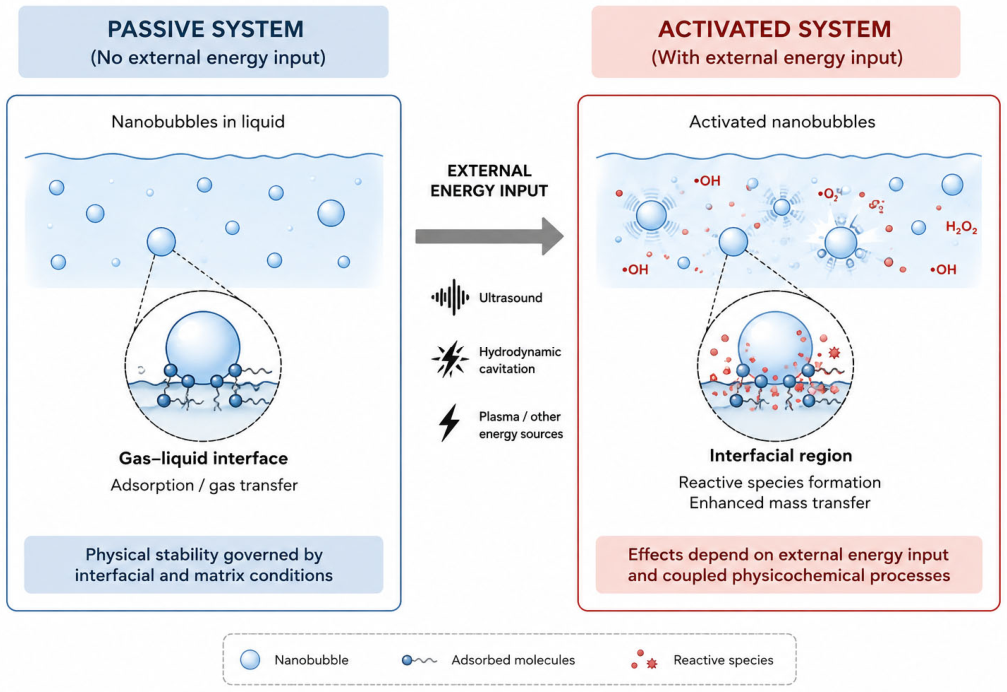
Food products are very different. Once proteins, fats, starches, suspended solids, emulsions, viscosity, and processing conditions enter the picture, bubble behaviour can change significantly.
So evidence of persistence in water should not automatically be treated as evidence of persistence in cake batter, cream filling, chocolate, or another complex food matrix.
What Are Food-Related Ultrafine Bubble Patents Signaling?
UFB patents generally reveal two different types of activity.
The first relates to how ultrafine bubbles are generated. This includes pressure-dissolution systems, venturi configurations, static mixers, ultrasound-assisted systems, and similar equipment.
The second relates to what those bubbles are being used to achieve.
For a food R&D team, the second group is often more useful because it shows the functional problems companies are trying to solve.
This is a useful first-pass distinction rather than a strict legal boundary. One patent can include several claim types.
There is another practical complication. The patent owner, equipment supplier, and company an R&D team eventually works with may not be the same organisation.
That is worth clarifying early because it changes the technical diligence required, the commercial conversation, and who ultimately needs to approve an agreement.
How to Test Whether Ultrafine Bubbles Add Value in Food Applications?
Before evaluating any UFB application, R&D teams need to separate what the gas itself achieved from what ultrafine bubble delivery was specifically added.
Nitrogen already reduces oxidation. Ozone already disinfects. Whipping already aerates. If a test shows a benefit, the question is never just whether something improved. It is whether that improvement required ultrafine bubbles specifically, or whether the same gas delivered conventionally would have produced a comparable result through a simpler or already established route. The examples discussed below do not always isolate that UFB contribution, and that distinction should guide how each one is interpreted.
Oxidation Control
Oxidation control is one of the more logical UFB applications to investigate.
A published patent application describes ultrafine bubbles of an inert gas dispersed in edible oil. The filing reports lower dissolved oxygen and reduced peroxide values during accelerated deterioration testing.
That is relevant because it is food-specific evidence.
However, it remains applicant-reported evidence from a published international patent application rather than independent validation.
The filing also combines UFB treatment with headspace gas replacement. As a result, the reported performance reflects the combined process. It does not isolate exactly how much improvement came from ultrafine bubbles.
The commercial question that actually matters is not whether nitrogen-UFB can lower dissolved oxygen. It is whether it does so more effectively than conventional nitrogen sparging after the product has been pumped, heated, and stored the way it would be in a real plant.
Manufacturers already have established alternatives here, including sparging, vacuum deaeration, antioxidants, and barrier packaging, each with known performance and integration requirements. UFB must demonstrate a meaningful advantage over those established alternatives.
Sanitation
A funded proof-of-concept study tested an ozone-UFB wash against Listeria monocytogenes on apples, celery, and romaine lettuce.
The study reported roughly a one-log reduction after about one minute of contact, although results varied by produce type and temperature.
That supports the performance of the combined ozone-UFB system.
However, the study did not compare it with conventionally ozonated water using the same ozone dose, temperature, and contact time.
Since ozone already has antimicrobial activity, the study does not isolate how much additional benefit came specifically from ultrafine bubble delivery.
Texture and Aeration
Texture and aeration are attractive application areas, but the current case relies much more heavily on adjacent evidence.
Food science already shows that bubble size and distribution can influence cake crumb, chocolate fracture, melting behaviour, and how aerated foods feel in the mouth.
For example, peer-reviewed research on chocolate used compression testing, fracture-toughness measurements, and mastication trials to examine micro-aeration.
The researchers found lower fracture stress, faster melting, and chocolate that sensory panelists perceived as softer and less sticky.
That is useful independent evidence for the effect of aeration.
But the bubbles examined were well above the modern ISO ultrafine threshold.
This distinction is important because older patents and technical literature do not always use today’s terminology consistently. The dimensions described in the study or patent claims matter more than whether the title happens to use terms such as “microbubble” or “ultrafine bubble.”
More importantly, none of this proves that UFB will create the same effect inside actual chocolate, cream filling, or cake batter.
For now, that remains a hypothesis worth testing rather than a demonstrated product benefit.
Why Doesn’t Ultrafine Bubble Performance in Water Prove Readiness for Food Applications?
Cake batter contains fat, protein, starch, and suspended solids. A cream filling is viscous and shear-sensitive. Chocolate is a fat-continuous system built around cocoa and sugar particles.
Each environment changes how gas dissolves, how bubbles form, how long they survive, and whether they still influence the process after pumping, heating, filling, or storage.
That means a supplier showing a strong bubble concentration at the generator outlet tells an R&D team relatively little about performance inside an actual product.
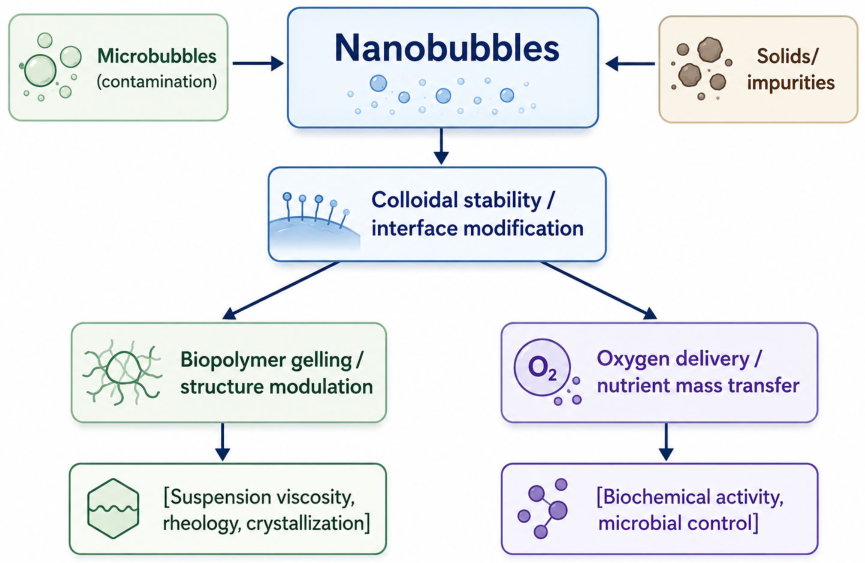
The bubbles also do not need to survive forever.
They only need to remain present long enough to perform the job they were introduced to do.
A bubble population that does its work during whipping and then largely disappears before baking may still be worth using; one that vanishes before it reaches the mixing stage is not, no matter how strong it looked at the generator. The more relevant question is whether it survives long enough to reach the point where it is supposed to matter.
This is exactly why UFB should not be evaluated as one universal technology. It is a combination of gas, generation route, product matrix, and insertion point, and each combination requires its own evidence rather than borrowed proof from another. Even ISO’s own UFB sampling guidance is scoped specifically to relatively stable dispersions in water; it does not automatically validate the same approach for a viscous, multiphase food matrix, which means a supplier citing that standard to back a concentration figure may not be citing something written with a cake batter or a chocolate matrix in mind.
The same caution applies to where supplier experience actually sits. “Food processing” on a website can mean direct product treatment, or it can mean produce washing, process water, cleaning-in-place, or wastewater treatment. All are legitimate applications, but none establish the same readiness for treating a batter, filling, or chocolate system, and the only way to know which one applies is to ask directly what was treated, under what conditions, and with what measured result.
Dynamic light scattering is a standardized method covered under ISO 22412:2025 for sizing sub-micrometer particles, emulsions, and fine bubbles dispersed in liquids. Particle tracking analysis is also standardized under ISO 19430:2024. However, food matrices already contain particles, droplets, and emulsified fat in the same size range, so neither method automatically proves that every detected object is a gas bubble. A concentration figure therefore requires information on the method, matrix, and controls used to confirm bubble identity.
Most importantly, bubble count should not be treated as the final result. R&D teams need to track both the bubble population and the outcome they actually care about, such as dissolved oxygen, oxidation rate, foam stability, texture, or microbial reduction. Bubbles may become difficult to detect while still producing a useful effect. They may also remain measurable without improving the final product. Bubble concentration only matters when it connects to a clear functional benefit.
How Should Ultrafine Bubbles Be Measured in Complex Food Matrices?
Measurement itself can introduce another problem.
Dynamic light scattering is covered under ISO 22412:2025 for sizing sub-micrometer particles, emulsions, and fine bubbles dispersed in liquids.
Particle tracking analysis is also standardized under ISO 19430:2024.
But food matrices already contain particles, droplets, proteins, and emulsified fat within similar size ranges.
That means a detected object cannot automatically be assumed to be a gas bubble.
Suppliers should therefore explain the measurement method, the matrix used, and the controls applied to confirm bubble identity.
Most importantly, bubble concentration should not become the success metric by itself.
R&D teams should track two things separately:
- What happens to the bubble population.
- What happens to the product or process.
Depending on the application, the functional measure might be dissolved oxygen, oxidation rate, foam stability, texture, rheology, sensory performance, or microbial reduction.
The bubbles may become difficult to detect while still producing a useful process change. A high and well-documented bubble count may also produce no meaningful benefit in the finished product.
Bubble concentration only becomes valuable information when it can be linked to a measurable functional result.
What Existing Food Processing Technologies Do Ultrafine Bubbles Need to Outperform?
UFB is entering processes where established alternatives already exist. For oxidation control, those alternatives include sparging, vacuum deaeration, antioxidants, and packaging. For texture, manufacturers already use whipping, homogenization, and emulsifiers. For sanitation, conventional ozone systems, heat, and UV treatment are already available.
UFB does not need to replace any of these outright to be worth using. It might precondition a liquid before whipping, improve nitrogen distribution before filling, or strengthen contact efficiency in an existing ozone wash, complementing an incumbent step rather than replacing it.
The test stays the same either way: does it create enough additional value, once equipment, energy, gas consumption, and cleaning are accounted for, to justify choosing it over what already works? A lab result is not a business case until that question has an answer.
Technical readiness is only one part of determining whether a UFB solution can reach the plant. Teams also need to consider food-grade gas purity, hygienic equipment design, cleanability, and material compliance for anything that touches the product.
Worker safety can also become a concern, especially when gases such as ozone are involved. Even after a promising technical result, shelf-life or texture claims still need to be substantiated. Any of these factors can delay scale-up or stop the technology from moving into production.
What Should R&D Teams Evaluate Before Funding an Ultrafine Bubble Pilot?
One of the easiest mistakes is moving from curiosity straight into supplier selection before defining the problem clearly enough to test. A broad objective such as “improve texture” gives the experiment little direction, whereas a target such as “reduce cake-density variation between production batches” creates a measurable outcome.
Once that objective is clear, the test can be designed around it. To isolate UFB’s contribution, R&D teams should compare the current process with the same gas delivered through a conventional method and then with the UFB treatment under equivalent conditions.
An untreated control may also be useful depending on the application. The conventional-gas comparison is especially important.
Without it, the team cannot tell whether the improvement came from ultrafine bubbles or from the gas performing the function it already performs through conventional delivery.
Success also needs to be defined before testing begins.
The value of a UFB trial depends on whether it improves the metrics that matter for the application. These may include bubble identity and size, oxidation markers, rheological changes, texture, sensory performance, throughput, and energy consumption. Performance should also be checked after realistic processing steps such as pumping, heating, filling, and storage.
If UFB does not outperform the current process, fails to remain effective through the relevant processing step, or requires integration costs that outweigh the benefit, further development may not be justified. Defining these limits early can prevent a promising lab result from turning into an expensive scale-up exercise.
Based on the public examples examined here, process-side applications such as oxidation management and sanitation currently have stronger direct support than product-side claims around texture, fat reduction, or additive replacement. This reflects the evidence available today and should not be treated as a limit on what the technology may eventually achieve.
Patent activity does not change that ranking by itself. Comparative performance in the intended food matrix does.
The first question for an R&D team is therefore not which UFB supplier looks most impressive. It is whether a specific application has enough technical logic and supporting evidence to justify controlled validation.
That requires three things to be clear before a pilot begins. It includes what UFB is expected to improve, which incumbent process it must be compared against, and what result would justify further investment.
Patents do not settle that decision. They show where an applicant believed an idea was worth protecting. Adoption depends on whether the claimed advantage can be demonstrated in the intended food matrix, under realistic processing conditions, and against the solution already performing.
How Can Slate Help R&D Teams Evaluate Ultrafine Bubble Technology?
Ultrafine bubbles can look promising across several food applications. However, promising does not always mean ready for an experiment. A supplier may report better sanitation, a patent may claim improved oxidation control, and an academic study may show benefits under controlled conditions. The harder question is whether enough independent signals support the same application.
SLATE helps bring those signals together before teams commit time and budget. The AI-powered R&D intelligence platform for F&B connects patents, scientific studies, companies, technology developments, and emerging activity around a specific technical question.
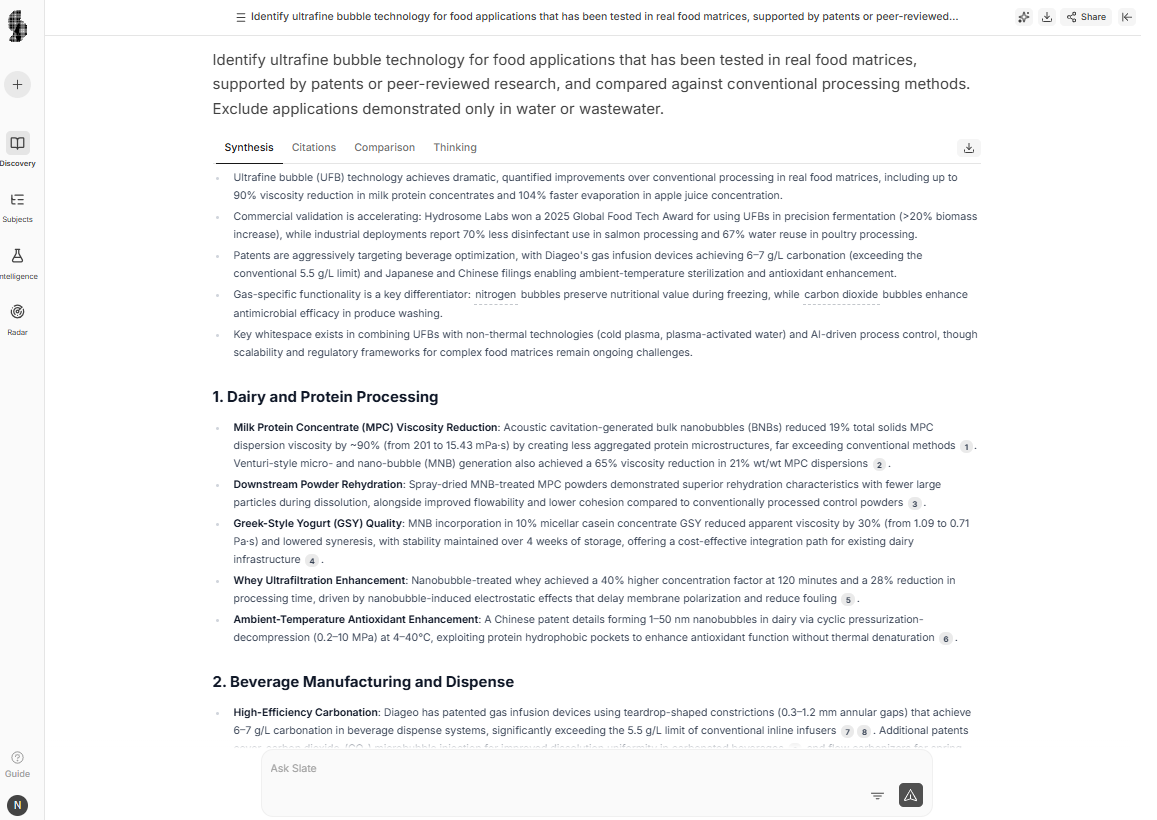
Teams can use SLATE to:
- Identify where UFB activity is increasing by comparing recent patents, research publications, and company activity across different food applications.
- Check whether technical claims have independent support by comparing patent and supplier claims with published scientific evidence.
- See which companies are solving the same problem and understand how their technical approaches differ.
- Find evidence gaps early such as limited independent validation, unclear operating conditions, scalability concerns, or weak commercial activity.
- Spot stronger R&D opportunities where patents, research, company activity, and technical validation are beginning to converge.
- Track new developments as additional patents, studies, suppliers, and technical approaches appear.
- Prioritize the next step by deciding whether an application deserves further research, supplier discussions, laboratory testing, or a pilot.
The strongest UFB opportunities will not be the ones with the most patents, papers, or supplier claims. They will be the ones where several independent technical signals point in the same direction. SLATE helps you find that convergence early, so you can focus your R&D resources on applications with stronger evidence and move into experiments, supplier discussions, or pilot work with greater confidence.
Author
Kritika Jaiswal
Associate-IP solutions