AI rollout looks like a success in most companies today. Sales teams are writing outreach in a fraction of the time. Marketing teams are turning one brief into multiple campaigns within a few minutes. Support teams have reduced response times and have dashboards to show the improvement.
R&D received the same AI tools on the same day. But ask an R&D director how it has changed their research process, and the answer is usually more complicated.
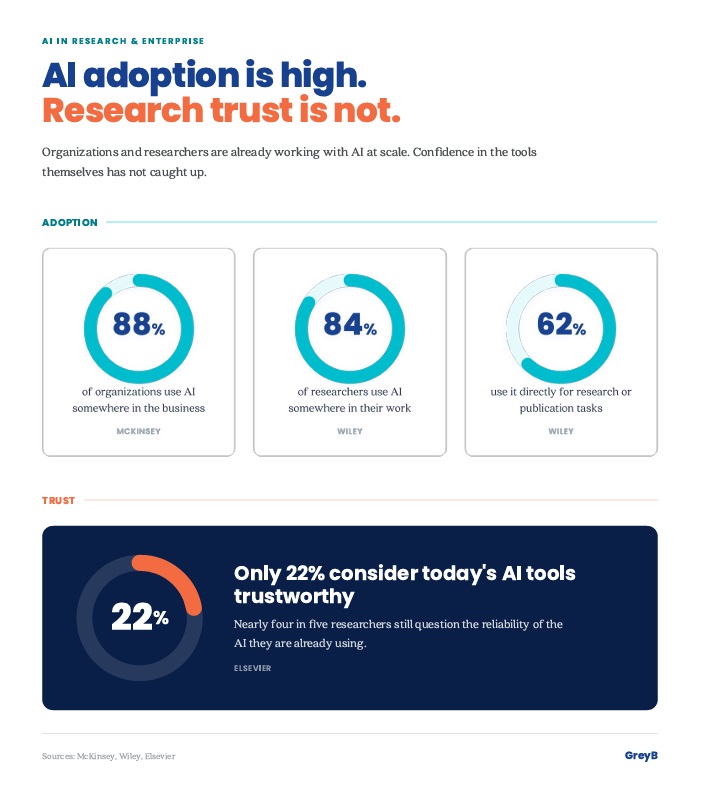
Most researchers used AI, and found it handy to summarize a paper, clean up a document, or organize notes. But when it comes to the core research work, finding evidence, evaluating technical information, and building confidence around a decision, they went back to doing the actual research the way they always have.
That does not show up as a failed AI rollout. The adoption numbers still look positive. The company can report success across functions while the team responsible for creating the next product, material, or technology is still working through the same research bottlenecks.
The gap is not whether R&D teams have access to AI. The gap is whether AI is helping them make better technical decisions.
The AI answer was fast but proving it took a week
We spoke with a materials scientist who had spent years studying a strange paradox in paper converting. When a sheet is pressed, it usually becomes stronger and thinner. But when the paper is already weak, the effect can reverse. His team knew the phenomenon existed but could not fully explain why. As a result, a product target that required both strength and reduced thickness kept moving into future development cycles.
The answer seemed like the type of problem AI could solve. The relevant information was likely somewhere across decades of scientific literature.
He turned to his company’s AI platform and within seconds, it produced a clear, confident, well-written response.
Then came the real work. He spent most of the week trying to establish whether any of it was actually true.
The scientist had to check whether the sources existed, whether the papers actually supported the conclusion, and whether the technical details matched the conditions of his team’s work. The time saved in generating an answer was replaced by the effort required to prove that answer was reliable. And, after the second attempt, he stopped using it for research questions.
This is where R&D differs from many other business functions. In everyday knowledge work, verification often happens after the answer is created. In research, verification determines whether the answer is useful in the first place.
For R&D teams, the challenge is not getting AI to produce information. The challenge is knowing whether that information is strong enough to influence experiments, product decisions, and technology investments.
A false citation can become a real R&D decision
An R&D director at a consumer products company described another risk that rarely appears in AI adoption reports. He stated if a AI creates a false citation, nobody notices immediately. It looks exactly like the real references around it.
His team carried that reference into the next stage of research, and the gap became part of the process. Weeks later, a development pathway was selected based on reasoning that contained a flaw nobody had identified. The cost of discovering that mistake was no longer measured in minutes saved or lost. It was measured in time, resources, and missed opportunities.
The problem goes beyond citations. Much of what matters in scientific research is not written in the main text. It sits inside figures, tables, experimental conditions, and stress curves. A tool that reads written explanations well but struggles with technical evidence can still capture the conclusion while missing the details that determine whether the conclusion is valid.
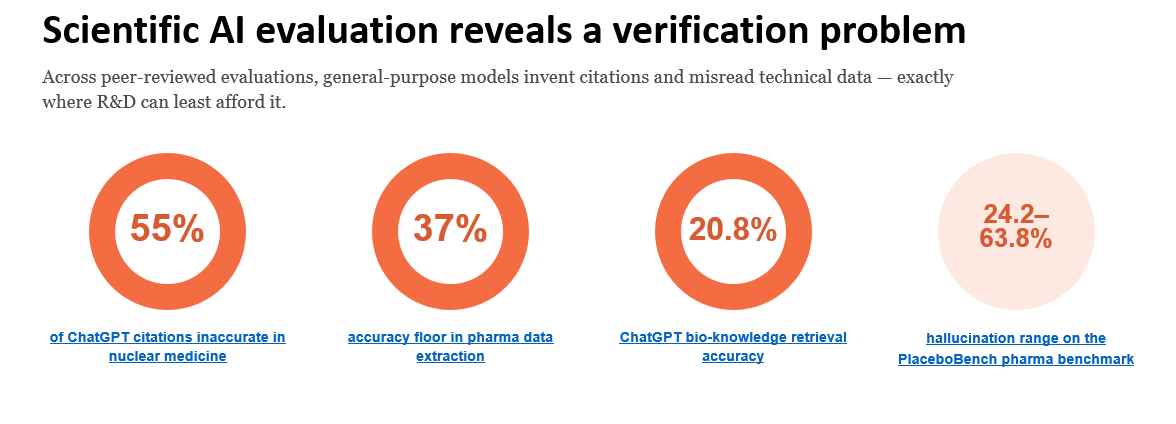
Small errors can also change outcomes. Units can be interpreted incorrectly. Comparison tables can quietly mix measurements that are not directly comparable. A peer-reviewed study and a vendor article can appear with the same level of confidence.
And when a researcher challenges an incorrect assumption, a general AI model may simply agree and continue the conversation. That is useful for brainstorming, but it is the opposite of what researchers need when they are testing a technical hypothesis.
None of this means general AI tools are ineffective. They were designed to generate useful, plausible responses. The challenge is that R&D does not need answers that sound right. It needs answers that can be defended.
Why a better-configured Copilot still needs specialized R&D research capabilities
Many companies are now taking the next step with AI. They are connecting enterprise data sources, building custom agents, and creating workflows around their existing platforms.
These improvements are valuable. But they do not automatically solve the hardest part of R&D research.
The challenge is not only finding information. It is understanding how pieces of evidence connect, identifying what matters, and knowing whether a conclusion is strong enough to influence a technical decision.
A general AI assistant can summarize a patent or explain a scientific paper. But R&D questions require in-depth discovery. Researchers need to understand technical relationships across hundreds of sources, identify which evidence matters, and determine whether the findings actually apply to their problem.
Four challenges that make this difficult.
Technical meaning is often hidden in details
Research documents contain information where small differences can change the conclusion. In patents, claim language and technical qualifiers can determine scope. A phrase such as “consisting essentially of” can determine whether a claim covers a formulation or leaves room for alternatives. General AI models often simplify language patterns, which can remove the very details that matter most.
Chemical structures, sequences, and complex technical relationships create an even bigger challenge. They are not represented like normal sentences, which makes it difficult for general models to reason about them accurately.
Research requires connecting evidence across sources
Most R&D questions cannot be answered by reading one document. They require connecting patents, papers, companies, technologies, and market activity to understand how a field is evolving.
The information that determines a research direction is often distributed across different sources. A patent may reveal a technical approach. A paper may explain the science behind it. Company activity may show commercial interest. Understanding the opportunity requires connecting all of these signals together.
Access to a database improves search capability and connecting an AI model changes where it can search. It does not automatically change how deeply it reads or connects information.
Confidence becomes harder at scale
Ask a general AI system to analyze hundreds of long technical documents, and limitations begin to surface. It start to prioritize certain sections, lose important context, or miss information buried in the middle of documents without making that limitation obvious.
For R&D teams, missing one critical detail can change the interpretation of an entire technology area.
Incorrect assumptions move through multiple steps of an AI workflow
If the initial interpretation of a technical question is wrong, every downstream step can follow the wrong direction. The final output may still look polished and logical, while the foundation behind it is flawed. Finding that mistake often requires the same technical expertise the AI was supposed to support.
Adding a database to a general AI model improves access to information. But retrieval is not the same as research intelligence.
R&D teams need systems that can connect claims, technologies, companies, scientific findings, and technical evidence into a structured conclusion can be trusted.
What a tool specifically built for research does differently
An R&D-focused AI system needs to understand the technical landscape behind the question. It needs to identify relevant evidence, connect information across sources, and show why a conclusion is supported.
This is the approach Slate, our AI-powered R&D intelligence platform takes. Instead of searching only for the exact words in a question, it starts by understanding the technical concept being investigated. It gathers the evidence before it tries to give you an answer.
Ask a question such as “What are the alternatives to TiO2 in sunscreens?” or “How can thermal runaway be reduced in EV batteries?” and it does not simply search for those exact words and summarize the first few results.
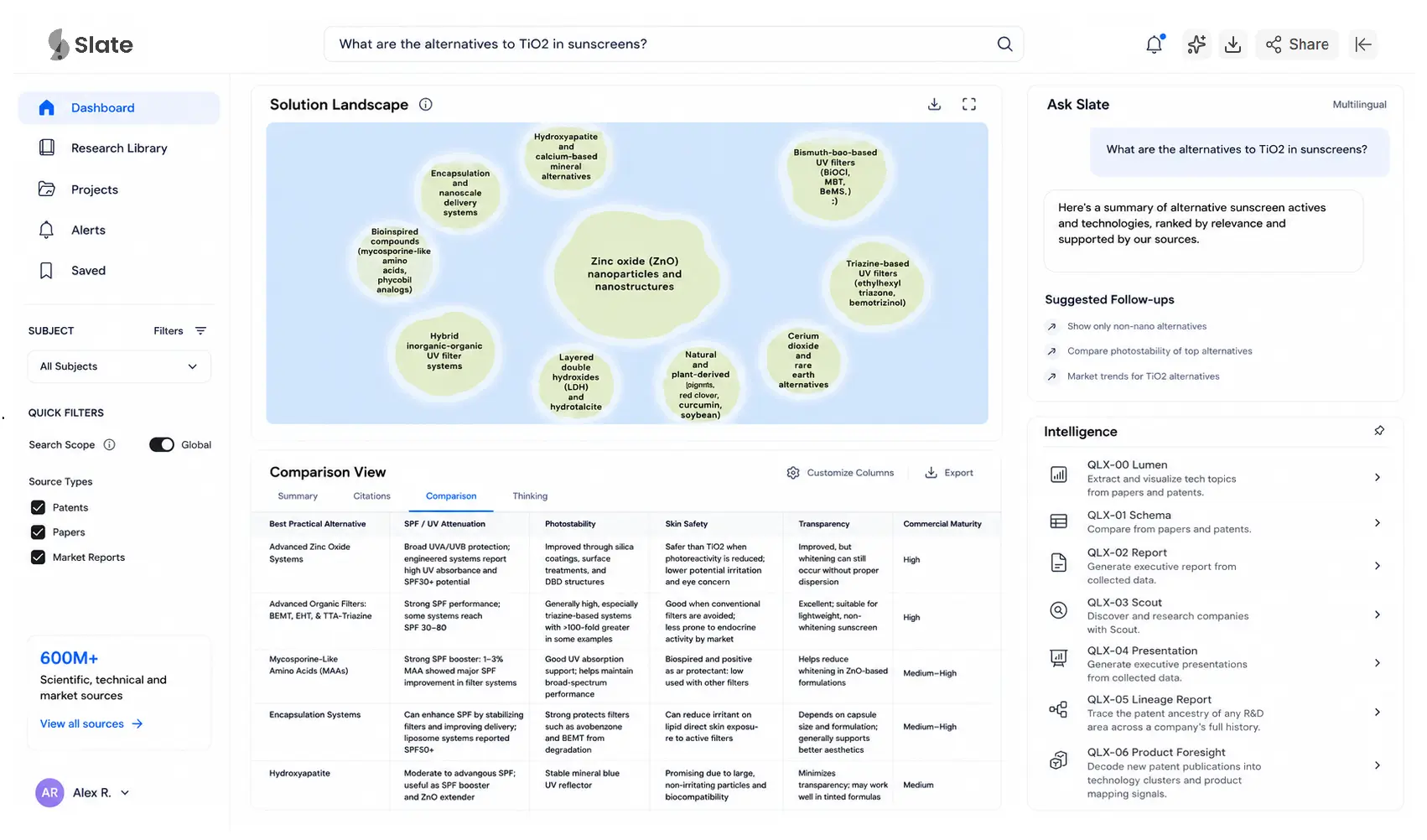
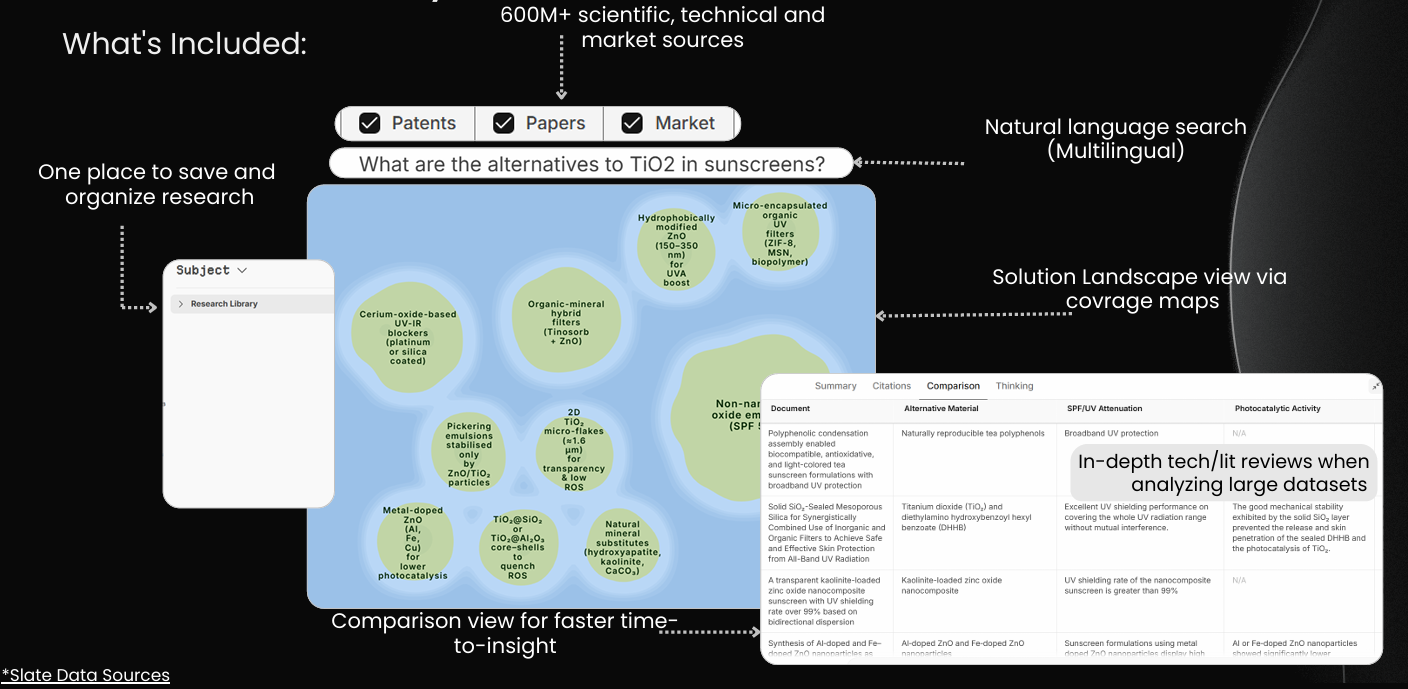
It starts with the technical concept behind the question, searches across patents, papers, and other technical sources, and maps the field before drawing a conclusion. That means you can see where activity is concentrated, which approaches are gaining attention, and where the gaps are before reading the final synthesis.
The answer then comes with the evidence attached. Instead of citing an entire paper or patent and leaving the researcher to find the relevant section, each finding can be traced back to the specific passage that supports it.
Researchers can also see how the system reached the answer. The Thinking view shows the queries it ran, the sources it considered, and how it approached the question. That makes it easier to spot where the research needs to go deeper rather than treating the output as a black box.
And because it is built specifically for R&D workflows, researchers can begin with their first question without building agents, designing complex prompts, or spending weeks configuring a system before they can start researching.
Read More: Generic AI vs. Slate
R&D teams need AI that finds what is changing before they ask
Emerging technologies rarely become important overnight. The evidence builds gradually across patents, scientific papers, competitor activity, partnerships, product launches, and technical developments.
The challenge is that these signals are often discovered by different people across the organization. One researcher may identify a new technical approach. Another team may notice competitor activity. A third group may be tracking customer requirements. Until those signals are connected, each one can look too small to act on.
General AI tools are useful when a researcher already knows what they want to investigate. They can summarize known documents, explain concepts, compare information, and help researchers work through a defined question faster.
The harder problem is knowing what is changing, which developments deserve attention, and how separate signals connect to each other.
That requires a more specialized research system. Instead of waiting for someone to ask the right question, it needs to continuously track technical activity across sources, connect related developments, and help researchers understand why a change may matter.
Slate Radar helps R&D teams continiously monitor technology areas, competitors, and innovation signals over time. It tracks changes across patents and technical sources, highlights meaningful developments, and helps researchers understand how a technology landscape is shifting.
This allows researchers to explore not only the approaches they are already considering, but also adjacent innovations that may offer new directions. It provide teams earlier visibility into changes that can influence future products, investments, and research priorities.

Integrate Slate in your existing AI research workflow
Researchers are already building workflows around the AI environments available inside their organizations, whether that is Copilot, ChatGPT, or Claude.
Adopting a specialized research system should not require them to change how they work or move between disconnected tools. Through MCP, Slate can connect its research capabilities directly into these existing AI environments, allowing researchers to access evidence-backed research support within the workflow they already follow.
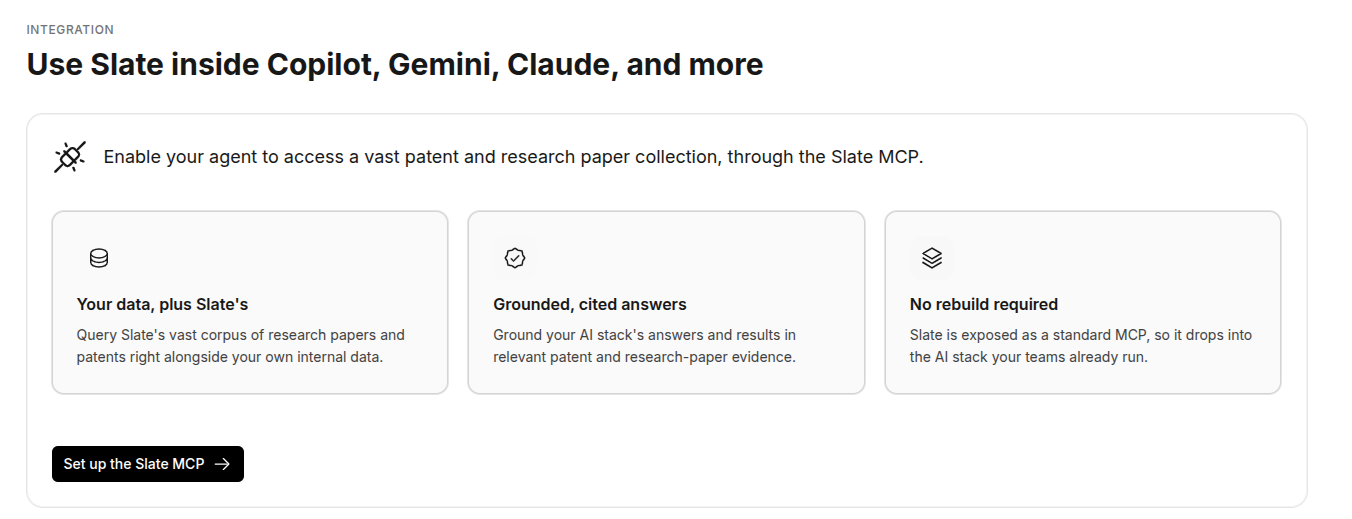
Teams can continue using the interfaces they are familiar with while adding the specialized capabilities required for technical research, such as connecting patents, papers, companies, and technology developments with supporting evidence.
The goal is not to introduce another standalone tool. It is to bring trusted research intelligence into the AI workflows R&D teams already use.
Read More: How to Connect Scientific Data to Copilot with MCP
Question every R&D leader should ask before approving AI
The most important question for an R&D AI system is not what it can generate. It is what happens when it is wrong.
For low-risk tasks, an incorrect AI output can often be caught the same day with limited impact. For R&D teams, the impact is much larger. A wrong assumption about a material, technology, competitor, or scientific finding can influence months of research, investment decisions, and product development priorities.
That difference is why an AI rollout can look successful across multiple functions while still failing to address the needs of research teams. The tool may be useful for everyday productivity tasks, but R&D requires a different standard.
That is why R&D leaders should evaluate AI differently.
Do not only ask:
- How quickly can it answer a question?
- How much information can it summarize?
- How impressive does the output look?
Also ask:
- Can my researchers verify where the answer came from?
- Can they understand the evidence behind the conclusion?
- Can the organization trust the insight enough to act on it?
The simplest way to evaluate this is to take a difficult research question your team has already spent significant time answering and run it on AI systems. You can also run it through Slate, a specialized AI research assistant. And, look at what the system discovered, what it missed, and whether it helped your team reach a stronger conclusion. That is the test our best customers designed themselves to evaluate AI systems for their research workflow.