
Scalp care has invested heavily in what to deliver to the scalp, but far less in the systems needed to deliver, personalize, and validate those actives.
From 2021 to 2026, botanical extracts generated 6,499 innovations, while generic topical delivery produced just 18. At the same time, bio-active research increased 33% between 2024 and 2026, while hardware delivery patents rose 125%. The activity is growing on both sides, but the technologies are not yet coming together.
Our analysis identified five gaps where formulation science, hardware, diagnostics, and clinical validation are progressing along separate paths. These intersections could become important areas for scalp care R&D as the category moves toward more targeted and biologically active treatments.
In this article, we explore the top 5 whitespaces in scalp care areas, the technical gaps behind them, and where they could open new opportunities for scalp care R&D and IP development.
1. Integrated Scalp Care Device and Cartridge Systems
Scalp care has plenty of formulation innovation and a growing number of delivery devices. What remains uncommon is a platform that controls both.
The landscape contains 1,352 innovations in hardware delivery combs and 6,499 in botanical extracts. Yet closed systems where a specific formulation is designed, validated, and supplied for a particular device remain rare. L’Oréal’s multi-chamber cartridge system and LG’s modular nutrient delivery platforms show what such a model could look like, but they remain exceptions.
One reason is the difference between the two industries. Cosmetic teams often develop shelf-stable products for broad manual use, while electronics companies are more accustomed to proprietary hardware, consumables, and faster product cycles. The result is that cosmetic companies typically own the formulation while electronics companies increasingly own the delivery interface.
That distinction could matter as scalp products use higher-potency actives such as exosomes and live probiotics. If dosing and application need tighter validation, companies may have to prove the formulation and delivery system together.
For cosmetic companies, the commercial question is therefore becoming broader than who owns the best ingredient. A company that controls the device, cartridge format, dosing mechanism, and compatible formulations could build a much harder ecosystem for competitors to enter.
2. Waterless Formats for Probiotics, Peptides, and Exosomes
Waterless hair care is progressing, but mainly around conventional surfactants and conditioning ingredients.
Henkel is developing solid fats that consumers can reconstitute before use. Church & Dwight has worked on oil-absorbing solid dry shampoos, while L’Oréal has developed concentrated cationic surfactants for low-water formulations. Traditional synthetic polymers and surfactants together account for 4,846 innovations.
Live probiotic strains from BASF and Cosmax, exosome compositions, and Caregen’s peptide-based follicle stimulators still rely mainly on aqueous or cream formulations. The analysis found no filings covering anhydrous or solid-state delivery of these complex bio-actives.
The challenge is stability. Removing water can lower product weight and enable concentrated formats, but sensitive biological ingredients are difficult to keep active in dry conditions. Standard shampoos can contain more than 70% water, while fermentation-derived ingredients often need carefully controlled conditions to remain stable.
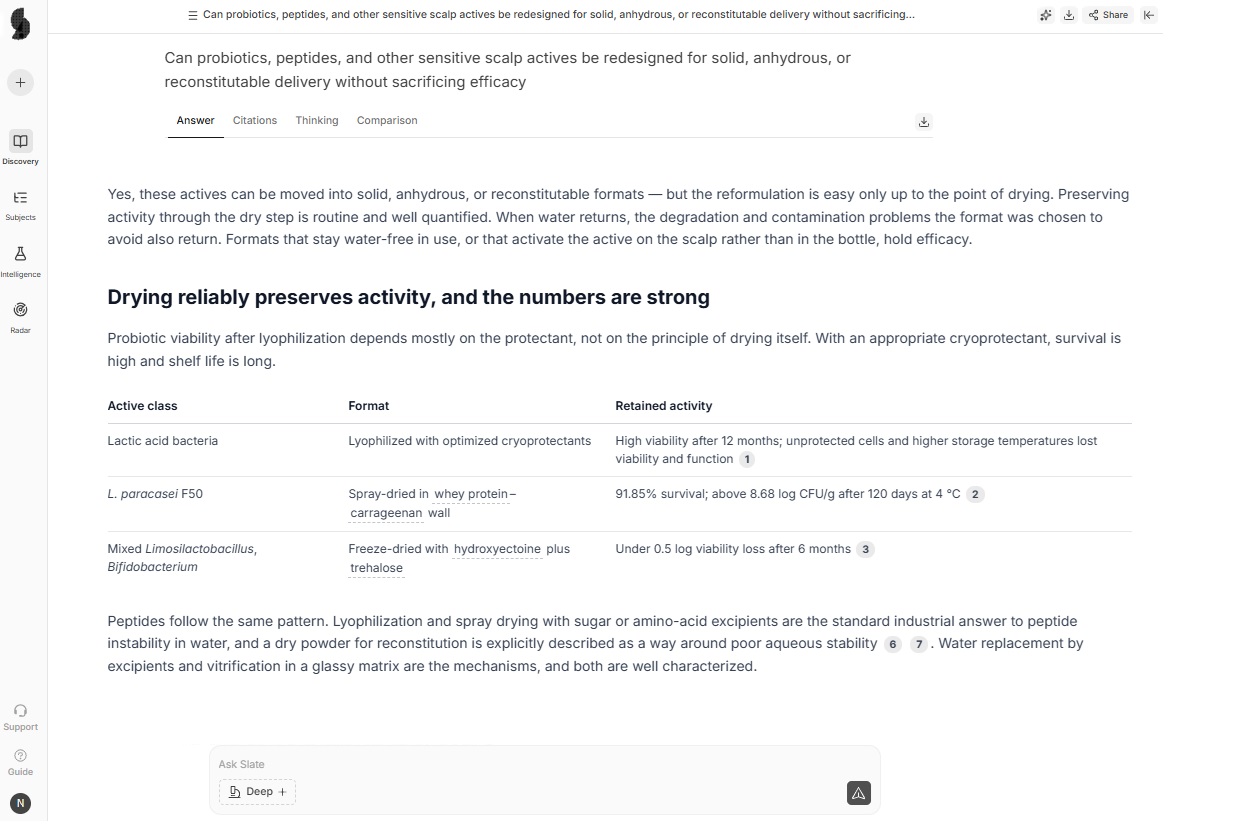
The missing capability is a practical way to dry, protect, store, and later reactivate these ingredients. Lyophilization and encapsulation could provide possible routes, but the patent landscape shows no clear consumer-ready solution that preserves biological activity after reconstitution.
Green chemistry innovation in traditional surfactants rose from 628 innovations in 2021 to 1,159 in 2026, while microbiome-focused products have largely remained in water-based formats.
For R&D teams, this creates a clear research question. Can probiotics, peptides, and other sensitive scalp actives be redesigned for solid, anhydrous, or reconstitutable delivery without sacrificing efficacy?
Here’s what the SLATE shows:
3. AI-Driven Scalp Treatment Recommendation Systems
Smart scalp devices are getting better at measuring what is happening on the scalp. They are much less developed at deciding what should happen next.
Hardware developers are patenting sensors for moisture, temperature, and sebum alongside atomizers, reservoirs, and dosing controls. LG has also explored mobile app integration for personalized scalp protocols. Yet the algorithmic layer connecting those measurements to a specific formulation, ingredient combination, dose, or treatment frequency remains largely absent.
The analysis found 1,352 hardware delivery innovations, but no clear patent activity around AI-driven treatment recommendation systems. Current devices can increasingly identify scalp conditions, but few appear able to translate that information into a validated treatment decision.
Device companies may have strong sensing technology but limited dermatological datasets for training recommendation engines. Cosmetic companies have extensive bio-active portfolios but often lack connected hardware capable of adjusting treatment from real-time scalp measurements.
Measuring moisture is different from diagnosing a scalp condition or recommending treatment. Once algorithms begin influencing therapeutic decisions, companies may need stronger clinical evidence. Cosmetic brands also need to manage the point at which stronger efficacy claims could move products closer to drug or medical-device regulation.
The opportunity is a closed-loop platform that links sensing, interpretation, formulation selection, and controlled dosing. Companies developing bio-actives should therefore consider how their formulations could connect with diagnostic platforms before those recommendation ecosystems become proprietary.
4. Standardized Clinical Endpoints for Scalp Health
Scalp care is increasingly targeting the microbiome, follicle regeneration, inflammation, and barrier health. Yet there is still no common way to compare whether one treatment works better than another.
The patent analysis found no filings focused on standardized clinical efficacy benchmarks for scalp health. Companies are reporting outcomes such as increased dermal papilla cell proliferation, reduced Malassezia activity, and improved barrier function, but there is no widely accepted testing framework for comparing those claims.
Traditional hair care could rely on outcomes such as shine, detangling, smoothness, and frizz reduction. Therapeutic scalp care requires more complex measures, including microbiome diversity, transepidermal water loss, inflammatory cytokines, and follicle density.
Without common endpoints, each company can generate evidence differently. That makes clinical results harder to compare and may complicate future regulatory submissions.
This problem grows as scalp care moves closer to dermatology. Unilever alone holds 309 innovations related to microbiome modulation, while microbiome and peptide technologies account for more than 10,000 combined innovations. Yet the category still lacks a shared system for comparing clinical efficacy.
Creating such standards will likely require agreement on endpoints, study populations, measurement methods, testing conditions, and study duration. That is difficult because companies may view parts of their testing methodology as a competitive advantage.
For R&D teams, the risk is that strong internal clinical data may not match the standards that regulators or industry groups eventually adopt. Building evidence around repeatable and clinically relevant endpoints now could reduce the need for costly re-testing later.
5. Bio-Active Formulations Engineered for Device Delivery
Most botanical extracts, peptides, and probiotics are still optimized for creams and gels. Atomizers, thermal applicators, ultrasonic exfoliators, and other delivery devices are generally built around standard fluids. Very little patent activity addresses what happens when advanced actives encounter the mechanical conditions created by those devices.
A formulation designed for device delivery may need very different properties. Its viscosity must work with a nozzle. Peptides may need protection from thermal stress. Probiotics may need to survive atomization forces. Ingredients used with ultrasonic devices may need to tolerate acoustic cavitation.
The disconnect is visible even among companies working across both areas. L’Oréal has patented ultrasonic exfoliation technologies and developed large numbers of bio-active extract compositions, but there is little IP connecting those formulations to the acoustic environment created by the device. Anshen’s infrared atomizer technology and BASF’s probiotic strains also remain in separate patent families.
This matters because mechanical delivery is expanding. Liquid-dispensing system innovation increased 125% between 2024 and 2026. Yet a more precise device will not improve efficacy if the active degrades, separates, clogs the delivery system, or loses biological activity during application.
The technical opportunity is therefore to treat the device as a formulation constraint from the beginning. Viscosity, particle size, thermal tolerance, mechanical stability, and compatibility with pumps, reservoirs, nozzles, or transducers may need to become part of formulation design itself.
This is where formulation science and hardware engineering need to meet. Companies that solve those compatibility problems could create IP that competitors cannot reproduce simply by placing an existing serum inside a new device.
Where Scalp Care R&D Should Focus Next
The strongest white spaces in scalp care now sit between established areas of expertise. R&D teams should look beyond improving individual ingredients and start investigating the interfaces between bio-actives, delivery hardware, diagnostics, and clinical validation.
That means designing formulations alongside the devices that deliver them, exploring solid-state stability for probiotics and peptides, connecting diagnostic signals with validated treatment decisions, and preparing clinical studies around endpoints that could support stronger efficacy claims. These problems will require formulation scientists, device engineers, AI teams, dermatologists, and regulatory specialists to work together rather than moving through separate development programs.
The next meaningful scalp care IP may therefore come less from another isolated formulation or sensor and more from solving the integration problems that currently sit between them.
Find the R&D Gaps That Patent Searches Alone Do Not Show
Research teams rarely struggle because there is too little technical information. The harder problem is working out which signals matter, how technologies connect, and where competitors have not yet built a solution.
SLATE, an AI-powered R&D intelligence platform helps researchers investigate those questions through capabilities such as:
- Patent and scientific literature search to study commercial IP and emerging research together.
- Technology clustering and white-space mapping to identify crowded areas and underdeveloped intersections.
- Competitor R&D tracking to follow changes in patenting, research activity, and technical direction over time.
- Cross-domain technology analysis to connect developments that sit in different research fields or patent classifications.
- Company, startup, researcher, and institution discovery to find potential technology owners, collaborators, or acquisition targets.
- AI-assisted technical analysis to organize large result sets, compare approaches, and turn hundreds of documents into focused R&D questions.
The five gaps in this analysis were hidden across different patent clusters, technologies, companies, and research fields. Slate brings those signals into one research workflow so your team can see not only what the industry is already working on, but where the technical connections are still missing. That is often where the more valuable R&D opportunities begin.