
Scalp care is no longer just about better formulas. Between 2024 and 2026, Dyson and LG Electronics published 33 innovations in scalp care hardware, while activity around liquid-dispensing comb systems rose 125%. This suggests that delivery technology is becoming an important part of the competitive landscape.
At the same time, research is expanding into microbiome modulation, precision delivery, advanced polymers, and more targeted biological interventions. For R&D teams planning for 2027, the challenge is deciding which technologies are gaining real momentum and where future differentiation may come from.
In this article, we will cover seven emerging scalp care technologies R&D teams should monitor in 2027, the innovation activity behind them, and what they could mean for future product development.
1. Scalp Care Hardware Delivery Systems Are Giving Electronics Companies More Control
Panasonic published 12 innovations in this area, while Anshen Electrical Technology patented infrared atomizers that attach directly to hair dryers using controlled airflow and detachable oil reservoirs. These systems give devices greater control over where and how scalp treatments are applied.
Some technologies are going further AI-powered smart combs can measure factors such as scalp moisture and temperature and use that information to recommend targeted treatments. This brings scalp devices closer to personalized assessment tools rather than simple applicators.
China accounts for 61% of activity in this technology cluster, making it an important center for development and manufacturing.
For traditional cosmetic companies, this creates a new challenge. If device companies control the hardware, treatment delivery, user data, and consumer interface, beauty brands could lose some control over the overall scalp-care experience. R&D teams may therefore need to think beyond formulations and consider device partnerships, hardware capabilities, or compatibility with emerging delivery systems.
2. Scalp Microbiome Modulation Is Becoming a Key R&D Battleground
Unilever has built a strong position in this space, with 309 innovations around botanical and fermented extract compositions, roughly three times the volume of its nearest competitor. Its work includes trehalose-based prebiotic approaches designed to inhibit S. hominis, a scalp microorganism associated with seborrheic dermatitis.
Caregen follows with 67 innovations focused on peptide-based follicle stimulation. BASF has 58 publications covering areas such as live probiotic strains and polysaccharide-rich extracts designed to increase skin thickness.
The wider patent activity shows a move away from broad antimicrobial approaches toward more targeted biological interventions. Bio-active and prebiotic publications increased 33% between 2023–2024 and 2025–2026. Researchers are exploring yeast strains that selectively target dandruff-causing fungi while preserving beneficial bacteria, as well as rhPDGF-BB combined with collagen carriers for hair follicle regeneration. Alteromonas ferment extracts combined with hexapeptides are also being studied for tissue repair.
This is becoming a crowded IP space. The plant and fermentation extract cluster contains 4,856 innovations across 2,364 publishers, with companies such as Unilever, Caregen, and BASF holding sizeable portfolios. Henkel, however, is absent from the leading group.
For companies without fermentation or bio-processing capabilities, entering this area may require longer validation cycles and greater reliance on ingredient suppliers such as BASF and Symrise. As biological signaling becomes more important to scalp-care efficacy, access to proprietary strains, peptides, extracts, and processing expertise could become an increasingly important source of differentiation.

3. Green Chemistry Is Reshaping Synthetic Scalp Care Formulations
Synthetic chemistry is not disappearing from scalp care. Patent publications for cationic surfactants and polymers increased from 628 in 2021 to 1,159 in 2026, showing that companies are continuing to improve established chemistries rather than replacing them entirely with botanical alternatives.
L’Oréal holds 687 innovations in this cluster. Its work includes cationic amidoamine surfactants combined with sebacic acid copolymers for concentrated formulations designed to maintain performance under high-humidity conditions. Henkel is taking another route, replacing alkoxylated surfactants with propanediol caprylate and developing solid conditioning fats that consumers can reconstitute with water. This approach can reduce shipping weight and plastic packaging by more than 70%.
Materials companies are also reworking synthetic ingredients themselves. Eastman Chemical has developed biodegradable cellulose ester microparticles as alternatives to conventional microplastics, while Living Proof has patented ionizable phosphorus-containing compounds designed to strengthen keratin bonds.
Format is changing alongside chemistry. Standard shampoos can contain more than 70% water, which is pushing companies toward waterless and concentrated products that reduce packaging and transport requirements while still maintaining the texture, flow, and sensory experience consumers expect.
For companies developing bio-based or clean-label alternatives, sustainability alone may no longer be enough to stand out. They will also need to match the performance and cost of these re-engineered synthetic systems. Otherwise, bio-based formulations could remain premium niche products rather than compete at mass-market scale.
4. Advanced Scalp Care Actives Need Better Delivery Systems
Scalp care R&D is moving toward more complex actives, including exosome-based treatments, sulfated polysaccharides from Aphanothece sacrum, and dicarboxylic acid pyridine derivatives combined with flavone heteroside antioxidants.
DIC is developing marine polysaccharides to reduce hair damage, while Givaudan has filed patents around encapsulation systems using core-shell microcapsules and polylactic acid particles for more targeted delivery. Amelanchier asiatica extract is also being explored for its combination of antioxidant, anti-inflammatory, and dermal papilla cell activation effects.
The challenge is getting these actives to work effectively on the scalp. Many are large, unstable, or difficult to penetrate through conventional liquid and cream formulations. In fact, 50% of recent activity in the generic topical delivery cluster focuses on improving active penetration.
This is driving work on encapsulation, ultrasonic exfoliation, and more precise dosing systems. For R&D teams, it means advanced actives and delivery technology need to be developed together. Investing in exosomes, marine polysaccharides, or similar high-cost ingredients without solving stability and penetration could make clinical validation much harder and limit their commercial potential.
5. Scalp Care Is Splitting Into Therapeutic Treatment and Aesthetic Conditioning
Scalp care innovation is beginning to develop along two very different paths: therapeutic scalp treatment and aesthetic hair conditioning.
Unilever has innovations in traditional conditioning alongside its growing work in biological actives. This suggests that large companies are still investing across both directions rather than committing to a single approach.
The requirements for each path are also very different. Microbiome-based scalp treatments need clinical validation, dermatological endpoints, and, where diagnostic hardware is involved, could potentially face Class I or Class II medical-device requirements. By comparison, aesthetic conditioning is focused on sensory performance, formulation stability, rheology, and concentrated formats that reduce environmental impact.
That creates an R&D capability gap. Fermentation expertise and clinical-trial infrastructure do little to help develop high-performance waterless polymers. Likewise, strong formulation and rheology capabilities do not automatically translate into dermatological validation.
For R&D teams, the challenge is deciding how much to invest in each direction. Focusing too heavily on one could create problems if both categories continue to grow, while spreading resources across both may weaken technical depth. Companies may therefore need to decide where they want specialist capabilities and where partnerships can fill the gaps.
See Where Scalp Care R&D Is Moving Before the Market Gets Crowded
For researchers, finding an interesting technology is rarely the difficult part. The harder questions come next: Is the space already crowded? Who is working on it? What approaches are gaining momentum? And where is there still room to innovate?
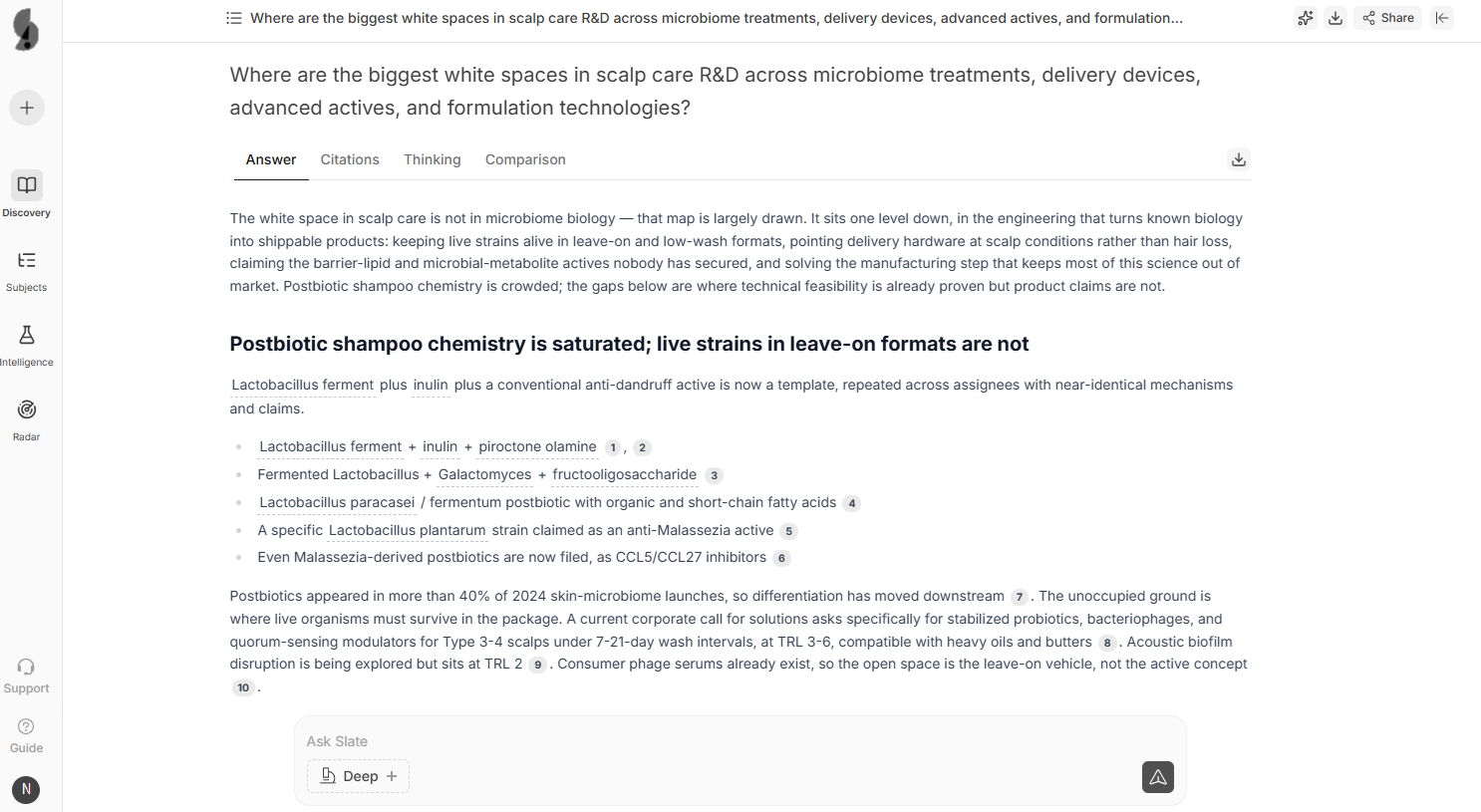
With SLATE, an AI-powered R&D intelligence platform, R&D teams can:
- Spot emerging technologies early by tracking how patent and research activity is changing over time.
- See who is working on what across competitors, startups, universities, and technology providers.
- Map technology clusters to understand how areas such as microbiome modulation, delivery devices, advanced actives, and formulation technologies are developing.
- Find less-crowded R&D opportunities instead of entering areas where competitors already hold dense patent portfolios.
- Benchmark your R&D pipeline against competitors and identify technologies where your portfolio has limited coverage.
- Trace technologies back to the underlying patents and research, so researchers can investigate the evidence rather than rely only on market-level trends.
- Identify capability gaps early, including areas where development may depend on ingredient suppliers, device partners, or external technical expertise.
If your team is deciding what to investigate next, where competitors are moving, or which technologies deserve deeper R&D attention, explore those questions directly in Slate.

Frequently Asked Questions
Why are scalp care companies investing in hardware and delivery devices?
Devices can control where and how treatments are applied while also measuring factors such as scalp moisture and temperature. Patent activity around liquid-dispensing combs increased 125% from 2024 to 2025–2026, showing growing interest in more precise and personalized delivery.
Which companies are active in microbiome and biological scalp treatments?
Unilever has 309 innovations around botanical and fermented extracts, while Caregen has 67 innovations focused on peptide-based follicle stimulation. BASF has contributed 58 publications covering areas such as probiotics and biological extracts.
Are synthetic ingredients being replaced by bio-based alternatives?
Not yet. Publications around cationic surfactants and polymers increased from 628 in 2021 to 1,159 in 2026. Instead of abandoning synthetic chemistry, companies such as L’Oréal and Henkel are adapting it for concentrated, waterless, and more sustainable products.
Why do advanced actives such as exosomes need better delivery systems?
Some advanced actives are unstable or difficult to deliver through conventional creams and liquids. This is driving research into encapsulation, ultrasonic technologies, and precision dosing systems that can improve stability and help actives reach the intended area of the scalp.
What is the difference between therapeutic scalp care and aesthetic conditioning?
Therapeutic scalp care focuses on areas such as the microbiome, inflammation, follicle health, and scalp diagnostics, often requiring stronger clinical validation. Aesthetic conditioning focuses more on hair feel, manageability, formulation performance, and concentrated or waterless formats.
What should R&D teams consider when investing in scalp care technologies?
The key question is whether the company has the capabilities needed to support the technology. Biological treatments may require fermentation and clinical expertise, while advanced delivery systems may require hardware partnerships. R&D teams need to consider both the active itself and the infrastructure required to make it work.