Your team has been working on the same engineering problem for months. You have reviewed relevant research, studied competing technologies, and tested approaches used across your industry. Yet progress remains slow.
What if a solution to a similar problem already exists in another industry?
Look at what GLP-1 drugs, which started as a diabetes treatment. In 2026, 11% of US adults say they currently take one for weight loss, up from 3% in 2024. That shift first changed how people eat, so food companies had to rethink portions and protein. Then it changed how skin looks after rapid weight loss, so beauty companies got a new set of problems.
Finding those answers is hard because each industry uses its own terms, journals, and patent classes. AI can help by searching on what a problem needs to do, not on industry keywords. But an analogy isn’t a solution. You still need to understand the mechanism, check the evidence, and test it against your requirements.
In this guide, you’ll learn how to find engineering solutions from other industries with AI. We’ll walk through a six-step process, from describing your problem to choosing which ideas are worth testing.
Let’s get into details.

Why Engineering Solutions Can Transfer Across Industries
Engineering problems often share fundamental principles, even when the products and applications look different.
GLP-1 drugs are themselves a good reminder. The first one came from studying lizard venom. In 1992, John Eng isolated exendin-4 from Gila monster venom and found it acted like the human gut hormone GLP-1, but lasted much longer in the body. It became exenatide (Byetta), the first approved GLP-1 drug, in 2005.
The same pattern shows up in the problems GLP-1 has created downstream. Packing enough protein into a small drink for someone on a GLP-1 drug and feeding a hospital patient with a poor appetite involve the same formulation challenge. Restoring facial volume after rapid weight loss and treating facial fat loss from other medical causes both involve the same tissue problem.
The users may differ, but some of the physical principles remain the same. This creates opportunities for technology transfer.
Industries develop specialized expertise because they repeatedly encounter certain technical challenges. Medical nutrition companies have years of experience feeding people who can only eat small amounts. Aesthetic medicine has long studied how to rebuild lost facial volume. Drug delivery firms have spent decades trying to get large molecules through the gut.
These capabilities may offer useful approaches to problems in other fields. However, the goal is not to copy a technology directly. It is to understand what makes it work and determine whether that principle can be adapted to another application.
That distinction is essential. Two industries might need the same outcome, such as more protein per sip or firmer skin, but require very different technical solutions because of their materials, costs, regulations, and users.
Why Finding Solutions Outside Your Industry Has Been Difficult
Cross-industry technology transfer is not new. The difficulty has been discovering relevant solutions systematically.
A food researcher building a high-protein drink for GLP-1 users may spend months studying beverage and dairy literature. Meanwhile, useful approaches may exist in hospital nutrition, sports nutrition, or pharmaceutical formulation, where getting a lot of nutrition into a small dose is equally important.
Those technologies might never appear in the researcher’s search results. One reason is terminology.
Different disciplines can describe related engineering problems using different languages. A researcher searching for a “GLP-1 friendly protein shake” may overlook work described as an “oral nutritional supplement for patients with reduced appetite” or a “high-protein, low-viscosity enteral formula.” A skincare chemist searching for “Ozempic face” may miss decades of clinical work filed under “facial lipoatrophy.”
Patent classifications, technical journals, supplier databases, and industry-specific terminology can reinforce these boundaries.
Search tools have evolved beyond exact keyword matching, but researchers still need to know how to formulate queries, identify adjacent technical fields, and assess unfamiliar results. This is where AI can improve the research process.
What AI Changes About Cross-Industry Engineering Research
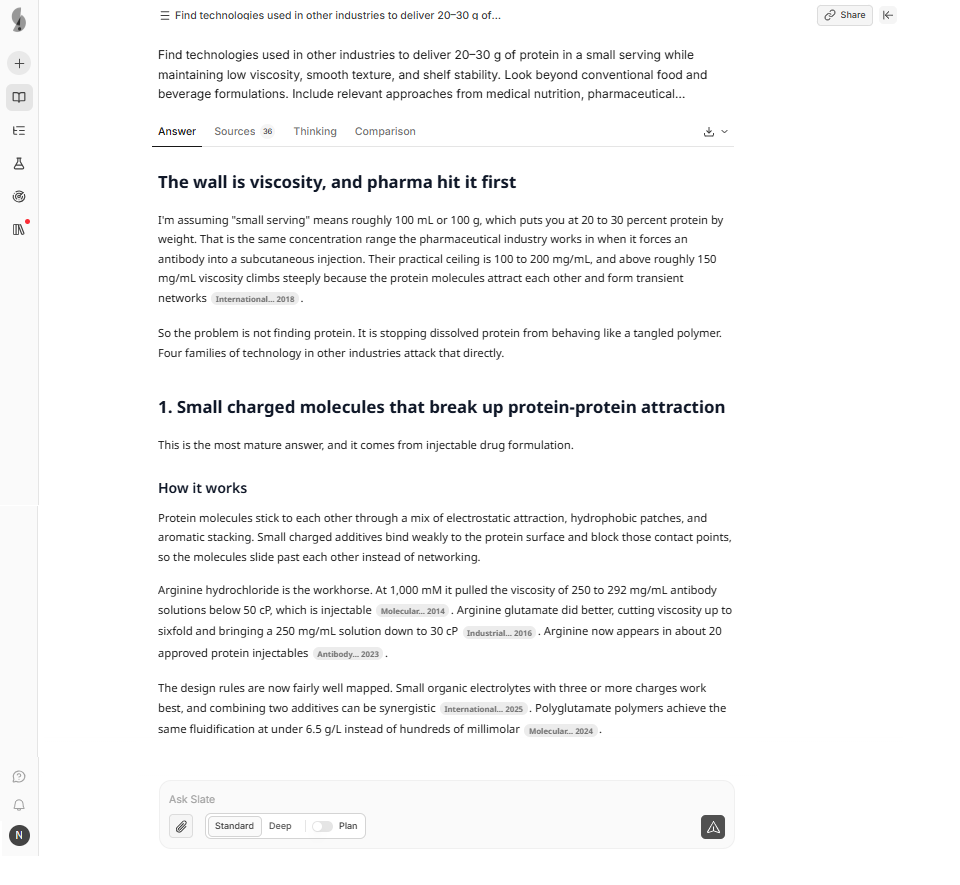
Traditional engineering research frequently starts with a product, technology, or known technical approach. AI makes it easier to start with the underlying problem. For example, rather than asking for GLP-1 friendly snack ideas, a researcher can describe the actual requirement:
Deliver 20 to 30 g of protein in a serving small enough for someone who feels full quickly, without the drink turning thick, gritty, or unstable on the shelf.
That functional description gives AI a broader starting point. It may identify relevant approaches from medical nutrition, sports nutrition, dairy processing, pharmaceutical formulation, or other fields. AI can support this process in three ways.
First, it can translate problems into domain-neutral language. This reduces dependence on the terminology commonly used in one industry.
Second, it can identify functional similarities across disciplines. AI can suggest other applications where engineers have encountered comparable physical constraints.
Third, it can help researchers examine unfamiliar technologies. It can summarize working principles, identify possible applications, and compare published technical information against defined requirements.
When connected to suitable research sources, AI tools can also support searches across patents, scientific publications, and technical databases.
This is the kind of search Slate, an AI agent for R&D, is built for. You describe the problem in plain language, and it searches global research for answers, including solutions already proven in other industries. The important limitation is that a plausible AI-generated connection is still a hypothesis. It requires supporting evidence before an engineering team can treat it as a credible solution.
How to Find Engineering Solutions from Other Industries Using AI
Finding technologies from another industry is only the first part of cross-industry research. The harder question is whether those technologies can solve your problem under real operating conditions.
A technology may perform exceptionally well in a laboratory but fail when applied to a different material, manufacturing process, or cost structure.
AI can help researchers narrow this gap by finding related engineering approaches, examining published evidence, and comparing technologies against their requirements.
The following process shows how, using a food-packaging challenge where an unexpected solution comes from semiconductor manufacturing.
Step 1: Define the Problem Before Searching for Solutions
Consider a packaging manufacturer developing a recyclable film that must prevent oxygen and moisture from entering while remaining flexible and compatible with existing production equipment.
Searching for “sustainable barrier coatings” would return familiar materials and packaging technologies.
A more useful starting point is to describe the engineering requirement:
Find technologies that create effective oxygen and moisture barriers on thin polymer films while maintaining flexibility, heat-sealing performance, and compatibility with industrial production.
This opens the search to technologies developed for other applications.
However, the functional description alone is not enough. Researchers must also establish the conditions a solution needs to meet, such as:
- Oxygen and moisture transmission targets
- Maximum coating thickness
- Performance after bending or folding
- Processing temperature and production speed
- Food-contact compliance and cost
These requirements help distinguish an interesting technology from one that might work in the intended application.
Step 2: Find Industries Working on Similar Engineering Problems
Once the problem is defined, AI can help identify industries where engineers face comparable physical challenges.
For a flexible packaging barrier, relevant fields include semiconductor manufacturing, flexible electronics, solar cells, and medical devices.
One technology worth investigating is atomic layer deposition (ALD), a coating technique used extensively in semiconductor manufacturing.
ALD creates extremely thin, controlled layers of material. Researchers have also explored its use in packaging because these layers can provide effective barriers against oxygen and moisture.
A 2025 study offers a useful example. Researchers deposited a 20-nanometre aluminium oxide coating onto PLA, a bio-based polymer used in packaging. Under the reported test conditions, the coating reduced water-vapour transmission from approximately 150 to 4.7 g/m²/day.
That is a substantial improvement from a coating only a few nanometres thick.
The interesting part is not simply the performance figure. It is that a technology developed for precision coating applications can potentially address a packaging problem.
Using AI for this search
A researcher could ask Slate:
Find technologies used outside food packaging to prevent oxygen and moisture transmission through flexible materials. Include semiconductor and electronics applications. Compare their working principles, published performance, and limitations for recyclable packaging.
[Insert screenshot of the Slate query and relevant research findings.]
The purpose is to identify technologies that deserve closer examination, rather than assume that every cross-industry connection represents a viable solution.
Step 3: Understand Why the Technology Works and Where It Might Fail
Once AI identifies a promising technology, the next task is to understand the mechanism behind its performance.
For ALD coatings, the barrier comes from a thin layer that restricts the movement of gases and moisture through the underlying material.
But there is a problem.
Packaging films are repeatedly bent, folded, sealed, and handled. Thin inorganic coatings can develop cracks or defects during these operations, reducing their barrier performance.
This changes how researchers should evaluate the technology.
A coating that performs well immediately after deposition may not deliver the same results after packaging conversion or transportation.
Researchers have investigated several ways to address this limitation, including combining inorganic barrier layers with more flexible polymer layers.
The important question is whether those changes preserve barrier performance under the conditions required by the intended product.
This is where AI can help researchers go beyond identifying a technology. It can locate studies examining failure mechanisms, compare alternative coating structures, and identify which approaches have already been tested.
That prevents teams from spending time investigating problems that other researchers have already encountered and documented.
Step 4: Check What the Evidence Actually Proves
A technology appearing in several patents or research papers does not necessarily mean it is ready for commercial use.
Different sources establish different things.
A patent may describe a promising coating architecture without demonstrating its performance at industrial scale. A research paper may report excellent barrier properties on a particular polymer, but those measurements may not apply to another substrate or processing condition.
For ALD coatings, researchers should examine whether the available evidence covers:
| What to check | Why it matters |
| Barrier performance | Results may change with the substrate, humidity, or measurement method. |
| Mechanical durability | Initial barrier performance may not survive repeated bending. |
| Manufacturing compatibility | A successful laboratory coating may require changes to production equipment. |
| Food-contact safety | Materials suitable for electronics may need additional qualification for packaging. |
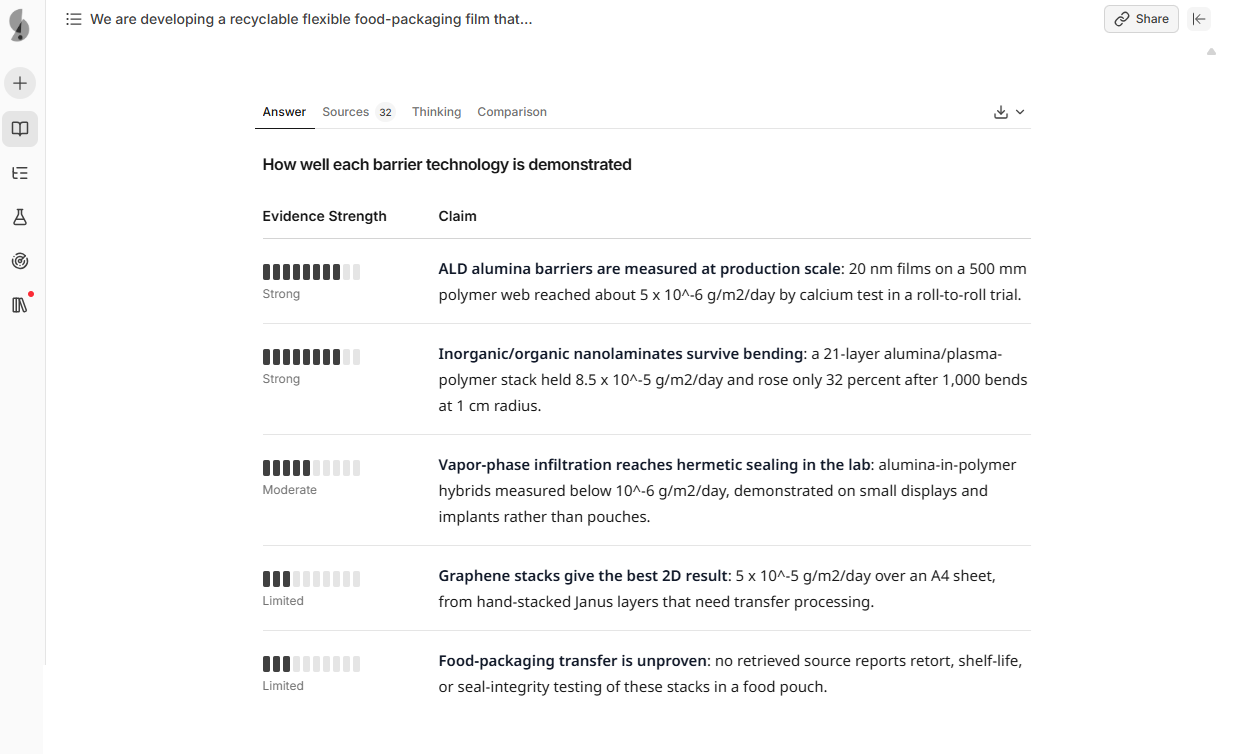
One useful practice is to classify findings as measured, claimed, or not yet established.
For example, a published water-vapour transmission measurement is evidence of performance under specified conditions. A supplier’s projected production cost is a commercial claim. Suitability for a particular food-contact application remains unestablished until the relevant requirements are checked.
This distinction is particularly important when AI combines information from patents, scientific papers, and company announcements into one answer.
Step 5: Compare Solutions Against the Requirements That Could Rule Them Out
The goal is not to find the technology with the most impressive laboratory result. It is to determine whether a technology offers a meaningful advantage over existing options.
For a packaging manufacturer, ALD would need to be compared with established barrier materials and coating processes, including conventional oxide coatings and barrier polymers.
A practical evaluation should begin with the questions most likely to eliminate a candidate.
First, can it meet the required performance? Check whether the reported barrier measurements are relevant to the target substrate and operating conditions.
Second, will the performance survive manufacturing and use? Examine evidence from bending, sealing, ageing, and other relevant tests.
Third, can it be produced and qualified economically? Investigate equipment availability, processing speed, food-contact requirements, and likely development costs.
The order of investigation should depend on which questions can be answered most quickly and at the lowest cost. For example, if a coating requires a processing temperature that would damage the intended polymer, there may be little value in reviewing its more advanced barrier properties. Similarly, if the necessary equipment cannot meet the expected production cost, the project may require a different manufacturing route.
For complex evaluations, Slate Prism can help compare technologies against multiple requirements and organize supporting and conflicting evidence. Researchers can use that comparison to identify which options need further investigation. The value is in narrowing the choices while making the reasons visible.
Step 6: Turn the Shortlist Into a Testable Engineering Decision
The final output of cross-industry research should be more specific than a recommendation to explore a technology.
It should identify what needs to be tested, under which conditions, and what result would justify further development.
For example, rather than recommending:
Investigate ALD coatings for recyclable packaging.
A more useful next step would be:
Apply a 20-nanometre aluminium oxide coating to the intended PLA film. Measure oxygen transmission before and after repeated bending under defined temperature and humidity conditions. Determine whether the coating maintains the barrier performance required for the target packaging application.
The specific performance threshold should come from the product’s packaging requirements.
If the coating meets the target, the next investigation might examine production speed, food-contact compliance, and cost.
If it fails after bending, researchers can investigate whether a different coating architecture addresses the problem before ruling out the technology entirely.
This approach turns a cross-industry discovery into a defined engineering experiment.
What This Looks Like in a Real R&D Investigation
A specialty coatings supplier faced a similar challenge when a major food-packaging customer began reconsidering its existing coating specification.
Using Slate, the supplier’s research team investigated emerging alternatives, including a technology direction borrowed from semiconductor manufacturing.
The investigation went beyond identifying competitors. The team examined patents, compared technical performance, assessed manufacturing and qualification requirements, and investigated potential development partners.
In a Slate R&D investigation, the research helped the supplier identify development options and propose a joint technical programme with its customer.
The useful lesson is that cross-industry research becomes more valuable when it helps teams decide what to pursue, what to test, and what to rule out.
AI can help researchers find and compare the evidence. The final engineering decision still depends on whether a technology can meet the requirements of the intended application.

Real Examples of Engineering Ideas Moving Between Fields
Cross-industry innovation becomes easier to understand when the original problem, transferred mechanism, and required adaptations are visible.
The first three examples come from the GLP-1 wave, in the order it spread: food first, then beauty, then the drugs themselves.
1. Medical Nutrition Science Applied to Mainstream GLP-1 Food
GLP-1 drugs cut appetite, and grocery baskets shrank with them. A Cornell study of about 150,000 US households found that grocery spending fell 5.3% in the first six months after someone in the household started a GLP-1 drug. Fast food spending fell about 8%.
That created a formulation problem. People who eat less still need enough protein to protect their muscles. But high-protein drinks tend to turn thick, chalky, or unstable on the shelf.
Nestlé had worked on this problem for years in health and medical nutrition, where many patients can only take small amounts. It has filed more than 100 whey protein patents in the past decade, including 11 behind a protein “microgel” format. Microgels pack protein into tiny particles so a shelf-stable drink can carry more protein without hurting texture or flavor.
The first product to use it was Boost Pre-Meal Hunger Support, a small shot aimed at GLP-1 users. Nestlé had already launched Vital Pursuit in May 2024, the first brand from a major food company built for people on GLP-1 drugs. In 2026 it added a Boost shake with 35 g of protein.
What transferred: Protein structuring know-how and nutrient-density formulation from medical nutrition.
What required adaptation: Everyday taste, retail pricing, portion sizes for a new consumer group, and careful label claims.
The engineering lesson: The mechanism may already exist in a neighboring field. The work lies in adapting it for a new user and proving it helps. Some nutrition experts still question whether these products beat ordinary protein-rich food.
2. A Treatment Built for HIV Facial Fat Loss, Now Tested on “Ozempic Face”
Rapid GLP-1 weight loss can leave the face looking hollow and the skin loose. Beauty companies call it “Ozempic face.” Boston Consulting Group expects revenue from clinical treatments for these skin changes to grow from about $700 million to $2 billion in five years.
One answer comes from an older medical problem. Some HIV medicines caused people to lose fat in their cheeks and temples. In 2004, the FDA approved Sculptra, an injectable poly-L-lactic acid (PLLA), to restore that lost volume. PLLA itself had been used for years in dissolvable stitches and bone screws. Its microparticles prompt the body to build new collagen.
Galderma, which now makes Sculptra, ran a study last year on how its existing treatments perform on GLP-1-related skin changes. L’Oréal, which owns 20% of Galderma, is testing products on GLP-1 users in separate studies. In its October 2026 results call, L’Oréal’s CEO said its SkinCeuticals range already includes products designed to complement GLP-1 treatment.
What transferred: A collagen-stimulating mechanism from a biodegradable polymer first used in sutures, then in HIV-related facial fat loss.
What required adaptation: A different patient group, faster fat loss across both face and body, larger treatment areas, and new clinical evidence, since these treatments were not approved specifically for GLP-1 users.
The engineering lesson: Solutions can move through several fields before reaching yours. It also shows the limits of a format. Dermatologists point out that creams can’t reposition the deep fat pads of the face, so a topical product alone may not solve this problem..
3. A Vitamin B12 Carrier That Helped Turn Wegovy into a Pill
Semaglutide is a peptide. Taken by mouth, the stomach breaks most of it down before it can be absorbed. That is why Wegovy and Ozempic started as injections.
The answer came from a drug delivery company. Emisphere Technologies developed a carrier molecule called SNAC (salcaprozate sodium). Its first product on the market was Eligen B12, a medical food that carries vitamin B12 through the stomach lining without needing the protein the body normally uses to absorb it.
Novo Nordisk used SNAC in its diabetes pill Rybelsus and later bought Emisphere for $1.8 billion in 2020. On December 22, 2025, the FDA approved the Wegovy pill, the first oral GLP-1 drug for weight loss.
What transferred: A carrier molecule and a method for absorbing large molecules through the stomach.
What required adaptation: A much higher dose (25 mg in the pill versus 2.4 mg at most in the injection), strict dosing rules (an empty stomach, a little water, then a 30-minute wait), and new clinical trials.
The engineering lesson: A delivery technology proven on a simple nutrient can unlock a harder molecule, but adaptation has real costs. Eli Lilly reached the same goal another way, with a small-molecule pill that needs no absorption enhancer. Two mechanisms, one outcome.
Still Stuck on the Same R&D Problem? Let Slate Search the Industries You Miss Out
Most R&D teams don’t lack ideas. They lack the time to search fields they’ve never worked in, using words they’ve never used. A food scientist won’t think to search “facial lipoatrophy.” A packaging engineer won’t browse brewing equipment. So the answer that already exists somewhere stays hidden, and your team keeps running the same experiments.
Slate, an AI agent for R&D, closes that gap. You describe your problem in plain language. Slate searches global research across industries and brings back insights you can check, compare, and act on.
Here’s what your team gets:
- Cross-industry solution discovery: find proven approaches from adjacent industries, not just more of what your field already knows.
- Answers you can verify: Slate answers only from published research, so every insight traces back to a source your team can open.
- Slate Prism: for problems with several constraints at once, it breaks the question into parts and weighs the evidence for and against each option.
- Slate Radar: see what innovators around the world are working on, so new approaches reach you before your competitors act on them.
- Ingredient and material discovery: find novel ingredients and alternative materials, including options first used in other industries.
- Company scouting: find the companies working in a technology area and filter them by maturity.
- Alerts and technology watch: get notified when new research, patents, or competitor moves match what you track.
- Your own knowledge base: upload internal documents so results fit your context, with private deployment behind your firewall if you need it.
Pick the problem your team has been stuck on the longest and run it through Slate. Start a free trial or book a demo to see what other industries have already figured out.