Cholecalciferol Environmental Fate & Ecotoxicity
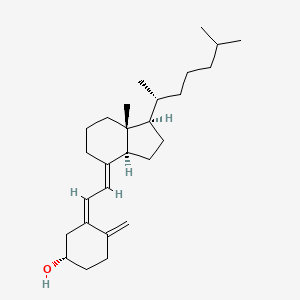
Identifiers
Functions
Hazards


What is known about the environmental fate of Cholecalciferol?
Cholecalciferol is expected to be immobile in soil and to adsorb strongly to suspended solids and sediment in water, based on an estimated Koc of 1.5×10⁶. Volatilization from moist soil or water may occur, but adsorption attenuates this process; the estimated volatilization half-life from a model pond is 85 years when adsorption is considered. In air, it exists solely in the particulate phase and may be removed by wet or dry deposition. Direct photolysis by sunlight is possible because it absorbs light above 290 nm. Hydrolysis is not expected to be significant.
What do biodegradation, bioaccumulation, and ecotoxicity findings indicate for Cholecalciferol?
Biodegradation data are not available, so persistence cannot be directly assessed. Bioaccumulation potential is low, with an estimated BCF of 3, despite a high log Kow of 10.24. No ecotoxicity endpoints were provided in the available evidence, so no conclusions can be drawn about aquatic or terrestrial toxicity. The low BCF suggests limited concern for food-chain accumulation, but the lack of biodegradation and ecotoxicity data means the overall environmental hazard profile is incomplete. This gap should be addressed before making any hazard-based regulatory or safety decisions.
Which environmental exposure pathways or concentrations are reported for Cholecalciferol?
Reported exposure pathways include release through production waste streams and direct release from use as a medication. Occupational exposure may occur via dermal contact during production or use. The general population is exposed through endogenous production upon sun exposure and through administration of cholecalciferol as a medication. No measured environmental concentrations were provided, so quantitative exposure levels in air, water, or soil are not available. This limits the ability to assess actual environmental exposure risk.
How might use context or formulation affect the environmental profile of Cholecalciferol?
Use context directly influences environmental release: production may release cholecalciferol via waste streams, while medicinal use leads to direct release into the environment. Formulation could affect fate processes such as volatilization and adsorption, but no specific formulation data were provided. The strong adsorption tendency suggests that soil or sediment contamination may be localized, but the potential for photolysis indicates that sunlight-exposed surfaces could degrade the compound. These factors should be considered when evaluating environmental exposure scenarios for different applications.
Which evidence gaps must be resolved before making sustainability claims about Cholecalciferol?
Before any sustainability claim can be made, critical data gaps must be filled: measured biodegradation rates, ecotoxicity endpoints for aquatic and terrestrial organisms, and actual environmental concentrations. The current evidence relies on estimated fate properties and provides no direct measurement of persistence, toxicity, or exposure levels. Without these data, it is impossible to assess the environmental impact or degradation profile of cholecalciferol. Until such evidence is generated, any sustainability assertion would be unsupported and potentially misleading.