EPA TSCA Regulatory Flag
Cyclohexanol, 3-[(2E)-2-[(1R,3aS,7aR)-1-[(1R)-1,5-dimethylhexyl]octahydro-7a-methyl-4H-inden-4-ylidene]ethylidene]-4-methylene-, (1S,3Z)-: ACTIVE
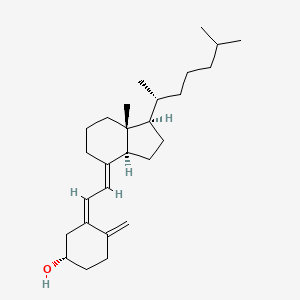
Identifiers
Functions
Hazards


Regulatory treatment of cholecalciferol varies by market and product category. In the US, it is an FDA-approved prescription drug, a food additive permitted for direct addition to food, affirmed as GRAS, and an active ingredient in registered rodenticide products. In the EU, it is listed under ECHA C&L notifications and regulated under EFSA legal basis Regulation (EC) No 178/2002 and status regulation 2004/129/EC. In Australia, it appears on the AICIS industrial chemicals inventory. In New Zealand, it has HSNO approval with controls. In cosmetics, it is listed in the EU with restriction II/335, indicating a regulatory constraint.
5 regulations
Cyclohexanol, 3-[(2E)-2-[(1R,3aS,7aR)-1-[(1R)-1,5-dimethylhexyl]octahydro-7a-methyl-4H-inden-4-ylidene]ethylidene]-4-methylene-, (1S,3Z)-: ACTIVE
Regulatory records
| Entry | Regulation | Type | Status | Source |
|---|---|---|---|---|
| 184.1950 | 21 CFR 184.1950 | Food Additive | authorized | View |
Regulatory records
| Entry | Regulation | Type | Status | Source |
|---|---|---|---|---|
| 172.380 | 21 CFR 172.380 | Food Additive | authorized | View |
Substance added directly to human food affirmed as generally recognized as safe (GRAS).
Sources
Regulatory records
| Regulation | Status |
|---|---|
| FDA Technical Effect: NUTRIENT SUPPLEMENT | authorized |
3 regulations
Regulation (EC) No 178/2002 (amended)
2004/129/EC
Regulatory records
| Entry | Regulation | Type | Status |
|---|---|---|---|
| 335 | EU 1223/2009 | II | prohibited |
Record details
1 regulation
Regulatory records
| Entry | Regulation | Type | Status |
|---|---|---|---|
| 67-97-0 | SOR/94-311 | DSL | authorized |
Conditions
This substance is on the Domestic Substances List (DSL). This substance was added to the DSL as an “Existing Substance” given that it meets the criteria set out in CEPA for substances that were in commerce in Canada between 1984 and 1986.
Record details
1 regulation
Chemical: 9,10-Secocholesta-5,7,10(19)-trien-3-ol, (3.beta.,5Z,7E)-
1 regulation
Cholecalciferol: HSNO Approval: HSR002778 Approved with controls
Key conditions affecting compliance include the intended product category and use context. For food use, the quantity added must not exceed the amount reasonably required to achieve its intended effect, and the substance must be of appropriate food grade. For drugs, FDA approval under the FD&C Act is required for prescription products. For OTC wound healing products, there is inadequate data to establish safety and effectiveness. GHS classifications indicate acute toxicity (fatal if swallowed, in contact with skin, or inhaled) and target organ toxicity, which may trigger labeling and handling requirements. In cosmetics, restriction II/335 applies, but specific concentration limits are not provided.
Before launch, a product containing cholecalciferol should have documentation confirming its regulatory status for the specific market and category. For US food use, evidence of GRAS affirmation or food additive compliance is needed. For drug products, FDA approval or appropriate OTC monograph compliance is required. For pesticide products, EPA registration is necessary. In the EU, compliance with EFSA regulations and cosmetic restrictions (II/335) must be verified. GHS classification data should be incorporated into safety data sheets and labeling. Additionally, for rodenticide uses, current EPA-approved uses must be confirmed as they may change.
The available regulatory position is insufficient to support a final launch decision because it lacks specific concentration limits, detailed conditions, and documentation requirements for most categories. For cosmetics, the restriction II/335 is noted but its exact meaning is not explained. For food additives, the permitted levels are not quantified. For OTC drugs, the inadequate data statement for wound healing products indicates a potential barrier. Additionally, GHS classifications are aggregated from company notifications and may not reflect a definitive regulatory classification. Therefore, further regulatory research is needed before proceeding.
No recent regulatory changes or effective dates are provided in the evidence. The available information includes current statuses such as FDA approval, GRAS affirmation, and EPA registration, but no upcoming or recent amendments are mentioned. For the EU, the legal basis references Regulation (EC) No 178/2002 (amended) and status regulation 2004/129/EC, but the amendment details and effective dates are not specified. Therefore, it is not possible to identify any material regulatory changes affecting cholecalciferol from the supplied evidence.