Inulin Propionate Ester
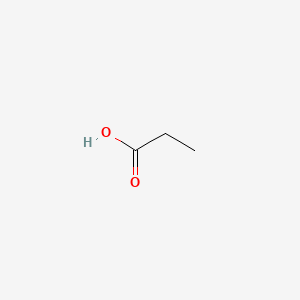
Identifiers
Functions
Hazards

Where is inulin propionate ester used, and what role does it play in each application?
Inulin propionate ester is not directly documented in the available evidence; the data describe propionic acid, its precursor. Propionic acid functions as an antifungal drug, a food preservative, a flavoring agent, a fragrance ingredient, a chemical intermediate, a solvent, a binder, a pH-regulating agent, and a lubricating agent. It is also used in veterinary medicine as an antiketogenic agent and to treat dermatophytic infections. For inulin propionate ester specifically, no application roles are established in the supplied evidence.
Which product or formulation problem does inulin propionate ester address?
Based on the evidence for propionic acid, the compound addresses microbial spoilage and fungal contamination in food, feed, and grain preservation, acting as an antifungal and antibacterial agent. It also solves formulation needs as a preservative, flavoring agent, and pH regulator. In veterinary applications, it addresses ketosis in ruminants and fungal skin infections. For inulin propionate ester, the specific formulation problems it solves are not documented in the supplied evidence.
What supports the main commercial or clinical uses of inulin propionate ester?
The main uses of propionic acid are supported by regulatory approvals and functional classifications. It is affirmed as generally recognized as safe (GRAS) for direct addition to human food and as a preservative in animal drugs and feeds. It is approved as a food additive in Europe and registered as a pesticide active ingredient in the U.S. Its antifungal activity is demonstrated at concentrations above 3 µg/ml against a toxigenic strain of Aspergillus parasiticus. However, no evidence supports the commercial or clinical uses of inulin propionate ester specifically.
How is Inulin propionate ester used clinically?
Propanoic acid and various direct sodium or calcium salt formulations of the acid are currently most commonly approved and indicated by organizations like the FDA and EMA for use as an antibacterial food additive preservative in animal feed and food for human consumption. Similarly, although the use of propanoic acid or any of its direct sodium or calcium salt formulations as excipient ingredients in pharmaceuticals is not necessarily a major role for the compound today, sodium propionate was used in some vaginal cream preparations indicated for cervicitis, cervical tears, and/or postcauterization, postcryosurgery, and postconization of the cervix. In such products, the sodium propionate was primarily used to elicit a preservative, bacteriostatic effect while other active ingredients combined in the formulation like urea, benzalkonium chloride, inositol, and methionine and cystine amino acids facilitated debridement, enhanced medication spread, epithelialization promotion, and wound healing, respectively. Nevertheless, a great variety of propionic acid derivatives exist as separate pharmaceuticals, each with their own unique therapeutic categories, pharmacodynamics, and pharmacokinetics
Which formulation trade-offs should researchers consider for inulin propionate ester?
For propionic acid, formulation trade-offs include handling precautions due to its corrosive nature, irritating vapor, and flammability; it must be stored away from strong oxidants and bases. It is a colorless liquid with a sharp rancid odor, which may affect sensory properties. It is corrosive to metals and tissue, requiring careful material selection. For inulin propionate ester, no formulation trade-offs are documented in the supplied evidence.
What are the physicochemical properties of Inulin propionate ester?
| Property | Value | Category |
|---|---|---|
| Physical Description | Propionic acid is a colorless liquid with a sharp rancid odor. Produces irritating vapor, Propionic acid, [solution] appears as a clear oily aqueous liquid with a pungent rancid odor. Burns skin and the vapors irritate mucous membranes. Corrosive to most metals and tissue, Liquid, Colourless or slightly yellowish, oily liquid with a slightly pungent odour, Colorless, oily liquid with a pungent, disagreeable, rancid odor. [Note: A solid below 5 degrees F.]; [NIOSH], OILY COLOURLESS LIQUID WITH PUNGENT ODOUR, oily liquid/slightly pungent, rancid odour, Colorless, oily liquid with a pungent, disagreeable, rancid odor, Colorless, oily liquid with a pungent, disagreeable, rancid odor. [Note: A solid below 5 °F.] | Appearance |
| Color/Form | Colorless, oily liquid [Note: A solid below 5 degrees F], Clear, colorless liquid | Appearance |
| Odor | Slightly pungent disagreeable, rancid odor | Appearance |
| Taste | SOUR & MILDLY CHEESE-LIKE | Appearance |
| Solubility | greater than or equal to 100 mg/mL at 72 °F, 1000000 mg/L (at 25 °C), Sol in alcohol, ether, chloroform, Miscible with ethanol; soluble in diethyl ether; slightly soluble in chloroform, In water, 1.0X10+6 mg/L at 25 °C /miscible/, 1000.0 mg/mL, Solubility in water: very soluble, miscible with water, alcohol, organic solvents, (in ethanol), Miscible | Formulation Relevant Properties |
| LogP | 0.33, log Kow = 0.33 | Formulation Relevant Properties |
| Acidic pKa | 4.874 | Formulation Relevant Properties |
| pKa | 4.88 | Formulation Relevant Properties |
| Dissociation Constants | pKa= 4.88 | Formulation Relevant Properties |
| Boiling Point | 285.3 °F at 760 mmHg, 141.1 °C, 141 °C, 138.5-142.5 °C, 286 °F, 141.1 °C @760 [mm Hg] | Handling Relevant Properties |
Which formulation benchmark best contextualizes inulin propionate ester, and what differs?
The closest formulation benchmark is propionic acid and its salts, such as sodium and calcium propionate, which are established preservatives and flavoring agents. These salts are GRAS and used in food and feed. Inulin propionate ester would differ by combining inulin, a prebiotic fiber, with propionic acid, potentially offering dual functionality as a fiber and a source of propionate. However, no data on inulin propionate ester's properties or performance are available to confirm this distinction.