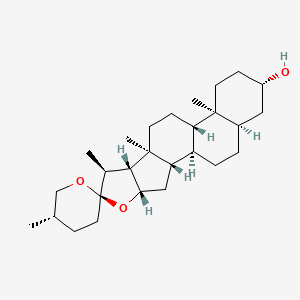
“Volufiline is rich in sarsasapogenin, which stimulates the accumulation of lipids in adipose (fat) tissues. This stimulation increases the volume of fat cells, leading to a visible plumping effect without the need for invasive procedures.”
Sarsasapogenin Consumer Sentiment
CtrlK
Identifiers
FormulaC27H44O3·CAS126-19-2·EC204-776-3
Functions
SKIN Conditioning
How do consumers feel about products containing Sarsasapogenin?
Positive
Mixed
Negative
Consumers and experts view Sarsasapogenin (primarily as Volufiline) as a promising, non-invasive natural alternative to injectable fillers for skin plumping.
Which consumer needs, benefits, and objections are associated with Sarsasapogenin?
Consumer conversations about Sarsasapogenin are extremely limited, with the only identified discussion being an expert-led educational post that identifies it as the trademarked ingredient Volufiline, extracted from Anemarrhena asphodeloides roots, and used for breast enhancement. No consumer objections, personal experiences, or benefit discussions were found in the available data. This means the ingredient is currently positioned in a niche aesthetic-benefit space, but the evidence base for consumer sentiment is too thin to infer broader needs or concerns. Researchers should treat any consumer-driven claims as unverified and focus on generating primary consumer insight before assuming market demand.
What do consumers discuss about Sarsasapogenin?
Natural Filler Alternative
Users describe Sarsasapogenin as a topical ingredient that mimics the volume-adding effects of injectable fillers without needles.
lemon8-app
tiktok
Lipid Accumulation Mechanism
Discussions highlight the specific biological mechanism where the ingredient stimulates fat cell accumulation to create a plumping effect.
lemon8-app
Botanical Origin
Posts identify the ingredient's source from Anemarrhena asphodeloides roots, emphasizing its natural derivation.
instagram
lemon8-app
How are current products and patent claims responding to consumer concerns about Sarsasapogenin?
Current patent claims respond to consumer concerns by expanding Sarsasapogenin's application beyond the aesthetic niche into metabolic, reproductive, and ophthalmic health. One patent application (US2025262233A1) claims a fenugreek extract containing Sarsasapogenin for improving sexual desire, sperm production, stamina, muscle mass, lactation, and hair growth, while reducing fatigue, cholesterol, and blood sugar. Another (KR20250089210A) claims Sarsasapogenin as an active ingredient for preventing or treating diabetic retinopathy. These claims suggest a strategic shift toward systemic health benefits, but they are patent applications, not evidence of product adoption. No commercial products containing Sarsasapogenin were identified in the available data, so market response remains speculative.
Where is the gap between consumer expectations and the current Sarsasapogenin offering?
The gap between consumer expectations and the current Sarsasapogenin offering is substantial: consumer awareness is limited to a single breast-enhancement claim, while patent activity targets systemic health outcomes like diabetic retinopathy, sexual function, and metabolic support. This disconnect means consumers may not associate Sarsasapogenin with the broader benefits being researched, and no commercial products are available to bridge that gap. The lack of consumer objection data also means potential safety or efficacy concerns are unknown. Researchers should recognize that the ingredient's public identity is narrow, and any expansion into new health claims would require significant consumer education and evidence generation to align with expectations.
Which formulation approaches are being used to address those concerns around Sarsasapogenin?
Formulation approaches in the patent literature respond to consumer concerns by incorporating Sarsasapogenin into multi-ingredient compositions or using it as a standalone active. The US patent application positions Sarsasapogenin within a fenugreek extract blend alongside diosgenin, gitogenin, dioscin, protodioscin, and other bioactives, suggesting a synergistic formulation strategy for broad metabolic and reproductive benefits. In contrast, the Korean patent application claims Sarsasapogenin as the sole active ingredient for diabetic retinopathy, indicating a targeted, single-molecule approach. These divergent strategies reflect different responses to consumer needs—one for general wellness and one for specific disease prevention—but neither provides concentration ranges or delivery-system details, leaving formulation specifics unverified.
What consumer-led opportunity or risk should researchers consider for Sarsasapogenin?
The consumer-led opportunity for Sarsasapogenin lies in repositioning it from a niche aesthetic ingredient to a broader wellness ingredient, but the risk is that current consumer perception is too shallow to support such a shift. The only consumer insight ties Sarsasapogenin to breast enhancement via Volufiline, while patents claim benefits like diabetic retinopathy treatment and metabolic support—areas with no consumer conversation. This creates an opportunity to educate consumers on evidence-backed benefits, but also a risk of overpromising without clinical proof. Researchers should prioritize generating consumer insight on health concerns like blood sugar or eye health to see if there is latent demand, while being cautious about unverified claims.