Sarsasapogenin Suppliers & Manufacturers
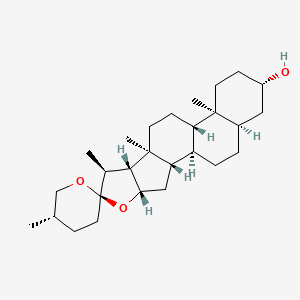
Identifiers
Functions
What does available trade activity indicate for Sarsasapogenin?
Sarsasapogenin is classified under HS Code 2932.99. This falls under Chapter 29: Organic chemicals, specifically Heading 2932 (Heterocyclic compounds with oxygen hetero-atom(s) only), under subheading: Heterocyclic compounds; with oxygen hetero-atom(s) only, no lactones or unfused furan rings in the structure, other than isosafrole, 1-(1,3-benzodiaxol-5-yl) propan-2-one, piperonal, safrole, tetrahydrocannabinols (all isomers), carbofuran (ISO).
* The data below is specific to the HS code, not the ingredient.
Suppliers
7,784
Across 128 countries
Shipments
34,456
from 2015 to 2026
Total weight
1.3B kg
75,921 TEU · standard 20-foot container units
Last shipment
8 months ago
Last updated at Feb 25, 2026
Growth
↑ 51%
Trade under 2932.99 has increased by 51% over the past 6 months
What does trade activity suggest about the Sarsasapogenin supply chain?
Trade activity under HS code 2932.99 shows a large, active supply chain with 7,784 suppliers and 34,456 shipments, but this is not ingredient-specific evidence. The signal is that sarsasapogenin, if traded, would move within a broad heterocyclic oxygen-compound category dominated by flavor and fragrance firms like Firmenich, IFF, Symrise, and Givaudan. Business implication: sourcing sarsasapogenin likely involves specialty chemical intermediaries rather than dedicated producers, and shipment volumes cannot be attributed to this ingredient. The boundary is that no shipment confirms sarsasapogenin content, so trade activity only indicates potential channel access, not actual supply availability.
What does the HS or HTS classification include, and where are its limits for Sarsasapogenin?
HS code 2932.99 covers heterocyclic compounds with oxygen hetero-atoms only, excluding lactones and unfused furan rings, and includes many non-ingredient chemicals like solvents and intermediates. Sarsasapogenin, a steroidal sapogenin, is typically classified under 2937 or 2938, so this code may not even be the correct classification. The limit is that all supplier activity under 2932.99 reflects a broad chemical category, not sarsasapogenin specifically. Formulation implication: using this trade data for sourcing decisions would overstate supplier relevance and volume, as most activity likely involves unrelated compounds. Regulatory or customs classification for sarsasapogenin would require verification under the appropriate steroidal heading.
Which suppliers are associated with Sarsasapogenin trade?
| Supplier | Shipments | Top customer | Growth | Last shipment | |
|---|---|---|---|---|---|
No suppliers found. | |||||
How concentrated or diversified does the supplier landscape appear for Sarsasapogenin?
The supplier landscape appears highly diversified, with 7,784 suppliers across 128 countries, but the top selected suppliers are concentrated among major fragrance and flavor multinationals like Firmenich, IFF, Symrise, and Givaudan, along with Indian specialty chemical firms like Privi and Gharda. This suggests a two-tier structure: a broad base of small suppliers and a concentrated core of large, established players. Business implication: while many potential suppliers exist, the most active and reliable partners for heterocyclic compounds are likely the large fragrance houses, which may not be sarsasapogenin-specific. The boundary is that no supplier is confirmed as a sarsasapogenin manufacturer, so diversification is apparent but not ingredient-verified.
Which supply risks or dependencies around Sarsasapogenin require further diligence?
Key supply risks include misclassification, as sarsasapogenin may fall under HS 2937 or 2938 rather than 2932.99, and the lack of ingredient-specific shipment evidence means supplier capabilities are unverified. Additionally, top suppliers like Firmenich and IFF are fragrance-focused, so their sarsasapogenin production is uncertain, and some suppliers show declining activity (e.g., Gharda Chemicals with a growth score of 7.2). Further diligence should confirm actual sarsasapogenin manufacturing through direct supplier qualification, verify correct HS classification for customs, and assess whether large fragrance firms can supply pharmaceutical-grade material. The boundary is that trade data alone cannot resolve these risks.
Which sourcing geographies and trade lanes appear most relevant to Sarsasapogenin?
China and India dominate the trade landscape, with China having 2,899 suppliers and 9,652 shipments, and India 755 suppliers and 5,454 shipments, followed by France, Japan, and South Korea. These geographies appear most relevant for sourcing heterocyclic oxygen compounds, with China and India as primary manufacturing hubs and France as a key European node. Business implication: procurement strategies should prioritize Asian suppliers, particularly Chinese and Indian chemical manufacturers, while European lanes via France and Spain serve as secondary sources. The boundary is that this reflects general HS-code activity, not sarsasapogenin-specific lanes, so actual sourcing geographies for this ingredient may differ.
Which countries drive Sarsasapogenin trade activity?
By shipment count
China
9,652 shipments
2,899 suppliers
258.2M kg total weight
India
5,454 shipments
755 suppliers
91.7M kg total weight
France
2,711 shipments
183 suppliers
62.6M kg total weight
Japan
1,959 shipments
161 suppliers
23.4M kg total weight
South Korea
1,818 shipments
198 suppliers
455.8M kg total weight
Vietnam
1,243 shipments
323 suppliers
19.9M kg total weight
Spain
945 shipments
190 suppliers
15.5M kg total weight
Mexico
908 shipments
130 suppliers
25.2M kg total weight
United Kingdom
758 shipments
120 suppliers
31.6M kg total weight
Belgium
735 shipments
352 suppliers
17.5M kg total weight