The next bottleneck in protein bar innovation may not be formulation. It may be access to the extraction technologies that determine how clean, functional, and scalable the protein ingredient is in the first place.
We uncovered this while using Slate to map the protein bar landscape across extraction, purification, formulation, and texturization. Rather than looking at patents in isolation, Slate connected where companies were filing, which technical clusters they were active in, and where activity was missing.
Slate identified 214 innovations in solvent-based protein purification concentrated among Louis Dreyfus Company, Burcon Nutrascience, Roquette Frères, Arla Foods, and Fonterra. Further down the value chain, General Mills has 15 innovations in formulation and texturization but none in this extraction cluster.
The companies developing the finished products are not necessarily the ones controlling the extraction chemistry behind the isolates those products depend on. For R&D teams, that raises questions around supplier dependence, access to processing IP, formulation freedom, and the cost of building extraction capability internally.
In this article, we look at where extraction IP is concentrating, why newer extraction routes are difficult to scale, how toll manufacturing changes the trade-off between speed and control, and what this means for future protein product development.
Why Clean-Label Protein Extraction Is Concentrating Around Specialized Processors
Louis Dreyfus Company holds nine innovations in aqueous and ethanol extraction, including methods for producing sunflower protein concentrate using 30 to 70 percent ethanol at controlled pH levels.
Burcon Nutrascience has published calcium salt extraction techniques followed by ultrafiltration to produce hemp protein with neutral pH and reduced salt content. Roquette Frères, Arla Foods, and Fonterra add further activity around high-purity protein extraction.
The underlying technologies include ethanol fractionation, calcium salt extraction, ultrafiltration, and salt-assisted aqueous processing. They are designed to reduce off-flavors and anti-nutritional factors while retaining the properties needed for food formulation.
Slate also shows that activity in this area is accelerating. Publications in the aqueous and ethanol extraction cluster increased from 62 in 2024 to 152 across 2025 and 2026.
The landscape is also widening beyond established processors. Corypro Ingredients has published a multi-stage ethanol process for extracting protein from cluster bean germ. GEA has five publications around high-shear steam infusion and drying, showing how equipment companies are developing technologies to support protein processing at larger scale.
Taken together, the cluster shows that technical capability is building around both extraction chemistry and the equipment needed to commercialize it.
Why Hexane-Free Protein Extraction Requires More Than a Solvent Change
The difficulty is that moving from conventional hexane-based extraction toward aqueous and ethanol-based methods is not a simple solvent replacement.
These processes can require ultrafiltration, steam infusion, spray drying, and tightly controlled shear. Performance also depends on variables such as pH, temperature, salt concentration, and ethanol levels.
Those conditions directly influence the ingredient that eventually reaches the formulation team. Poorly controlled extraction can leave beany, grassy, or bitter notes, retain unwanted anti-nutritional compounds such as phytates and trypsin inhibitors, or reduce useful properties such as solubility, emulsification, and gelation.
This becomes especially important in high-protein products. Commodity pea or soy isolates can bring bitterness or chalkiness that needs to be managed during formulation. That becomes harder when teams are also trying to reduce sugar or fat that might otherwise help mask those sensory issues.
The technical challenge is therefore not simply producing more protein. It is extracting protein with the sensory and functional characteristics needed for the final application.
Why Toll Manufacturing Reduces Capex but Limits Process Control
If building extraction capacity is costly and technically difficult, manufacturers have three main routes. They can use toll manufacturing, license proprietary ingredients, or build extraction capability through vertical integration.
Toll manufacturing offers the fastest route, but it does not remove the dependency. The processor still controls key process parameters, capacity allocation, and pricing. For manufacturers whose product quality depends on extraction conditions, that means an important part of the formulation remains outside their control.
As extraction IP concentrates around processors such as Louis Dreyfus Company and Burcon Nutrascience, manufacturers without their own extraction chemistry may need licensing agreements or partnerships to access high-purity isolates with the required sensory and functional properties.
Toll manufacturing can shorten time to market, but it may limit the ability to adjust extraction conditions for a specific formulation or sensory target. The risk becomes higher when only one or two processors have validated methods for a protein source such as sunflower or hemp.
The alternative is greater control through captive extraction capacity. But that requires significant capital investment and multi-year process validation. For mid-sized manufacturers, the choice is therefore not simply build or outsource. It is how much technical control they are willing to give up in exchange for faster access to specialized protein ingredients.
Why Food Companies Are Competing on Formulation While Processors Control Extraction
General Mills holds 15 innovations focused primarily on protein blends and extraction, yet the company is conspicuously absent from the cluster dedicated to twin-screw puffing and molding equipment. This absence is mirrored by other major players such as Louis Dreyfus Company and the Sobinsky Bread Factory cohort, all of whom maintain significant activity in ingredient clusters but zero recorded innovations in extrusion hardware.
This pattern suggests a strategic divide where large-scale food producers are prioritizing the rheological properties and shelf-life of protein matrices rather than the development of the machinery used to form them. Large food companies are competing on shelf-life stabilization, binder chemistry, and textural engineering at the formulation layer while ceding control of the upstream extraction layer to specialized processors.
General Mills has published innovations using hydrolyzed collagen and soluble fiber syrups to maintain moisture and softness over extended shelf life. While corporate players like General Mills and Arla Foods maintain higher total innovation counts, their activity is concentrated in extraction chemistry and formulation, leaving Northeast Agricultural University as a primary connector to the mechanical extrusion layer.
If General Mills with its scale, capital, and R&D infrastructure is not investing in proprietary extraction, it signals that the capital and technical barriers are prohibitive even for market leaders. The industry is converging on a model where ingredient processors control the upstream layer and food manufacturers compete on formulation and brand. This is a reversal of the traditional vertically integrated food company model.
General Mills is betting that differentiation happens at the formulation and texturization layers. But if the five processors begin offering turnkey ingredient solutions that include functional properties like texture, taste, and shelf-life, the food company’s role may be commoditized to brand and distribution. The market is bifurcating into two increasingly distinct areas of competition. One group is building control over extraction and ingredient functionality, while food manufacturers continue to compete through formulation, product performance, and brand. The extraction layer, however, appears to be consolidating faster.
Why New Protein Extraction Technologies Are Hard to Scale
The divide between extraction specialists and food manufacturers is difficult to close because building extraction capability requires more than installing new equipment.
A hexane-free extraction line can require ultrafiltration, spray drying, and solvent recovery systems. The process also has to be validated over multiple years to deliver food-grade purity and consistent functionality. Each protein source needs its own operating conditions for pH, temperature, salt concentration, and ethanol levels, along with any required regulatory approval for novel solvents or methods.
Slate’s landscape shows why this becomes an ongoing R&D commitment. Sunflower, hemp, canola, and cluster bean germ each require their own extraction protocols. At the same time, publications in plant protein extraction increased from 62 in 2024 to 152 across 2025 and 2026, showing how quickly companies are building technical knowledge around these processes.
GEA has five publications around high-shear steam infusion and drying, indicating that hardware suppliers are developing systems to take these extraction and stabilization methods to industrial throughput.
Once the protein is produced, companies still need to manage binder chemistry, moisture migration, and other factors that determine how the ingredient performs in the final product. Building internal capability therefore means validating the chemistry, securing regulatory clearance where needed, installing industrial-scale equipment, and then optimizing the protein for its intended application.
For new entrants, that creates a high capital and time barrier. It also helps explain why the extraction landscape remains concentrated around established processors with the infrastructure and technical expertise to support continuous development.
High barriers protect incumbent processors, but they can also slow the introduction of new protein sources and cleaner-label ingredients. As demand expands, the pace of innovation may increasingly depend on whether new players can overcome the same capital, validation, and scale-up hurdles that helped create the current bottleneck.
Where R&D Teams Should Focus Next
The immediate priority is to understand how exposed your product roadmap is to extraction dependencies. That means checking whether key protein inputs rely on a small number of processors, whether toll manufacturing limits your ability to change extraction parameters, and whether newer sources such as sunflower or cluster bean germ can be multi-sourced.
It also means testing how your roadmap would hold up if branded, functionally optimized isolates begin replacing commodity powders, shifting differentiation away from formulation and toward access to proprietary ingredients.
At the same time, teams should track whether new equipment and processing models begin lowering the barrier to internal extraction. GEA’s work in high-shear steam infusion and drying is one signal that industrial-scale processing is evolving.
Use Slate to Find the Bottleneck Before It Reaches Your Product Roadmap
Most R&D questions do not live in one patent or one paper. The useful answer often sits across several signals. A processing method appears in a patent, a competing approach shows up in a publication, another company starts building IP around it, and an adjacent technology reveals a route that was not part of the original search.
That is the kind of research Slate, an AI-powered R&D tool for F&B is built for.
In this analysis, Slate did more than retrieve protein extraction patents. It connected extraction methods with company activity, formulation IP, processing equipment, and emerging protein sources. That made it possible to move from “what technologies exist?” to more useful questions such as who is building control around them, which technical routes are gaining activity, where dependencies are forming, and which areas still have room to explore.
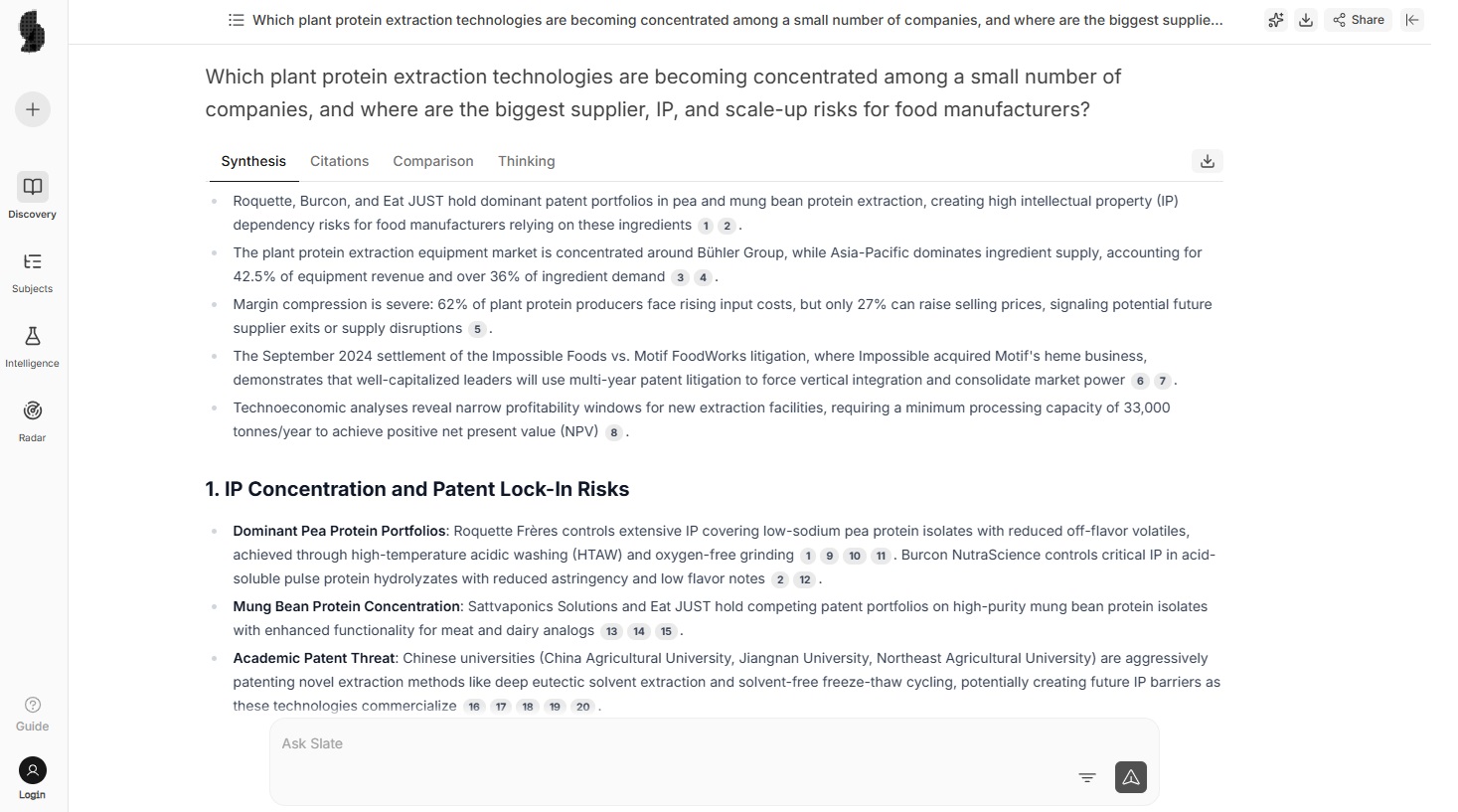
For a researcher, the real value is being able to follow those connections without losing the underlying evidence. You can start with a technical question, explore competing approaches, move into adjacent technologies, compare company activity, and trace the findings back to the patents and research behind them.
So do not try Slate with a generic search.
Take the R&D question you are already spending time on. The ingredient you cannot stabilize. The process you need an alternative for. The technology landscape you are trying to understand. The competitor activity you suspect you are missing.
Run that question through Slate and see whether it takes your research somewhere your current search process has not.
Frequently Asked Questions
What makes hexane-free protein extraction technically challenging?
Hexane-free extraction requires specialized hardware including ultrafiltration and spray drying systems, plus non-obvious process parameters like pH control and ethanol fractionation windows. Unlike hexane extraction, aqueous and ethanol methods must selectively remove off-flavors and anti-nutritional factors while preserving protein functionality, which demands integrated knowledge of extraction chemistry, protein biochemistry, and mechanical processing that takes years to validate per protein source.
Why are only five processors dominating clean-label protein extraction?
The capital expenditure on ultrafiltration, spray drying, and solvent recovery systems combined with multi-year process validation creates prohibitive barriers to entry. Louis Dreyfus Company, Burcon Nutrascience, Roquette Frères, Arla Foods, and Fonterra have secured 214 innovations in solvent-based purification, and each new protein source like sunflower or hemp requires its own extraction protocol, making this consolidation structural rather than transient.
Can toll manufacturing bypass the need to control extraction capacity?
Toll manufacturing gives access to clean-label inputs but sacrifices strategic control. The processor retains control over process parameters, capacity allocation, and pricing, which limits your ability to iterate on extraction conditions that define functional properties like solubility and off-flavor profiles. This is particularly limiting if your competitive strategy depends on a specific protein source where only one or two processors have validated methods.
How does extraction consolidation affect product innovation timelines?
If you depend on toll manufacturing or licensed isolates, your innovation velocity is constrained by the processor’s willingness to modify extraction parameters for your specific application. The concentration of extraction IP among five entities means you cannot easily multi-source or switch suppliers if your sensory or functional requirements change, which extends product development cycles and reduces your ability to respond to market shifts.
What functional differences separate clean-label isolates from commodity protein powders?
Clean-label isolates produced via aqueous or ethanol extraction remove off-flavors like beany, grassy, and bitter notes that commodity hexane-extracted powders retain. They selectively eliminate anti-nutritional factors like phytates and trypsin inhibitors while preserving functional properties including solubility, emulsification, and gelation. This allows formulation in low-sugar, high-protein products without requiring high-fat or high-sugar masking strategies.
Should mid-market manufacturers invest in captive extraction capacity?
The investment timeline is multi-year and capital requirements are significant. You must validate chemistry, secure regulatory approval, build industrial-scale equipment, and iterate on functional properties per protein source. The data suggests this requires sustained executive commitment and is not a pilot-line-and-scale scenario, making it viable only for organizations with strategic commitment to vertically integrated clean-label supply chains.
Which protein sources face the most severe extraction bottlenecks?
Sunflower and hemp show the highest consolidation risk, with Louis Dreyfus Company holding ethanol extraction methods for sunflower and Burcon Nutrascience controlling calcium salt extraction for hemp. If your innovation strategy depends on these sources, you face potential single-source or dual-source dependency that exposes you to capacity constraints, pricing power, and quality variability you cannot mitigate through multi-sourcing.